BCS Pairing BCS theory of superconductivity was proposed by - - PowerPoint PPT Presentation

bcs pairing
SMART_READER_LITE
LIVE PREVIEW

BCS Pairing BCS theory of superconductivity was proposed by - - PowerPoint PPT Presentation

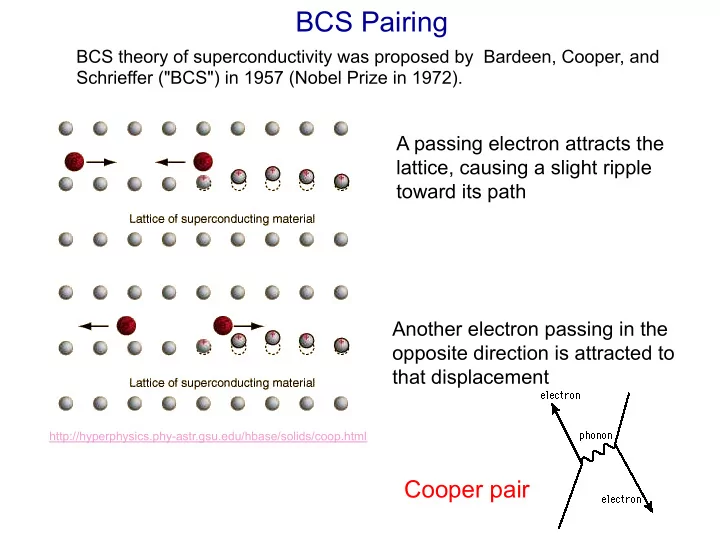
BCS Pairing BCS theory of superconductivity was proposed by Bardeen, Cooper, and Schrieffer ("BCS") in 1957 (Nobel Prize in 1972). A passing electron attracts the lattice, causing a slight ripple toward its path Another electron


slide-1
SLIDE 1

BCS Pairing

A passing electron attracts the lattice, causing a slight ripple toward its path Another electron passing in the

  • pposite direction is attracted to

that displacement

http://hyperphysics.phy-astr.gsu.edu/hbase/solids/coop.html

Cooper pair

BCS theory of superconductivity was proposed by Bardeen, Cooper, and Schrieffer ("BCS") in 1957 (Nobel Prize in 1972).

slide-2
SLIDE 2

Energies of first excited states: even-even vs. odd-A nuclei

Energy gap Bohr, Mottelson, Pines 1958

slide-3
SLIDE 3

rigid

irrotational

well reproduced by cranked HFB calculations

Ground-state nuclear moments of inertia Nuclear moments of inertia at T=0 lie between the superfluid and normal limits

Reduction of moment of inertia due to BCS pairing. Migdal (59)

slide-4
SLIDE 4

Gezerlis and Carlson, Phys. Rev. C 77, 032801(R) (2008)

Low-density regime of neutron EOS

Dilute fermion matter:

  • strongly correlated (pairing)
  • very large scattering length

(unitary limit)

  • Low-density neutron matter
  • Cold fermions in traps
  • Connections to nucleonic pairing in nuclei and

neutron stars

  • Connections to color superconductivity in quark

matter