BASIC STOCK DASHI Dashi or basic stock plays a fundamental role in - - PDF document

basic stock dashi dashi or basic stock plays a
SMART_READER_LITE
LIVE PREVIEW

BASIC STOCK DASHI Dashi or basic stock plays a fundamental role in - - PDF document

BASIC STOCK DASHI Dashi or basic stock plays a fundamental role in simmered dishes, soups and other Japanese cuisine, ultimately determining their flavors. This tasty stock will greatly enhance the overall taste of food and by learning


slide-1
SLIDE 1

BASIC STOCK “DASHI” Dashi or basic stock plays a fundamental role in simmered dishes, soups and other Japanese cuisine, ultimately determining their flavors. This tasty stock will greatly enhance the overall taste of food and by learning how to prepare it, cooking Japanese food will become more fun. PREPARATION: 2000ml water Warm up the water, just before boiling add: 40g kombu algae (previously soaked in cold water for 2-4hrs) When the water boils, add: 60g dried Shiitake mushrooms/Bonito flakes MISO SOUP WITH EGGPLANT “MISO SHIRU”

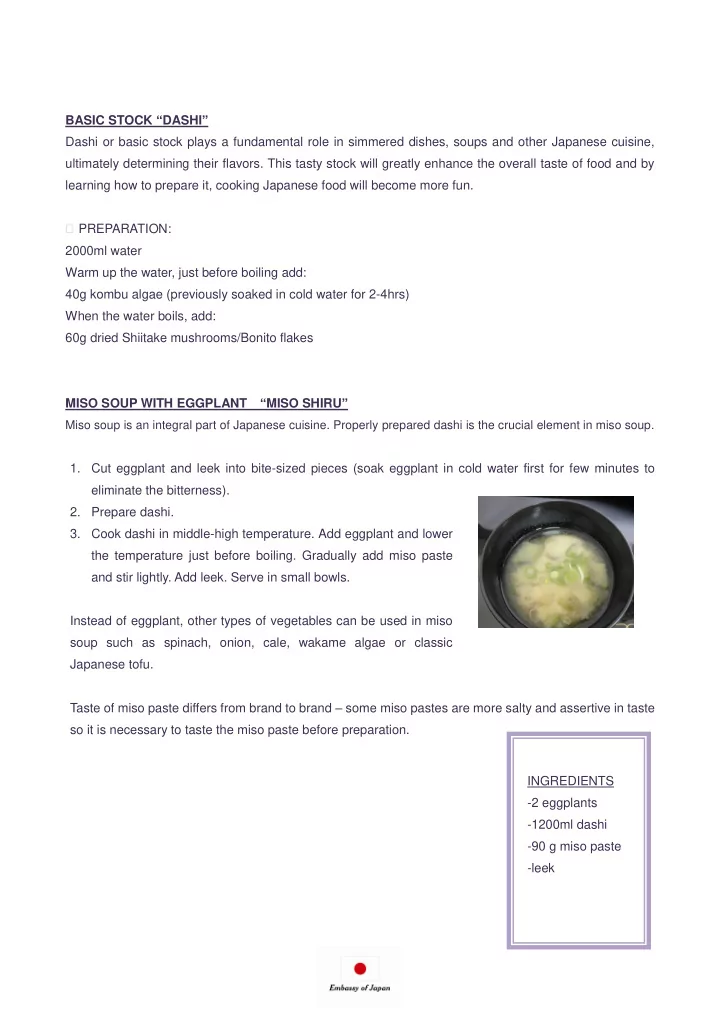
Miso soup is an integral part of Japanese cuisine. Properly prepared dashi is the crucial element in miso soup.

  • 1. Cut eggplant and leek into bite-sized pieces (soak eggplant in cold water first for few minutes to

eliminate the bitterness).

  • 2. Prepare dashi.
  • 3. Cook dashi in middle-high temperature. Add eggplant and lower

the temperature just before boiling. Gradually add miso paste and stir lightly. Add leek. Serve in small bowls. Instead of eggplant, other types of vegetables can be used in miso soup such as spinach, onion, cale, wakame algae or classic Japanese tofu. Taste of miso paste differs from brand to brand – some miso pastes are more salty and assertive in taste so it is necessary to taste the miso paste before preparation. INGREDIENTS

  • 2 eggplants
  • 1200ml dashi
  • 90 g miso paste
  • leek
slide-2
SLIDE 2

“TEMPURA” Tempura is a Japanese dish of seafood or vegetables that have been battered and deep fried.

  • 1. Prepare sauce –

Cook soy sauce, mirin and sake (medium heat) for several minutes. Remove the heads of the shrimps, shell and devein but leave the tails

  • attached. Chop off the tips of the shrimp tails and gently press out the

moisture from the shrimps with the flat blade of the knife tip. To prevent the shrimps from curling, make 3 incisions across the belly, and open each of the cuts with your hands to straighten the body.

  • 2. Cut the vegetables into bite-sized pieces (it is important to wipe

moisture away from the vegetables immediately)

  • 3. Prepare the batter -

Stirr briefly egg yolk, ice water and flour. Don’t overmix, otherwise, the batter will become sticky. If the water is not chilled, you can put in a few pieces of ice.

  • 4. Dust each of the ingredients to be fried with flour.
  • 5. Preheat the oil to 160C. Vegetables that are less likely to

leave odour in the oil should be put into the pan and fried first. When the batter feels crispy, it’s time to take it out of the pan. Place the fried food on a draining tray. Arrange the fried food on plates and garnish with grated white radish and grated ginger. Provide a bowl

  • f dipping sauce for each dinner as well.

White fish, eggplant, zucchini, carrot, Shiitake mushrooms can also be used as ingredients for Tempura. INGREDIENTS: Tempura Sauce

  • 200ml dashi
  • 50ml soy sauce
  • a pinch of sugar
  • grated white

radish

  • grated ginger

Batter (koromo):

  • 200g soft wheat

flour (cake, pastry or all-purpose flour).

  • a pinch of baking

soda

  • 1 egg yolk
  • 150ml chilled

water

  • vegetables
  • il
slide-3
SLIDE 3

“CHIRASHI-SUSHI”

Apart from classic sushi (Nigiri-Sushi), there are several other types of

  • sushi. Chirashi-Sushi is traditionally prepared for Hina-matsuri, Girl’s

Day which is annually celebrated on March 10.

PREPARATION:

  • 1. Wash the rice and leave in the draining try for 1 hour. Boil the

rice (medium heat) for 12-15min, or until all the liquid is gone. Keep the bowl covered and let it stand for 10 minutes until the grains are settled.

  • 2. Prepare the rice dressing -

Cook rice vinegar, salt and sugar (medium heat) and stir until dissolved completely. Transfer the rice to a wooden bowl. Sprinkle the rice dressing all over rice while the rice is still hot. Using a flat wooden spoon, toss the rice with horizontal, cutting strokes while cooling the rice with hand-fan. Wooden sushi bowl eliminates the excess moisture of cooked rice, and keeps the grains firm. Use an electric fan if any at home and let it swing in order to let the rice exposed to the breeze while mixing the

  • rice. It will facilitate cooling off the rice and result in making tasty

and glossy vinegard rice.

  • 3. Beat the egg. Add water and salt. Pour in the beaten egg in the

frying pan and make a paper-thin omelet. Corn starch can be added to make the egg thick. When cool, fold the egg and cut into julienne strips.

  • 4. Scatter the egg threads all over the rice and decorate the surface colourfully with the smoked salmon

stripes, prawns, green peas, nori algae and sesame seeds. INGREDIENTS:

  • 400g rice
  • 550ml water

Rice Dressing:

  • 50ml rice vinegar
  • 30g sugar
  • a pinch of salt
  • smoked salmon
  • prawns
  • 1 egg
  • nori algae
  • green peas
slide-4
SLIDE 4

TERIYAKI CHICKEN SAUTE

Chicken is low in calories and contains a lot of protein. Soy sauce goes well with chicken. Chicken Saute is served with rice and sake.

  • 1. Prepare Teriyaki sauce -

Simmer soy sauce, sake, mirin and sugar (medium heat) for 10min.

  • 2. Dust the chicken to be fried with flour. Fry (medium heat)

until golden-brown. Eliminate the excess oil in the pan.

  • 3. Pour Teriyaki sauce all over the chicken. Garnish with

susame seeds. Serve with vegetables such as cabbage, parsley etc. BRAISED MEAT AND VEGETABLES “NIKUJAGA” PREPARATIONS:

  • 1. Peel the potatoes, cut lengthwise into four wedges. Peel the
  • nion and cut lengthwise.
  • 2. Heat oil in a pot, add the beef and stir- fry brefly.
  • 3. Add potato and onion.
  • 4. Add dashi, soy sauce, sake, mirin, sugar and cook for 30min

INGREDIENTS ( 2 servings):

  • 2 chicken tighs
  • 1 tea spoon of oil
  • soft wheat flour (cake,

pastry or all-purpose flour). Teriyaki sauce:

  • 45ml soy sauce
  • 30ml sake
  • 30ml mirin
  • 15ml sugar

INGREDIENTS:

  • 800ml dashi or water
  • 100ml sake
  • 30ml mirin
  • 75ml soy sauce
  • 40g sugar
  • 500g potato
  • 100g onion
  • 250g minced beef
  • oil
slide-5
SLIDE 5

SPINACH WITH SESAME DRESSING “GOMA-AE” Nutritious, refreshing meal. PREPARATION: 1.Place the spinach in boiling salted water and boil for 1 minute. It is important not to overcook the spinach. Soak in cold water. Squeeze

  • ut to drain with hands.

2.Toast the sesame seeds and grind in a grinding bowl while they are still hot. Sesame is very healthy but its full nutritional value is obtained when the sesame is grinded. The smell and taste are much better this way as well. 3.Add mixture of soy sauce and sugar to the sesame paste. 4.Mix well with the spinach. MARINATED CUCUMBER WITH SWEET VINEGAR SAUCE “SUNOMONO” PREPARATION:

  • 1. Prepare the sweet vinegar sauce -

Cook rice vinegar, sugar and kombu algae (medium heat) for several minutes. The sauce will enhance the flavor of the food. It goes well with fish, shellfish, clamps, shrimp, crabs and vegetables.

  • 2. Soak wakame algae in water for 5 minutes to soften. Squeeze
  • ut to drain with hands.
  • 3. Peel the cucumber. Soak it in cold water to soften, squeeze out

to drain with hands. Cut cucumber into paper-thin slices.

  • 4. Pour the sweet vinegar sauce all over the cucumber, add grated

ginger and wakame alge. For a more luxurious version of the meal, add crab meat instead of wakame alge. INGREDIENTS:

  • 200g spinach
  • 5g sugar
  • 15ml soy sauce
  • 75g sesame seeds

INGREDIENTS:

  • 2 cucumber
  • 30ml rice vinegar
  • a pinch of salt
  • 15g sugar
  • 30ml water
  • 30g wakame algae or crab

meat

  • grated ginger
  • kombu algae
slide-6
SLIDE 6

RICE Rice is an integral element of every Japanese meal. It is usually served with rice dressing. BASIC JAPANESE MEAL Basic Japanese meal consist of steamed rice, miso soup, main dish and 2 or 3 side dishes. Example:

  • 1. Chicken saute, sunomono, gomae, rice and miso soup.
  • 2. Nikujaga, sunomono, gomae, rice and miso soup.

SAKE Substitute for sake is dry martini. MIRIN (sweet cooking sake) Mirin is made by adding sugar to sake. As an alternative, mirin can be made by adding sugar to dry martini. RICE VINEGAR Substitute for rice vinegar is apple vinegar.