Basic Ruby Syntax No variable declarations sum = 0 Newline is - - PowerPoint PPT Presentation

basic ruby syntax
SMART_READER_LITE
LIVE PREVIEW

Basic Ruby Syntax No variable declarations sum = 0 Newline is - - PowerPoint PPT Presentation

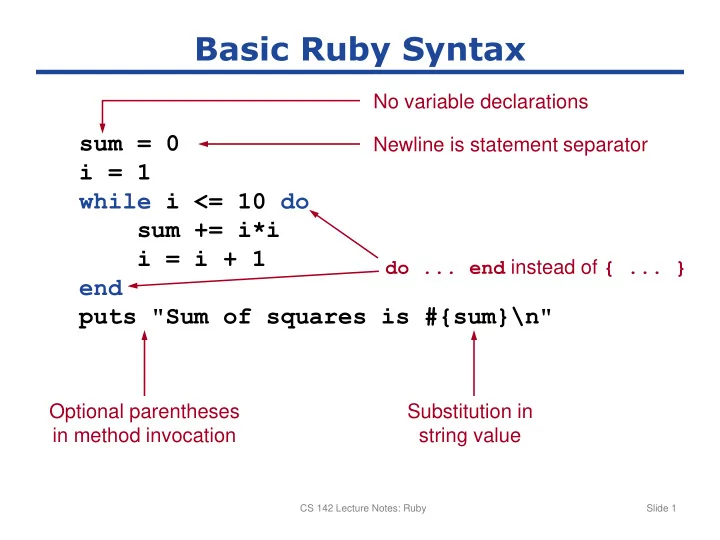
Basic Ruby Syntax No variable declarations sum = 0 Newline is statement separator i = 1 while i <= 10 do sum += i*i i = i + 1 do ... end instead of { ... } end puts "Sum of squares is #{sum}\n" Optional parentheses


slide-1
SLIDE 1

CS 142 Lecture Notes: Ruby Slide 1
Basic Ruby Syntax

sum = 0 i = 1 while i <= 10 do sum += i*i i = i + 1 end puts "Sum of squares is #{sum}\n"

Newline is statement separator do ... end instead of { ... } Optional parentheses in method invocation Substitution in string value No variable declarations

slide-2
SLIDE 2

CS 142 Lecture Notes: Ruby Slide 2

Variable Names and Scopes

foo Local variable $foo Global variable @foo Instance variable in object @@foo Class variable MAX_USERS “Constant” (by convention)

slide-3
SLIDE 3
  • Single quotes (only \' and \\)

'Bill\'s "personal" book'

  • Double quotes (many escape sequences)

"Found #{count} errors\nAborting job\n"

  • %q (similar to single quotes)

%q<Nesting works: <b>Hello</b>>

  • %Q (similar to double quotes)

%Q|She said "#{greeting}"\n|

  • “Here documents”

<<END First line Second line END

CS 142 Lecture Notes: Ruby Slide 3

Ruby String Syntax

slide-4
SLIDE 4

x = Array.new x << 10 x[0] = 99 y = ["Alice", 23, 7.3] x[1] = y[1] + y[-1] person = Hash.new person["last_name"] = "Rodriguez" person[:first_name] = "Alice“

  • rder = {:item => "Corn Flakes", :weight => 18}
  • rder = {item: "Corn Flakes", weight: 18}

CS 142 Lecture Notes: Ruby Slide 4

Arrays and Hashes

slide-5
SLIDE 5

CS 142 Lecture Notes: Ruby Slide 5

Ruby Statements

if x < 10 then ... elsif x < 20 ... else ... end while x < 10 do ... end array = [14, 22, 34, 46, 92] for value in array do ... end

slide-6
SLIDE 6

CS 142 Lecture Notes: Ruby Slide 6

Factorial

def fac(x) if x <= 1 then return 1 end return x*fac(x-1) end

slide-7
SLIDE 7

CS 142 Lecture Notes: Ruby Slide 7

Arguments: Defaults, Variable #

def inc(value, amount=1) value+amount end def max(first, *rest) result = first for x in rest do if (x > result) then result = x end end return result end

slide-8
SLIDE 8

CS 142 Lecture Notes: Ruby Slide 8

Keyword Arguments

def create_widget(size, properties) ... end create_widget(6, {:id => "table22", :class => "Cart"}) create_widget(6, :id => "table22", :class => "Cart") create_widget(6, id: "table22", class: "Cart")

slide-9
SLIDE 9

CS 142 Lecture Notes: Ruby Slide 9

Blocks, Iterators, Yield

Invoke method’s block Block: code passed to method

  • dd_numbers(3) do |i|

print(i, "\n") end def odd_numbers(count) number = 1 while count > 0 do yield(number) number += 2 count -= 1 end end

Iterator

slide-10
SLIDE 10

CS 142 Lecture Notes: Ruby Slide 10

Iterators are Reusable

def sum_odd(count) sum = 0

  • dd_numbers(count) do |i|

sum += i end return sum end def odd_numbers(count) number = 1 while count > 0 do yield(number) number += 2 count -= 1 end end

slide-11
SLIDE 11

CS 142 Lecture Notes: Ruby Slide 11

Equivalent Code

array = [14, 22, 34, 46, 92] for value in array do print(value, "\n") end array = [14, 22, 34, 46, 92]; array.each do |value| print(value, "\n") end

slide-12
SLIDE 12

CS 142 Lecture Notes: Ruby Slide 12

Simple Class

class Point def initialize(x, y) @x = x @y = y end def x @x end def x=(value) @x = value end end p = Point.new(3,4) puts "p.x is #{p.x}" p.x = 44

slide-13
SLIDE 13

CS 142 Lecture Notes: Ruby Slide 13

Module Example

class MyClass include Enumerable ... def each ... end end New methods available in MyClass:

min, max, sort, map, select, ...