Bandwidth 1 Terabyte 1 Terabyte Parallelism: 10 MB/s divide a - - PDF document

bandwidth
SMART_READER_LITE
LIVE PREVIEW

Bandwidth 1 Terabyte 1 Terabyte Parallelism: 10 MB/s divide a - - PDF document

Parallel DBMS Chapter 22, Part A Slides by Joe Hellerstein, UCB, with some material from Jim Gray, Microsoft Research. See also: http://www.research.microsoft.com/research/BARC/Gray/PDB95.ppt Database Management Systems, 3 nd Edition. Raghu


slide-1
SLIDE 1

Database Management Systems, 3nd Edition. Raghu Ramakrishnan and Johannes Gehrke 1

Parallel DBMS

Slides by Joe Hellerstein, UCB, with some material from Jim Gray, Microsoft Research. See also:

http://www.research.microsoft.com/research/BARC/Gray/PDB95.ppt

Chapter 22, Part A

Database Management Systems, 3nd Edition. Raghu Ramakrishnan and Johannes Gehrke 2

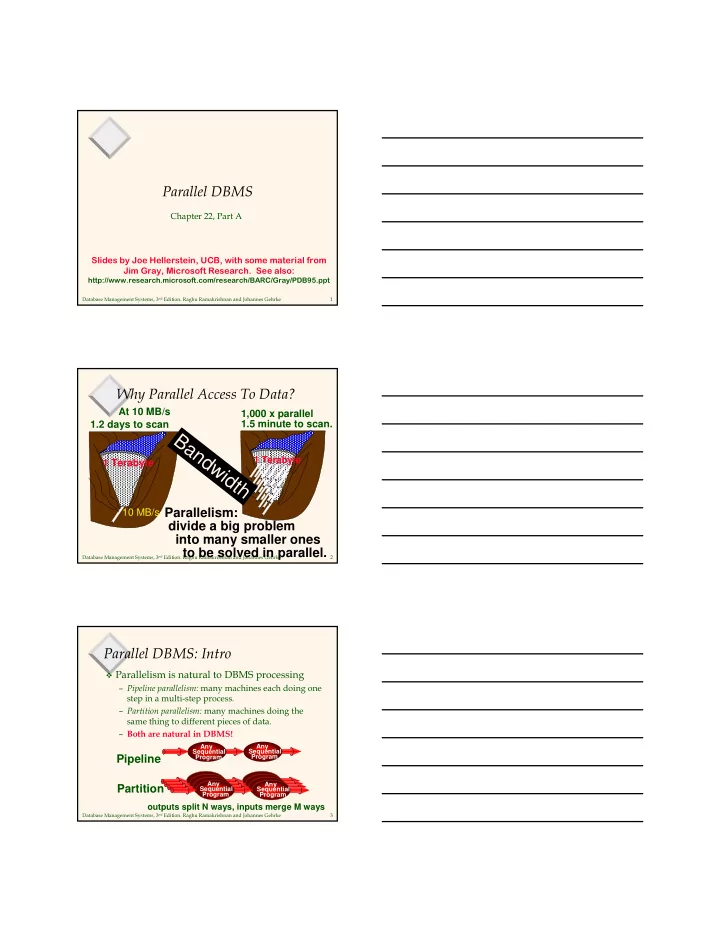
Why Parallel Access To Data?

1 Terabyte 10 MB/s At 10 MB/s 1.2 days to scan

1 Terabyte

1,000 x parallel 1.5 minute to scan.

Parallelism: divide a big problem into many smaller ones to be solved in parallel.

Bandwidth

Database Management Systems, 3nd Edition. Raghu Ramakrishnan and Johannes Gehrke 3

Parallel DBMS: Intro

Parallelism is natural to DBMS processing

– Pipeline parallelism: many machines each doing one step in a multi-step process. – Partition parallelism: many machines doing the same thing to different pieces of data. – Both are natural in DBMS!

Pipeline Partition

Any Sequential Program Any Sequential Program Sequential Sequential Sequential Sequential Any Sequential Program Any Sequential Program

  • utputs split N ways, inputs merge M ways
slide-2
SLIDE 2

Database Management Systems, 3nd Edition. Raghu Ramakrishnan and Johannes Gehrke 4

DBMS: The || Success Story

DBMSs are the most (only?) successful

application of parallelism.

– Teradata, Tandem vs. Thinking Machines, KSR.. – Every major DBMS vendor has some || server – Workstation manufacturers now depend on || DB server sales.

Reasons for success:

– Bulk-processing (= partition ||-ism). – Natural pipelining. – Inexpensive hardware can do the trick! – Users/app-programmers don’t need to think in ||

Database Management Systems, 3nd Edition. Raghu Ramakrishnan and Johannes Gehrke 5

Some || Terminology

Speed-Up

– More resources means proportionally less time for given amount of data.

Scale-Up

– If resources increased in proportion to increase in data size, time is constant. degree of ||-ism Xact/sec. (throughput) Ideal degree of ||-ism sec./Xact (response time) Ideal

Database Management Systems, 3nd Edition. Raghu Ramakrishnan and Johannes Gehrke 6

Architecture Issue: Shared What?

Shared Memory (SMP) Shared Disk Shared Nothing (network)

CLIENTS CLIENTS CLIENTS Memory Processors

Easy to program Expensive to build Difficult to scaleup Hard to program Cheap to build Easy to scaleup

slide-3
SLIDE 3

Database Management Systems, 3nd Edition. Raghu Ramakrishnan and Johannes Gehrke 7

Different Types of DBMS ||-ism

Intra-operator parallelism

– get all machines working to compute a given

  • peration (scan, sort, join)

Inter-operator parallelism

– each operator may run concurrently on a different site (exploits pipelining)

Inter-query parallelism

– different queries run on different sites

We’ll focus on intra-operator ||-ism

Database Management Systems, 3nd Edition. Raghu Ramakrishnan and Johannes Gehrke 8

Automatic Data Partitioning

Partitioning a table: Range Hash Round Robin

Shared disk and memory less sensitive to partitioning, Shared nothing benefits from "good" partitioning

A...E F...J K...N O...S T...Z A...E F...J K...N O...S T...Z A...E F...J K...N O...S T...Z

Good for equijoins, range queries group-by Good for equijoins Good to spread load

Database Management Systems, 3nd Edition. Raghu Ramakrishnan and Johannes Gehrke 9

Parallel Scans

Scan in parallel, and merge. Selection may not require all sites for range or

hash partitioning.

Indexes can be built at each partition. Question: How do indexes differ in the

different schemes?

– Think about both lookups and inserts! – What about unique indexes?

slide-4
SLIDE 4

Database Management Systems, 3nd Edition. Raghu Ramakrishnan and Johannes Gehrke 10

Parallel Sorting

Current records:

– 8.5 Gb/minute, shared-nothing; Datamation benchmark in 2.41 secs (UCB students! http://now.cs.berkeley.edu/NowSort/)

Idea:

– Scan in parallel, and range-partition as you go. – As tuples come in, begin “local” sorting on each – Resulting data is sorted, and range-partitioned. – Problem: skew! – Solution: “sample” the data at start to determine partition points.

Database Management Systems, 3nd Edition. Raghu Ramakrishnan and Johannes Gehrke 11

Jim Gray & Gordon Bell: VLDB 95 Parallel Database Systems Survey

Parallel Aggregates

A...E F...J K...N O...S T...Z A Table

Count Count Count Count Count Count

For each aggregate function, need a decomposition:

– count(S) = Σ count(s(i)), ditto for sum() – avg(S) = (Σ sum(s(i))) / Σ count(s(i)) – and so on...

For groups:

– Sub-aggregate groups close to the source. – Pass each sub-aggregate to its group’s site.

Chosen via a hash fn.

Database Management Systems, 3nd Edition. Raghu Ramakrishnan and Johannes Gehrke 12

Parallel Joins

Nested loop:

– Each outer tuple must be compared with each inner tuple that might join. – Easy for range partitioning on join cols, hard

  • therwise!

Sort-Merge (or plain Merge-Join):

– Sorting gives range-partitioning.

But what about handling 2 skews?

– Merging partitioned tables is local.

slide-5
SLIDE 5

Database Management Systems, 3nd Edition. Raghu Ramakrishnan and Johannes Gehrke 13

Parallel Hash Join

In first phase, partitions get distributed to

different sites:

– A good hash function automatically distributes work evenly!

Do second phase at each site. Almost always the winner for equi-join.

Original Relations (R then S) OUTPUT 2 B main memory buffers Disk Disk INPUT 1 hash function h B-1 Partitions 1 2 B-1

. . .

Phase 1

Database Management Systems, 3nd Edition. Raghu Ramakrishnan and Johannes Gehrke 14

Dataflow Network for || Join

Good use of split/merge makes it easier to

build parallel versions of sequential join code.

Database Management Systems, 3nd Edition. Raghu Ramakrishnan and Johannes Gehrke 15

Complex Parallel Query Plans

Complex Queries: Inter-Operator parallelism

– Pipelining between operators:

note that sort and phase 1 of hash-join block the

pipeline!!

– Bushy Trees A B R S Sites 1-4 Sites 5-8 Sites 1-8

slide-6
SLIDE 6

Database Management Systems, 3nd Edition. Raghu Ramakrishnan and Johannes Gehrke 16

N×M-way Parallelism

A...E F...J K...N O...S T...Z

Merge Join Sort Join Sort Join Sort Join Sort Join Sort Merge Merge

N inputs, M outputs, no bottlenecks. Partitioned Data Partitioned and Pipelined Data Flows

Database Management Systems, 3nd Edition. Raghu Ramakrishnan and Johannes Gehrke 17

Observations

It is relatively easy to build a fast parallel

query executor

It is hard to write a robust and world-class

parallel query optimizer.

– There are many tricks. – One quickly hits the complexity barrier. – Still open research!

Database Management Systems, 3nd Edition. Raghu Ramakrishnan and Johannes Gehrke 18

Parallel Query Optimization

Common approach: 2 phases

– Pick best sequential plan (System R algorithm) – Pick degree of parallelism based on current system parameters.

“Bind” operators to processors

– Take query tree, “decorate” as in previous picture.

slide-7
SLIDE 7

Database Management Systems, 3nd Edition. Raghu Ramakrishnan and Johannes Gehrke 19

Best serial plan != Best || plan! Why? Trivial counter-example:

– Table partitioned with local secondary index at two nodes – Range query: all of node 1 and 1% of node 2. – Node 1 should do a scan of its partition. – Node 2 should use secondary index.

SELECT *

FROM telephone_book WHERE name < “NoGood”;

What’s Wrong With That?

N..Z Table Scan A..M Index Scan

Database Management Systems, 3nd Edition. Raghu Ramakrishnan and Johannes Gehrke 20

Parallel DBMS Summary

||-ism natural to query processing:

– Both pipeline and partition ||-ism!

Shared-Nothing vs. Shared-Mem

– Shared-disk too, but less standard – Shared-mem easy, costly. Doesn’t scaleup. – Shared-nothing cheap, scales well, harder to implement.

Intra-op, Inter-op, & Inter-query ||-ism all

possible.

Database Management Systems, 3nd Edition. Raghu Ramakrishnan and Johannes Gehrke 21

|| DBMS Summary, cont.

Data layout choices important! Most DB operations can be done partition-||

– Sort. – Sort-merge join, hash-join.

Complex plans.

– Allow for pipeline-||ism, but sorts, hashes block the pipeline. – Partition ||-ism acheived via bushy trees.

slide-8
SLIDE 8

Database Management Systems, 3nd Edition. Raghu Ramakrishnan and Johannes Gehrke 22

|| DBMS Summary, cont.

Hardest part of the equation: optimization.

– 2-phase optimization simplest, but can be ineffective. – More complex schemes still at the research stage.

We haven’t said anything about Xacts,

logging.

– Easy in shared-memory architecture. – Takes some care in shared-nothing.