Background Simulations for the IXO Wide Field Imager Steffen Hauf, - - PowerPoint PPT Presentation

background simulations for the ixo wide field imager
SMART_READER_LITE
LIVE PREVIEW

Background Simulations for the IXO Wide Field Imager Steffen Hauf, - - PowerPoint PPT Presentation

Background Simulations for the IXO Wide Field Imager Steffen Hauf, Markus Kuster, Dieter H.H. Hoffmann, Maria Grazia Pia, Eckhard Kendziorra, Philipp Lang, Alexander Stephanescu, Lothar Strder, Chris Tenzer and Georg Weidenspointner Credit:


slide-1
SLIDE 1

18.08.2010| TU Darmstadt | Institut für Kernphysik | Steffen Hauf | 1

Background Simulations for the IXO Wide Field Imager

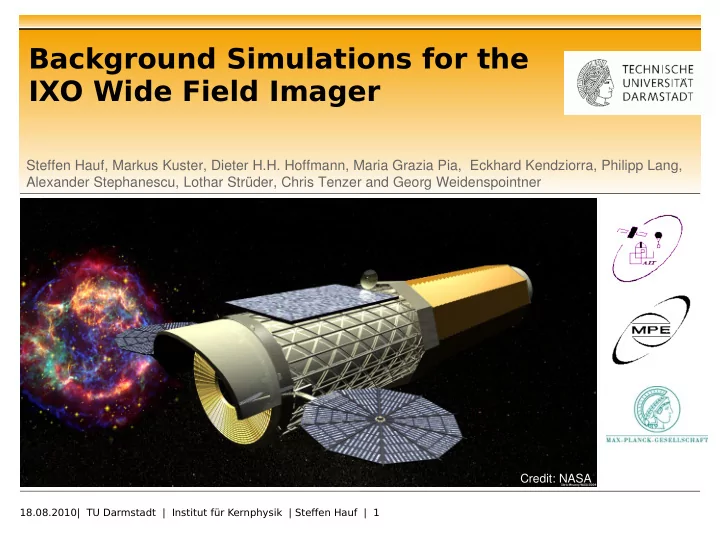
Credit: NASA
Steffen Hauf, Markus Kuster, Dieter H.H. Hoffmann, Maria Grazia Pia, Eckhard Kendziorra, Philipp Lang, Alexander Stephanescu, Lothar Strüder, Chris Tenzer and Georg Weidenspointner

slide-2
SLIDE 2

18.08.2010 | TU Darmstadt | Institut für Kernphysik | Steffen Hauf | 2

IXO Scientific Goals

Images: Simbol-X Proposal

Study of AGN, accretion discs and black holes limited by ability to penetrate obscuring dust Hard X-rays can penetrate this dust Imaging of extended sources i.e. diffuce X-ray background at high energies requires long focal length Low background for faint and/or extended sources

slide-3
SLIDE 3

18.08.2010 | TU Darmstadt | Institut für Kernphysik | Steffen Hauf | 3

The IXO Spacecraft

credit: NASA X-ray Microcalorimeter Spectrometer Wide Field and Hard X-ray Imager X-Ray Polarimeter X-Ray Polarimeter High Time Resolution X-Ray Spectrometer X-Ray Grating Spectrometer

slide-4
SLIDE 4

18.08.2010 | TU Darmstadt | Institut für Kernphysik | Steffen Hauf | 4

IXO & WFI Specifications

  • Optic system offers 10x the effective area
  • f XMM below 7 keV
  • Effective area comparable to XMM up to 40 keV

IXO Optics Wide Field Imager (and HXI)

Energy ranges Resolution 5 “ Pixel size Focal plane area10.24 cm x 10.24 cm 0.1 – 15 keV 5 – 40 keV 1024 x 1024 px 100 µm x 100 µm

WFI (DePFET based) Filter Wheel HXI Graded- Z Shield

credit: A. Parmar

slide-5
SLIDE 5

18.08.2010 | TU Darmstadt | Institut für Kernphysik | Steffen Hauf | 5

IXO Radiation Environment

Soft protons: variable intensity (flares: >1000%) patterns similar to X-rays variable, continuous, unpredictable spectrum Shielding, magnetic deflection GTI Electronic Noise constant, single bright pixels patterns mostly distinct from X-rays low energy tail Cooling, electronics design, post processing Internal (cosmic ray induced) flourescence, radioactive decay and direct hits patterns distinct from X-rays spatially dependent on materials, continuum spectrum with flourescence lines Graded-Z, post processing, material selection Hard and soft X-ray Background from AGN, galactic disc, sun thermal (soft), power-law (hard) spectrum, dominates below 5 keV Models in spectral analysis

slide-6
SLIDE 6

18.08.2010 | TU Darmstadt | Institut für Kernphysik | Steffen Hauf | 6

Geant4 Simulation Overview

  • Geant4 version: 4.9.1 & 4.9.2 (with

patches, 64 bit)

  • Physics: Low-Energy EM, user

physics list for hadronics (binary cascade)

  • Geometry: hand-coded, CGS,

pixelized detector (in tracking and readout geometry)

  • Source: GPS, user defined spectral

input, spherical, isotropic

  • Output: FITS compatible events list,

detailed output of processes and particle origin separatly possible. Simulation

  • utput

IDL analysis package

(pattern + MIP detection)

Background rate Detailed origins analysis

slide-7
SLIDE 7

18.08.2010 | TU Darmstadt | Institut für Kernphysik | Steffen Hauf | 7

IXO Radiation Enviroment

The Simulation Input

Energy [MeV]

Flux [ Protons MeV-

1 cm- 2 s- 1]

solar minimum solar maximum

  • CREME 96
  • Valid up to Mars orbit – so it

should be valid at L2

  • Simulations at

solar minimum

  • Mean flux:

2.31 protons/cm²/s

  • Neglect He and heavier

elements (<2% of total flux)

slide-8
SLIDE 8

18.08.2010 | TU Darmstadt | Institut für Kernphysik | Steffen Hauf | 8

WFI Geometrical Design and Simulation Implementation

Approx. by primitives Mechanical Design Model GEANT4 Representation (C++) BCB Si

SixOx, SixNx,Al

+ +

Wafer-proximity in greater detail X-rays X-rays Thin layers (~10nm)

slide-9
SLIDE 9

18.08.2010 | TU Darmstadt | Institut für Kernphysik | Steffen Hauf | 9

WFI Geometrical Design

Influence of Fixed and Movable Instrument Platforms

  • Possibility to add XMS, MIP and

FIP mass dummys

  • This prolongs the simulation

time since more volume has to be irradiated by source → longer runs for same statistics

  • n detector
  • Change in count rate is

negligable :

  • with satellite structs: 21.0±2.7
  • w/o sattellite structs: 18.9±0.3

x 10-

4 cts/cm²/s/keV

  • Therefore most simulations w/o

satellite structures

XMS MIP

slide-10
SLIDE 10

18.08.2010 | TU Darmstadt | Institut für Kernphysik | Steffen Hauf | 10

Pattern Detection as a Background Reduction Measure

raw rate after detection with 400 px exclusion

1 10 100 1000

686,43 18,98 9,39

  • Pattern detection for invalid patterns

caused by non-gamma particles (similar to XMM Newton)

  • MIP detection
  • Significant reduction of background rate
  • BUT: in wafer charge distribution not

modelled yet

x 1

  • 4

c t s / k e V / c m ² / s

x 24% singles x 17 % valid x 22% doubles x 0.5% valid no valid n>2

slide-11
SLIDE 11

18.08.2010 | TU Darmstadt | Institut für Kernphysik | Steffen Hauf | 11

WFI Background Spectrum - Before Pattern and MIP Detection

  • No line emission except Si

– supressed by graded-Z shield

  • Electrons main component
  • Protons second strongest

component

  • Flat spectrum

sum electrons gammas protons

  • thers

positrons

Particle species

Flux (10-4 cts/cm²/s/keV)

e- 452.68±1.52 p 228.04±1.08 e+ 91.04±0.68 γ 12.2±0.25

70 Mio. primaries, with realistic wafer, WFI only Flux by Particle Species

slide-12
SLIDE 12

18.08.2010 | TU Darmstadt | Institut für Kernphysik | Steffen Hauf | 12

WFI Background Spectrum - After Pattern and MIP Detection

  • Events produced by

protons are suppressed by pattern recognition

  • Electron component one
  • rder of mag. stronger than
  • thers outside Si-line

→ primary optimization goal sum electrons gammas

Particle species

Flux (10-4 cts/cm²/s/keV)

e- 11.21±0.17 p 0.12±0.02 e+ 0.09±0.2 γ 7.54±0.15

70 Mio. primaries, with realistic wafer, WFI only Flux by Particle Species

slide-13
SLIDE 13

18.08.2010 | TU Darmstadt | Institut für Kernphysik | Steffen Hauf | 13

Angular Distribution of Secondary Electron Component

Winkelverteilung der Elektronen im Detektor-Energiebereich

  • Dominating electron component mainly incident at small angles
  • Additional Al-layer on Si-wafer could help

switch from simplified entrance → window representation to more realistic one

  • Significant reduction

Simplified Entrance Window Realistic Wafer

WFI Box XMS WFI Box XMS Entrance window design Flux 10-4 cts/cm²/s/keV simplified 22.99±0.31 realistic 18.98±0.34

Effects of Entr. Window Design

slide-14
SLIDE 14

18.08.2010 | TU Darmstadt | Institut für Kernphysik | Steffen Hauf | 14

Realistic Wafer Representation

Problems encountered

  • Energy deposit at SiO – Si boundry shows unrealistically sharp peak
  • By default no secondary production in Si below approx. 10nm or 990 eV particles
  • Need to manually tell Geant to process these particles.
  • Problem of scales (macroscopic vs. microscopic) known

intensive work within nano5 R&D →

Wafer Entrance Window

slide-15
SLIDE 15

18.08.2010 | TU Darmstadt | Institut für Kernphysik | Steffen Hauf | 15

Optimization Possibilities

  • HXI, BGO and graded-Z are

important contributers

  • Optimization of HXI and BGO

needs to be coordinated with HXI group

  • Simplified simulation of

shielding layers shows that changes in high-Z layer configuration do not significantly change secondary electron production (see next slide) Graded-Z HXI BGO HXI-WFI Al-filter Secondary e- Production

  • Arb. units
slide-16
SLIDE 16

18.08.2010 | TU Darmstadt | Institut für Kernphysik | Steffen Hauf | 16

Influence of Graded-Z Composition on e- Production

  • Changes in high-Z layer

thicknesses have marginal influence on secondary electron production

  • Electrons instead

produced in next lower layers Secondary e- Production with Varying Ta-Thickness

slide-17
SLIDE 17

18.08.2010 | TU Darmstadt | Institut für Kernphysik | Steffen Hauf | 17

Comparison to Suzaku

  • IXO: simulation

Suzaku: measured blank sky files

  • Similar pattern and

MIP detection algorithms

  • Similar detector specs:

1024x1024 px, 0.4-12 keV energy range

  • IXO data is near solar

minimum while Suzaku data was taken during intermediate cycle Suzaku BI Suzaku FI WFI

Flux (10-4 cts/cm²/s/keV)

IXO 9.89±18.98 (~1% error) Suzaku BI 30.25-80.25 ( err. unknown) Suzaku FI 13.75-27.50 (err. unknown)

slide-18
SLIDE 18

18.08.2010 | TU Darmstadt | Institut für Kernphysik | Steffen Hauf | 18

Summary

  • All major costituents of the background were identified.
  • Secondary electrons domitate background by one order of magnitude outside Si-

Kα line.

  • Currently implemented, non mass optimized graded-Z shield supresses all

emission lines except Si (emitted from wafer bulk).

  • Graded-Z shielding is currently being optimized for mass and minimum electron

production.

  • Main contributers of the different constituents indentified within the geometry.

For secondary electrons: HXI and BGO and graded-Z shield.

  • Pattern and MIP detection algorithms significantly reduce the background by 90%,

by reliantly identifying events due to protons and positrons.

  • Realistic representation of the entrance window is needed, since this has non-

negliable influence on the dominating secondary electron component.

slide-19
SLIDE 19

18.08.2010 | TU Darmstadt | Institut für Kernphysik | Steffen Hauf | 19

Summary

  • Geant4 has problems simulating microscopic and macroscopic geometry within
  • ne simulation.

Special care has to be taken when using layers thinner then default minimum secondary production threshold because artifacts may appear. This problem is known and is intensively being worked on within the nano5 R&D effort.

  • Current estimate of the WFI background lies between 9.89 and 18.98 x

10-

4 cts/s/cm²/keV depending on post-processing and entrance window

implementation. This is partly below the measured background of the Suzaku XIS detector even under more severe background conditions (solar minimum

  • vs. intermediate cycle)
slide-20
SLIDE 20

18.08.2010 | TU Darmstadt | Institut für Kernphysik | Steffen Hauf | 20

Outlook

  • Optimisation of the graded-Z shield is currently ongoing. The goal is to optimize

for mass and reduce the secondary electron production while retaining the good emission line supression capabilities.

  • Realistic inplementation of charge collection and charge cloud distribution in

wafer needs to be added → event splitting

  • Prototype of WFI could be used for benchmarking simulation
  • Include simulation of background due to radioactive decays of satellite materials

(either intrinsic or through on orbit activation)

  • Validation of radioactive decay physics and inclusion of long term activation as

part of nano5 project

slide-21
SLIDE 21

18.08.2010 | TU Darmstadt | Institut für Kernphysik | Steffen Hauf | 21