Background: Renin inhibition in heart failure with reduced ejection - - PowerPoint PPT Presentation

background renin inhibition in heart failure with reduced
SMART_READER_LITE
LIVE PREVIEW

Background: Renin inhibition in heart failure with reduced ejection - - PowerPoint PPT Presentation

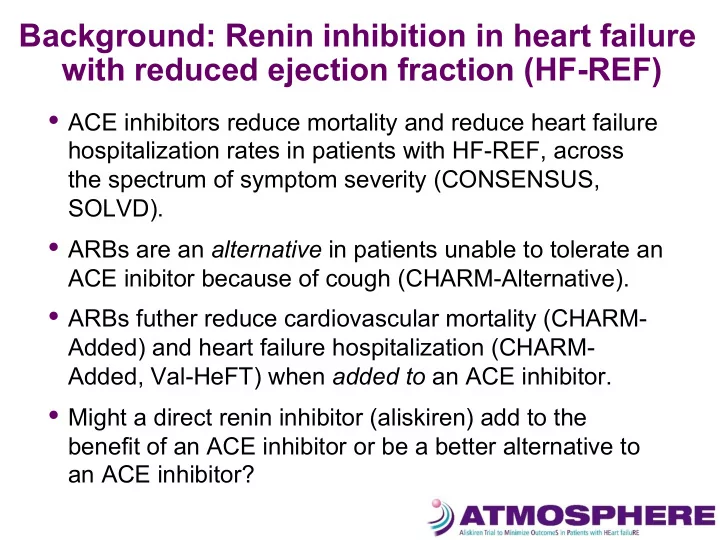
Background: Renin inhibition in heart failure with reduced ejection fraction (HF-REF) ACE inhibitors reduce mortality and reduce heart failure hospitalization rates in patients with HF-REF, across the spectrum of symptom severity (CONSENSUS,


slide-1
SLIDE 1
  • ACE inhibitors reduce mortality and reduce heart failure

hospitalization rates in patients with HF-REF, across the spectrum of symptom severity (CONSENSUS, SOLVD).

  • ARBs are an alternative in patients unable to tolerate an

ACE inibitor because of cough (CHARM-Alternative).

  • ARBs futher reduce cardiovascular mortality (CHARM-

Added) and heart failure hospitalization (CHARM- Added, Val-HeFT) when added to an ACE inhibitor.

  • Might a direct renin inhibitor (aliskiren) add to the

benefit of an ACE inhibitor or be a better alternative to an ACE inhibitor?

Background: Renin inhibition in heart failure with reduced ejection fraction (HF-REF)

slide-2
SLIDE 2

Aliskiren Trial to Minimize OutcomeS in Patients with HEart failuRE (ATMOSPHERE)

  • Age ≥18 years. NYHA class II-IV. LVEF ≤0.35
  • BNP ≥150 pg/ml (NTpro-BNP ≥600 pg/ml) or if HF hosp. within12 mo. BNP

≥100 pg/ml (NTpro-BNP ≥400 pg/ml)

  • Background ACEi therapy equivalent to enalapril ≥10 mg/d
  • Beta-blocker unless contraindicated/not tolerated
  • SBP ≥95 mmHg run-in/ ≥90 mmHg at randomization
  • eGFR ≥35 ml/min/1.73m2 at randomization /no decrease >25% during run in
  • Potassium <5.0 mmol/l run-in/ <5.2 mmol/l at randomization
slide-3
SLIDE 3

Aliskiren+Enalapril (n=2340) Aliskiren (n=2340) Enalapril (n=2336) Age (years) 63.2 ± 11.7 63.3 ± 12.1 63.3 ± 11.7 Women (%) 21.1% 22.7% 21.4% Ischemic etiology (%) 57.1% 55.3% 55.7% LVEF (%) 28.5 ± 5.7 28.4 ± 5.7 28.3 ± 5.7 NYHA class II / III (%) 64.0% / 33.7% 64.0% / 34.3% 61.7% / 36.3% Systolic BP (mm Hg) 124 ± 19 124 ± 18 123 ± 18 Heart rate (beats/min) 72 ± 13 72 ± 12 72 ± 13 NT pro-BNP (pg/ml) 1193 (640-2351) 1167 (627-2173) 1223 (634-2194) History of diabetes 28.4% 26.8% 27.9% Digitalis 32.7% 32.0% 31.2% Beta-blocker 92.0% 91.2% 91.9% MRA 36.6% 36.9% 37.8% CRT-P/CRT-D 6.1% 5.1% 5.6% ICD/CRT-D 15.0% 15.5% 14.4%

ATMOSPHERE: Baseline characteristics

slide-4
SLIDE 4
  • Aliskiren added to enalapril is

superior to enalapril

  • Aliskiren monotherapy is

superior to enalapril

  • Aliskiren monotherapy is non-

inferior to enalapril Non-inferiority hypothesis Superiority hypotheses

https://clinicaltrials.gov NCT00853658

Aliskiren Trial to Minimize OutcomeS in Patients with HEart failuRE (ATMOSPHERE)

In reducing the risk of the primary composite outcome of cardiovascular death or heart failure hospitalization

slide-5
SLIDE 5

ATMOSPHERE: Primary outcome

slide-6
SLIDE 6

ATMOSPHERE: Comparison of enalapril and aliskiren monotherapy (non-inferiority)

Aliskiren (n=2340) Enalapril (n=2336) HR (95% CI) P value All patients n (%) 791 (33.8%) 808 (34.6%) 0.99 (0.90-1.10) 0.0184*

*Did not meet the pre-specified P-value for significance Pre-specified criterion for declaring non-inferiority was a P-value ≤0.0123 (one-sided)

slide-7
SLIDE 7

ATMOSPHERE: Secondary and exploratory outcomes

Secondary outcome:

  • Kansas City Cardiomyopathy Questionnaire (KCCQ) -

Change in the clinical summary score (CSS) from baseline to 12 months Exploratory outcomes (selected):

  • Composite CV outcome: CV death, HF hospitalization,

MI, stroke or resuscitated cardiac arrest

  • Composite renal outcome: renal death, ESRD (initiation of

dialysis, renal transplantation, or a serum Cr above 6.0 mg/dl [530 µmol/l]), or doubling of serum Cr from baseline (to >upper limit of normal) sustained for at least 1 month

slide-8
SLIDE 8

Combination n/N (%) Interaction P-value Aliskiren n/N (%) Interaction P-value

ATMOSPHERE: Pre-specified subgroups

Favors combination Favors enalapril Favors enalapril Favors aliskiren

Enalapril n/N (%) Enalapril n/N (%)

slide-9
SLIDE 9

Aliskiren+ Enalapril (n=2340) Aliskiren (n=2340) Enalapril (n=2336) P value (1) P value (2) Hypotension n (%) Symptoms Symptoms and SBP <90mmHg 322 (13.8%) 87 (3.7%) 249 (10.6%) 31 (1.3%) 258 (11.0%) 55 (2.4%) 0.005 0.008 0.67 0.009 Renal impairment n (%) Cr ≥2.5mg/dl Cr ≥3.0mg/dl 95 (4.1%) 46 (2.0%) 63 (2.7%) 35 (1.5%) 62 (2.7%) 29 (1.2%) 0.009 0.06 1.00 0.53 Hyperkalemia n (%) K+ >5.5mmol/l K+ >6.0mmol/l 401 (17.1%) 116 (5.0%) 255 (10.9%) 70 (3.0%) 291 (12.5%) 83 (3.6%) <0.0001 0.02 0.10 0.29 Cough n (%) 290 (12.4%) 241 (10.3%) 284 (12.2%) 0.83 <0.05

ATMOSPHERE: Safety outcomes

(1) = Comparison of enalapril plus aliskiren versus enalapril; (2)= Comparison of aliskiren versus enalapril

slide-10
SLIDE 10

Combination therapy

  • The addition of aliskiren to an evidence-based dose of

enalapril led to more adverse events without an increase in benefit.

  • This finding differs from the prior ARB “add-on” trials and

may reflect a difference in study design (the previous trials did not require an evidence-based dose of background ACE inhibitor).

  • There is probably a ceiling to RAS blockade in heart

failure, above which there is no further benefit

Aliskiren monotherapy

  • Non-inferiority was not demonstrated for aliskiren

compared with enalapril.

Summary and conclusions