BACK TO THE FUTURE: Lessons Learned from Californias 1990s Methanol - - PowerPoint PPT Presentation

back to the future
SMART_READER_LITE
LIVE PREVIEW

BACK TO THE FUTURE: Lessons Learned from Californias 1990s Methanol - - PowerPoint PPT Presentation

BACK TO THE FUTURE: Lessons Learned from Californias 1990s Methanol Program and Renewed Interest in Petroleum Reduction By Paul Wuebben Senior Director of Renewable Fuels CARBON RECYCLING INTERNATIONAL 2015 European Methanol Forum


slide-1
SLIDE 1

Carbon Recycling International

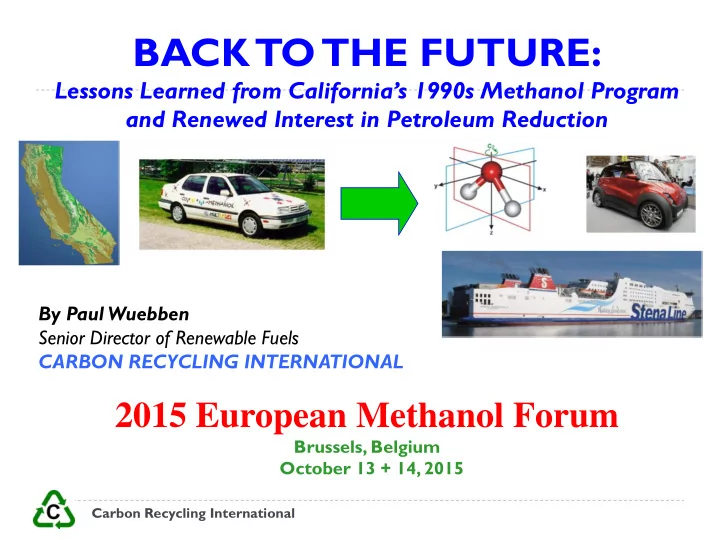
BACK TO THE FUTURE:

Lessons Learned from California’s 1990s Methanol Program and Renewed Interest in Petroleum Reduction

By Paul Wuebben Senior Director of Renewable Fuels CARBON RECYCLING INTERNATIONAL

2015 European Methanol Forum

Brussels, Belgium October 13 + 14, 2015

slide-2
SLIDE 2

Carbon Recycling International

slide-3
SLIDE 3

Carbon Recycling International

Outline

 CA Methanol Experience  Governor’s and CARB’s GHG + Energy

Priorities

 Next Steps in Methanol Transition  Conclusions

slide-4
SLIDE 4

Carbon Recycling International

Summary of CA Fuel Methanol Program

 17,000+ M85 FFVs sold to public without restriction  Max fuel volume throughput: 7.5 M liters / month  10 OEMs involved  Station deployment: 60+  7 oil company branded stations

slide-5
SLIDE 5

Carbon Recycling International

CA Legacy:

World’s 1st M-85 FFV OEM Production

 Ford *  GM  Chrysler  Toyota  Nissan  Honda  VW  Volvo  Mitsubishi  Mercedes

* From 1996 through 1998, Ford

  • ffered the Taurus, then the

nation’s highest volume passenger car, for $385 LESS than its gasoline counterpart.

5

slide-6
SLIDE 6

Carbon Recycling International

slide-7
SLIDE 7

Carbon Recycling International

7

Over 14 million in U.S.

as of 2014 2014

slide-8
SLIDE 8

Carbon Recycling International

Oil Companies Offering M-85 in CA - 1990s:

 ARCO (now BP)  Texaco (now Chevron)  Mobil (now Exxon)  Chevron  Shell  Exxon  Ultramar (now Shell)

slide-9
SLIDE 9

Carbon Recycling International

Specific Methanol T echnology Highlights

 World’s 1st M85 FFV demonstration

 With Roberta Nichols, Ford Motor Co.

 World’s 1st “gasoline tolerant” M85 FFV

 With Gordon Alardyce, Chrysler

 World’s 1st FFV with high CR

 Achieved gasoline-equivalent COP, Volvo

 World’s 1st methanol bus retrofit

 With Glen Short, ICI (with Avocet)

9

slide-10
SLIDE 10

Carbon Recycling International

T echnical Issues Successfully Addressed as a Result of the CA Methanol Program

 Octane Effects  Blending Vapor Pressure  Distillation Properties  Water Solubility  Vehicle Emission Impacts

 e.g., HCHO standard adopted and easily complied with via close

coupled catalysts

 Toxicity of Vapors  Risk Mitigation

 e.g., flame arrestors, anti-siphoning devices

 Material Compatibility in FFVs

  • Neat Methanol
  • Methanol Gasoline Blends
slide-11
SLIDE 11

Carbon Recycling International

Methanol Was Shown to Provide Ozone Reactivity and Emission Reduction Benefits Compared to Gasoline

Methanol Low Level Blend Effects in Non-FFVs Ozone Reactivity Associated With Specific Fuel Components (applicable to FFVs)

slide-12
SLIDE 12

Carbon Recycling International

Methanol Was Shown to Provide Health and Ecosystem Benefits Compared to Gasoline

slide-13
SLIDE 13

Carbon Recycling International

Inhalation Toxicity (LD50):

Gasoline + Diesel MUCH Worse than Methanol

slide-14
SLIDE 14

Carbon Recycling International

Dermal Toxicity (LD50): Methanol Superior than Either Gasoline or Diesel

slide-15
SLIDE 15

Carbon Recycling International

Oral LD50 Toxicity: Gasoline Worse than Methanol

slide-16
SLIDE 16

Carbon Recycling International

Example of Mature HCHO Control Using Well-Established Catalyst Technology

slide-17
SLIDE 17

Carbon Recycling International

Diesel Particulate:

50 x More Potent Cancer Risk Than HCHO

Source: rce: California Air Resources Board, Consolidated Table of OEHHA/ARB Approved Risk Assessment Health Values, March 2005; http://www.arb.ca.gov/toxics/healthval/healthval.htm

Toxic Air Contaminant Inhalation Cancer Unit Risk (u g/m3)-1 Benzene 2.2 × 10⁶ Diesel PM 3.0 × 10⁴ Formaldehyde 6.0 × 10⁶ Comparative Toxicities of Selected Toxic Compounds from Vehicle Sources

slide-18
SLIDE 18

Carbon Recycling International

September 23, 2015

slide-19
SLIDE 19

Carbon Recycling International

METHANOL USE IN TRANSPORATION:

 Toxicity of methanol, ethanol, gasoline and diesel are

comparable

 Morbidity effect from methanol ingestion is far greater

than gasoline or ethanol

 Affects Central Nervous System and can cause blindness

 In 2000, there were 11 deaths in the U.S. from 2,000

methanol exposures

 In the CA Fuel Methanol Program, with over 200

million miles of consumer experience, there was not a single documented harmful event.

 Existing commercial products contain significant amounts

  • f methanol (e.g., windshield washer fluid)
slide-20
SLIDE 20

Carbon Recycling International

slide-21
SLIDE 21

Carbon Recycling International

slide-22
SLIDE 22

Carbon Recycling International

Materials and Phase Separation Were Carefully Considered

slide-23
SLIDE 23

Carbon Recycling International

Relevant Question:

 It was recently disclosed that Chevron dewatered

their entire pipeline distribution system in the mid- 1990s to accommodate methanol distribution. This was the first and last time that an entire refiner’s distribution system was made compatible for an alternative fuel not derived from petroleum.

 Are there any technical barriers to repeating

that transition in this decade?

NO

slide-24
SLIDE 24

Carbon Recycling International

Reasons that “Orphaned” Opportunities Were Left Unrealized in the mid-1990s

 Low oil price environment very challenging…  “Romance of the number zero” ZEV ideology

 Even though BEVs are 2nd car niche vehicles in reality…

 Lack of adequate public education  Distorted U.S. ethanol policies

 Now resolved with repeal of the VEETC

 Limited number of “fuel methanol” champions  China’s methanol efforts were not mature at that time  Demographics of 5 billion population were less onerous

than 7+

 Renewable Methanol from recycled CO2 emissions

not demonstrated at that time…

slide-25
SLIDE 25

Carbon Recycling International

California’s Latest Initiatives

slide-26
SLIDE 26

Carbon Recycling International

California’s Energy / GHG Challenges

 CO2 concentrations already @ 400 ppm threshold  Severe drought raising public awareness of GHGs  Governor’s commitment to 50% reduction in petroleum

use by 2030

 Growing skepticism regarding “clean diesel”  Pace of electric drive and H2 fuel cell vehicles slower than

needed

 Compliance with new federal ozone standard  Disproportionate public health impact from port / marine

activities

slide-27
SLIDE 27

Carbon Recycling International

CALIFORNIA’S RECENT INITIATIVES:

slide-28
SLIDE 28

Carbon Recycling International

California On-Road GHG Emission Reductions

slide-29
SLIDE 29

Carbon Recycling International

CA South Coast NOx Emission Trends

slide-30
SLIDE 30

Carbon Recycling International

California Petroleum Reduction Trends

slide-31
SLIDE 31

Carbon Recycling International

California Heavy Duty Vehicle Fleet**

slide-32
SLIDE 32

Carbon Recycling International

slide-33
SLIDE 33

Carbon Recycling International

Where Can Methanol Play a Role in California + EU for LDVs?

slide-34
SLIDE 34

Carbon Recycling International

GEM Fuel “Elegance”

  • Same AFR
  • Same Gravimetric LHV
  • Same Volumetric LHV
  • Same Octane
  • Same Heat of Vaporization
  • Same O2 Sensor Output
  • & All Lower CI than Gasoline

*

* NG based CH3OH ~

slide-35
SLIDE 35

Carbon Recycling International

CH3OH FFV Δ $100:

The Lowest Cost Path to Scalable + Sustainable Mobility:

slide-36
SLIDE 36

Carbon Recycling International

Where Can Methanol Play a Role in California + EU for HDVs?

slide-37
SLIDE 37

Carbon Recycling International

EPA VW 1.9l TDI Conversion: Spark Ignited Methanol, + 19:1 CR

37

The Full Potential of Methanol has Not Been Fully Leveraged

slide-38
SLIDE 38

Carbon Recycling International

Where Can Methanol Play a Role in California + EU in the Marine Segment ?

slide-39
SLIDE 39

Carbon Recycling International

slide-40
SLIDE 40

Carbon Recycling International

What’s Different This Time?

 Global population: 7 B rather than 5 B

 China, India, Indonesia demographics + growth

 California 1st to target 50% petroleum reduction by

2030

 OEMs need non-diesel + high octane engine

efficiency gains!

 Fuel cell infrastructure costs are becoming transparent  Oil prices of $50 - $100 rather than < $20

 Petroleum supply vulnerabilities growing

 Ethanol “Biofuel Limit” reached @ 15 B gallons

 U.S. ethanol price distortion (VEETC) now ended

slide-41
SLIDE 41

Carbon Recycling International

Fuel Methanol Has a Significant Role To Play –

Let’s Put All Its Strengths Together !

slide-42
SLIDE 42

Carbon Recycling International

Thank You For This Opportunity…!

Paul@cri.is