Back Backgr grou ound (ENDS): Inf Information a rmation and D - - PDF document

back backgr grou ound
SMART_READER_LITE
LIVE PREVIEW

Back Backgr grou ound (ENDS): Inf Information a rmation and D - - PDF document

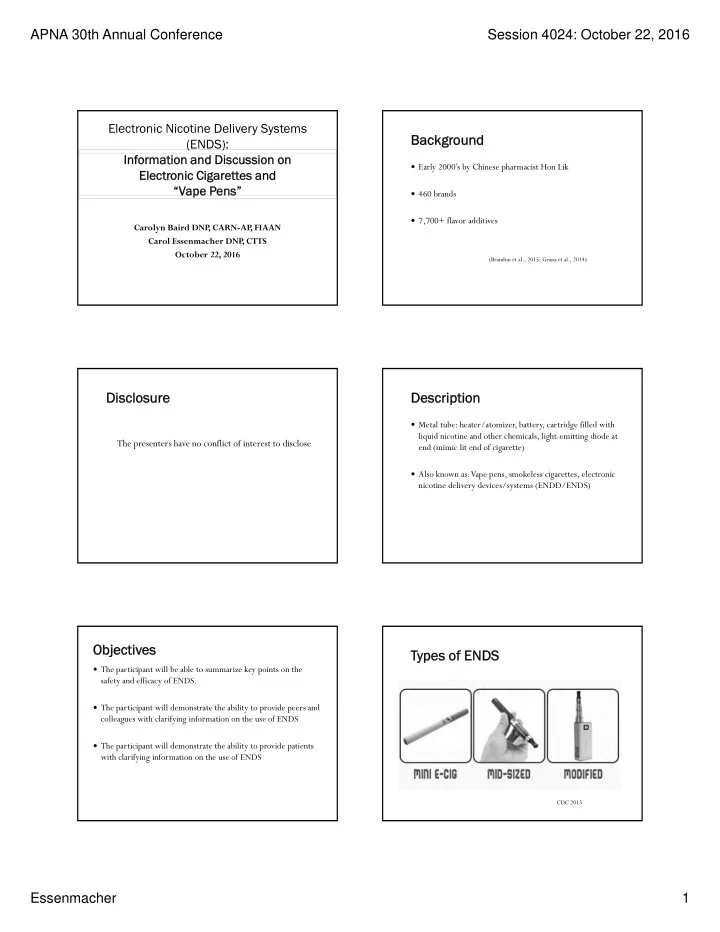
APNA 30th Annual Conference Session 4024: October 22, 2016 Electronic Nicotine Delivery Systems Back Backgr grou ound (ENDS): Inf Information a rmation and D d Discussion on scussion on Early 2000s by Chinese pharmacist Hon Lik


slide-1
SLIDE 1

APNA 30th Annual Conference Session 4024: October 22, 2016 Essenmacher 1

Carolyn Baird DNP , CARN-AP , FIAAN Carol Essenmacher DNP , CTTS October 22, 2016

Electronic Nicotine Delivery Systems (ENDS): Inf Information a rmation and D d Discussion on scussion on El Electr ectronic Cig

  • nic Cigare

rett ttes a es and d “V “Vape P Pens”

Discl Disclosure re

The presenters have no conflict of interest to disclose

Objectiv Objectives es

 The participant will be able to summarize key points on the

safety and efficacy of ENDS.

 The participant will demonstrate the ability to provide peers and

colleagues with clarifying information on the use of ENDS

 The participant will demonstrate the ability to provide patients

with clarifying information on the use of ENDS

Back Backgr grou

  • und

 Early 2000’s by Chinese pharmacist Hon Lik  460 brands  7,700+ flavor additives

(Brandon et al., 2015; Grana et al., 2014)

Desc Descri ripti ption

 Metal tube: heater/atomizer, battery, cartridge filled with

liquid nicotine and other chemicals, light-emitting diode at end (mimic lit end of cigarette)

 Also known as: Vape pens, smokeless cigarettes, electronic

nicotine delivery devices/systems (ENDD/ENDS)

Type pes of END

  • f ENDS

CDC 2015

slide-2
SLIDE 2

APNA 30th Annual Conference Session 4024: October 22, 2016 Essenmacher 2 Other Options: ENDS Other Options: ENDS

CDC 2015

Clarific Clarification ion

 Not actually a vapor – is an aerosol (different sizes of

particles)

 Aerosol seen upon exhale is similar to “fog” machine

(concerts)

Chemi Chemicals F s Frequently ly Found und in in ENDS (~42) ENDS (~42)

 Benzene (pesticides, gasoline)  Formaldehyde (embalming

fluid)

 Nicotine (pesticides/does not

cause cancer)

 Toulene (industrial solvent)  Cadmium (car batteries)  Lead  Propylene Glycol (de-icing

solution)

(CDC, 2015; Group to Alleviate Smoking Pollution of Colorado)

Mark Marketin ing

 Alternative to conventional cigarettes  Smoking cessation aid  Less harmful / improved health  Use nicotine in smoking-restricted areas

Mark Marketing: Who Pr ing: Who Prof

  • fits?

its?

 Remember – 460+ manufacturers  Between 2007 & 2013 ENDS businesses grew to

$2 Billion/year industry

 Forecast: $10 Billion/year industry by 2017  Research funded by tobacco companies: historical

perspective

Brandon et al, 2015; Shaw et al, 2015

Mar Marketing Who Uses ENDS Who Uses ENDS?

 Use of ENDS quadrupled in US between 2009 and 2010  Women more likely to try them; Men more likely to continue

use

 3x more likely to use if HS diploma or less  Low income (<$15,000) more likely to try use  6x more likely try ENDS and 3x more likely to continue use if

currently smoking

(CDC, 2015)

slide-3
SLIDE 3

APNA 30th Annual Conference Session 4024: October 22, 2016 Essenmacher 3

ENDS & ENDS & Pa Patients w tients with th Mental H ntal Health Is alth Issues es

 Prochaska & Grana (2014) found that 24% state they are

using ENDS to quit, but there was no actual decrease in cigarettes smoked per day

 Dual Use  No reduction in CPD with use of ENDS

Patien Patient’ t’s P Perception of ENDS: eption of ENDS:

 To quit smoking (Research does not support this)  To reduce cigarette consumption (Research does not support

this)

 To deal with nicotine withdrawal (Reduces cravings but not

irritability, restlessness, poor concentration)

(CDC, 2015)

Percept eptions co

  • ns conti

ntinued… ued…

 Perceived safer than conventional cigarettes (no RCTs on

ENDS users, no standardized dosing, types & concentrations

  • f chemicals not studied, safety of flavor additives, sold to

underage, etc.)

 Cheaper than smoking (avg. costs to start ENDS kit =

$120/per month vs 20cpd =$144/month)

Percept eptions co

  • ns conti

ntinued… ued…

 To not disturb others w/cig smoke (second-hand ENDS

exposure)

 To use in smoking restricted areas (most ENDS restricted

same places that cig smoking is banned)

(American Industrial Hygiene Association, 2014)

Re Reporte ted P Pote tential B Benefits

 May decrease risks for adult patients who stop smoking and only

use ENDS, but no data to support that people are making total switch to only ENDS use

Re Reporte ted P Pote tential & & Re Real H Harms

 Accidental poisonings  Nicotine can cause death in adults at 30-60mg and in children

at 10mg

 Refill bottles contain up to 1 GRAM of nicotine

(CDC, 2015)

slide-4
SLIDE 4

APNA 30th Annual Conference Session 4024: October 22, 2016 Essenmacher 4 Harms co s continued… ntinued…

 18.4% report that nicotine leaks out of cartridge

sometimes/often

 Exploding batteries/fires  Increased respiratory resistance impedance, less exhaled carbon

monoxide, Pneumonia

(CDC, 2015; Vardavas et al., 2012)

Youth and uth and ENDS ENDS

 Among high school youth, ENDS use tripled between 2013

(4.5%) and 2014 (13.4%)

 Middle school students increase ENDS use: 1.1% (2013) to

3.9% (2014)

 13% high school students used ENDS compared to 9% cigarette

use)

 “Enjoy the taste” “Sweet Tarts” and “Unicorn Puke”

(CDC, 2015)

MAJOR STAKEHOLDERS Findings and Positions

CDC CDC

FI FINDI NDINGS GS POSIT SITION

 Dual use  Potential health risks for

adolescents, pregnant women, non-smokers

 Not FDA approved, not

harmless

 Possible benefit might be if

people who use ENDS completely quit tobacco

FD FDA

FI FINDI NDINGS GS POSIT SITION

 Growing health risks  Adolescents using  Associated risks from liquid  Require registration with FDA

and report all product ingredients

 Require childproof caps on

ENDS liquids

 Warning labels on products &

advertisement

 Prohibit youth-oriented

marketing and sales

 Prohibit child-friendly ENDS

flavors

 Prohibit ENDS where smoking

prohibited.

Surgeo Surgeon Genera n General

FI FINDI NDINGS GS POSIT SITION

 No evidence that they

work

 Growing use by

adolescents

 Public health concerns  Research  Regulation

slide-5
SLIDE 5

APNA 30th Annual Conference Session 4024: October 22, 2016 Essenmacher 5

American I erican Industrial H dustrial Hygiene ene Asso Associati ation

FI FINDI NDINGS GS POSIT SITION

 Additional chemicals

delivered to lungs

 Environmental pollution

  • ccurs

 Substances other than

nicotine are being smoked

 Does not recommend

using until further research

 Ban use indoors due to

passive smoke exposure

World Health Organization rld Health Organization

FI FINDI NDINGS GS POSIT SITION

 High level of dual use  No evidence that people

quit

 Less toxicants but still too

much

 Passive smoke exposure  Recommends regulation

Am American N erican Nonsmok nsmokers’ Rig rs’ Rights hts Fo Foundation

FI FINDI NDINGS GS POSIT SITION

 Confusion about right to

use ENDS in smoke free areas

 Public health concerns

from exposure to second hand ENDS smoke

 ENDS should be regulated

the same as smoked tobacco

Americ American L Lung Assoc ng Associat ation

FI FINDI NDINGS GS POSIT SITION

 Nicotine not safe  Increased use by

adolescents who are at high risk

 Detectable levels of toxic

chemicals

 Diacetyl & lung disease  Second hand exposure  Attractive nuisance  Concerned about the

impact of use, especially by adolescents

Ame American an Asso Associati ation f for Can r Cancer Re Research & American S Society o

  • f

Cli Clinic ical Onco Oncology gy

FI FINDI NDINGS GS POSIT SITION

 Concerns for use by

  • ncology patients

 Dual use  Need for research  Support federal, state, and

local regulation of ENDS

STAKEHOLDERS FINDINGS POSITIONS CDC Potential health risks Not harmless FDA Growing use by vulnerable population Regulation starts Fall 2016 SURGEON GENERAL No evidence that they work, growing health concerns Research: regulation American Industrial Hygiene Association Source of environmental pollution Ban from smoke free zones American Association of Cancer Research & American Society of Clinical Oncology Health concerns Local, state and federal regulation American Nonsmokers’ Rights Foundation Significant public health concern due to second hand smoke Should be considered the same as smoking tobacco & banned from smoke free zones American Lung Association Public health concerns Should be regulated

slide-6
SLIDE 6

APNA 30th Annual Conference Session 4024: October 22, 2016 Essenmacher 6

Nu Nursing I g Implications: plications: Wh What to T Tell Pa ll Patients tients

“Because clinical studies about the safety and effectiveness

  • f these products have not been well studied, we have no

way of knowing:

 Whether e-cigarettes are safe for their intended use  What types of concentrations of potentially harmful

chemicals are found in these products

 How much nicotine they are inhaling when they use

these products (emphasize advertised content vs. fact)”

Nu Nursing I g Implications: plications: What What to T Tell ll P Peers eers (sugge (suggesti stion…)

(In addition to previous slide): “I can’t vouch for their safety. I am not in the habit of recommending devices when there is still so much unknown about them. Nicotine is very clearly harmful to the developing human brain and is not recommended for use in persons under the age of 18 (ideally 25). Therefore it is also harmful to a pregnant women’s fetus.”

APNA T NA Tobacco D bacco Dependence pendence Branch anch (TDB) E DB) ENDS C DS Committ mmittee ee M Member mbers

 Lisa Atwa  Carolyn Baird  Patricia Black  Sonia Duffy  Carol Essenmacher  Madeline Naegle  Leigh Powers  Rhonda Schwindt  Marie Smith  Matthew Tierney  Dorothy Valin  Bridgette Vest

TDB TDB ENDS ENDS Outcomes & tcomes & Next xt Steps eps

 Summary of Evidence Position Paper  Publication  ENDS information handouts for nurses  Suggestions

Questions?

35

Cont ntact act I Informat rmation ion

Carol Essenmacher DNP , PMHCNS-BC, CTTS quittobaccoRN@gmail.com carolessenmac@gmail.com 269-275-6030 Carolyn Baird, DNP

, RN-BC, CARN-AP , CCDPD, FIAAN cb@counselingandtraumaservices.com 724-263-0475

slide-7
SLIDE 7

APNA 30th Annual Conference Session 4024: October 22, 2016 Essenmacher 7

Re References

American Industrial Hygiene Association. (2014). White paper: Electronic cigarettes in the indoor environment.Available at: https://www.aiha.org/government- affairs/Documents/Electronc%20Cig%20Document_Final.pdf

Brandon, T. H., Goniewicz, J. J., Hanna, N. H., Hatsukami, D. K., Herbst, R. S., Hobin, J. A.,… & Warren,

  • G. W. (2015). Electronic nicotine delivery systems: A policy statement from the American Association

for Cancer Research and the American Society of Clinical Oncology. Clinical Cancer Research. 21(3), 514- 535.

  • CDC. (2015). E-Cigarette use among teens tripled from 2013 to 2014. Available at:

http://www.cdc.gov/media/releases/2015/p0416-e-cigarette-use.html

CDC Office on Smoking and Health. (2015). E-cigarettes: An emerging public health challenge. Available at: http://www.cdc.gov/cdcgrandrounds/archives/2015/october2015.htm

Grana, R., Benowitz, N., & Glantz, S. A. (2014). E-Cigarettes: A scientific review. Circulation, 129, 1972- 1986.

Prochaska, J. J., & Grana, R. (2014). Tobacco use among middle and high school students: U.S., 2011-2015. MMWR Weekly Report, 65(14), 361-367.

Shaw, D. M. Etter, J., & Elgar, B. (2015). Should academic journals publish e-cigarette research linked to tobacco companies? Addiction, 111, 1328-1332.

Vardavas, C., Anagnostopoulos, N., Kougias, M., Evangelopolou, V ., Connollly, G., & Behrakis, P . (2012). Short-term pulmonary effects of using an electronic cigarette: Impact on respiratory flow resistance, impedence, and exhaled nitric oxide. Chest, 141(6), 1400-1406.

Williams, R. S., Derrick, J., & Ribisi, K. M. (2015). Electronic cigarette sales to minors via the internet. JAMA Pediatrics, 169(3), e1563. doi:10.1001/jamapediatrics.2015.63.

Images Slides 6 & 7, From public domain: CDC Public Health Grand Rounds: http://www.cdc.gov/cdcgrandrounds/archives/2015/october2015.htm