
SLIDE 1
BA BALTI TIMO MORE E YO YOUTH FUND
No Novemb mber 21,
21, 2017 2017
Fr Frederick Douglas High Sc School
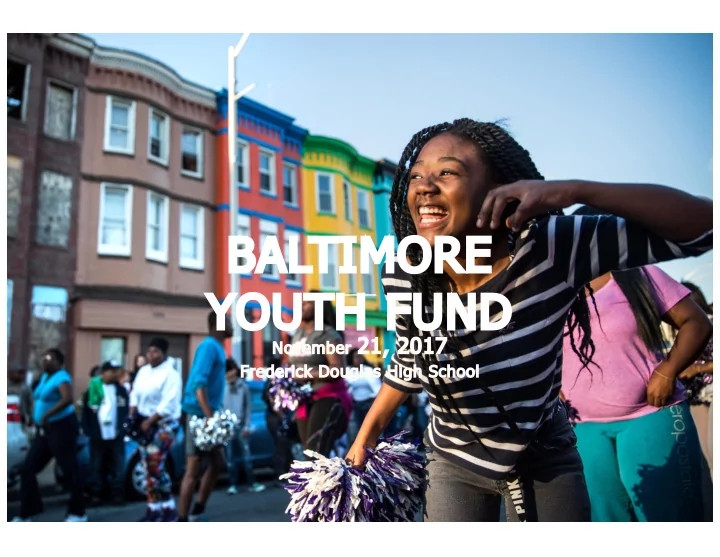
BA BALTI TIMO MORE E YO YOUTH FUND mber 21, 21, 2017 2017 No - - PowerPoint PPT Presentation
BA BALTI TIMO MORE E YO YOUTH FUND mber 21, 21, 2017 2017 No Novemb Fr Frederick Douglas High Sc School YO YOUTH FUND: HOW HOW IT BEGAN Les Lester er Da Davi vis, Depu Deputy y Chief ef of f Staff, Co Council President
No Novemb mber 21,
21, 2017 2017
Fr Frederick Douglas High Sc School
Les Lester er Da Davi vis, Depu Deputy y Chief ef of f Staff, Co Council President Jack Young’s Office
“Jack” C. Young
2016 with more than 80 percent support
revenue specifically to aid Baltimore’s Youth
ü The Task Force began its work February 21, 2017 ü The group met regularly between February and mid-May ü The Task Force was established by Council President Young to make recommendations on the Fund’s governance, and was facilitated by the Council President’s Office. ü The Task Force includes community leaders, youth program services providers, and City government representatives. ü Co-Chaired by Adam Jackson, Chief Executive Officer of Leaders of a Beautiful Struggle, and Dr. John Brothers, President of the Program for Charitable Giving at the T. Rowe Price Foundation
ü High involvement from community members ü Hundreds of attendees participated in more than half-a-dozen meetings held throughout Baltimore. ü Autonomy for Task Force to make recommendations to Council ü Work culminated in mid-May with a set of recommendations to the City Council on how the Children and Youth Fund should operate
The Youth Fund Task Force developed a set of values that would guide the Task Force during the process. Those values are as follows: ü Our work is informed, driven and led by youth voices, and ü Our work both advances equity and is welcoming and supporting of all races, classes and gender identities, and ü Our work is accountable and has impact to local communities, neighborhoods and places where young people connect, and ü Our work is not politically-driven and promotes confidence from the caring networks of Baltimore’s Young people, and ü Our work inspires new partnerships and new approaches to philanthropy to advance Baltimore’s young people, and ü Our work is focused, expedient, and conducted with urgency.
Jo John B Broth thers, P President, t, T
Rowe we P Price F Foundati tion
ü The organization does not need to be a 501 (c)3 but if it is not, will need a fiscal agent who is a 501 (c)3 and has agreed to serve as the financial fiduciary for the organization ü The organization does not need to be an organization that
ü The organizations do not have to be a local organization but efforts that show a history and focus locally are significantly
must have an accountability mechanism to local residents to receive funding. Local
would be heavily preferred ü It does not matter if the organization has a history of funding from the City of Baltimore. If the organization has or is receiving funding from the City, the amount or percentage should have no bearing on whether they receive assistance from the Youth Fund. If the organization has been negatively cited by the City for mismanagement of a previous City contract, this should have bearing on whether they receive assistance from the Youth Fund
ü The organization can have one project and /or program or a number of projects and/or programs that focus on serving young people ü The organization can have a project and/or program focus on a single youth area or age or a multitude of areas and ages ü The organization can serve an area as small as one block, a census tract or any neighborhood or community that they can outline ü The organization, or its fiscal agent, does not need to have fund or income diversity and should have enough financial strength to successfully implement the programs that they have outlined in their proposal
ü The organization does not have to be solely youth-focused in their programming or have a history in serving young people although approaches to serving and having impact on behalf
people living in Baltimore’s disenfranchised neighborhoods and communities ü It should be noted that experience and history of serving young people can come in a number of forms, including program leaders history of living amongst and working with the young people in their defined neighborhoods and communities being as or more valuable as an organization’s history in serving young people as a whole ü Funding from the Youth Fund can be general operating support and for specific project and/or program-related efforts
ü The organization will need to have a plan for how it will improve outcomes for the youth they plan on working with. They will not need to know exactly the population or young people that will be using or benefitting from their services ü The organization will need to have a plan on how they will execute services to the betterment of the young people they aim to serve and knowing exact program impacts they aim to achieve can be helpful, but not a requirement for receiving Youth Fund funding ü As part of the organization’s application, organizations will need to be able to identify a plan, which should include specific projects and/or programs that will be used to implement the plan ü The organization will need to identify the neighborhoods and neighborhoods and communities that they will serve young people but do not need to know the exact locations of where the services will be delivered at the time of their application
ü As part of the organization’s application, organizations will need to be able to identify a plan, which should include specific programs that will be used to implement the plan but will not at the time of application need to know the exact impact or difference the programs will make ü They should identify the impact or difference their efforts hope to make in the neighborhoods and communities they serve, especially in Baltimore’s disenfranchised neighborhoods and communities. As part of the Youth Fund efforts, capacity building and technical assistance will be provided to assist organizations in areas, including areas
in this section like program evaluation and development ü The Youth Fund can be used for once-off, pilot or seed project and/or programs that can test a new idea that may be able to be brought to scale at a later date. Additionally, the Youth Fund will be able to make multi-year funding engagements based on the organizations project and/or programed plan for serving and obtaining impact for young people in the neighborhoods and communities it aims to serve, especially in Baltimore’s disenfranchised neighborhoods and communities
ü As part of the organization’s plan for improving the lives of young people in the neighborhoods and communities it aims to serve, especially in Baltimore’s disenfranchised neighborhoods and communities, the organization should have as part of that plan an understanding of where the proposed funding will be
should be of the total project and/or program or organizational budget ü While having this information might be an important part of the
sustainability is important, it should not be a requirement of
ü If the project and/or program is not a once-off, pilot or seed project and/or program, then program or project sustainability is an important criterion for the Youth Fund in considering whether a program or project should receive Youth Fund dollars ü To this end, both Task Force and the community discussions have highlighted capacity building as an important aspect of the Youth Fund dollars and focus. The Youth Fund should dedicate a meaningful and significant part of its outlay to building the capacity
community and neighborhood-based efforts, especially in Baltimore’s disenfranchised neighborhoods and communities
ü The Youth Fund can assist early-stage organizations and programs or does NOT need to have a history and budget position to be considered for the Youth Fund ü For consideration for the Youth Fund, the organization applying will need to have a plan outlined on how it will
communities it aims to serve, especially in Baltimore’s disenfranchised neighborhoods and communities. This plan can include a realistic timetable, plan and overall budget
ü While both Task Force and community members cited the importance of partnership and collaboration in helping to achieve impact young people in the neighborhoods and communities, especially in Baltimore’s disenfranchised neighborhoods and communities, for applying to the Youth Fund, multiple organizations, projects and/or programs that serve the exact same geographic area are still eligible for Youth Fund consideration ü While showing a specific need relating to young people in a specific community could be an important part of the
qualitative data is as important as quantitative data in both showing need and potential impacts to be reached for young people in neighborhoods and communities, especially in Baltimore’s disenfranchised neighborhoods and communities
Ad Adam Jackson, CEO, Leaders for a Beautiful Struggle
ü The Youth Fund Task Force has decided that an intermediary is the best structure to administer the future Youth Fund. ü The future intermediary must have three qualities: 1) Experience working in disenfranchised communities in Baltimore, 2) Experience in racial equity, and 3) Experience with building the capacity
serving disenfranchised communities in Baltimore. ü The Youth Fund Task Force is aiming to find a Intermediary selection that serves three capacities: 1) Lead a process to establish an independent
with an independent governing body that will oversee the Youth Fund over the long term, 2) Establish the structure for the long-term Youth Fund by summer of 2018, and 3) If this timeline is not met, the intermediary would serve in other capacities as to ensure that grantmaking begins during the summer of 2018
ü The Youth Fund Task Force recommends that the Associated Black Charities (ABC) be named as short-term
the only one who fulfills the three qualities named by the Task Force. ü The primary responsibility of ABC will be establish an independent organization with an independent governing body that will oversee the Youth Fund over the long term. The goal is to establish this structure by summer of 2018. ü The board of the future independent organization will be appointed via the Executive Nominations process of the City Council ü If ABC is not able to establish the structure for the long- term Youth Fund by summer of 2018, the intermediary would serve in the other capacities as to ensure that grantmaking and other intermediary activities begin during the summer of 2018.
If ABC or other Intermediary is unable to establish the long-term governing structure by summer of 2018, the Intermediary’s staff and governing body would have to agree to continue to establish the long- term structure while also focusing the following short-term
ü Fiscal management and fiduciary responsibility ü Implementing a city-wide capacity-building program to serve community-based organizations in disenfranchised communities, ü Conducting a community-needs assessment to help the Youth Fund governing structure determine grant-making areas, ü Produce an annual report on the activities and impact of the Youth Fund, ü Potentially manage and execute a participatory-budgeting process and other external communication efforts to show the impact and efforts of the Youth Fund grantees. The selected intermediary would not be involved in the grant selection process.
The Intermediary may need supports and assistance to help them perform their duties and meet their obligations. The Intermediary can use Youth Fund dollars to: ü Hire external efforts to help provide counsel
establishing an independent organization, like the Forum for Youth Investment or another consultant or support
ü If an independent organization is not established by summer of 2018, the Intermediary may sub-contract with
entities to serve the additional Intermediary functions outlined earlier like capacity building, needs assessment and grant making.
If the Intermediary does not set up the long-term governing structure by summer
2018, the Intermediary would be responsible for the grantmaking process to ensure that Youth Fund dollars get into the community as soon as possible. To this end, the Intermediary would need to establish an “Assembly” to serve as the selection body for the funding. An “Assembly” would be selected through a public process led by the Task Force sub-committee. The following characteristics have been highlighted as important by the Task Force for the future “Assembly”: ü Clear representation of members representing the neediest communities in the city ü Must include youth members – no less than 50% of the Assembly should consist of members less than 30 years old, with majority
members should be mix of both in-school and out-of-school
ü “Assembly” members should include individuals representing the diversity of Baltimore including geographic diversity and include members from the LGBT communities, members from the faith and community-based
which can include
education, workforce development, recreation, juvenile delinquency, re-entry, immigrant youth, mentorship and anti- violence efforts.
Assembly and its members will serve in the additional areas: ü Will be the ongoing evaluator of the intermediary and will make on-going decisions on the evaluation and potential re-selection of the intermediary organization ü Members should be grounded in racial equity, have experience and a moral compass that is based in equality and has prioritized needs of disenfranchised communities
Va Valencia King, Chief of Operations, Associated Black Charities Da Daniel ielle le To Torain, Senior Consultant, Frontline Solutions
Who is the Associated Black Charities? Associated Black Charities is a public foundation that advocates and facilitates the creation of measurably healthier and more prosperous communities through responsible leadership and philanthropic investment throughout the State of Maryland. Through its More in the Middle Initiative and its health disparities work, ABC acts as a convener, advocate and grantmaker to address issues impacting Maryland communities. Website: http://www.abc-md.org/.
Who is Frontline Solutions? Frontline Solutions is a black owned, national consulting firm that delivers a full range of strategic and business planning, program design and implementation, research and evaluation, technical assistance, and community engagement services. A full-time staff of 14 spanning four cities (Philadelphia, PA, Baltimore, MD, Washington, DC and Durham, NC), the Frontline Solutions team is comprised of organizers, scholars, strategists, artists and coaches who are adept at utilizing consulting as a tool for social change. Frontline’s guiding values are: 1. Community-Driven Innovation; 2. Intersectional Equity, 3. Activating a Network for Change. Website: http://www.frontlinesol.com/.
The BCYF’s Design process will consist of the following planning elements: 1. Community Planning Sessions 2. Local & National Modeling & Benchmarking Research 3. Capacity Building for Interested/Prospective Applicants 4. Design of the BYF’s Grantmaking Strategy, Capacity Building & Technical Assistance Strategy, and Operational & Programmatic Build-out 5. Ongoing Engagement & Communication with Community Members 6. Buildout & Support of 1st Public Assembly Deliberation & Grantmaking Process Important Note: All proposed timelines and process components are TENTATIVE and subject to further adjustment/revision.
Tentative* Timeline
January Planning Process officially begins Planning Team Convening 1 February Community Engagement Sessions begin March Capacity Building for Interested/Prospective Community Applicants begins Planning Team Convening 2 May Planning Team Convening 3 June First RFP (or set of RFPs) released to public 30-day anticipated turnaround July 1st deliberation of the BCYF Public Assembly August 1st cohort of BCYF grantees announced to public September Onboarding of 1st grantee cohort begins
*Important Note: The timeline for the BCYF Planning Process heavily depends on the timing
Community Planning Sessions Objective: Engage a diverse cross-section of city residents (youth and adults), practitioners and other community-based stakeholders to: 1. Understand the needs, interests and priorities of city youth, and youth-serving entities/institutions; 2. Understand the composition, profile and needs of the Fund’s prospective applicants; 3. Identify prospective general assembly members; 4. Build community awareness of the design process and ways to get involved; and, 5. Shape and refine plans for the Fund’s design, launch and deployment/implementation. Note:
neighborhood-based settings across the city.
Capacity Building & Technical Assistance Objective: Support the capacity of interested/prospective applicants to successfully apply to and be competitive for the Fund’s grant opportunities. Note:
Community Planning Sessions.
sessions, i.e. Grant Writing, and Program Design.
throughout the city.
including prospective applicants with little or no prior experience with grant application processes, or formal grant experience.
Organizational Design & Strategy Development Objective: Apply learnings from the community engagement effort, data analysis, and local and national research to shape/define:
selection
prospective applicants and funded organizations
Note:
planning component
learnings and make key decisions
Workgroup 1 - Process Management, Oversight & Coordination
Monitors planning process and ensures team alignment with the articulated goals,
project communications efforts.
Workgroup 2 - Community Engagement
Leads design and execution of the process’ community engagement component.
Workgroup 3 - Capacity Building, T/TA & Resource Deployment Strategy
Leads design of capacity building, training and technical assistance and resource deployment components. Executes BCYF’s capacity building strategy for prospective applicants.
Workgroup 4 - Public Assembly
Leads design of the BCYF’s public assembly component. Conducts national research on promising models and prototypes, and applies local feedback into inform design. Identifies potential assembly candidates and designs process for member training, onboarding and management.
Workgroup 5 - Staffing, Operations & Infrastructure
Reviews operational and infrastructure-related considerations tied to each design
core infrastructure design.
Planning Team Members
Local Advisors
Bring a range of technical, programmatic, contextual and operational expertise to the planning process.
Youth Advisors
Anchor the planning process in the voices of diverse populations of young people across the city.
Communications Staff
Shape and manage project communications strategy/implementation efforts.
ABC Staff
Ensure that the work of the Planning Team is executed in alignment with the charge to which ABC will be accountable, and achieves the overarching goals and objectives of the design process. Official voice and public representative of the planning effort.
Frontline Staff Consultants
Provide facilitative support to members of the Planning Team, and support work plan execution through coordination, research and logistical support. Advise as needed.
Baltimore Residents & Youth/Community Stakeholders
Shape the priorities and design of the BCYF by actively participating in community design/planning sessions, and by sharing feedback along the way.
What will the Planning Team do in Convening 1 (Jan*)? Milestones:
following workgroups:
Objectives:
management and execution.
workgroup.
What will the Planning Team do in Convening 2 (March*)? Milestones:
Objectives:
Community Engagement process.
deployment/applicant selection
applicants and funded organizations
What will the Planning Team do in Convening 3 (May*)? Milestones:
finalized Objectives:
Community Engagement process.
resource deployment strategies of the BCYF.
development.
How do I stay informed about BCYF developments and/or get more involved? There will be many opportunities to get involved! Stay tuned for more information about Community Design & Planning Sessions, and opportunities to volunteer. After the planning process is formally launched, information about the process will be available online and communicated through email distribution and other forms of outreach. In the interim, you can contact the Baltimore City Council via Lester Davis for more information: Lester Davis Deputy Chief of Staff Office of City Council President Bernard C. “Jack” Young lester.davis@baltimorecity.gov (O) 410-396-4804 (C) 443-835-0784