
SLIDE 1
Planning and Optimization
- B5. Computational Complexity of Planning: Background
Malte Helmert and Gabriele R¨
- ger
Universit¨ at Basel
October 20, 2016
- M. Helmert, G. R¨
- ger (Universit¨
at Basel) Planning and Optimization October 20, 2016 1 / 19
Planning and Optimization
October 20, 2016 — B5. Computational Complexity of Planning: Background
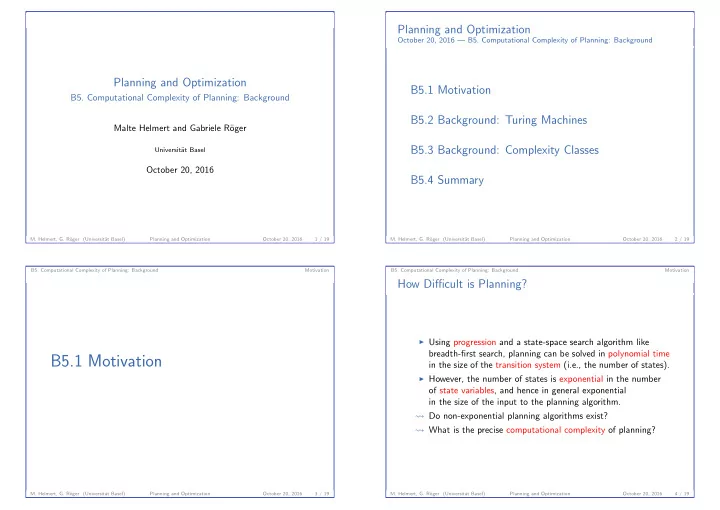
B5.1 Motivation B5.2 Background: Turing Machines B5.3 Background: Complexity Classes B5.4 Summary
- M. Helmert, G. R¨
- ger (Universit¨
at Basel) Planning and Optimization October 20, 2016 2 / 19
- B5. Computational Complexity of Planning: Background
Motivation
B5.1 Motivation
- M. Helmert, G. R¨
- ger (Universit¨
at Basel) Planning and Optimization October 20, 2016 3 / 19
- B5. Computational Complexity of Planning: Background
Motivation
How Difficult is Planning?
◮ Using progression and a state-space search algorithm like
breadth-first search, planning can be solved in polynomial time in the size of the transition system (i.e., the number of states).
◮ However, the number of states is exponential in the number
- f state variables, and hence in general exponential
in the size of the input to the planning algorithm. Do non-exponential planning algorithms exist? What is the precise computational complexity of planning?
- M. Helmert, G. R¨
- ger (Universit¨
at Basel) Planning and Optimization October 20, 2016 4 / 19