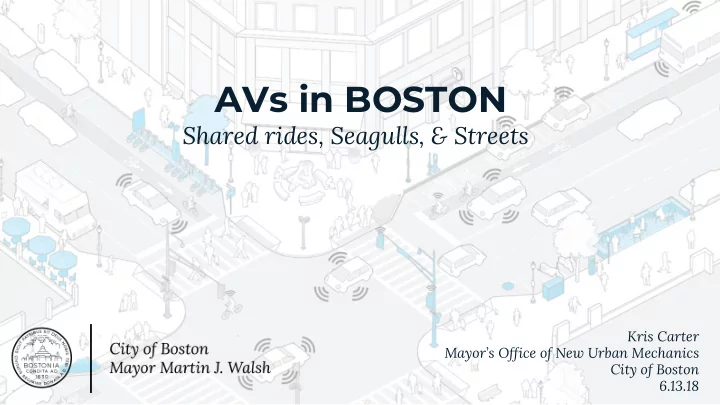
SLIDE 1 AVs in BOSTON
Shared rides, Seagulls, & Streets
Kris Carter Mayor’s Office of New Urban Mechanics City of Boston 6.13.18
SLIDE 2 1
What is motivating Boston?
2
What do our testing efforts look like?
3
What is happening beyond testing?
4
What have we learned so far?
SLIDE 3
SLIDE 4
SLIDE 5 source: Boston Globe
SLIDE 6 Source: Brookings Institute Graphic by Huntington News
SLIDE 7
GoBoston 2030 Goals
SLIDE 8 14 4,537 SAFETY
Source: 2017 Boston Vision Zero
SLIDE 9
BETTER ACCESS
24% of Mattapan residents have a commute over 60 minutes The average commute in Boston is 28 minutes
SLIDE 10 MORE RELIABLE
Source: MBTA Snow Map, Sara Morrison
(Unofficial Winter 2015 Snow Map)
SLIDE 11 ENSURE EQUITY
Source: Boston Globe
SLIDE 12
If you’re not at the table, you’re on the menu
SLIDE 13
“...that our expected preferred deployment will be fleets of autonomous vehicles that are electric and shared...ensure equitable access to opportunity for those least well served by transportation options today, including seniors, youth, and those with physical disabilities.”
SLIDE 14 Our Five Areas of Research
1
AV Testing
2
Business Models
3
Street Design & Infrastructure
4
Workforce
5
Governance
SLIDE 15 What Have We Been Doing?
Technology Testing Formed Research Partnerships Set Policy Priorities
SLIDE 16 Governance
Testing Plans MOU Executive Order(s)
All Documents Available at Boston.gov/Boston-AV
SLIDE 17
Testing: 1,000 Acre Innovation District
SLIDE 18
Testing: 1,000 Acre Innovation District
SLIDE 19 Three Partners
nuTonomy
aptiv (delphi)
SLIDE 20 Testing: 1,000 Acre Innovation District
A B A B
SLIDE 21
Testing: Learning by Doing
SLIDE 22 Getting AV- Ready: Digitizing our curbs
Prototype Completed to date:
- 37.9 linear miles of curb
- 9,372 assets
SLIDE 23
Socializing: The AV Petting Zoo
SLIDE 24 Research: Citizen Behaviors
source: World Economic Forum & BCG analysis, 2018
SLIDE 25 Situations along four criteria
1 Trip reason
- 3. Weather
- 4. Time of day
Commute to work alone Family trip to the zoo Night out with friends
Use case examples
source: World Economic Forum & BCG analysis, 2018
SLIDE 26 Autonomous shared taxi Autonomous minibus Taxi/ ride sharing Autonomous taxi
Mobility on demand
Commuter rail Bus/ Subway
Mass Transit Personal car
Autonomous personal car Personal car
source: World Economic Forum & BCG analysis, 2018
SLIDE 27 ⅓ of trips will be through mobility on-demand service (mostly shifted from private vehicles)
source: World Economic Forum & BCG analysis, 2018
SLIDE 28 34%
+9%
38% 29%
20-40 min <20 min >40 min
The shorter the trip, the higher the AV adoption
source: World Economic Forum & BCG analysis, 2018
SLIDE 29 AV adoption is correlated to income levels.
$100–$149K Seaport and South Boston 53 26 $50–$74K Dorchester % AV adoption Median income
source: World Economic Forum & BCG analysis, 2018
SLIDE 30 Results from agent-based trip model for City of Boston
source: World Economic Forum & BCG analysis, 2018
SLIDE 31 We shape our buildings; thereafter they shape us.
SLIDE 32 We shape our buildings; thereafter they shape us.
Streets
SLIDE 33 source: World Economic Forum; BCG analysis, August 2016
44% of people said the number one reason for having a self-driving car is to not have to park.
SLIDE 34
shared trips = fewer cars = more space for people
SLIDE 35
Best practices for launching an AV pilot
Develop clear a mobility vision Balance stakeholder interests in approval process Create a tiered testing plan with achievement milestones Build trust between stakeholders Share updates on testing progress with residents regularly to build awareness
SLIDE 36 Thank you
@Kris_W_Carter Kristopher.Carter@Boston.gov Boston.gov/Boston-av