Avoiding "Crummey Power" Mistakes in Drafting Trust - - PowerPoint PPT Presentation

avoiding quot crummey power quot mistakes in drafting
SMART_READER_LITE
LIVE PREVIEW

Avoiding "Crummey Power" Mistakes in Drafting Trust - - PowerPoint PPT Presentation

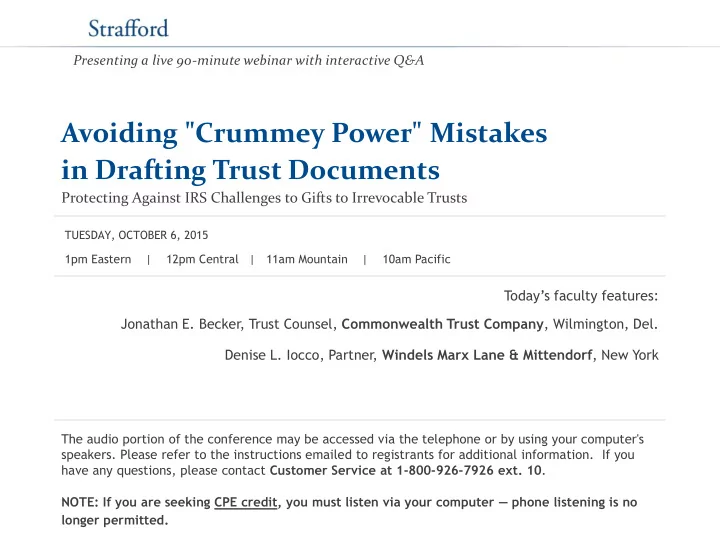
Presenting a live 90-minute webinar with interactive Q&A Avoiding "Crummey Power" Mistakes in Drafting Trust Documents Protecting Against IRS Challenges to Gifts to Irrevocable Trusts TUESDAY, OCTOBER 6, 2015 1pm Eastern |


slide-1
SLIDE 1

The audio portion of the conference may be accessed via the telephone or by using your computer's

  • speakers. Please refer to the instructions emailed to registrants for additional information. If you

have any questions, please contact Customer Service at 1-800-926-7926 ext. 10. NOTE: If you are seeking CPE credit, you must listen via your computer — phone listening is no longer permitted.

Avoiding "Crummey Power" Mistakes in Drafting Trust Documents

Protecting Against IRS Challenges to Gifts to Irrevocable Trusts

Today’s faculty features:

1pm Eastern | 12pm Central | 11am Mountain | 10am Pacific TUESDAY, OCTOBER 6, 2015

Presenting a live 90-minute webinar with interactive Q&A Jonathan E. Becker , Trust Counsel, Commonwealth Trust Company, Wilmington, Del. Denise L. Iocco, Partner, Windels Marx Lane & Mittendorf, New York

slide-2
SLIDE 2

Tips for Optimal Quality

Sound Quality If you are listening via your computer speakers, please note that the quality

  • f your sound will vary depending on the speed and quality of your internet connection.

If the sound quality is not satisfactory, you may listen via the phone: dial

1-866-328-9525 and enter your PIN when prompted. Otherwise, please

send us a chat or e-mail sound@straffordpub.com immediately so we can address the problem. If you dialed in and have any difficulties during the call, press *0 for assistance. NOTE: If you are seeking CPE credit, you must listen via your computer — phone listening is no longer permitted. Viewing Quality To maximize your screen, press the F11 key on your keyboard. To exit full screen, press the F11 key again.

FOR LIVE EVENT ONLY

slide-3
SLIDE 3

Continuing Education Credits

In order for us to process your continuing education credit, you must confirm your participation in this webinar by completing and submitting the Attendance Affirmation/Evaluation after the webinar. A link to the Attendance Affirmation/Evaluation will be in the thank you email that you will receive immediately following the program. For CPE credits, attendees must participate until the end of the Q&A session and respond to five prompts during the program plus a single verification code. In addition, you must confirm your participation by completing and submitting an Attendance Affirmation/Evaluation after the webinar and include the final verification code on the Affirmation of Attendance portion of the form. For additional information about continuing education, call us at 1-800-926-7926 ext. 35.

FOR LIVE EVENT ONLY

slide-4
SLIDE 4

AVOIDING “CRUMMEY POWER” MISTAKES IN TRUST INSTRUMENTS

Denise L. Iocco, Esq. Windels Marx Lane & Mittendorf, LLP

OCTOBER 6, 2015

slide-5
SLIDE 5

Setting the Stage for the Use of Crummey Powers

5

slide-6
SLIDE 6

Gift Tax Annual Exclusion

A donor can make gifts to any donee within one calendar year up to $14,000 (as adjusted for inflation each year) without the gift being a taxable transfer for federal gift tax purposes under the Internal Revenue Code (“IRC”).

  • Commonly called the “Annual Exclusion”
  • IRC §2503(b) provides for the Annual Exclusion
  • The number of donees to whom an Annual

Exclusion gift can be made is unlimited

6

slide-7
SLIDE 7

The Exact Language of §2503(b)

IRC §2503(b)(1) provides in relevant part:

  • In the case of gifts (other than gifts of future

interests in property) made to any person by the donor during the calendar year [currently the first $14,000] of such gifts to such person shall not, for purposes of subsection (a) [of §2503 which defines a taxable gift], be included in the total amount of gifts made during such year.

  • Treas. Reg. §25.2503-3(b) defines a present

interest in property as:

  • An unrestricted right to the immediate use,

possession, or enjoyment of property or the income from property.

7

slide-8
SLIDE 8

§2503(b) and Gifts to Irrevocable Trusts

  • §2503(b) and the related regulations specifically

provide that gifts of future interests do not qualify for the Annual Exclusion

  • A gift to an irrevocable trust is generally

considered a gift to the beneficiaries of the trust (and not trustees) who hold only a future interest in the property contributed to the trust. (Helvering v. Hutchings, 312 U.S. 393 (1941); Estate of W.W. Fondren v. Commissioner, 1 T.C. 1036 (1943))

  • As a result, gifts to irrevocable trusts generally

do not qualify for the Annual Exclusion

8

slide-9
SLIDE 9

Withdrawal Powers Over Trust Principal

  • Granting a beneficiary the right to withdraw the trust

principal creates a present interest in the amount subject to the withdrawal for the purposes of §2503(b)

– Creating a present interest in trust principal with a withdrawal power has been sanctioned by Courts in a number of cases dating to the 1950s (e.g., Kieckhefer v. Comm’r, 189 F.2d 118 (7th Circ. 1951)) – However, the power to withdraw in those cases was over the entire principal of the trust and was exercisable by the beneficiary at any time

  • There are obvious downsides to allowing a trust

beneficiary to withdraw trust principal in any amount and at any time

9

slide-10
SLIDE 10

The History of Crummey Powers

10

slide-11
SLIDE 11

How Crummey Powers Got Their Name

  • Crummey v. Commissioner, 397 F.2d 82 (9th Cir.

1968)

  • In this case, the Grantor gave adults and minor

beneficiaries withdrawal rights limited to the amount of the Annual Exclusion available for each beneficiary and provided that the withdrawal right would lapse if not exercised by the end of each year

  • The IRS challenged each withdrawal right given to a

minor beneficiary because no legal guardian had been appointed for any of the minor beneficiaries who could immediately exercise the right on behalf

  • f the minor beneficiary

11

slide-12
SLIDE 12

The Result in Crummey

  • The Court sided with the taxpayer and held that

all the powers granted in the trust at issue, including those to minors, created a present interest qualifying for the Annual Exclusion

  • The Court concluded that “as a technical matter”

a minor could make a demand to exercise his withdrawal right under the trust and that was enough to create a present interest sufficient for qualifying for the annual exclusion even though the Court “think[s] it unlikely that any demand ever would have been made”

12

slide-13
SLIDE 13

Summary of a Crummey Power

  • A Crummey Power is:

– A presently exercisable withdrawal power over principal granted to a beneficiary in the trust instrument – Limited in amount, usually limited to the amount

  • f the Annual Exclusion

– Only exercisable for a limited period of time, usually 30-60 days after the contribution to the trust giving rise to the power – Lapsing if not exercised (more on this to come)

13

slide-14
SLIDE 14

Pushing the Envelope - Cristofani

  • In Cristofani v. Comm’r, (97 T.C. 74 (1991)), the Trust at issue

granted Crummey Powers to the grantor’s two children and five grandchildren

  • The two children were income beneficiaries of the Trust and

the presumptive remaindermen

  • The five grandchildren were contingent remaindermen and
  • nly received a benefit from the Trust (other than by

exercising their Crummey Power) if their parent predeceased them

  • The parties stipulated that there was no agreement or

understanding between the grantor and the beneficiaries that the beneficiaries would refrain from exercising their Crummey Powers

14

slide-15
SLIDE 15

The IRS’ Challenge in Cristofani

  • The IRS argued that the Crummey Powers granted

to the grandchildren, whose only other interest in the trust was as contingent remaindermen, were not proper present interests for purposes of the Annual Exclusion because:

– The grandchildren’s interest was so remote that the grantor did not intend to benefit them – There was only a small chance that they would actually exercise the Crummey Powers granted to them

15

slide-16
SLIDE 16

The IRS Loses in Cristofani

  • The IRS lost on both parts of its challenge
  • The Court held that the grantor did intend to confer some

benefits on the grandchildren by including them in the Trust as contingent remaindermen and that holders of Crummey Powers do not need “a vested present interest or vested remainder interest in the corpus in order to qualify for the section 2503(b) exclusion” I.C. Supra, at 83

  • The Court followed the holding in the Crummey case that the

proper test is whether the holder of the Crummey Power has a legal right to withdraw corpus that the trustee cannot legally resist

16

slide-17
SLIDE 17

IRS’ Response to Cristofani

  • The IRS issued an Action on Decision disagreeing with

the holding in Cristofani (AOD 1992-09) and vowing to continue to litigate cases such as Cristofani, “preferably out of the Ninth Circuit”

  • In 1996, the IRS issued another Action on Decision

relating to Cristofani (AOD 1996-010) vowing to “deny the exclusions for the Crummey powers, regardless of the powerholders’ other interests in the trust, where the withdrawal rights are not in substance what they purport to be in form,” especially when there is a “prearranged understanding that the withdrawal rights would not be exercised

17

slide-18
SLIDE 18

Here We Go Again

  • In Kohlsaat v. Comm’r, 73 T.C.M. 2732 (1997), the

Trust at issue granted Crummey Powers to the grantor’s two children, seven grandchildren, eight great-grandchildren and a daughter-in-law, none of which were ever exercised

  • The income and principal of the trust were only

available to the grantor’s two children, and the 16

  • ther powerholders were only contingent

beneficiaries

  • The IRS disallowed the Annual Exclusion for each of

the 16 contingent remainder beneficiaries, arguing that the fact that none of the 16 remainder beneficiaries exercised their Crummey Powers shows an implied agreement not to do so

18

slide-19
SLIDE 19

Holding in Kohlsaat

  • The Court sided with the taxpayer and “refuse[d] to

infer any understanding” that there was a prearrangement for the beneficiaries to not exercise the Crummey Powers from the mere fact that they were not exercised

19

slide-20
SLIDE 20

The IRS is Still at It

  • The IRS has challenged Crummey Powers as recently as a

few months ago

  • In Mikel v. Commissioner, T.C. Memo 2015-64, a husband

and wife each claimed 60 annual exclusions for transfers to a trust they established for transfers made during 2007 for a total of $1,440,000 of Annual Exclusions

  • The Trust had 60 beneficiaries composed of the grantors’

lineal descendants and their spouses

  • The Trustee was permitted to make distributions of

income and principal to any of the 60 beneficiaries

  • The Trust provided for mandatory arbitration before a

“panel consisting of three persons of the Orthodox Jewish faith” (a beth din) and included an “in terrorem” clause that revoked the interest of any beneficiary who contested any distribution made by the Trustee

20

slide-21
SLIDE 21

The IRS’ Challenge in Mikel

  • The IRS argued that requiring arbitration of a

dispute regarding the Trust at a beth din did not provide an adequate legal remedy such that the powerholder’s withdrawal right was “legally enforceable”

  • The IRS further argued that the “in terrorem”

clause would cause the powerholder to be so reluctant to challenge the Trustee if he refused to honor a Crummey Power that the beneficiary did not have a “legally enforceable right” in any meaningful sense

21

slide-22
SLIDE 22

The Result in Mikel

  • The Court rejected the IRS’ argument that the

provision for arbitration before the beth din failed to give the beneficiary a legal method to enforce the Crummey Power for two reasons:

– There was no reason to think the beth din would fail to uphold the right – The IRS stipulated that after arbitration the beneficiary would still have to resort to state courts

  • The Court also interpreted the in terrorem

clause to apply only to a beneficiary’s challenge to distributions from the trust and not exercises

  • f a beneficiary’s Crummey Power

22

slide-23
SLIDE 23

There is Continued Disfavor of the Use of Crummey Powers

  • As we have seen, the courts have upheld the use of

Crummey Powers, however, both Congress and the Obama Administration have been critical of them

  • In December 2014, the Joint Committee on Taxation

(composed of members of the House and Senate) issued a recommendation that the present interest requirement for the Annual Exclusion be abolished to render Crummey Powers unnecessary while creating a new $50,000 exemption per donor, per year for transfers to trusts

  • The 2016 General Explanation of the Administration’s

Fiscal Year 2016 Revenue Proposals (the 2016 “Greenbook”) endorses this plan as well

23

slide-24
SLIDE 24

Drafting Tips

24

slide-25
SLIDE 25

Drafting Tips

  • The Mikel Court opined that the in terrorem

provision at issue in that case was “not a paragon of draftsmanship”

  • We hope that the drafting tips offered in this

presentation will help you avoid such criticism regarding your Crummey withdrawal provisions

25

slide-26
SLIDE 26

Drafting Tip #1: Make Sure the Crummey Power is Legally Enforceable

  • As we have just seen, the crux of the

Crummey Power is that it is legally enforceable and the Trustee “cannot legally resist” the powerholder’s demand

  • Make sure the Crummey Power is

coordinated with the other provisions of the trust (e.g., the spendthrift clause) so that the Trustee does not have the authority to defeat an exercise of the power

26

slide-27
SLIDE 27

More on Legal Enforceability

  • A key fact in each of the cases just discussed was

that the IRS could not show that the donor had prearranged with the donee not to exercise the Crummey Power

  • If such an arrangement exists, the IRS can argue that

the Crummey Power has no economic substance and thus fails to create a present interest

  • The IRS has had some success with this argument in

court (e.g., Trotter v. U.S., T.C. Memo 2001-250)

27

slide-28
SLIDE 28

Facts of Trotter v. U.S.

  • In Trotter, the taxpayer transferred a condominium to a

Trust with her daughter as Trustee, but then continued to live in the condo rent-free and paid the expenses associated with the condo until her death

  • The Trust authorized distributions of income and

principal for the benefit of the taxpayer’s five grandchildren and upon the taxpayer’s death the Trust terminated and paid over to the grandchildren

  • Each of the five grandchildren held Crummey Powers

but did not exercise them

  • The IRS argued that the condo should have been

included in the taxpayer’s gross estate for estate tax purposes

28

slide-29
SLIDE 29

Holding in Trotter v. U.S.

  • The Tax Court agreed with the IRS that the

condominium constituted part of the taxpayer’s gross estate under §2036(a)(1)

  • The Court held that because the taxpayer continued to

live in the condo rent-free and paid all expenses associated with it there was an implied understanding with her daughter (the Trustee) and the holders of the Crummey Powers (her grandchildren) that they would allow her use and enjoyment of the condo after it was transferred to the Trust, thus causing estate inclusion under §2036(a)(1)

  • The Court extended this reasoning to the Crummey

Powers and held that they were a mere “paper formality without economic substance”

29

slide-30
SLIDE 30

Drafting Tip #2: Limit Withdrawal Period (But Not Too Drastically)

  • One of the most attractive features of a Crummey Power is that

the powerholder only has a small window of time in which the power can be exercised (the “Withdrawal Period”)

  • If the Withdrawal Period is too short, the IRS may argue that the

powerholder does not have a meaningful opportunity to exercise the Crummey Power (see generally, Rev. Rul. 81-7, 1981-1 C.B. 474) and thus the Crummey Power is illusory and should be disallowed

  • The following withdrawal periods have been allowed:

– 60 days (Treas. Reg. 26.2612-1(f), Ex. 3) – 45 days (Rev. Rul. 83-108, 1983-2 C.B. 167 (1983)) – 30 days (Kohlsaat, Mikel) – 15 days (Cristofani)

  • Practitioners often draft a Withdrawal Period of 30 days or more

30

slide-31
SLIDE 31

Drafting Tip #3: Avoid Naked Crummey Powers When Possible

  • Despite its lack of success to date, the IRS has

stated it will continue to challenge Crummey Powers given to persons with little or no other interest in the trust

  • Accordingly, it is recommended that naked

Crummey Powers be avoided, or at least used with caution

31

  • Giving a Crummey power to

someone with little or no

  • ther interest in the trust has

been referred to as a “naked power”

slide-32
SLIDE 32

Drafting Tip #4: Consider Creating Tiers of Beneficiaries

  • The IRS has repeatedly indicated that it

accepts Crummey Powers given to beneficiaries holding present interests in a trust

  • Because those beneficiaries are less likely to

have their Crummey Powers disallowed, one technique is to give them the right to exercise their Crummey Powers by giving more remote beneficiaries powers only when needed to qualify any excess amount of gifts to the trust for the Annual Exclusion

32

slide-33
SLIDE 33

Drafting Tip #4: Example

  • A donor creates a trust that provides as follows:

– Grantor’s children are current income beneficiaries – Grantor’s grandchildren are remaindermen upon death of grantor – Grantor’s nieces and nephews are contingent remaindermen if none of Grantor’s grandchildren survive him

  • Give Crummey Powers to Grantor’s children first, and

to the extent the gifts to a trust in a calendar year exceed the amount of those powers, Crummey Powers are granted to the grandchildren, and then similarly to the Grantor’s nieces and nephews, if necessary

33

slide-34
SLIDE 34

Drafting Tip #5: Give Donor Right to Alter Withdrawal Rights

  • Provide that in the instrument of transfer the

donor can exclude a powerholder from any withdrawal right with regard to that contribution

  • This technique gives an extra measure of

control to the donor and allows the donor to exclude beneficiaries disfavored by the IRS (such as remote contingent beneficiaries) if not needed in order to reduce the likelihood

  • f a challenge by the IRS

34

slide-35
SLIDE 35

Drafting Tip #5: Sample Language

  • Notwithstanding said withdrawal rights, the withdrawal rights of any

powerholder (as said term is defined below) may be altered by a “Contribution Instrument” as defined below.

  • A Contribution Instrument shall be a notarized statement made by the Grantor or
  • ther person contributing property to such trust, as the case may be. The

Contribution Instrument must be delivered to the Trustees simultaneously with the contribution of property to such trust. The Contribution Instrument shall affect only that particular contribution to such trust and any future contributions by the same donor to such trust in the following way. The Contribution Instrument may (a) deny a powerholder the right to withdraw with respect to such transfer(s); (b) increase or decrease the amount that a powerholder can withdraw with respect to such transfer(s); (c) increase or decrease the categories

  • f persons or fiduciaries who are authorized to exercise a withdrawal right with

respect to such transfer(s) on behalf of a beneficiary under a disability; and (d) make the Contribution Instrument applicable to future transfers by the same donor for a specified period or for an indefinite period lasting until said donor delivers to the Trustees written notice to the contrary. Subject to any Contribution Instrument, the powerholders shall have the withdrawal rights described below in this article.

35

slide-36
SLIDE 36

Gift Splitting with Crummey Powers

36

slide-37
SLIDE 37

Gift Splitting by Spouses to Leverage Use of Crummey Withdrawal Rights

Introduction to IRC §2513: Donor may treat a gift as made one-half by his or her spouse1, thereby permitting gifts of double the Annual Exclusion Amount Ex: A wife makes a gift of $28,000 to her mother in 2015. Her husband consents to “split” (IRC §2513) the gift and thereby is considered to make a gift of $14,000 to his mother-in-law

37

I guess we’re not mad anymore!

slide-38
SLIDE 38

What are the Basic Rules for “Splitting” a Gift Between Spouses Under IRC §2513 ?

  • The gifts must be made during the marriage
  • Both spouses must consent to split gifts and a return

must be filed

  • Each spouse must be a United States citizen or

resident at the time that the gift is made

38

slide-39
SLIDE 39

Gift By Husband or Wife To Third Party Considered To Be Made One-Half By Each

  • When electing to split gifts, the non-donor spouse

will generally be considered, for gift tax purposes, to be a transferor as to one-half of each gift that is subject to gift splitting

  • See generally, IRC §2513, Treas. Regulation

§25.2513-1, and PLR 200130030

39

slide-40
SLIDE 40

Mechanics of Splitting Gifts

  • Each spouse must consent on the other spouse’s gift tax return if

both spouses are required to file, or the non-donor spouse must consent on the donor spouse’s return if only one spouse is required to file because in that year no gifts to third parties exceed $28,000 and all gifts are gifts of present interest

  • If an election is made to split gifts, it automatically applies to all

gifts made by either spouse to a third party during the calendar year

40

slide-41
SLIDE 41

Combining Gift Splitting with Crummey Withdrawal Rights

  • Gift splitting in connection with Crummey withdrawal

rights permits the donor to make annual exclusion gifts to the trust that are twice the amount of the donor’s available annual exclusion gift

  • Of course, the Crummey Power in the trust instrument

must be drafted to provide for a withdrawal right up to the combined Annual Exclusion amounts of the donor and his or her spouse

41

slide-42
SLIDE 42

Drafting Tip #6: Reference Both IRC § 2503(b) and § 2513 in Provision Granting Crummey Power

  • Example of such a provision:
  • The amount of withdrawal is the amount that will

qualify for any gift tax exclusions or any exclusions with respect to such [powerholder] by [such] transferor and [such] transferor’s spouse during such calendar year under 2503(b) of the Code (after allowing for prior gifts during such year). For purposes of determining an amount pursuant to this paragraph, a transferor’s spouse shall be deemed to split all gifts with such transferor pursuant to Section 2513 of the Code regardless of whether any consent to split gifts is later effectuated

42

slide-43
SLIDE 43

Two Rules that Complicate the Use of Gift Splitting in Connection with Crummey Powers

1. IRC § 2513 and the related regulations provide that a donor’s spouse cannot split a gift to himself or herself 2. A donor’s spouse cannot split a gift if the value of the donee spouse’s interest in the gift is not ascertainable, or severable, at the time of the gift

  • Therefore, if a donee spouse has a beneficial interest in a trust, gift

splitting can be problematic; however, the election to split gifts for such a trust is effective under the following circumstance: “…if the interest transferred to third parties…is ascertainable at the time

  • f the gift and hence severable from the interest transferred to the donee

spouse” (Treas. Reg. 25.2513- 1(b)(4))

43

slide-44
SLIDE 44

Illustration - Gift Cannot Be Split

  • The Donor spouse creates a trust (containing no Crummey Powers) that

is a pot trust for the benefit of the Donor’s husband and children with no ascertainable standard (e.g., health, education, support or maintenance) for distributions of income or principal to the beneficiaries.

  • The Donor then makes a gift in the amount of $100,000 to this trust
  • Can the Donor’s husband split the gift under the rules just discussed?
  • NO, because the Donor’s husband’s interest in the trust is not severable

from the interest of the other beneficiaries of the trust, i.e., the children (See Treas. Reg. 25.2513 1(b) (4))

44

slide-45
SLIDE 45

Illustration – Gift Can Be Split

  • When a spouse has a Crummey Power limited to a specific

amount, the interest of such spouse would be ascertainable and severable from other gifts

  • This result has not been clearly defined in reliable authority,

but has been the general consensus among practitioners

  • See generally, Wang v. Commissioner, TC Memo 1972-143;

PLR 200616022

45

slide-46
SLIDE 46

Drafting Tip #7: Do Not Condition Amount of Crummey Withdrawal Right on Spouse’s Election to Split Gifts

  • Recall that a gift splitting election is made on

a gift tax return to be filed on April 15 of the following year (not counting extensions)

  • If the amount of a Crummey Power is made

contingent upon whether the donor’s spouse splits gifts (which will happen months after the gift is made), it will not be ascertainable at the time of the gift and gift splitting will not be allowed

46

slide-47
SLIDE 47

More on Gift and Estate Taxation of Crummey Powers

47

slide-48
SLIDE 48

Gift and Estate Tax Effects of the Lapse of a Crummey Power

  • The powerholder’s withdrawal right is

considered a general power of appointment for gift and estate tax purposes (IRC §2514 and §2041)

  • The lapse of a Crummey Power is considered a

release of a general power (IRC §2514(e))

  • A release of a general power of appointment is

deemed a transfer of property by the releasor (IRC §2514(b))

48

slide-49
SLIDE 49

Non-Exercise of Crummey Withdrawal Rights

  • With one major exception, the lapse of a Crummey Power is

considered a transfer of property to the trust by the powerholder

  • If the entire amount of a powerholder’s withdrawal right is

allowed to lapse every year, the powerholder is in the same position as the donor would be by making the annual contribution to the trust without a Crummey power (again, with one exception)

  • There is a common drafting technique used to prevent the entire

amount subject to withdrawal from being deemed a transfer of property to the trust by the powerholder

  • This technique involves the utilization of the exception to the rule

regarding the release of general power of appointment provided in IRC § 2514(e)

49

slide-50
SLIDE 50

“5 or 5” Rule

  • The annual lapse of an individual’s general powers of

appointment is not treated as a release (and therefore is ignored for estate and gift tax purposes) to the extent of (i) $5,000 or (ii) 5% of the aggregate value of the assets subject to the general powers, whichever is greater

  • IRC §2514(e)(1)and(2)
  • This is known as the “5 or 5” amount

50

Warning! We will now embark

  • n the roller coaster ride of

“hanging” Crummey Powers!

slide-51
SLIDE 51

The Issue “Hanging” Attempts to Address

  • The “5 or 5” amount has never been

indexed for inflation

  • The Annual Exclusion Amount was once

$3,000, then was $10,000, and is now indexed for inflation to $14,000 in 2015

51

slide-52
SLIDE 52

“Hanging” Crummey Powers

  • A powerholder will become a transferor for gift tax

purposes if his or her power is allowed to lapse in excess of the “5 or 5” amount in any year

  • The “hanging” power technique provides that the

power lapses only to the extent of the “5 or 5” amount each year and the remaining amount of the power “hangs” over and continues to be exercisable by the powerholder

  • The purpose of a hanging power is to postpone the

lapse of the power until another “5 or 5” amount is available to reduce the amount of the lapse and thus reduce the adverse gift tax (and income tax) consequences of the lapse

52

slide-53
SLIDE 53

Three Important Notes Regarding “Hanging” Crummey Powers

  • An individual is allowed only one release of general

powers of appointment up to the “5 or 5” amount in any calendar year for the total amount of the combined value of the powers

  • If a beneficiary dies holding hanging Crummey

Powers, the aggregate amount of those powers are includible in the powerholder’s gross estate for estate tax purposes because the hanging powers are general powers of appointment

  • Consider whether the inclusion of the value of

hanging Crummey Powers in a powerholder’s estate will have GST tax consequences

53

slide-54
SLIDE 54

Drafting Tip #8: Always Provide for Terms

  • f Lapse of Crummey Power
  • A Crummey Power provision should always include a

definite period for the exercise of the power and the hanging power technique should be considered

  • If using the hanging power technique, the powerholder

should not decline to exercise a Crummey Power because the power may not be considered to “hang”

  • The lapse provision should not take effect on a specific

date (e.g., December 31) but rather within a set number

  • f days after a gift is made to the trust so that there will

always be an adequate amount of time for the powerholder to exercise the Crummey Power

54

slide-55
SLIDE 55

Drafting Tip #9: Necessary Considerations When Drafting Hanging Powers

  • Provide that current or hanging withdrawal powers

lapse in any year only to the extent of the “5 or 5” amount, and the excess carries over to the following year

  • Do not base the lapse of hanging powers on a

condition subsequent, e.g., do not provide that the power lapses when the lapse will not result in a taxable gift (see TAM 8901004)

  • Reference the “5 or 5” amount provision contained in

IRC §2514 (e)

55

slide-56
SLIDE 56

Drafting Tip #10: Consider Placing Conditions

  • n the Exercise of Hanging Powers
  • Hanging powers can result in a powerholder having

withdrawal rights in substantial amounts

  • In order to prevent a holder of a sizeable hanging

power from making a large withdrawal from the trust at one time, consider conditioning the exercise of a hanging power on the consent of a non-adverse third party such as a trust protector. However, be mindful

  • f grantor trust issues in selecting such party
  • Make sure that the original withdrawal power is not

conditioned in any way or it will not create the necessary present interest

56

slide-57
SLIDE 57

Drafting Tip #11: Limit the Withdrawal Amount

  • f the Crummey Power to the “5 or 5” Amount
  • Given the possibility of unfavorable federal

tax consequences of using the hanging power technique, consider limiting the withdrawal amount of the Crummey Power to the “5 or 5” amount so that the Crummey Power can lapse in full each year without adverse federal gift and estate tax consequences. However, this will not utilize the full Annual Exclusion.

57

slide-58
SLIDE 58

Drafting Tip #12: Consider a Savings Clause

  • “[ ] It is the Grantor’s intention through the provisions of

this Article [ ] to qualify transfers to the trust for the federal gift tax annual exclusion and to minimize the federal gift tax consequences to any powerholder. The provisions of this Article should be construed to achieve these objectives. The Grantor authorizes the Trustee, in its sole and absolute discretion, to amend the provisions of this Article [ ] so as to make transfers to this trust eligible for the annual gift tax exclusion under Section 2503(b) of the Code.”

58

slide-59
SLIDE 59

Drafting Tip #13: Consider Limiting the Withdrawal Amount of A Crummey Power Given to the Donor’s Spouse to the “5 or 5” Amount

  • Consider that a donor’s spouse may be the eldest Crummey

powerholder and less likely than the donor’s descendants to survive the complete lapse of hanging Crummey Powers

  • If a spouse’s withdrawal power is limited to the “5 or 5”

amount, and he or she survives until the power lapses, there will be no inclusion in his or her estate of any portion of the property subject to the power

  • Also consider the spouse’s estate tax inclusion period in

connection with the allocation of his or her GST tax exemption

59

slide-60
SLIDE 60

Income Tax and GST Tax Effects of Crummey Powers

60

slide-61
SLIDE 61

Be Cognizant of the Income Tax Ramifications

  • f Granting Crummey Powers
  • The holder of a Crummey Power may be liable for

income taxes on the portion of a trust over which the power is exercisable under certain circumstances (e.g., IRC § 678(a)(1)), but not all circumstances (e.g., IRC § 678(b))

  • A Powerholder may also be taxed on the portion of a

trust over which the power was held even after the lapse of the power depending on the other rights given to the beneficiary by the trust instrument (see generally, IRC § 678(a)(2))

  • Consider “Grantor Trust” rules found in IRC § 671-678

where original grantor is deemed owner of income and trust principal

61

slide-62
SLIDE 62

Generation-Skipping Transfer Tax Basics

  • The federal generation-skipping transfer (GST) tax is a

separate tax in addition to the federal gift and estate taxes (See Chapter 13 of the IRC)

  • The GST tax is imposed on transfers that “skip” a

generation (i.e., to a person 2 or more generations below the donor)

  • Example: A grandmother makes a gift to her

grandchild when the child’s parent who is the grandmother’s child is living; the grandchild is a “skip person”

  • An outright gift to a skip person in the amount of the

Annual Exclusion is not subject to GST tax (IRC §2642(c))

62

slide-63
SLIDE 63

Be Cognizant of the GST Tax Ramifications of Granting Crummey Powers

  • If a gift to a skip person is made in trust, using a

Crummey Power to qualify the gift for the Annual Exclusion for gift tax purposes will not exclude the gift for purposes of the GST tax unless the terms of the trust meet the following requirements (IRC §2642(c)):

– Income and principal can be distributed or used only for the benefit of the skip person powerholder – The trust assets must be distributed to the powerholder or includible in his or her gross estate

  • Jonathan will discuss GST issues in more detail

63

slide-64
SLIDE 64

Additional Thoughts on Crummey Powers

64

slide-65
SLIDE 65

Common Uses of Crummey Powers

  • Irrevocable Life Insurance Trusts
  • Trusts designed only to hold annual exclusion

gifts (other than 2503(c) trusts which qualify for the Annual Exclusion without Crummey Powers)

  • Other trusts where the Annual Exclusion

would be helpful from a transfer tax perspective

65

slide-66
SLIDE 66

Drafting Tip #14: Be Cognizant of Other Gifts from Donor to Holder of Crummey Power

  • The Annual Exclusion is applied to the first

gifts made in any year from the donor to any person, including a holder of a Crummey Power

– Subsequent gifts in excess of the Annual Exclusion will be subject to gift tax

66

slide-67
SLIDE 67

Drafting Tip #15: Authorizing Crummey Powers to Be Satisfied In Kind

  • In order for a Crummey Power to be meaningful,

there must be property available to distribute to the powerholder

  • Therefore, if there is not enough cash on hand

the Trustee should be authorized to distribute property instead

  • One way to avoid this problem is to require the

trustee to hold the contributions to the trust giving rise to the Crummey withdrawal right until after the withdrawal period has ended

67

slide-68
SLIDE 68

AVOIDING “CRUMMEY POWER” MISTAKES IN TRUST INSTRUMENTS

Jonathan E. Becker, J.D., LL.M. Trust Counsel, Commonwealth Trust Company

slide-69
SLIDE 69
  • Statement that a gift was made to the trust for the benefit of the

beneficiary

  • Specify the amount of the gift subject to the demand right
  • Specify the period in which the demand right must be exercised
  • Request that the beneficiary notify the Trustee if, and the extent to

which, the beneficiary wishes to exercise the demand right.

What Must a Crummey Notice Contain?

69

slide-70
SLIDE 70

The Crummey Notice should NOT contain:

  • A waiver of the beneficiary’s right to exercise the demand right; or
  • A waiver of future Crummey Notices with respect to the trust

The Crummey Notice may (and probably should) contain:

  • An attached acknowledgement of notice, and a request that the

beneficiary sign and return such, to provide Trustee with documentation that the notice was received

What Should a Crummey Notice Also Contain or NOT Contain?

70

slide-71
SLIDE 71
  • Must the Crummey Notice be in writing?
  • What is a “reasonable opportunity” to exercise a Crummey demand right?
  • Need I and, if so, how, do I give notice to a minor or incapacitated beneficiary?
  • When does (or should) the exercise period begin?
  • How are late year gifts addressed?
  • Can the exercise period carry over into the next calendar year?
  • Unusual additions – forgiveness of debt, gifts of entity interests, illiquid assets,

and associated drafting considerations

  • What special issues are raised by additions being used for the payment of

insurance premiums?

  • What kind of issues are raised in tracking?

– How should I deliver the notices? – How much can someone actually withdraw (accounting for outside gifts to the Crummey beneficiary by the donor) – Should I get an acknowledgement and refunding agreement if a Crummey demand right is exercised? – What if you are assured by a third party (grantor, attorney) that (non-written) notices have been given to the Crummey beneficiaries?

Common Questions Regarding Crummey Notices

71

slide-72
SLIDE 72
  • Crummey power is a GPOA
  • Crummey power may change (or partially change) the identity of the transferor for GST

purposes; Danger (and added administrative complexity) of having multiple transferors (and waste of original transferor’s GST exemption)

  • Compare 5/5 power (lapsed vs. held at death), hanging power (lapsed vs. held at death)
  • Effect of a testamentary limited power of appointment or a general power of

appointment of hanging amounts in excess of 5/5

  • Issues surrounding Spousal Crummey powers
  • Estate Tax Inclusion Period
  • Difficulty with availability of GST Annual Exclusion

Some GST Matters to Bear in Mind

72

slide-73
SLIDE 73
  • Special Needs provisions and Crummey
  • Provisions allowing the Trustee to withhold distributions on the basis of

substance abuse or similar circumstances

  • Gifts directly from revocable trusts
  • Gifts from incompetent donors and checks from deceased donors
  • Decanting when unlapsed Crummey demand rights exist
  • Advisability of more technologically advanced notice methods
  • Tip on GST allocations and term insurance
  • Participant Questions!

Odds and Ends

73

slide-74
SLIDE 74

Thank You

Jonathan E. Becker Commonwealth Trust Company 29 Bancroft Mills Rd. Wilmington, Del. (302) 658-7214 jbecker@comtrst.com

74

slide-75
SLIDE 75

Wealth Planning Group Windels Marx Lane & Mittendorf, LLP

Denise L. Iocco, Esq. diocco@windelsmarx.com

75

Daniel P. Buckley, Esq. dbuckley@windelsmarx.com

Sharon C. Maguire, Esq.

smaguire@windelsmarx.com

  • Mr. Michael Greubel

Legal Assistant mgreubel@windelsmarx.com