Automorphisms of Divisible Rigid Groups Denis Ovchinnikov - - PowerPoint PPT Presentation

automorphisms of divisible rigid groups
SMART_READER_LITE
LIVE PREVIEW

Automorphisms of Divisible Rigid Groups Denis Ovchinnikov - - PowerPoint PPT Presentation

Contents Introduction Main Results Automorphisms of Divisible Rigid Groups Denis Ovchinnikov Novosibirsk State University, Russia May, 29, 2013 Contents Introduction Main Results Introduction 1 Main Results 2 Contents Introduction


slide-1
SLIDE 1

Contents Introduction Main Results
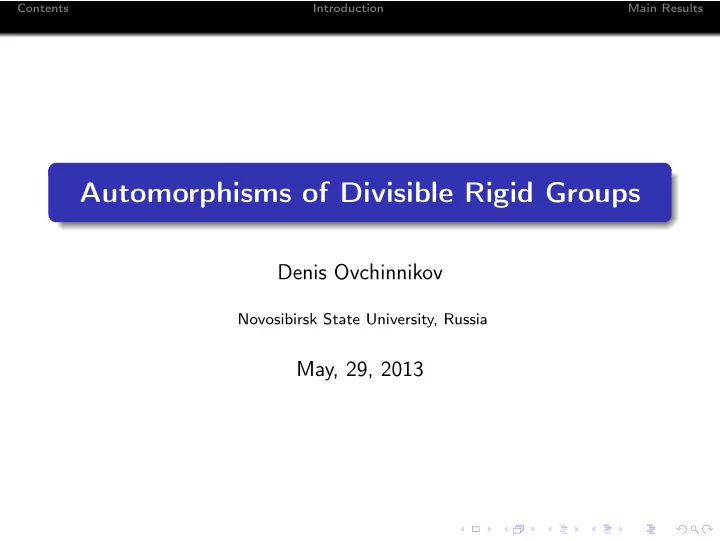
Automorphisms of Divisible Rigid Groups

Denis Ovchinnikov

Novosibirsk State University, Russia

May, 29, 2013

slide-2
SLIDE 2

Contents Introduction Main Results

1

Introduction

2

Main Results

slide-3
SLIDE 3

Contents Introduction Main Results

G ⊲ A, A is abelian. G acts by conjugation: a → ag = g−1ag. G/A acts, A is a right Z[G/A]-module. u = α1g1 + . . . + αngn ∈ Z[G/A], au = (ag1)α1 · . . . · (agn)αn. Definition m-rigid group G: there is a normal series G = G1 > G2 > . . . > Gm > Gm+1 = 1, Gi/Gi+1 are abelian and considering as right Z[G/Gi]-modules have no torsion. Why rigid? - this series is unique. Given group G is solvable of length exactly m.

slide-4
SLIDE 4

Contents Introduction Main Results

G ⊲ A, A is abelian. G acts by conjugation: a → ag = g−1ag. G/A acts, A is a right Z[G/A]-module. u = α1g1 + . . . + αngn ∈ Z[G/A], au = (ag1)α1 · . . . · (agn)αn. Definition m-rigid group G: there is a normal series G = G1 > G2 > . . . > Gm > Gm+1 = 1, Gi/Gi+1 are abelian and considering as right Z[G/Gi]-modules have no torsion. Why rigid? - this series is unique. Given group G is solvable of length exactly m.

slide-5
SLIDE 5

Contents Introduction Main Results

G ⊲ A, A is abelian. G acts by conjugation: a → ag = g−1ag. G/A acts, A is a right Z[G/A]-module. u = α1g1 + . . . + αngn ∈ Z[G/A], au = (ag1)α1 · . . . · (agn)αn. Definition m-rigid group G: there is a normal series G = G1 > G2 > . . . > Gm > Gm+1 = 1, Gi/Gi+1 are abelian and considering as right Z[G/Gi]-modules have no torsion. Why rigid? - this series is unique. Given group G is solvable of length exactly m.

slide-6
SLIDE 6

Contents Introduction Main Results

1) Free solvable group is rigid, rigid series consists of commutator subgroups. 2) W = Am ≀ (Am−1 ≀ (... ≀ A1)...), where Ai are free abelian groups. Subgroups of rigid groups are rigid too: G H, Hi = H ∩ Gi. Corresponding series for H may be shorter. Rigid groups were defined by N.Romanovskiy, he proved that arbitrary rigid group is equationally Noetherian (Equational Noetherianess of rigid solvable groups, Algebra and Logic, 48(2), 2009, pp. 147-160). This result made possible to develope algebraic gemetry over rigid groups. The dimesion theory for rigid groups was constructed by A.Myasnikov ang N.Romanovskiy (Krull dimension

  • f solvable groups, J.Algebra, 324 (10), 2010, pp. 2814-2831).
slide-7
SLIDE 7

Contents Introduction Main Results

1) Free solvable group is rigid, rigid series consists of commutator subgroups. 2) W = Am ≀ (Am−1 ≀ (... ≀ A1)...), where Ai are free abelian groups. Subgroups of rigid groups are rigid too: G H, Hi = H ∩ Gi. Corresponding series for H may be shorter. Rigid groups were defined by N.Romanovskiy, he proved that arbitrary rigid group is equationally Noetherian (Equational Noetherianess of rigid solvable groups, Algebra and Logic, 48(2), 2009, pp. 147-160). This result made possible to develope algebraic gemetry over rigid groups. The dimesion theory for rigid groups was constructed by A.Myasnikov ang N.Romanovskiy (Krull dimension

  • f solvable groups, J.Algebra, 324 (10), 2010, pp. 2814-2831).
slide-8
SLIDE 8

Contents Introduction Main Results

1) Free solvable group is rigid, rigid series consists of commutator subgroups. 2) W = Am ≀ (Am−1 ≀ (... ≀ A1)...), where Ai are free abelian groups. Subgroups of rigid groups are rigid too: G H, Hi = H ∩ Gi. Corresponding series for H may be shorter. Rigid groups were defined by N.Romanovskiy, he proved that arbitrary rigid group is equationally Noetherian (Equational Noetherianess of rigid solvable groups, Algebra and Logic, 48(2), 2009, pp. 147-160). This result made possible to develope algebraic gemetry over rigid groups. The dimesion theory for rigid groups was constructed by A.Myasnikov ang N.Romanovskiy (Krull dimension

  • f solvable groups, J.Algebra, 324 (10), 2010, pp. 2814-2831).
slide-9
SLIDE 9

Contents Introduction Main Results

If G is a solvable torsion free group then the group ring ZG is an Ore domain, so one can consider the Ore skew field of fractions which we denote by Q(G) (follows from P.H.Kropholler, P.A.Linnell and J.A.Moody, Applications of a new K-theoretic theorem to soluble group rings, Proc. Amer. Math. Soc., 104 (1988), 675-684). Definition Rigid group G is called divisible if any factor Gi/Gi+1 is a divisible module over the ring Z[G/Gi], then this factor may be consider as a vector space over skew field of fractions Q(G/Gi).

slide-10
SLIDE 10

Contents Introduction Main Results

If G is a solvable torsion free group then the group ring ZG is an Ore domain, so one can consider the Ore skew field of fractions which we denote by Q(G) (follows from P.H.Kropholler, P.A.Linnell and J.A.Moody, Applications of a new K-theoretic theorem to soluble group rings, Proc. Amer. Math. Soc., 104 (1988), 675-684). Definition Rigid group G is called divisible if any factor Gi/Gi+1 is a divisible module over the ring Z[G/Gi], then this factor may be consider as a vector space over skew field of fractions Q(G/Gi).

slide-11
SLIDE 11

Contents Introduction Main Results

Let α1, . . . , αm be nonzero cardinalities. Construct a group M(α1, . . . , αm) by induction. M(α1) is a direct sum of α1 copies of

  • Q. Take A = M(α1, . . . , αm−1) and let T be a vector space with a

basis of cardinality αm over the skew field Q(A). Then set M(α1, . . . , αm) = (︃A T 1 )︃ . We call such group divisible splittable rigid group because it splits into semidirect product A1A2 . . . Am of abelian groups.

slide-12
SLIDE 12

Contents Introduction Main Results

Arbitrary m-rigid group can be embedded with preserving linear independence into some divisible splittable m-rigid group (see N.S.Romanovskiy, Divisible rigid groups, Algebra and Logic, 47(6), 2008, pp. 426-434). And any divisible rigid group is splittable, so it is isomorphic to some group M(α1, . . . , αm) (see A.Myasnikov, N.S.Romanovskiy, Logical aspects of divisible rigid groups, submitted for publication). A.Myasnikov ang N.Romanovskiy also proved that divisible m-rigid groups are exactly algebraic closed or existential closed objects in the class of all ≤ m-rigid groups and that the elementary theory of any such group is decidable.

slide-13
SLIDE 13

Contents Introduction Main Results

Arbitrary m-rigid group can be embedded with preserving linear independence into some divisible splittable m-rigid group (see N.S.Romanovskiy, Divisible rigid groups, Algebra and Logic, 47(6), 2008, pp. 426-434). And any divisible rigid group is splittable, so it is isomorphic to some group M(α1, . . . , αm) (see A.Myasnikov, N.S.Romanovskiy, Logical aspects of divisible rigid groups, submitted for publication). A.Myasnikov ang N.Romanovskiy also proved that divisible m-rigid groups are exactly algebraic closed or existential closed objects in the class of all ≤ m-rigid groups and that the elementary theory of any such group is decidable.

slide-14
SLIDE 14

Contents Introduction Main Results

We study the group of automorphisms of divisible (splittable) m-rigid group G = M(α1, . . . , αm). For m = 1 : Aut(G) ∼ = GLα1(Q). Suppose m ≥ 2. Fix some splitting A1A2 . . . Am of G into semidirect product of abelian subgroups. Let Qi = Q(A1 . . . Ai) and Φ = {ϕ ∈ Aut(G) | Aiϕ = Ai, i = 1. . . . , m}. Theorem 1 There is a splitting Φ as a semidirect product Φ1Φ2 . . . Φm, where Φi ∼ = GLαi(Qi). We can say that Φ is a general polylinear group.

slide-15
SLIDE 15

Contents Introduction Main Results

We study the group of automorphisms of divisible (splittable) m-rigid group G = M(α1, . . . , αm). For m = 1 : Aut(G) ∼ = GLα1(Q). Suppose m ≥ 2. Fix some splitting A1A2 . . . Am of G into semidirect product of abelian subgroups. Let Qi = Q(A1 . . . Ai) and Φ = {ϕ ∈ Aut(G) | Aiϕ = Ai, i = 1. . . . , m}. Theorem 1 There is a splitting Φ as a semidirect product Φ1Φ2 . . . Φm, where Φi ∼ = GLαi(Qi). We can say that Φ is a general polylinear group.

slide-16
SLIDE 16

Contents Introduction Main Results

We study the group of automorphisms of divisible (splittable) m-rigid group G = M(α1, . . . , αm). For m = 1 : Aut(G) ∼ = GLα1(Q). Suppose m ≥ 2. Fix some splitting A1A2 . . . Am of G into semidirect product of abelian subgroups. Let Qi = Q(A1 . . . Ai) and Φ = {ϕ ∈ Aut(G) | Aiϕ = Ai, i = 1. . . . , m}. Theorem 1 There is a splitting Φ as a semidirect product Φ1Φ2 . . . Φm, where Φi ∼ = GLαi(Qi). We can say that Φ is a general polylinear group.

slide-17
SLIDE 17

Contents Introduction Main Results

We study the group of automorphisms of divisible (splittable) m-rigid group G = M(α1, . . . , αm). For m = 1 : Aut(G) ∼ = GLα1(Q). Suppose m ≥ 2. Fix some splitting A1A2 . . . Am of G into semidirect product of abelian subgroups. Let Qi = Q(A1 . . . Ai) and Φ = {ϕ ∈ Aut(G) | Aiϕ = Ai, i = 1. . . . , m}. Theorem 1 There is a splitting Φ as a semidirect product Φ1Φ2 . . . Φm, where Φi ∼ = GLαi(Qi). We can say that Φ is a general polylinear group.

slide-18
SLIDE 18

Contents Introduction Main Results

As the center of G is trivial we identify Inn(G) with G. Theorem 2 1) The intersection of Φ and G is equal to A1. 2) Aut(G) is a semidirect product of Φ and the normal subgroup A2 . . . Am. Remind that an automorphism of a group is called normal if it preserves all normal subgroups. Theorem 3 The group of all normal automorphisms of G is a semidirect product of the group ⟨ϕ0⟩ of order 2 and Inn(G), where ϕ0 acts trivially on A1 . . . Am−1 and ϕ0 : x → x−1, x ∈ Am.

slide-19
SLIDE 19

Contents Introduction Main Results

As the center of G is trivial we identify Inn(G) with G. Theorem 2 1) The intersection of Φ and G is equal to A1. 2) Aut(G) is a semidirect product of Φ and the normal subgroup A2 . . . Am. Remind that an automorphism of a group is called normal if it preserves all normal subgroups. Theorem 3 The group of all normal automorphisms of G is a semidirect product of the group ⟨ϕ0⟩ of order 2 and Inn(G), where ϕ0 acts trivially on A1 . . . Am−1 and ϕ0 : x → x−1, x ∈ Am.

slide-20
SLIDE 20

Contents Introduction Main Results

As the center of G is trivial we identify Inn(G) with G. Theorem 2 1) The intersection of Φ and G is equal to A1. 2) Aut(G) is a semidirect product of Φ and the normal subgroup A2 . . . Am. Remind that an automorphism of a group is called normal if it preserves all normal subgroups. Theorem 3 The group of all normal automorphisms of G is a semidirect product of the group ⟨ϕ0⟩ of order 2 and Inn(G), where ϕ0 acts trivially on A1 . . . Am−1 and ϕ0 : x → x−1, x ∈ Am.

slide-21
SLIDE 21

Contents Introduction Main Results

As the center of G is trivial we identify Inn(G) with G. Theorem 2 1) The intersection of Φ and G is equal to A1. 2) Aut(G) is a semidirect product of Φ and the normal subgroup A2 . . . Am. Remind that an automorphism of a group is called normal if it preserves all normal subgroups. Theorem 3 The group of all normal automorphisms of G is a semidirect product of the group ⟨ϕ0⟩ of order 2 and Inn(G), where ϕ0 acts trivially on A1 . . . Am−1 and ϕ0 : x → x−1, x ∈ Am.