Fixed subgroups of automorphisms and auto-closures in free-abelian - - PowerPoint PPT Presentation

fixed subgroups of automorphisms and auto closures in
SMART_READER_LITE
LIVE PREVIEW

Fixed subgroups of automorphisms and auto-closures in free-abelian - - PowerPoint PPT Presentation

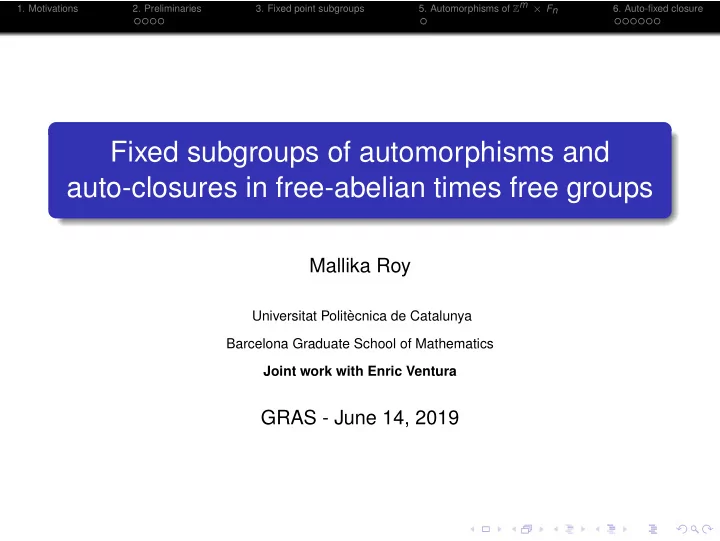
5. Automorphisms of Z m Fn 1. Motivations 2. Preliminaries 3. Fixed point subgroups 6. Auto-fixed closure Fixed subgroups of automorphisms and auto-closures in free-abelian times free groups Mallika Roy Universitat Polit` ecnica de


slide-1
SLIDE 1
  • 1. Motivations
  • 2. Preliminaries
  • 3. Fixed point subgroups
  • 5. Automorphisms of Zm × Fn
  • 6. Auto-fixed closure

Fixed subgroups of automorphisms and auto-closures in free-abelian times free groups

Mallika Roy

Universitat Polit` ecnica de Catalunya Barcelona Graduate School of Mathematics Joint work with Enric Ventura

GRAS - June 14, 2019

slide-2
SLIDE 2
  • 1. Motivations
  • 2. Preliminaries
  • 3. Fixed point subgroups
  • 5. Automorphisms of Zm × Fn
  • 6. Auto-fixed closure

Outline

1

Motivations

2

Preliminaries Periodic subgroup, stabilizer and auto-fixed closure Previous results about fixed subgroups of automorphisms in free groups

3

Fixed point subgroups: Fn and Zm × Fn

4

Finite ordered automorphisms of Zm × Fn Finite ordered automorphisms and periodic points of endomorphisms of Zm × Fn

5

Algorithmic computation of auto-fixed closure of a subgroup of Zm × Fn Our goal and complications Main theorem and Questions

slide-3
SLIDE 3
  • 1. Motivations
  • 2. Preliminaries
  • 3. Fixed point subgroups
  • 5. Automorphisms of Zm × Fn
  • 6. Auto-fixed closure

Outline

1

Motivations

2

Preliminaries Periodic subgroup, stabilizer and auto-fixed closure Previous results about fixed subgroups of automorphisms in free groups

3

Fixed point subgroups: Fn and Zm × Fn

4

Finite ordered automorphisms of Zm × Fn Finite ordered automorphisms and periodic points of endomorphisms of Zm × Fn

5

Algorithmic computation of auto-fixed closure of a subgroup of Zm × Fn Our goal and complications Main theorem and Questions

slide-4
SLIDE 4
  • 1. Motivations
  • 2. Preliminaries
  • 3. Fixed point subgroups
  • 5. Automorphisms of Zm × Fn
  • 6. Auto-fixed closure

Motivations

How the fixed point subgroups of automorphisms look like in Zm × Fn, while for Q ∈ GLm(Z), it is E1(Q) (the eigenspace with respect to the eigenvalue 1) and for free groups, Fn, it is very well studied in the literature. The dual problem of the above, i.e., given a subgroup, decide whether it can be realized as the fixed subgroup of a family of automorphisms and in the affirmative case, compute such a family of automorphisms.

slide-5
SLIDE 5
  • 1. Motivations
  • 2. Preliminaries
  • 3. Fixed point subgroups
  • 5. Automorphisms of Zm × Fn
  • 6. Auto-fixed closure

Motivations

How the fixed point subgroups of automorphisms look like in Zm × Fn, while for Q ∈ GLm(Z), it is E1(Q) (the eigenspace with respect to the eigenvalue 1) and for free groups, Fn, it is very well studied in the literature. The dual problem of the above, i.e., given a subgroup, decide whether it can be realized as the fixed subgroup of a family of automorphisms and in the affirmative case, compute such a family of automorphisms.

slide-6
SLIDE 6
  • 1. Motivations
  • 2. Preliminaries
  • 3. Fixed point subgroups
  • 5. Automorphisms of Zm × Fn
  • 6. Auto-fixed closure

Outline

1

Motivations

2

Preliminaries Periodic subgroup, stabilizer and auto-fixed closure Previous results about fixed subgroups of automorphisms in free groups

3

Fixed point subgroups: Fn and Zm × Fn

4

Finite ordered automorphisms of Zm × Fn Finite ordered automorphisms and periodic points of endomorphisms of Zm × Fn

5

Algorithmic computation of auto-fixed closure of a subgroup of Zm × Fn Our goal and complications Main theorem and Questions

slide-7
SLIDE 7
  • 1. Motivations
  • 2. Preliminaries
  • 3. Fixed point subgroups
  • 5. Automorphisms of Zm × Fn
  • 6. Auto-fixed closure

Periodic subgroup and Stabilizer

Periodic subgroup For an endomorphism of a group G, Ψ ∈ End(G), the periodic subgroup of Ψ is denoted as Per Ψ and Per Ψ = ∪∞

p=1 Fix Ψp.

Stabilizer Let H G. We denote by AutH(G) the subgroup of Aut(G) consisting

  • f all automorphisms of G which fix H pointwise,

AutH(G) = {φ ∈ Aut(G)|H Fix φ}, usually called the (pointwise) stabilizer of H. Similar definition for EndH(G). Clearly, AutH(G) EndH(G).

slide-8
SLIDE 8
  • 1. Motivations
  • 2. Preliminaries
  • 3. Fixed point subgroups
  • 5. Automorphisms of Zm × Fn
  • 6. Auto-fixed closure

Periodic subgroup and Stabilizer

Periodic subgroup For an endomorphism of a group G, Ψ ∈ End(G), the periodic subgroup of Ψ is denoted as Per Ψ and Per Ψ = ∪∞

p=1 Fix Ψp.

Stabilizer Let H G. We denote by AutH(G) the subgroup of Aut(G) consisting

  • f all automorphisms of G which fix H pointwise,

AutH(G) = {φ ∈ Aut(G)|H Fix φ}, usually called the (pointwise) stabilizer of H. Similar definition for EndH(G). Clearly, AutH(G) EndH(G).

slide-9
SLIDE 9
  • 1. Motivations
  • 2. Preliminaries
  • 3. Fixed point subgroups
  • 5. Automorphisms of Zm × Fn
  • 6. Auto-fixed closure

Auto-fixed closure

Auto-fixed closure The auto-closure of H in G, denoted a-ClG(H), is the group a-ClG(H) = Fix(AutH(G)) =

  • φ∈Aut(G)

HFix φ

Fix φ, i.e., the samallest auto-fixed subgroup of G containing H. Similarly, the endo-closure of H in G, is e-ClG(H) = Fix(EndH(G)). H is called auto-fixed if a-ClG(H) = H. Example In Fn = a1, . . . , an, a-ClFn(ai 2) = ai. Note that, as AutH(G) EndH(G), it is obvious that e-ClG(H) a-ClG(H). A subgroup H Zm is endo-fixed ⇔ H is auto-fixed ⇔ H is 1-endo-fixed ⇔ H is 1-auto-fixed ⇔ H ⊕ Zm.

slide-10
SLIDE 10
  • 1. Motivations
  • 2. Preliminaries
  • 3. Fixed point subgroups
  • 5. Automorphisms of Zm × Fn
  • 6. Auto-fixed closure

Auto-fixed closure

Auto-fixed closure The auto-closure of H in G, denoted a-ClG(H), is the group a-ClG(H) = Fix(AutH(G)) =

  • φ∈Aut(G)

HFix φ

Fix φ, i.e., the samallest auto-fixed subgroup of G containing H. Similarly, the endo-closure of H in G, is e-ClG(H) = Fix(EndH(G)). H is called auto-fixed if a-ClG(H) = H. Example In Fn = a1, . . . , an, a-ClFn(ai 2) = ai. Note that, as AutH(G) EndH(G), it is obvious that e-ClG(H) a-ClG(H). A subgroup H Zm is endo-fixed ⇔ H is auto-fixed ⇔ H is 1-endo-fixed ⇔ H is 1-auto-fixed ⇔ H ⊕ Zm.

slide-11
SLIDE 11
  • 1. Motivations
  • 2. Preliminaries
  • 3. Fixed point subgroups
  • 5. Automorphisms of Zm × Fn
  • 6. Auto-fixed closure

Auto-fixed closure

Auto-fixed closure The auto-closure of H in G, denoted a-ClG(H), is the group a-ClG(H) = Fix(AutH(G)) =

  • φ∈Aut(G)

HFix φ

Fix φ, i.e., the samallest auto-fixed subgroup of G containing H. Similarly, the endo-closure of H in G, is e-ClG(H) = Fix(EndH(G)). H is called auto-fixed if a-ClG(H) = H. Example In Fn = a1, . . . , an, a-ClFn(ai 2) = ai. Note that, as AutH(G) EndH(G), it is obvious that e-ClG(H) a-ClG(H). A subgroup H Zm is endo-fixed ⇔ H is auto-fixed ⇔ H is 1-endo-fixed ⇔ H is 1-auto-fixed ⇔ H ⊕ Zm.

slide-12
SLIDE 12
  • 1. Motivations
  • 2. Preliminaries
  • 3. Fixed point subgroups
  • 5. Automorphisms of Zm × Fn
  • 6. Auto-fixed closure

Previous results about fixed subgroups of automorphisms in free groups

Theorem (Bogopolski–Maslakova, ’16 ; Feingh–Handel, ’18) Let φ : Fn → Fn be an automorphism. Then, a free-basis for Fix φ is computable. Theorem (Culler–Imrich–Turner–Stallings, 1984, 1989, 1991) For every φ ∈ End(Fn), we have Per φ = Fix φ(6n−6)!. Theorem (McCool, 1975) Let H fg Fn, given by a finite set of generators. Then the stabilizer, AutH(Fn), of H is also finitely generated (in fact, finitely presented), and a finite set of generators (and relations) is algorithmically computable.

slide-13
SLIDE 13
  • 1. Motivations
  • 2. Preliminaries
  • 3. Fixed point subgroups
  • 5. Automorphisms of Zm × Fn
  • 6. Auto-fixed closure

Previous results about fixed subgroups of automorphisms in free groups

Theorem (Bogopolski–Maslakova, ’16 ; Feingh–Handel, ’18) Let φ : Fn → Fn be an automorphism. Then, a free-basis for Fix φ is computable. Theorem (Culler–Imrich–Turner–Stallings, 1984, 1989, 1991) For every φ ∈ End(Fn), we have Per φ = Fix φ(6n−6)!. Theorem (McCool, 1975) Let H fg Fn, given by a finite set of generators. Then the stabilizer, AutH(Fn), of H is also finitely generated (in fact, finitely presented), and a finite set of generators (and relations) is algorithmically computable.

slide-14
SLIDE 14
  • 1. Motivations
  • 2. Preliminaries
  • 3. Fixed point subgroups
  • 5. Automorphisms of Zm × Fn
  • 6. Auto-fixed closure

Previous results about fixed subgroups of automorphisms in free groups

Theorem (Bogopolski–Maslakova, ’16 ; Feingh–Handel, ’18) Let φ : Fn → Fn be an automorphism. Then, a free-basis for Fix φ is computable. Theorem (Culler–Imrich–Turner–Stallings, 1984, 1989, 1991) For every φ ∈ End(Fn), we have Per φ = Fix φ(6n−6)!. Theorem (McCool, 1975) Let H fg Fn, given by a finite set of generators. Then the stabilizer, AutH(Fn), of H is also finitely generated (in fact, finitely presented), and a finite set of generators (and relations) is algorithmically computable.

slide-15
SLIDE 15
  • 1. Motivations
  • 2. Preliminaries
  • 3. Fixed point subgroups
  • 5. Automorphisms of Zm × Fn
  • 6. Auto-fixed closure

Auto-closure in free groups

Theorem (Ventura, ’11) Let H fg Fn, given by a finite set of generators. Then, a free-basis for the auto-fixed closure a-ClFn(H) of H is algorithmically computable. Corollary (Ventura, ’11) It is algorithmically decidable whether a given H fg Fn is auto-fixed

  • r not.
slide-16
SLIDE 16
  • 1. Motivations
  • 2. Preliminaries
  • 3. Fixed point subgroups
  • 5. Automorphisms of Zm × Fn
  • 6. Auto-fixed closure

Outline

1

Motivations

2

Preliminaries Periodic subgroup, stabilizer and auto-fixed closure Previous results about fixed subgroups of automorphisms in free groups

3

Fixed point subgroups: Fn and Zm × Fn

4

Finite ordered automorphisms of Zm × Fn Finite ordered automorphisms and periodic points of endomorphisms of Zm × Fn

5

Algorithmic computation of auto-fixed closure of a subgroup of Zm × Fn Our goal and complications Main theorem and Questions

slide-17
SLIDE 17
  • 1. Motivations
  • 2. Preliminaries
  • 3. Fixed point subgroups
  • 5. Automorphisms of Zm × Fn
  • 6. Auto-fixed closure

Comparison table

Fn Zm × Fn rk(Fix φ) n ∀φ ∈ End(Fn) NOT always finitely generated. Fix φ ff Fn ∀ finite ordered φ ∈ Aut(Fn) NOT true but bounded rank. Fix φ ff Per φ ∀φ ∈ End(Fn) NOT true in general.

slide-18
SLIDE 18
  • 1. Motivations
  • 2. Preliminaries
  • 3. Fixed point subgroups
  • 5. Automorphisms of Zm × Fn
  • 6. Auto-fixed closure

Outline

1

Motivations

2

Preliminaries Periodic subgroup, stabilizer and auto-fixed closure Previous results about fixed subgroups of automorphisms in free groups

3

Fixed point subgroups: Fn and Zm × Fn

4

Finite ordered automorphisms of Zm × Fn Finite ordered automorphisms and periodic points of endomorphisms of Zm × Fn

5

Algorithmic computation of auto-fixed closure of a subgroup of Zm × Fn Our goal and complications Main theorem and Questions

slide-19
SLIDE 19
  • 1. Motivations
  • 2. Preliminaries
  • 3. Fixed point subgroups
  • 5. Automorphisms of Zm × Fn
  • 6. Auto-fixed closure

Finite ordered automorphisms and periodic points of endomorphisms

Theorem (Ventura–Roy, ’19) Let G = Zm × Fn, m 1, n 2. (i) There exists a computable constant C1 = C1(m, n) such that, for every Ψ ∈ Aut(G) of finite order, ord(Ψ) C1. (ii) There exists a computable constant C2 = C2(m, n) such that, for every Ψ ∈ Aut(G) of finite order, rk(Fix Ψ) C2. Theorem (Ventura–Roy, ’19) There exists a computable constant C3 = C3(m, n) such that Per Ψ = Fix ΨC3, for every Ψ ∈ End(Zm × Fn).

slide-20
SLIDE 20
  • 1. Motivations
  • 2. Preliminaries
  • 3. Fixed point subgroups
  • 5. Automorphisms of Zm × Fn
  • 6. Auto-fixed closure

Finite ordered automorphisms and periodic points of endomorphisms

Theorem (Ventura–Roy, ’19) Let G = Zm × Fn, m 1, n 2. (i) There exists a computable constant C1 = C1(m, n) such that, for every Ψ ∈ Aut(G) of finite order, ord(Ψ) C1. (ii) There exists a computable constant C2 = C2(m, n) such that, for every Ψ ∈ Aut(G) of finite order, rk(Fix Ψ) C2. Theorem (Ventura–Roy, ’19) There exists a computable constant C3 = C3(m, n) such that Per Ψ = Fix ΨC3, for every Ψ ∈ End(Zm × Fn).

slide-21
SLIDE 21
  • 1. Motivations
  • 2. Preliminaries
  • 3. Fixed point subgroups
  • 5. Automorphisms of Zm × Fn
  • 6. Auto-fixed closure

Outline

1

Motivations

2

Preliminaries Periodic subgroup, stabilizer and auto-fixed closure Previous results about fixed subgroups of automorphisms in free groups

3

Fixed point subgroups: Fn and Zm × Fn

4

Finite ordered automorphisms of Zm × Fn Finite ordered automorphisms and periodic points of endomorphisms of Zm × Fn

5

Algorithmic computation of auto-fixed closure of a subgroup of Zm × Fn Our goal and complications Main theorem and Questions

slide-22
SLIDE 22
  • 1. Motivations
  • 2. Preliminaries
  • 3. Fixed point subgroups
  • 5. Automorphisms of Zm × Fn
  • 6. Auto-fixed closure

Revisiting our Goal

Our goal is to decide if a given finitely generated subgroup H of Zm × Fn is auto-fixed.

slide-23
SLIDE 23
  • 1. Motivations
  • 2. Preliminaries
  • 3. Fixed point subgroups
  • 5. Automorphisms of Zm × Fn
  • 6. Auto-fixed closure

Complications

To accomplish the goal we had to overcome the following difficulities : (1) We need an analog to McCool’s result for the group Zm × Fn. (2) Computing the whole intersection Fix Ψ1 ∩ · · · ∩ Fix Ψk, at a time not one-by-one.

slide-24
SLIDE 24
  • 1. Motivations
  • 2. Preliminaries
  • 3. Fixed point subgroups
  • 5. Automorphisms of Zm × Fn
  • 6. Auto-fixed closure

Complications

To accomplish the goal we had to overcome the following difficulities : (1) We need an analog to McCool’s result for the group Zm × Fn. (2) Computing the whole intersection Fix Ψ1 ∩ · · · ∩ Fix Ψk, at a time not one-by-one.

slide-25
SLIDE 25
  • 1. Motivations
  • 2. Preliminaries
  • 3. Fixed point subgroups
  • 5. Automorphisms of Zm × Fn
  • 6. Auto-fixed closure

Used theorems from the literature

Theorem (Day, ’14) There is an algorithm that takes in a tuple W of conjugacy classes from a right-angled Artin group A(Γ) and produces a finite presentation for its stabilizer AutW(A(Γ)). Theorem (Bogopolski–Ventura, ’11) Let G be a torsion-free δ-hyperbolic group with respect to a finite generating set S. Let g1, . . . , gr and g′

1, . . . , g′ r be elements of G such

that gi ∼ g′

i for every i = 1, . . . , r. Then, there is a uniform conjugator

for them if and only if w(g1, . . . , gr) ∼ w(g′

1, . . . , g′ r) for every word w

in r variables and length up to a computable constant C = C(δ, |S|, r

i=1 |gi|), depending only on δ, |S|, and r i=1 |gi|.

slide-26
SLIDE 26
  • 1. Motivations
  • 2. Preliminaries
  • 3. Fixed point subgroups
  • 5. Automorphisms of Zm × Fn
  • 6. Auto-fixed closure

Used theorems from the literature

Theorem (Day, ’14) There is an algorithm that takes in a tuple W of conjugacy classes from a right-angled Artin group A(Γ) and produces a finite presentation for its stabilizer AutW(A(Γ)). Theorem (Bogopolski–Ventura, ’11) Let G be a torsion-free δ-hyperbolic group with respect to a finite generating set S. Let g1, . . . , gr and g′

1, . . . , g′ r be elements of G such

that gi ∼ g′

i for every i = 1, . . . , r. Then, there is a uniform conjugator

for them if and only if w(g1, . . . , gr) ∼ w(g′

1, . . . , g′ r) for every word w

in r variables and length up to a computable constant C = C(δ, |S|, r

i=1 |gi|), depending only on δ, |S|, and r i=1 |gi|.

slide-27
SLIDE 27
  • 1. Motivations
  • 2. Preliminaries
  • 3. Fixed point subgroups
  • 5. Automorphisms of Zm × Fn
  • 6. Auto-fixed closure

Algorithm for computing intersection

Proposition (Ventura–Roy, ’19) Let G = Zm × Fn. There is an algorithm which, given Ψ1, . . . , Ψk ∈ Aut(G), it decides whether Fix Ψ1 ∩ · · · ∩ Fix Ψk is finitely generated or not and, in the affirmative case, computes a basis for it.

slide-28
SLIDE 28
  • 1. Motivations
  • 2. Preliminaries
  • 3. Fixed point subgroups
  • 5. Automorphisms of Zm × Fn
  • 6. Auto-fixed closure

Main result

Theorem (Ventura–Roy, ’19) Let H fg G = Zm × Fn, given by a finite set of generators. Then the stabilizer, AutH(G), of H is finitely generated (also finitely presented), and a finite set of generators (and relations) is algorithmically computable. Corollary (Ventura–Roy, ’19) For a given finitely generated subgroup H of Zm × Fn, it is algorithmically decidable whether H is auto-fixed or not.

slide-29
SLIDE 29
  • 1. Motivations
  • 2. Preliminaries
  • 3. Fixed point subgroups
  • 5. Automorphisms of Zm × Fn
  • 6. Auto-fixed closure

Questions

Questions Let G = Zm × Fn. Is there an algorithm which, given a finite set of generators for a subgroup H fg G, decides whether (i) the monoid EndH(G) is finitely generated or not and, in case it is, computes a set of endomorphisms Ψ1, . . . , Ψk ∈ End(G) such that EndH(G) = Ψ1, . . . , Ψk ? (ii) e-ClG(H) is finitely generated or not and, in case it is, computes a basis for it ? (iii) H is endo-fixed or not ? http://arxiv.org/abs/1906.02144

slide-30
SLIDE 30
  • 1. Motivations
  • 2. Preliminaries
  • 3. Fixed point subgroups
  • 5. Automorphisms of Zm × Fn
  • 6. Auto-fixed closure

Questions

Questions Let G = Zm × Fn. Is there an algorithm which, given a finite set of generators for a subgroup H fg G, decides whether (i) the monoid EndH(G) is finitely generated or not and, in case it is, computes a set of endomorphisms Ψ1, . . . , Ψk ∈ End(G) such that EndH(G) = Ψ1, . . . , Ψk ? (ii) e-ClG(H) is finitely generated or not and, in case it is, computes a basis for it ? (iii) H is endo-fixed or not ? http://arxiv.org/abs/1906.02144

slide-31
SLIDE 31
  • 1. Motivations
  • 2. Preliminaries
  • 3. Fixed point subgroups
  • 5. Automorphisms of Zm × Fn
  • 6. Auto-fixed closure

Questions

Questions Let G = Zm × Fn. Is there an algorithm which, given a finite set of generators for a subgroup H fg G, decides whether (i) the monoid EndH(G) is finitely generated or not and, in case it is, computes a set of endomorphisms Ψ1, . . . , Ψk ∈ End(G) such that EndH(G) = Ψ1, . . . , Ψk ? (ii) e-ClG(H) is finitely generated or not and, in case it is, computes a basis for it ? (iii) H is endo-fixed or not ? http://arxiv.org/abs/1906.02144