Automation in Geotechnics Case Studies and Future Innovation Zeena - - PowerPoint PPT Presentation

automation in geotechnics case studies and future
SMART_READER_LITE
LIVE PREVIEW

Automation in Geotechnics Case Studies and Future Innovation Zeena - - PowerPoint PPT Presentation

Geotechnical Analysis Automation in Geotechnics Case Studies and Future Innovation Zeena Farook Application Specialist and Geotechnical Engineer Discuss 1. Drive for Automation in Geotechnics 2. Case Study Examples 3. Opportunities and


slide-1
SLIDE 1

Zeena Farook Application Specialist and Geotechnical Engineer

Geotechnical Analysis
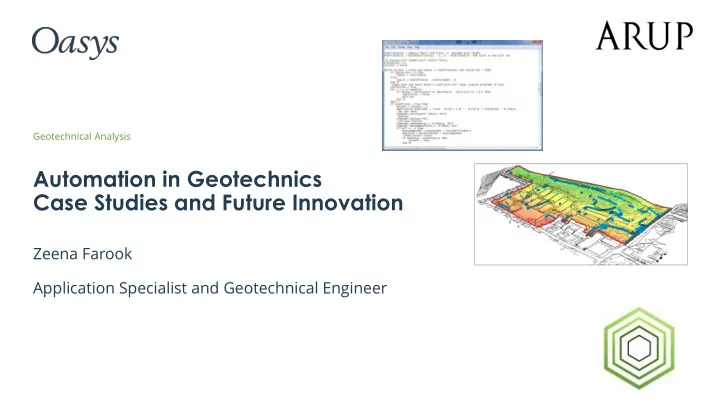
Automation in Geotechnics Case Studies and Future Innovation

slide-2
SLIDE 2

Discuss

  • 1. Drive for Automation in Geotechnics
  • 2. Case Study Examples
  • 3. Opportunities and challenges from Automation
  • 4. How to find out more
slide-3
SLIDE 3

Authors

Exhibiting at Booth 15

  • Mark Skinner – Senior Geotechnical Engineer, Arup
  • Matthew Brown – Senior Geotechnical Engineer, Arup
  • Carol Matthews – Associate, Arup and Lead Geotechnical Developer, Oasys
  • Zeena Farook
slide-4
SLIDE 4

Oasys Customers

Exhibiting at Booth 15

slide-5
SLIDE 5

Universities using Oasys

Exhibiting at Booth 15

slide-6
SLIDE 6

Why Automate?

Figures for concept illustration from Zhang et al (2016), The Workflow and Operational Model for Geotechnical Investigation based on BIM, IEEE Open Access Journal

Exhibiting at Booth 15

slide-7
SLIDE 7

How do we Automate?

  • Allow external programs to pass information and instructions

to and from each other

  • Use COM (Component Object Model).

Can use Excel (VBA), MATLAB and Python

Exhibiting at Booth 15

slide-8
SLIDE 8

Where can we Automate?

  • Input
  • Import of data from various other sources
  • Geometry from GIS or CAD
  • SI data from AGS format ? What about interpretation?
  • Instrumentation data
  • Analysis
  • Sensitivity analyses / iteration / optimisation
  • Back-analysis
  • Output
  • Export for post-processing
  • Databases

Exhibiting at Booth 15

slide-9
SLIDE 9

Case Study 1 – Retaining Wall Automation

  • Large site on a ~1:6 slope.
  • Lots of terracing of the ground profile required
  • Retained height, retained slope and geology varied
  • Wanted an ‘off the shelf’ L section retaining wall solution to

each situation, as the site layout was still being developed.

Exhibiting at Booth 15

slide-10
SLIDE 10

Case Study – Retaining Wall Automation

Exhibiting at Booth 15

slide-11
SLIDE 11

Why did we automate?

  • Design lots of walls very quickly, with just a table of input parameters.
  • Changing geometry
  • Changing soil parameters
  • Easy to optimise designs
  • Iterate heel length to optimise FoS
  • Calculate max retained height for a given geometry
  • Sensitivity investigations – quickly plot outputs
  • Incremental analyses
  • Get max bending moment from compaction

pressures during incremental backfilling Exhibiting at Booth 15

slide-12
SLIDE 12

Case Study 2 – Single Bored Pile Design

Loads Ground model Base models Pile properties Displacement limit Pile length Critical case Iterated models and log file Extracted BM and displacement Displacement interpretation

ULS 1 ULS 2 SLS 1 SLS 2

Four alp models per load case. Length iterated to iteration limits. 1) Lateral calculations Axial (compression and tension) capacity calculations completed, for ULS1, ULS2 and SLS. Pile length iterated until FoS = 1 in each case. 2) Axial calculations … is the longest of any case (lateral or axial). 3) Determination of design length Calculation spreadsheet runs iterative design calculations:

Inputs Outputs Automated calculations

EI

Exhibiting at Booth 15

slide-13
SLIDE 13

Opportunities from Automation

  • Time saving

Overall time reduction dependant of size of analysis. The bigger the analysis the bigger the saving

  • Input data (40%)
  • Output generation / plotting maps (40%)
  • Help us to avoid and prevent human errors
  • Iterative / multiple analysis (RW movements, etc)
  • Future plans for real-time monitoring.

Back analysis and Observational Method

Exhibiting at Booth 15

slide-14
SLIDE 14

Challenges from Automation

  • Only small numbers of calculations or load cases required?

Use on larger projects

  • Less checking and reviewing could potentially and incorrectly be justified

Check base model and outputs carefully. Models need to be created

  • Difficult to check the code rather than calculations that have been presented

step-by-step Developers within design teams?

Exhibiting at Booth 15

slide-15
SLIDE 15

Future Trends

  • Engineers or developers?
  • Modular automation
  • Interdisciplinary automation
  • Design on demand

Exhibiting at Booth 15

slide-16
SLIDE 16

Discuss

  • 1. Drive for Automation in Geotechnics
  • 2. Case Study Examples
  • 3. Opportunities and challenges from Automation
  • 4. How to find out more
slide-17
SLIDE 17

Visit us at Booth 15 (near the lifts) Any Questions?

Automation in Geotechnics Case Studies and Future Innovation