Audience Response Where We Live, Learn, Work Who is in our - - PDF document

audience response
SMART_READER_LITE
LIVE PREVIEW

Audience Response Where We Live, Learn, Work Who is in our - - PDF document

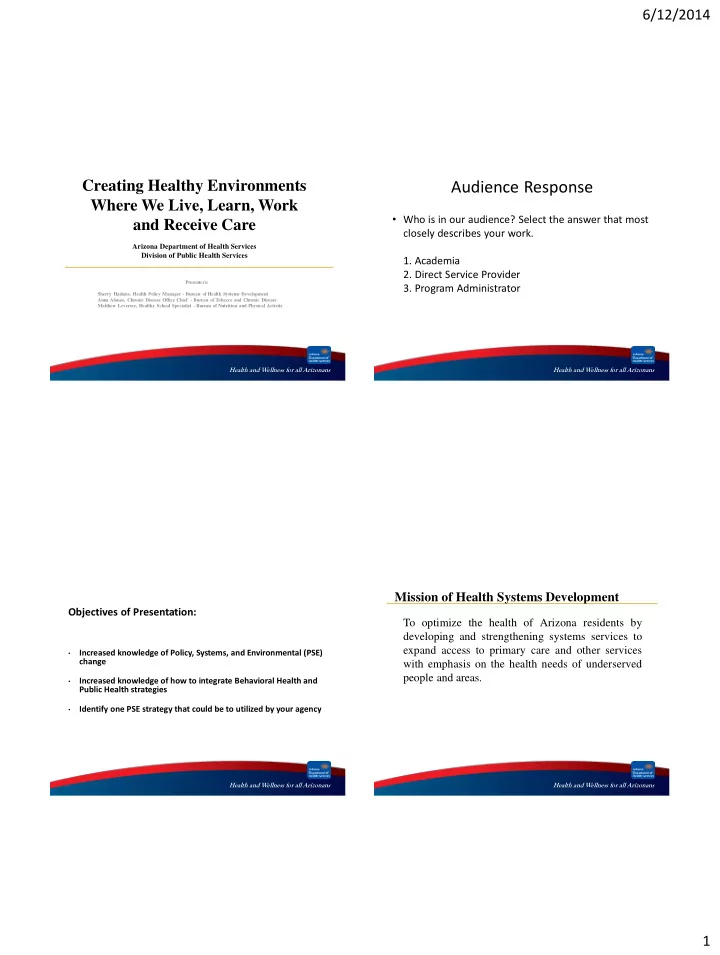
6/12/2014 Creating Healthy Environments Audience Response Where We Live, Learn, Work Who is in our audience? Select the answer that most and Receive Care closely describes your work. Arizona Department of Health Services Division of


slide-1
SLIDE 1

6/12/2014 1

Health and Wellness for all Arizonans

Creating Healthy Environments Where We Live, Learn, Work and Receive Care

Arizona Department of Health Services Division of Public Health Services

Presenters: Sherry Haskins, Health Policy Manager - Bureau of Health Systems Development Anna Alonzo, Chronic Disease Office Chief - Bureau of Tobacco and Chronic Disease Matthew Leversee, Healthy School Specialist - Bureau of Nutrition and Physical Activity

Health and Wellness for all Arizonans

Audience Response

  • Who is in our audience? Select the answer that most

closely describes your work.

  • 1. Academia
  • 2. Direct Service Provider
  • 3. Program Administrator

Health and Wellness for all Arizonans

Objectives of Presentation:

  • Increased knowledge of Policy, Systems, and Environmental (PSE)

change

  • Increased knowledge of how to integrate Behavioral Health and

Public Health strategies

  • Identify one PSE strategy that could be to utilized by your agency

Health and Wellness for all Arizonans

To optimize the health of Arizona residents by developing and strengthening systems services to expand access to primary care and other services with emphasis on the health needs of underserved people and areas.

Mission of Health Systems Development

slide-2
SLIDE 2

6/12/2014 2

Health and Wellness for all Arizonans Health and Wellness for all Arizonans

Core Functions

 Primary Care Office for Arizona  Develop and implement strategies for strengthening

primary care/health care delivery system

 Administer programs to increase the number of providers/

improve services in underserved areas

 Identify areas that need improved health services/assist

with federal/state shortage designations

 Provide TA to statewide partners

Health and Wellness for all Arizonans

  • Health in Arizona Policy Initiative (HAPI) utilizes evidence-

based approaches to address population health needs including the: – Health in All Policy Framework – Health Impact Pyramid – National Prevention Strategy How can Behavioral Health be integrated into these evidence- based approaches?

Health in Arizona Policy Initiative (HAPI)

Health and Wellness for all Arizonans

What is Health in All Policies (HiAP)?

  • It is a strategy to assist leaders and policymakers to

integrate health, well-being and equity in the development, implementation, & evaluation of policies and services. – Strategies are meant to ensure all policies and services from all sectors have beneficial or neutral impact on the determinants of health.

Source: Department of Health, Government of South Australia. (2010). Implementing Health in All Policies: Adelaid 2010. http://www.who.int/sdhconference/resources/implementinghiapadel-sahealth-100622.pdf

slide-3
SLIDE 3

6/12/2014 3

Health and Wellness for all Arizonans

Health in Arizona Policy Initiative (HAPI)

  • Three year initiative funded through tobacco tax, state lottery

and federal Title V dollars.

  • Focus Areas include Healthy Worksites, School Health,

Community Design / Healthy Communities, Clinical Care, & Procurement

Health and Wellness for all Arizonans

Why Worksites?

Health and Wellness for all Arizonans

To help Arizona employers successfully implement evidence-based healthy worksite initiatives to improve the health of their employees and businesses.

Purpose of the Healthy Arizona Worksites Program

Health and Wellness for all Arizonans

  • Reduce the risk of chronic disease among employees and their

families through evidence-based workplace health interventions and best practices.

  • Promote sustainable & replicable workplace health activities.
  • Promote peer-to-peer healthy business mentoring.

Healthy Arizona Worksites Program Goals

slide-4
SLIDE 4

6/12/2014 4

Health and Wellness for all Arizonans

13

  • Arizona Department of Health

Services (ADHS)

  • Maricopa County Department of

Public Health (MCDPH)

  • Arizona Small Business Association

(ASBA)

Program Structure

Health and Wellness for all Arizonans

HAWP Utilizes the CDC Worksite Health ScoreCard

A tool designed to help employers assess the extent to which they have implemented science-based health promotion interventions in their worksites to prevent heart disease, stroke, and related chronic conditions.

Health and Wellness for all Arizonans

The CDC Worksite Health ScoreCard (HSC)

  • Tobacco control
  • Nutrition
  • Physical activity
  • Weight management
  • Stress management
  • Depression
  • High blood pressure

Assesses best practice health promotion interventions:

  • High cholesterol
  • Diabetes
  • Signs and symptoms of

heart attack and stroke

  • Emergency response to

heart attack and stroke

  • Organizational supports

New:

Lactation Support, Immunization, Community Connectedness, Worksite Safety Culture

Health and Wellness for all Arizonans

CDC ScoreCard – Behavioral Health Areas

Stress Management

  • In the past 12 months did your worksite:
  • Provide dedicated space where employees can engage in relaxation

activities, such as meditation, yoga, biofeedback?

  • Sponsor or organize social events throughout the year?
  • Provide stress management programs?
  • Provide work-life balance/ life-skills programs?
  • Provide training for managers on identifying and reducing workplace

stress-related issues?

  • Provide opportunities for employee participation in organizational

decisions regarding workplace issues that affect job stress?

slide-5
SLIDE 5

6/12/2014 5

Health and Wellness for all Arizonans

CDC ScoreCard – Behavioral Health Areas

Depression

  • In the past 12 months did your worksite:
  • Provide free or subsidized clinical screening for depression (beyond HRAs)

followed-by directed feedback and clinical referral when appropriate?

  • Provide access to online or paper self-assessment depression screening

tools?

  • Provide brochures, videos, posters, pamphlets, newsletters , or other

written or online information that address depression?

  • Provide a series of educational seminars, workshops, or classes on

preventing and treating depression?

  • Provide on-on-one or group lifestyle counseling for employees with

depression?

  • Provide training for managers on depression in the workplace?
  • Provide health insurance coverage with no or low out-of-pocket costs for

depression medications and mental health counseling? Health and Wellness for all Arizonans

Public Health in Action

  • Collaborative initiative across the Division of Public Health Prevention

Services

  • New 5 Year grant (Beginning June 29, 2013-Ending June 30, 2018)
  • The CDC grant is a combination of two components: Basic (Non-

Competitive) and Enhanced (Competitive)

  • Supports the implementation of targeted strategies resulting in

measureable impacts addressing School Health, Nutrition and Physical Activity, Obesity, Diabetes, Heart Disease and Stroke Prevention

Health and Wellness for all Arizonans

Public Health in Action

  • Promote Collaboration and De-Siloing
  • Promote Policy Systems and Environmental (PSE)

Change/Public Health Approaches

  • Combines the former CDC Diabetes, Heart Disease,

Obesity and School Health funding

  • Effectively and Efficiently Address the CDC Four

Domains

Health and Wellness for all Arizonans

  • The grant is guided by CDC’s Chronic Disease Prevention and Health

Promotion’s Four Domains: Domain 1-Epidemiology & Surveillance Domain 2-Environmental Approaches that Promote Health Domain 3-Health Systems Intervention, and Domain 4-Strategies to Improve Community-Clinical Linkages

  • Budget for Year 1:

Basic Component $624,404 Enhanced Component $1,291,468 Total Grant: $1,915,872

Public Health in Action

slide-6
SLIDE 6

6/12/2014 6

Health and Wellness for all Arizonans

Audience Response

Policy, System and Environment (PSE) change

  • 1. Refers to how funding is utilized.
  • 2. Is implemented to positively impact population health.
  • 3. Evaluates the health of the community.

Health and Wellness for all Arizonans

  • PHIA-Basic and Enhanced (School Health)
  • Pilot program in Local Educational Agencies (LEA = school districts)
  • Partner with Az Department of Education (ADE) Health and

Nutrition Team

  • Empower model started in Early Childcare Education facilities-2010

“super-hero themed”

  • Ten wellness standards for healthier youth and policies to address them
  • Expansion
  • Empower Plus
  • Empower Home Visiting
  • Empower Schools

Empower Schools

Health and Wellness for all Arizonans

  • Quick history of what school policies need to address:
  • Wellness policy leadership
  • Inclusion
  • Nutrition promotion/education
  • Physical Activity/Physical Education
  • Other student wellness programming
  • Food/beverage marketing
  • Updates, assessment, public notice
  • Oversight

Empower Schools

Health and Wellness for all Arizonans

  • Nine LEAs across seven counties through 2018
  • ~38,000 students
  • Creation of ten wellness standards, guidebook and policies
  • “Empower Schools addresses physical activity and education, safety,

nutrition and health promotion in the school environment”

  • Based off of CDC-Coordinated School Health Model
  • (Health education, physical education, health/nutrition,

counseling/psychological, health promotion, community involvement)

Empower Schools

slide-7
SLIDE 7

6/12/2014 7

Health and Wellness for all Arizonans

  • Unique PSE, early intervention and healthy behavioral improvement

approaches

  • Sustainable
  • Best practice
  • Personal/parental accountability and involvement
  • Creation of policies and connecting resources (de-silo)
  • County health departments/hospitals
  • Pediatrics/dentists/etc.
  • Cooperative extension programs
  • Behavioral/psychosocial services

Empower Schools

Health and Wellness for all Arizonans

  • Schools are in the business of creating a well-rounded student
  • Look internally at resources (common mistake)
  • Re-thinking resources available in community
  • What’s not available and how to supplement it?
  • Providing resources for each wellness standard
  • Referral source (resources) provides opportunity for discussion
  • Education to all staff and parents

Empower Schools

Health and Wellness for all Arizonans

  • Evaluation and Future
  • Youth Risk Behavior Survey (YRBS) and Behavioral Risk

Factor Survey System (BRFSS)

  • Staff/parent surveys
  • Endorsement and expansion state-wide
  • Best practice tool nationally

Empower Schools

Health and Wellness for all Arizonans

Empower Schools

Takeaways from Empower Schools:

  • School wellness policy improvement program geared to change health,

educational capacity and understanding/use of resources

  • Five year pilot program with hope to expand on a large scale
  • PSE project similar to the mandatory worksite wellness approaches in the

late 90s that are common today

  • ROI driven and risk involved by investor
  • Has ability to change how schools interact with community and

improve quality of life for some

slide-8
SLIDE 8

6/12/2014 8

Health and Wellness for all Arizonans

Audience Response

Empower Schools is focused on updating Wellness Policies.

  • 1. True
  • 2. False

Health and Wellness for all Arizonans

Audience Response

The opportunity to support local schools to improve health is available to

  • 1. Academia
  • 2. Direct Service Providers
  • 3. Program Administrators
  • 4. All of the above

Health and Wellness for all Arizonans

Chronic Disease Self Management Program (CDSMP) – Healthy Living

  • Evidence-based self-management program developed by
  • Dr. Kate Long at Stanford University (Stanford Model)
  • Peer-led, community-based intervention that helps

individuals with chronic conditions learn how to manage and improve their health

  • Helps people with diverse medical and behavioral concerns

develop the skills and coping strategies they need to manage their symptoms.

Health and Wellness for all Arizonans

Chronic Disease Self Management Program (CDSMP) – Healthy Living

  • Six week workshops are led by a pair of trained facilitators,

many of whom have chronic health conditions. Approximately 10 – 15 participants

  • 2.5 hour workshops using an established curriculum.

Workshops are highly participative, with mutual success and support building participants’ confidence in their ability to manage their health and maintain active, fulfilling lives encouraged.

  • Anyone with a chronic condition such as diabetes, arthritis,

heart disease, asthma, or any other on-going health problem can participate.

slide-9
SLIDE 9

6/12/2014 9

Health and Wellness for all Arizonans

Chronic Disease Self Management Program (CDSMP) – Healthy Living

  • Employs action planning, interactive learning, behavior

modeling, problem-solving, decision making, and social support for change.

  • Available – online or in-person, at community-based

settings such as senior centers, churches, community health clinics and libraries

  • Available in Spanish for the chronic disease and diabetes

self-management programs

  • Stanford-developed CDSMP trainer manual is available in
  • ver 19 different languages.

Health and Wellness for all Arizonans

Cost Effectiveness

Based on a review of major published studies, CDSMP results in significant, measurable improvements in the health and quality of life of people with chronic conditions. Studies show CDSMP saves enough through reductions in health care expenditures to pay for itself within the first year.

  • Cost Savings

– $714 per person savings in emergency room visits and hospital utilization. – $364 per person net savings after considering program costs of $350 per participant. – Potential savings of $6.6 billion by reaching 10% of Americans with one or more chronic conditions.

Health and Wellness for all Arizonans

Health Benefits

  • Improvement in exercise and ability to participate

in one’s own care over a two-year period.

  • Improved health status in seven of nine variables:

– fatigue, shortness of breath, pain, social activity limitation, illness intrusiveness, depression, and health distress. – Improved health behaviors in variables related to exercise, cognitive symptom management, communication with physicians, and self-efficacy.

Health and Wellness for all Arizonans

Arizona

  • Arizona Living Well Institute

– https://alwi.org – 2066 W. Apache Trail, Suite 116 Apache Junction, AZ 85120 Phone: 480-982-3118 Toll Free: 877-982-3118 Fax: 480-982-7320 – Master Training – Lay Leader Training – Workshops Scheduled

slide-10
SLIDE 10

6/12/2014 10

Health and Wellness for all Arizonans

Counties Offering CDSMP

County Program Apache CDSMP Coconino CDSMP Cochise CDSMP/Tomando Su Control Graham CDSMP Greenlee CDSMP La Paz CDSMP Mohave CDSMP Navajo CDSMP/Tomando Su Control Pima CDSMP/Tomando Su Control Yavapai CDSMP/Tomando Su Control Yuma CDSMP/Tomando Su Control

Health and Wellness for all Arizonans

Audience Response

Chronic Disease Self-Management Programs can be utilized by

  • 1. University Employees
  • 2. Health Care Providers
  • 3. County Health departments
  • 4. All of the Above

Health and Wellness for all Arizonans

Thank You

www.azdhs.gov/hsd 602-542-01219

Sherry Haskins, Health Policy Manager - Sherry.Haskins@azdhs.gov - Bureau of Health Systems Development Anna Alonzo, Chronic Disease Office Chief - Anna.Alonzo@azdhs.gov - Bureau of Tobacco and Chronic Disease Matthew Leversee, Healthy School Specialist – Matthew.Leversee@azdhs.gov - Bureau of Nutrition and Physical Activity