ATUs Advances in Vibroacoustics Emiliano Rustighi Jen Muggleton - - PowerPoint PPT Presentation

β–Ά
atu s advances in
SMART_READER_LITE
LIVE PREVIEW

ATUs Advances in Vibroacoustics Emiliano Rustighi Jen Muggleton - - PowerPoint PPT Presentation

ATUs Advances in Vibroacoustics Emiliano Rustighi Jen Muggleton Objectives To use a pipe vibration method to assess the condition of buried pipework To investigate a variety of ground excitation methods to interrogate both the


slide-1
SLIDE 1

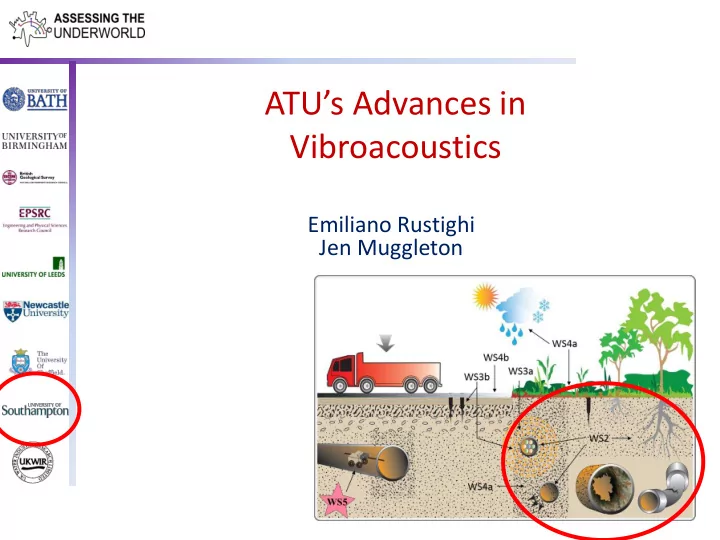
ATU’s Advances in Vibroacoustics

Emiliano Rustighi Jen Muggleton

slide-2
SLIDE 2

Objectives

  • To use a pipe vibration

method to assess the condition of buried pipework

  • To investigate a variety of

ground excitation methods to interrogate both the ground and the buried infrastructure

  • To explore a tree

excitation method to determine the location of tree roots in order to identify areas of pipe network at risk of damage

2

slide-3
SLIDE 3

Pipe Excitation method: Background

  • When pipe is excited, wave propagation in the pipe

mirrored at the ground surface and the run of the pipe can be determined from ground vibration contours

35Hz

  • 6
  • 4
  • 2

2 4 6

  • 6
  • 4
  • 2

2 4 6 8

  • 10
  • 5

5 10

Soil wavespeed Pipe wavespeed

Phase of ground surface response above an MDPE pipe laid under grass

3

slide-4
SLIDE 4

Pipe excitation: Detection of holes and cracks

Lateral distance from pipe, y(m) Axial distance along pipe, x(m)

  • 2

2 2 4 6 8 10 12 14 16 18 20

  • 60
  • 55
  • 50
  • 45
  • 40
  • 35
  • 30
  • 25
  • 20

pipe end 32mm hole

  • Reflections from

discontinuities in pipe (bends, holes, cracks) will manifest as more

  • r less subtle changes

in ground surface response

  • Monitor changes over

time

Magnitude of ground surface response above an MDPE pipe laid under grass

4

slide-5
SLIDE 5

Pipe excitation: Assessing soil condition

  • Changes in the soil will also

affect ground surface response: wave reflections = peaks in magnitude

  • Interactions between ground

and buried infrastructure are complex

19Hz Lateral distance from excitation location (m) Axial range (m)

  • 2

2 2 4 6 8 10 12

  • 30
  • 25
  • 20
  • 15
  • 10
  • 5

change in soil type

5

slide-6
SLIDE 6

In-Pipe Excitation

  • Recent change in UK legislation
  • Local excitation/assessment
  • Source Localisation: Techniques well developed

6

slide-7
SLIDE 7

We have now proven that we can use surface response to assess pipes We can now acoustically excite a pipe from inside

slide-8
SLIDE 8

Apodization: comi Type: DAX

1 2 3 4 5 6

Horizontal Position (m)

0.5 1 1.5 2

Depth (m)

  • Array of sensors

focused on the surface only

  • Max in std

Near-surface wavespeed estimation

slide-9
SLIDE 9

DA Signal Processing

Phase Coherence Imaging

1 2 3 4 5 6

Horizontal Position (m)

0.5 1 1.5 2

Depth (m)

0.5 1

Sign Coherence Imaging

1 2 3 4 5 6

Horizontal Position (m)

0.5 1 1.5 2

Depth (m)

0.5 1

Coherence Factor Map

1 2 3 4 5 6

Horizontal Position (m)

0.5 1 1.5 2

Depth (m)

0.5 1

Istantaneous Phase Weight

1 2 3 4 5 6

Horizontal Position (m)

0.5 1 1.5 2

Depth (m)

0.5 1

Uniform Stacking

1 2 3 4 5 6

Horizontal Position (m)

0.5 1 1.5 2

Depth (m)

0.5 1

Apodized Stacking

1 2 3 4 5 6

Horizontal Position (m)

0.5 1 1.5 2

Depth (m)

0.5 1

9

slide-10
SLIDE 10

We can now automatically detect near-surface wavespeed We have now reduced data analysis time and interpretation time

slide-11
SLIDE 11

Crack Detection I

  • MASW/MISW 𝑔-𝑙 spectra: MISW adds

a fictitious periodicity which manifests in the spectral image

  • Extract information regarding location

and depth of the cracking.

MISW MASW

11

slide-12
SLIDE 12

Crack Detection II

  • Use of wave decomposition method: direct and reflected

waves amplitudes and phase

  • The resonances of the reflection coefficient and the cut-offs
  • f the transmission coefficient are associated with the

depth of the crack.

  • The phase of the direct and of the reflected wave gives an

indication of the location of the crack with respect to the reference point.

12

slide-13
SLIDE 13

We can now assess crack presence from MISW/MASW We can now locate and characterise cracks from reflections

slide-14
SLIDE 14

Buried Tree Root Lab Experiment

  • Simulated root embedded in sand

– Experiments and Numerical models – Flexural & axial waves studied – Work to date shows that roots can potentially be detected at ground surface using this method

Instrumented root model buried in the sandbox

14

ground response (axial excitation)

slide-15
SLIDE 15

Tree Root Mapping: Field Experiments

  • Simulated Root buried at UoS

15

slide-16
SLIDE 16

Tree Root Mapping: Field Experiments

  • Simulated Root buried at UoS
  • Distinct signature on ground

surface vibration responses

16

slide-17
SLIDE 17

We can now locate a buried root