SLIDE 1
Atos Origin – Third quarter 2008 revenue Management Board Conference Call
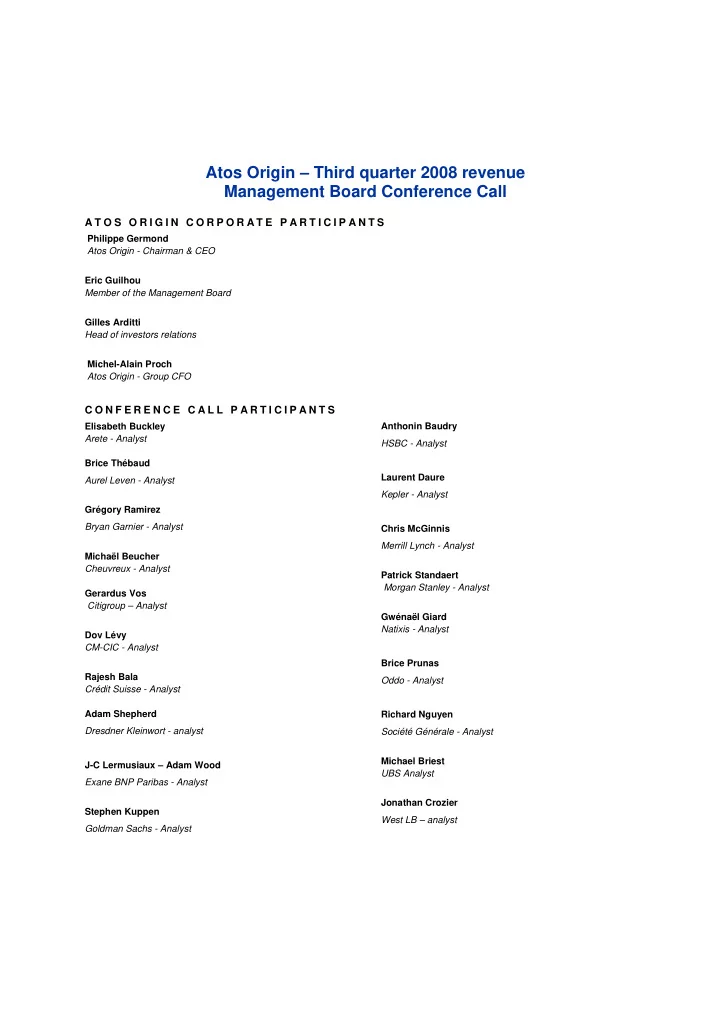
A T O S O R I G I N C O R P O R A T E P A R T I C I P A N T S
Philippe Germond Atos Origin - Chairman & CEO Eric Guilhou Member of the Management Board Gilles Arditti Head of investors relations Michel-Alain Proch Atos Origin - Group CFO
C O N F E R E N C E C A L L P A R T I C I P A N T S
Elisabeth Buckley Arete - Analyst Brice Thébaud Aurel Leven - Analyst Grégory Ramirez Bryan Garnier - Analyst Michaël Beucher Cheuvreux - Analyst Gerardus Vos Citigroup – Analyst Dov Lévy CM-CIC - Analyst Rajesh Bala Crédit Suisse - Analyst Adam Shepherd Dresdner Kleinwort - analyst J-C Lermusiaux – Adam Wood Exane BNP Paribas - Analyst Stephen Kuppen Goldman Sachs - Analyst Anthonin Baudry HSBC - Analyst Laurent Daure Kepler - Analyst Chris McGinnis Merrill Lynch - Analyst Patrick Standaert Morgan Stanley - Analyst Gwénaël Giard Natixis - Analyst Brice Prunas Oddo - Analyst Richard Nguyen Société Générale - Analyst Michael Briest UBS Analyst Jonathan Crozier West LB – analyst
SLIDE 2 P R E S E N T A T I O N
Operator Good morning ladies and gentlemen and welcome to the Atos Origin Q3 revenue conference call. At this time all participants are in listen-only mode until we conduct a question and answer session and instructions will be given at that time. I would like now to hand over to the Chairperson, Philippe Germond. Please begin your meeting and I will be standing by. Philippe Germond - Atos Origin - Chairman & CEO Yes good morning to all of you and thank you for joining us for the Q3 results call. With me we have Eric Guilhou, the other Management Board Member, Michel-Alain Proch, the CFO is here for the Group and Gilles Arditti the Investor Relation. You probably have with you the slides we put on our site this morning. So I will go, shortly, through all these slides and then we are going to be ready to answer any of your questions. I would like to start with slide number 4, which gives you a summary of the Q3 achievements. So first the revenue organic growth in the quarter is on track with the full guidance of the year, so basically above +5%. The statutory Q3 2008 revenue including one month's of AEMS Exchange is at EUR1 353 million, with an organic growth at constant exchange rate of +5.5%. And if you exclude AEMS Exchange -- you know we closed the disposal of that joint venture with New York Stock Exchange in
- August. The new scope revenue excluding AEMS is at EUR 1,329 billion in Q3 with an organic growth of +5.3%, which means that
year to date for the first nine months of the year we achieved an organic growth of +6.3%. The commercial activity remains strong. Year-to-date the order entry is at EUR 3.9 billion, up +10% compared to last year with a book to bill ratio of 95%, 5 points higher than where we were one year ago in September '07. Full backlog of EUR7.5 billion represents a 1.4 year of revenue. And the full backlog to be applied on 2009, and we will come back on a few comments regarding next year later, represents EUR2.5 billion. And if I do compare to the backlog we had at the same time last year in '07 to be applied in '08, that backlog today is 8% higher than last year. At the same time, on the one side we have an increasing backlog and on the other side we still have a pretty strong weighted pipeline at EUR 2.6 billion, a bit higher compared to last year. We continued to reduce the net debt, which is at EUR409 million at the end of September '08 compared to EUR490 million in September '07 and EUR 514 million just three months ago at the end of the first semester. As I said, we finalized the disposal of AEMS Exchange early August with a net cash effect for the Company of EUR142 million. In the same condition as we decided and we contracted in December '07, and at the same time we purchased from New York Stock Exchange Euronext the Clearing and Capital Market activities, which are now owned at 100% by Atos Origin. In term of governance, there is now a stability of the shareholding. You know the key shareholders of the Company. And I will come back later to the work we have done quite intensively with our Supervisory Board, with the Strategic Committee about the strategic
- rientations of the Group.
On slide number 5, you have as usual, as every quarter, a list of major deals we signed. Let me just make a few comments. First, the commercial momentum remained dynamic in all geographies. So in Europe we've a good performance in France in most of our main market, in the retail with Redcats, in the public sector, in utilities and in finance. In Netherlands we signed significant contracts with Achmea, the Ministry of Education. In Spain we had successes with Repsol, Banco Santander and also Telefonica. We signed two major contracts with Telefonica in the last two quarters, which is a major breakthrough of Atos Origin in Spain with this major telecom operator.
SLIDE 3 We had also significant wins overseas in North America in manufacturing and public sector and also in Asia mainly in financial
- services. So still a good volume of new signature or contract renewable, both based on multi annual contracts. We signed contracts
between two years and 10 years, and especially in the public sectors which remain extremely dynamic in the UK but also in France, and also now in Netherland, which is pretty new, because we are not very active in the public sector in Netherland. So we signed two major contracts; one with the Chamber of Commerce and also one with the Ministry of Education, which is the first department
- f the Dutch Government moving into a full outsourcing.
The financial services remained dynamic on specific subsectors, such as insurance or payment systems where the transaction level is lower, but volume is higher. And you know that the business model of Worldline is based on the number of transactions and not the value of the transactions. On slide number 6 you have some more indication about the book to bill. I said that year-to-date the book to bill ratio was at 95% compared to 90% last year. And I confirmed that we had a good commercial dynamic during the first nine months, 10% growth of
- ur order intake year-to-date. You remember that in H1 we achieved a 14% growth, which means that Q3 was flat.
Does it mean that we have a major slowdown of our order intake? You just have to take into account that last year we signed in Q3 a significant deal with Dresdner Bank, which was a multi-year contract for EUR150 million. So we had a strong basis in Q3 last year which has an impact on the growth in Q3 '08. And I still consider that Q3 '08 was very active in terms of order intake. You have on that slide also the book to bill ratio in the different activities, 98% in Consulting, 97% in System Integration and 93% in Managed Operations, 15 points up compared to last year. If we move to slide number 8 you have some details about the structure for revenues between future scope and statutory scope. On statutory scope we reach, as I said before, EUR1.353 billion, representing an organic growth of +5.5%. And if we take out the month of the AEMS Exchange we achieved on the future scope -- on today's scope +5.3% growth. We will see later that this positive
- rganic growth has been reported in all service lines and in most of the geographies.
If we have the same slide year-to-date on slide number 9, we reach, as I said, a bit more than EUR 4 billion year-to-date, excluding Italy and the AEMS Exchange, which represents an organic growth of +6.3%. So considering this figure and backlog coverage for the last quarter of the year, we feel in a position to confirm the guidance for the full year to be above +5% organic growth. On slide number 10, and you are probably used to slide now.and you have the reconciliation between the statutory first nine months, last year revenue and the pro forma, excluding Italy and AEMS Exchange. So on year-to-date September revenue -- incremental revenues were at EUR242 million compared to last year with EUR66 million incremental revenues in Q3 this year compared to last year. On slide number 11, it's one way for me to tell you that now it's the fifth quarter in a row that we show an organic growth, which is above 5%. So, it's a steady position of being overall the last five quarters since Q3 '07, at more than 5% growth. And ,given the tougher market conditions during last week some industry analysts started to revise down their growth assumption for the IT services market, for example, Gartner revised down, I think that the IT service market in Western Europe should grow by about 4.8%. So it just means that probably Atos Origin is growing faster than the market and we could say we are gaining market share. When I read Gartner, when I read Forrester, they account for next year to arrange from plus 2% to plus 3% growth in '09. So at that stage they are not talking about an IT service market with revenue decrease. They are still talking about an organic growth of this market next year. And I will come back to our own Atos Origin comments later on. On slide number 12, we can see the revenue organic growth by quarter for the last three years. In '07 we had a significant increase
- f the organic growth in Q3 at +6.6% relating more to the basis of the prior year. This year Q1 and Q2 were above '07 performance,
and Q3 momentum remained good since we achieved more than +5% growth with a baseline which -- last year, which had already a pretty significant growth, which was at +6.6%. I consider that the Group as demonstrated its ability to pursue the improvement of the revenue increase year after year. So now if we move to slide number 13 we dig into a bit more details by giving you the revenues by service line. So let's start with
- Consulting. With 6% of total revenue at EUR 84 million, Consulting continued to show a recovery trend and reported an organic
growth of a bit more than +11% in the third quarter of '08.
SLIDE 4 On the year-to-date basis the revenue organic growth was at +2%. So during the third quarter this year, France, Netherland and Spain increased their revenue compared to last year while the United Kingdom had, as expected, still a slight decrease. But we can say not that year-to-date Consulting as a whole in Europe is back to growth. So the action plan implemented in the United Kingdom in Consulting is underway, including short term sales initiatives made proactively with System Integration in order to go back to
- rganic growth in the UK in Consulting.
With 39% of total revenue, System Integration reached EUR 521 million and recorded a bit more than +5% growth during the third quarter of '08. And this performance was led by the United Kingdom with a +10% growth, Germany +21%, partially linked to the Dresdner Bank contract implementation. France reached +3% growth and Netherland down was -2%. On a year-to-date basis the revenue organic growth was at +6.8% in System Integration and probably higher than the average market growth in Europe. On the Managed Operations side, which represents 55% of our revenues with EUR 725 million in Q3, they achieved +4.7% organic
- growth. That activity continued to benefit from Atos Worldline, which is growing at double digit growth. But at the same time France
Managed Services, United Kingdom, Asia Pacific had all a strong growth, while Netherland and Germany had a slight decrease. But for these two countries it's linked mainly to two major contracts, which were totally forecasted. One is being KPN; and we all know that we renegotiated the contract a year ago with a tariff decrease. And the second one, which is totally planned, because it's multi- year contract with year after year a small decrease of revenues on our side, which is Arcandor, which is performing well. Year-to-date on slide number 14, you have the growth of our different activities. So as I said, Consulting is back to growth 2% and System Integration and Managed Operations are both above 6% growth, which is really encouraging. If we look on slide 15 on the geographies. All the countries, except two countries or regions, are growing. France is growing by more than +6%, close to +7%. Germany is above +6%. Asia Pacific is at +29%. UK is at +8% growth. And on the year-to-date basis revenue organic growth was altogether, as I said before, +6.3%. For Netherlands we have a small decrease, which was forecasted. The small decrease of their revenues is decreasing quarter after
- quarter. So year-to-date they are at minus 0.7%. But if I would exclude KPN from Netherland, I confirm that the growth without KPN
contract in Netherland is at +6.5% in their overall positive activities, so in line with the rest of the Company. And year-to-date they are at +5.1%. So Netherland is doing well and the KPN decline of revenues, was forecasted, is in line with what we were expecting. The other country or region, which is going down in terms of revenues is Americas, but as usual, and up to the end of the year we compare with '07 where we had significant one-off revenues coming from the Pan American Games in Brazil. But if we would exclude that activity this part of the world is growing. On slide number 16, you have the revenues by country on a year-to-date basis, so I'm not going to comment more. But you can see that, for example, the United Kingdom has double digit growth, and is recovering; France being close to +7% growth. On slide number 17 we talk about net debt. As I said before, the net debt is down. We had a positive effect coming from the disposal of AEMS Exchange, and as per the decision taken during the first semester to pay the dividend for the first time of our history to our shareholders we had an effect on the net debt by EUR28 million cash out. So year-on-year we have a decrease of the net debt by EUR 81 million. We have also a decrease compared to where we were at the end of June by more than EUR 100 million. Early September '08 the Group decided, to implement a strong plan to further reduce the cost base and anticipate streamlining from '09. So we know the market condition. We know the potential economic slowdown and we took a few decisions, and I will comment a bit more later about that. But we took a few decisions, including anticipating restructuring actions which we'll plan in '09, anticipating them during Q4 '08. So this will have an impact of EUR 30 million of cash out by the end of '08 in Q4. But I consider that as an anticipation of cash out from '09 to '08 with a positive effect on the cost base of the Company with a positive effect on the operating margin for next year.
SLIDE 5 About headcount evolution on slide number 18, at the end of September we had around 51,300 employees, total recruitment was at 8,700. But there is one point I want to insist on; the fact that during Q3 '08 we pursued recruitments in order to get young staff from the university and we didn't want to miss the best talents, especially the one trained by Atos Origin. During third quarter the average age of the people we hired is below 30 years old and most of them have between two and five years of experience, and will benefit also to the cost base of Atos Origin for next year. In India the staff hired are mainly coming from the university and we have a training program for them. The attrition rate remains stable at 13.5%, which is still high, and even decreasing in Consulting, which is now at about 20%. However, attrition is not going to be the first concern in the next few months, as you can imagine. If we look at the headcount by geography on slide number 19, you have the split between the different countries. I want to insist on a few points. First one the net staff increase is +5.3% compared to the beginning of the year. Out of the net increase of 2,600 staff we have 2,150 staff in Brazil, India and Spain. I mention Spain, because most of these people are located in low cost areas. So 80% of the total net addition for headcount is coming from low cost areas. And at the end of September the total staff in low cost countries reached 6,600 people, which is about 13% of total staff. And keep in mind that we have the objective to have 20% of our employees to be based in low cost countries by the end of '09. If we move to slide number 20, offshore and near shore, we have about now, 4,000 staff in offshore and near shore activity. During Q3 we have increased by 500 staff our workforce for offshoring and near shoring compared to the end of June. Our main focus is
- bviously on India where it is now easier for us to hire good staff than 18 months ago when we launched the transformation plan.
The main reason is first our visibility which is higher because now we have a much bigger structure than 12 or 18 months ago. The slowdown of the IT service in the US lead our colleagues in India to control their headcount or even decrease their headcount, and we can benefit from that to accelerate our offshore platform. If I look at the usage of offshore resources I can consider that a push is still to be made by the French organization for System Integration in order to reach the level already achieved by the UK, Netherlands or even Germany. I consider the Netherland, UK and Germany now have a good culture of using offshore and have significantly increased the share of offshore resources in their activities. So my first priority in offshoring for '09 remains to grow the staff in India above 5,000 headcount. And, I just want to remind you that the new campus in Pune, which will open at the very beginning of '09, will strongly contribute to that objective, because that new site will have about 3,000 seats and will give us significant flexibility to increase our offshoring share within Atos Origin. So I would like to move to some comments regarding the intensive work we have done with Supervisory Board and the Strategy Committee on the strategic evolution of the Group. So as you remember, after the General Assembly at the end of the first semester, we decided to put in place within the Supervisory Board a Strategy Committee. And the Strategy Committee, ,include the representative of our major shareholders. So we have two months of intensive process, led by the Strategy Committee and the Management Board about what are the different options in terms of evolution of the Company, and in terms of priorities to be developed by Atos Origin. I can tell you that we had a really constructive and open process to discuss all the other different options and we reviewed in very much detail every single option which were -- we could envisage to create value for the Group and to develop our Company. And at the end we all agreed and there was a unanimous support of the strategic priorities proposed by the Management Board. We all agreed on the few key priorities we are going to perform over the next few years. On slide number 23 you have four points. The first priority for the Group is to become the European leader in transaction
- processing. The strategy of Atos Worldline is to become the European leader in transaction processing, which include payment
platforms and e-services. We have an ambition to reach EUR1.5 billion of revenue for Atos Worldline within the next three years while maintaining the same level of profitability as today, which mean with an operating margin above 15%. This is a significant growth we envisage for that
- activity. We will dedicate financial resources to that development, but that development is a mix of organic growth.
SLIDE 6 And I remind you that, for example this year, Atos Worldline had a double digit growth; slightly above 10%. So they are capable of generating a significant organic growth. It will be also through selective acquisitions, but it could be also through partnership and
- utsourcing of platforms from banks as it happened in the past. So it's a mix. The development of Atos Worldline, which is the first
priority of the Group, is a mix of organic growth, acquisitions and partnerships or outsourcing contracts with banks. The second point is on Consulting and System Integration. We will continue to focus on selected profitable service offerings, which is totally in line with what we launched at the end of last year regarding the distinctive offerings. So we will continue to focus on these distinctive offerings, where we have clear differentiators compared to most of our peers, and where we can build some added value and incremental margin. As we did in the past that we may accelerate into that direction, the Group will explore partnerships and JVs, joint ventures to leverage existing platforms in Consulting and System Integration. What does it mean? Obviously, we will extend our partnership with
- SAP. We are doing extremely well in terms of partnership with SAP. We will continue in that direction. But we could also envisage
this kind of partnership in the telecom areas, maybe with telecom equipment suppliers. So we are really open minded to partnership and joint venture to accelerate our differentiation. On Managed Operations the objective is to focus growth on local infrastructure, mainframe and server management. And when I say objective is to focus growth, and if we use the word focus it's at the same time, focus profitable growth. So one of the key subjects, and when we talk about changing a little bit the way we compensate the management of the Company, and the bonus scorecard, and how we measure the performance of the management in the countries, we will inject more and more objectives based on gross margin. So the objective is profitable growth, focus on profitable growth. The word focus I'm going to use it also on geography. And that's one of the key decision we made, which is not new because, for example, we disposed early this year Italy. But the Group will focus on core geographies and activities, and will proceed between EUR250 million and EUR500 million revenues in the next months. Therefore, a first has started for non-core geographies on the scope we presented EUR250 million. We are willing to focus on a limited number of geographies, which are not in Europe because in China, I considered that we can make breakthroughs in this part
- f the world. But we are going to decrease the number of geographies where we operate, because they are geographies which are
far away from Europe, difficult to control, where we don't have the critical size. And we have now a program to disinvest from these countries and the first step is on the EUR250 million of revenues. The last point is operational improvement. The Group will maintain its emphasis on additional identified areas in order to accelerate the operational improvement. So it's the 3o3 plan plus additional actions which are, improving the operating margin in SI France; Consulting in UK; G&A costs in Netherland, which is not new. I've already addressed this point with you. And we are making policies in that field. If we move to slide number 24 you have some figures regarding the small countries we plan to disinvest, which we consider as non-core geographies. And as I said, these geographies will be disinvested within the next few months, maybe some will be disinvested already by the end of '08 and the other ones will be during '09. We give you the figures. These geographies we considered disinvesting will represent, I give you an estimate for this year, EUR 249 million of revenues, and will be slightly negative in terms of operating margin for two major reasons. The first one you are already aware; we had some accidents in the small countries during the first semester, especially in Turkey and Thailand. And currently we are making some additional cleaning in these countries in order to prepare the disposal of these countries. If we move to slide number 25; accelerate operational improvement, as I said, is on one side to pursue the effort on the 3o3 plan. So, it's still industrialization initiatives. It's pushed towards offshore, mainframe consolidation, increased cost reduction through
- purchasing. But there is an additional emphasis made on improving the margin of System Integration in France, Consulting UK,
G&A Netherland, but also a tighter management of subcontractors. You know that we had a high usage during the first semester of subcontractors, which had additional cost for us of EUR 9 million during the first semester, with a peak in numbers of subcontractors at the beginning of Q3. So now we put a tight control on that side in order to decrease and make more difficult to use subcontractors within the different countries of the Group.
SLIDE 7 We continue to work on improving the low margin contracts and we are going to accelerate resource streamlining; ,accelerating the resource streamlining means also simplify the management structure of the Company. So if we move to some details about the focus on operational improvement; you have a few slides about the 3o3 plan. It is not
- exhaustive. It's a few example of the progress we are currently making. On slide number 27 you have the number of people, which
are now CMMI level three plus the objective. So between mid '07 and now we make significant progress. We have multiplied by three the number of people and development centers, which are now a CMMI level three. And we still have an objective to increase by 50% before the end of '09. In India -- our structure is CMMI level five, as all Indian companies. If we move to slide number 28, software development and maintenance centers are the key organization you need unique to create economy of scale and standardization. So we continue to progress well on this factory approach. Now 74% of the eligible staff are now in these units and we plan to continue to increase; and remember, that a year ago it was in the range of 41%. So we are making progresses in terms of industrialization and putting in place the right structure, the right unit for improving the productivity of
- ur system integration activities.
The tooling shared service centers provide also the standard process into platform for projects in all factories and the usage currently cover now more than 4,000 users, which represent 26% of the eligible population. So we make significant processes. We move from 0% a year ago. We are at 26%. There are still significant progress to be made and you have on that chart what we expect to achieve within the next 12 months. On slide number 29, nothing new. You know that we move all our mainframe activities in one single mainframe center in Germany in Essen. France is on the process to be moved. It's partially done. It's going to be finalized at the end of this year. On slide number 30 you have a few examples of the savings. If you add EUR 1 million, EUR 2 million plus additional savings, at the end we saved EUR 44 million in purchasing this year. The EUR 44 million helped us to be more competitive and to dynamise
- ur order intake and probably to have an organic growth higher than the market.
So I would like to move to another chapter which is; the Group actions versus new environment. Because on the one side, if I look back to what happened during the first nine months, good organic growth, very good order intake, a backlog which is growing; the backlog to be applied for next year which is higher 8% than previous year. But at the same time there is a reality; there is an economy slowdown. I think this is a role of the management team to anticipate potential significant slowdown which could come up within the next few months or in '09. So we decided early September to take a few actions, despite the fact that we were maintaining a good organic growth this year. So we decided to have a full set of actions, 24 actions on top of the transformation program. You have a few actions on that list. They are actions on revenue, actions on cost and actions on staff. These actions are mainly oriented towards cost savings related to both direct and indirect expenses and to improve the cash performance. The most important ones are accelerating the use of offshore capacity. That's why I was pointing out the progress which are required from SI in France, and that's why I mentioned also the fact that the opening of Pune early '09 will give us some potential upside or acceleration of our offshore capacity. Reduction of subcos is mandatory. Adaptation of bonus scheme to the new environment is also important. So that will be totally reviewed for '09 with a strong emphasis on growth margin, on profitable growth. Adaptation or freeze of all indirect recruitments and special caution on direct staff hiring. We decided mid of September to freeze the indirect recruitments and in order to recruit people for direct staff, the level of authorization has been significantly increased. So we have put a significant tight control on recruitment with a really short term effect and which will embetter the cost base for '09. We have also significantly reduced the expenses such as travelling and training, optimization of resource management. So there are a lot of actions which have been put in place, but there are also actions on cash and you have two examples on page 33. You have reduction of CAPEX. On cash actions are reinforced on CAPEX optimization and collation of receivable in all geographical areas with a strong monitoring by Group finance centrally. So Michel-Alain Proch and his team have weekly calls with each country
SLIDE 8 The objective is to move down the CAPEX intensity of the Group from 5.5% of our revenues down to 4.5%. So, decrease by 1 point the CAPEX with an obvious effect on the free cash flow we generate. In the new economic environment there is a risk of increasing credit losses of bad debt, because of bankruptcy, and I ask all the teams to collect much more aggressively the receivables from the
- customers. We have a tight monitoring once again, under the full control -- direct operational control of Michel-Alain Proch of the
receivables. On slide number 34 I make a few comments regarding management actions. It is clear that the success of a company like Atos Origin is linked to the quality of the management and to the progress of the management team we have within the Group. I decided a few months ago to launch an executive assessment of the top 50 managers of the Group in order to detect the key talents, and also to help some of them to progress with additional training and really to embetter the management team of the Company. We also made a review of operational staff and managers' scorecard as I said before, really to align the focus of the Company to the new environment. And I will come back to you at the beginning of next year with the guidance or the outlook for '09, but I will also comment the objective we gave to the management and how we are going to measure the governance of the management in '09 in line with the new market environment. As I said, we continue, we reinforce the control on the human resources hiring and decreasing subcos and I'm going to speed up the implementation of some organizational changes like the implementation of the operational global factory. Next subject is some comments regarding the market exposure, because there are a lot of question marks about; what does it mean for next year this market economy slowdown? What could be the impact on a company like Atos Origin? So if we look at slide 36 I give you as we used to give you what are our key markets. Year-to-date the number one market for the Group is the public sector, and the public sector is still very active and when I look at the order intake we got from France, UK, Netherland in the public sector it just demonstrates that this sector is not slowing down their investments. They are going through major transformation and we benefit from that as one of the key players in the public sector. The second one is financial services with 22% of our revenues. And you might say, well, it might be dangerous, because that market has been hurt by the financial crisis and we may see a slowdown. But I would like to emphasize one point that first within this 22% you have Atos Worldline, which is a significant part of that and you have the retail banking, which is to date not hurt. And in the retail banking, you have a big part which is based on multi-year contract and on outsourcing. The other market which might be hurt from the economy slowdown is the retail. It's 10%. But within retail, we have also Atos Worldline activities and we have significant Managed Services activities in Germany with Arcandor or in France with Redcats. So we are naturally exposed to the markets which have potentially a slowdown of their IT service activity. Telecom it's 15% of our activities. Telecom is decreasing this year by 4% but we have also activities in energy and in utilities and, we grow by 9% in these sectors. And finally manufacturing, we grow by 10%. If we move to slide 37, the key point is the fact that as we usually say we have a strong basis of recurring revenues. 68% of our revenues are recurring. This is application management, this is Managed Services and this is Atos Worldline and BPO. They are based on retail contracts; so more than two-third is linked to media contract with a good visibility. We made a few scenarios and, it's too early to decide what are going to be the options for next year. And I will come back to you early '09 with what is our objective in term of growth. But what I would like to tell you is the fact that I consider that Atos Origin with that strong base of multi-year contracts, with the strong backlog we have, with the good momentum in terms of order intake Atos Origin next year should generate a positive organic growth. We made some scenarios and these scenarios are just scenarios today. It's sensitive in the analysis we work on, but which demonstrates that even if we would take an assumption of 0% growth, since we have a good visibility on the Worldline and BPO on Managed Services and on application management, we know about what is going to be within next year. It will mean that Consulting would go down by 10%, Professional Services by 10% and Projects by 5%.
SLIDE 9
And just demonstrate that this is only a sensitivity analysis I want to share with you, so please don't put that in your model, but the purpose of that slide is to demonstrate that with the basis of multi-year contracts we have, with the good momentum for order intake, we are in the position of next year generating positive organic growth. One sensible point is also the financing, because here many journalists are talking about the renegotiation of major companies, about their financing during '09, more difficult debt environment. The good thing about Atos Origin, the fact that we have credit line for EUR1.2 billion. Out of this EUR1.2 billion -- and it's on slide number 38, out of this EUR1.2 billion, EUR100 million will have to be renegotiated in May 2011. So it's in three years from now. And EUR1.1 billion will have to be renegotiated in four years from now. So we do not have any short-term negotiation to launch with banks. So we have a clear vision of our credit line; a strong stability of this credit line for the next three to four years. As any other company, we have covenants on our credit lines and the current leverage net debt to EBITDA is below 1, while the covenant was to be below 2.5. So we are not stretched at all. And in the current financial environment we do not have any short term issue. So it doesn't mean that we are not going to make progress. As I said before, we are going to bring pressure on cash, on CAPEX, on the working capital and our objectives remain to generate a good free cash flow by putting that pressure. But let me really insist that we do not have any short-term, mid-term negotiation to launch on the credit line or debt. So let me move to the two final slides on '08. So I'm not going to spend time on the slide number 40, just to mention to you that the visibility on the fourth quarter is pretty good. The coverage of the fourth quarter, as we look at it today, is better than last year. So we have a good level of comfort to confirm that we will generate an organic growth full year '08 above +5%. So the last slide, slide number 41, the objective for '08. So, as I said before, the Group confirms the objective of revenue organic growth above +5% in '08. On the scope representing more than 95% of total revenues, which means Atos Origin minus the non-core geographies being divested, and which are going to be divested within the next months, the Group should reach an operating margin at 5.5%, which means for that 95% of our revenues an improvement by +100 basis points compared to '07 in line with our initial objectives. On the non-core geographies being divested, I already disclosed in H1 the overrun projects we had in Thailand and in Turkey. In addition to that we are preparing the sale of these geographies, which means some additional cleaning, which altogether will experience in this geography a small operating loss in '08. And let me just remind you some '09 outlook, even if it's too early to give you a full feeling about '09, but the Group is currently working on the budget process for next year and you can imagine we are extensively actively exchanging with our customers to understand what is their own budget process. But, due to the structure, as I said before, of our activities where 68% of the revenues are recurring and the level of backlog already contracted, Atos Origin remains confident to generate a positive organic growth next year, despite the economic environment. We are fully aware of the economic environment and that's why we took some tough decisions in September in order to anticipate the economic slowdown and to work on the cost base for next year. So now we will be very pleased to answer any of your questions.
SLIDE 10 Q U E S T I O N A N D A N S W E R
Gilles Arditti – Atos Origin _ Head of Investors Relation So we start with the questions coming from the web. So we have Dov Levy from Credit Mutuel CIC asking for what is the impact of the current economical slowdown on Atos Worldline? Do we have any other covenants than debt to OMDA, less than 2.5? And the last question is do we evaluate the impact of the acceleration of the cost savings on 2009? Philippe Germond - Atos Origin - Chairman & CEO
- Okay. So first on Worldline; what is the impact of the slowdown of the economy? That's a very good question. We ask ourselves
that question based on past history, because it's not the first time that there is an economic slowdown and also based on what happened last few months. I confirm that Worldline is a transaction processing activity, whose business model is based on number of transaction and not value
- f the transaction. So, the major trend we see is that it's not a decrease of number of transactions these days. It's more a decrease
- f the average value of each transaction. So we are not hurt by the economic slowdown on Atos Worldline.
So that's why the basic assumption I take for next year is still good growth for Worldline. Maybe not double-digit growth, but good growth for Worldline not being hurt in its own business model by the economic slowdown. That's the advantage of being a transaction processing company and not being a -- and having our revenues not linked to the value of transaction but on the single transaction and that's it. On the OMDA, Michel-Alain, on the covenants, maybe you want to comment? Michel-Alain Proch - Atos Origin - Group CFO So the syndicated loan has actually two covenants; one that we have already mentioned which is the net debt on OMDA. And the second one is about the interest coverage in which operating margin divided by cost of debt should be above 4 and we are much above this ratio. For the year we'll be more than the double. Philippe Germond - Atos Origin - Chairman & CEO So once again, credit line we have a full visibility control for the next four years and we are far away from any covenants. So the subject of debt financing is not an issue for Atos Origin. On the cost base evolution, it's a bit early to give you very much detail. But, as I said before, we are currently anticipating some resource optimization we planned initially in '09 in 2008.The objective will be to streamline the cost base for the beginning of '09. I mention to you that we will have a transfer of a cash outlay from what we forecasted initially in '09 in Q4 '08 of about EUR 30 million. Basically, with all the actions I would say that -- just give you a rough idea and is very preliminary, that in term of cost base we should decrease the cost base by at least EUR 50 million, but once again as it will be confirmed in much more details early '09. Gilles Arditti – Atos Origin - Head of Investors Relation The next question coming from Antonin Baudry from HSBC. First question is any guidance for EBIT margin for 2009?
SLIDE 11 The second question is what is the estimated net debt at the end of 2008, estimated? And another question related to the restructuring, is there any new restructuring planned next year? Philippe Germond - Atos Origin - Chairman & CEO On the EBIT margin for '09, it's too early. It is too early. We take all the actions to maintain an operating margin improvement next
- year. But once again, in today's market condition it's too early. We are in the middle of the budgeting process, and I will come back
to you next year. But our ambition is to continue to improve the operating margin and that's why we took some additional actions in
- rder to anticipate potential slowdown of the IT service market.
On the net debt, as I said, there are two major actions for this year which have been made recently. First decision is to anticipate from '09 into '08 some resource optimization with an additional cash outlay of EUR 30 million in '08, more than what we anticipated for '08 or we forecasted '08. We took another decision; usually during the first semester we have a capital increase for employees. We have a share purchase plan for employees and because of the market situation, the volatility of the market, we decided to postpone that capital increase for next year and probably for early next year. Just to give you an idea that was forecasted to be this year. In '07, we had cash inlay from our employee capital increase of EUR20
- million. So this will be the two new effects on net debt compared to what we forecasted initially. And on the rest, things are going as
usual, nothing special. On restructuring, maybe to Michel-Alain for next year, for '09? Michel-Alain Proch - Atos Origin - Group CFO So in restructuring, the plan that we have launched during this summer will have a part of the effect in Q4, as already mentioned. And it will have another part of the effect during the first semester of '09. So we will be around a cash effect of EUR50 million for this plan. Gilles Arditti – Atos Origin - Head of Investors Relation Next question is on acquisition for Atos Worldline, more specifically. And which is which type of price do you expect from the disposal of the EUR250 million? Philippe Germond - Atos Origin - Chairman & CEO Atos Worldline acquisition, there is one visible potential acquisition, as I said before. It's SIA SSB in Italy. There is a formal process which was launched a couple of months ago. We are a candidate for acquiring this company and we have been selected in the second round. That something if the process is moving as planned initially by the sellers and their bank it should end by the end of this year. But once again, we are a candidate for that acquisition. It's a payment platform, like Banksys BCC, like the one we acquired in Belgium in '06 which has been a very successful acquisition. SIA SSB is similar to Banksys BCC and they have activities in Italy and in some countries in Central and Eastern Europe. For which type of price or cash we could get for the disposal of the EUR250 million of revenues in the small countries, it's too early to give you an indication. But we'll keep you informed step by step after every single disposal. I said these disposals are going to happen between maybe some before the end of this year and the rest in '09.
SLIDE 12 Gilles Arditti – Atos Origin - Head of Investors Relation A question from Credit Suisse: In January, 2007 what was your original margin forecast for non-core geographies with revenue of EUR250 million. We don't remember exactly, but it was in the range of what was has been reached in 2007, which was 5% operating margin. Philippe Germond - Atos Origin - Chairman & CEO As you can see on one of the slides it was in the range of, I think, EUR13 million of operating margin and 5% of operating margin, which was above the average of the Group in '07. Gilles Arditti – Atos Origin - Head of Investors Relation A question from Jean Christophe Lemusiaux from Exane BNP Paribas: several large clients, especially in the finance insurance segment, have asked for 10% to 15% discount on prices for fiscal year '09. How do you manage that? Philippe Germond - Atos Origin - Chairman & CEO Well, my first answer is that I'm not aware of that. Our customers have not asked that. Once again, integrate the fact that we have multi-year contract with commitment in terms of yearly price decrease. It's already structured and it's already integrated into our business model. Gilles Arditti – Atos Origin - Head of Investors Relation We have one question from Nick Mays (PAC in the UK) asking what are the current trends that Atos is seeing in terms of sales cycles? Philippe Germond - Atos Origin - Chairman & CEO Yes, as I said; two comments. My first comment is regarding the pipeline. The pipeline is good. ,Our weighted pipeline is a bit higher than last year. The second comment I would make; that it takes a bit more time for customers to take decisions so we see a longer sales cycle than
- before. And it's probably linked to their own budgeting process they are going through. So that's why we are tightly monitoring the
discussion with the customers to really understand what could be the forecast for next year. Gilles Arditti – Atos Origin - Head of Investors Relation There is one question from Mark Bryan of Deutsche Bank: a rumor saying that the acquisition in Italy is being rumored at EUR600 to EUR700 million. We will not comment on the rumors on an acquisition where it is known that we working it. Philippe Germond - Atos Origin - Chairman & CEO Well, we are in the bidding process. So I'm not going to communicate what I consider being the right price for that entity. Should we move to the questions on line?
SLIDE 13 Gilles Arditti – Atos Origin - Head of Investors Relation We move now to the questions from the call. Operator (Operator Instructions). Our first question comes from the line of Patrick Standaert. Please go ahead with your question and announce your company and location. Patrick Standaert - Morgan Stanley - Analyst Hi, good morning. It's Patrick here from Morgan Stanley in London. Two questions, if I may. The first one is the losses in the non- core operations were known in H1 08 and you've already announced it. You haven't changed your guidance then and still maintain the 5.6%. Now my question on that would be, what in the core countries have gone worse than you initially expected since then? That would be the first question. And secondly, when you mentioned that you had to give back the EUR44 million of cost savings from your purchasing activities to achieve the organic growth rate that you have. I'm wondering, what's the margin leverage you have in Atos Origin? And can you confirm us that Atos is not a 5% margin story over the long-term and that you actually have a potential to improve your margin to the 7% you indicated not too long time ago? Thank you. Philippe Germond - Atos Origin - Chairman & CEO Well, the first point on the large countries, keep in mind that what we say also is that the small countries last year in '07 had an
- perating margin rate which was above the large countries. And what we announced today is that if we take out the small countries
which account for less than 5% of our revenues, we are still improving operating margin rate by 100 basis points on the 95% of our revenues, so on the large countries. Patrick Standaert - Morgan Stanley - Analyst So, you knew that already. You knew that it's 5% last year. Philippe Germond - Atos Origin - Chairman & CEO Yes, but we say -- let me make it very clear. What we said for '08 that we would improve by 100 basis points the overall Company. You know that we have these accidents in Thailand and in Turkey. You know that we took the decision at the Strategy Committee to dispose some of the small countries where we operate for total revenue of about EUR250 million. That activity was hurt by some
- accidents. And is also on top of that hurt by some decisions I took to improve the structure of these small countries to embetter our
capacity to dispose these small countries. Patrick Standaert - Morgan Stanley - Analyst I understand that but you mentioned that in 1H and it means that either the loss in those small countries has become bigger in the third quarter or some operation in your core countries have been a bit worse or slowed down since 1H. What's the reality? Philippe Germond - Atos Origin - Chairman & CEO No, what we can also say that on the large countries, Worldline including, we improve by 100 basis points. Another way to look at that, it's clear that we are not compensating the overruns in Turkey and Thailand with additional margin in the large countries, but we are still in the large countries within our objective of 100 basis point improvement.
SLIDE 14
Patrick Standaert - Morgan Stanley - Analyst And on the second question, on the leverage? Philippe Germond - Atos Origin - Chairman & CEO On the second question, maybe I miss-explained the point. We made EUR44 million of savings through our purchasing, our centralized purchasing approach and that's a good progress. And I didn't say that we gave all the EUR44 million to customers. I said that part of these savings contributed to the dynamism of our commercial activity and the company business. So keep in mind that we keep part of these savings with us, because they are some savings which address the indirect costs, because we are making savings in real estate, for example. We are making savings in travel. But it's clear that, for example, in some contracts we have commitments to pass the savings to customers in some outsourcing contracts when we negotiate globally contracts with, for example, hardware suppliers. So I'm not saying that out of the EUR44 million we pass everything to the customers. So you can put in your model that part of the savings we generate will contribute to the improvement of the operating margin and already contributed to the improvement of the operating margin in '08. Patrick Standaert - Morgan Stanley - Analyst In your comments earlier on you mentioned that you were looking for some or maintaining some improvement in the margins for next year. Historically you were talking about reaching margins of 7%. Let me remind you that you were talking about 8% not so much time ago. Are we going to struggle to reach the 7%? What's the story there? Philippe Germond - Atos Origin - Chairman & CEO You know, Patrick, we are not a 5% margin story company. My objective, my ambition, and it's step by step, is to bring Atos Origin up to 7% to 8% operating margin. We have an economic environment which is not going to help. Currently we are working on the budget to look at the way we are going to improve the margin next year compared to this year in today's economic slowdown environment. But a model for Atos Origin with a 5% margin at perpetuity is not my ambition. My ambition is step by step to improve the operating margin rate for the Company and what I said today is that this year we will improve on the core activity, which represents more than 95% of our revenues by 100 basis points. That's the first step operating margin rate. If I may just finish the point; it's on one side a story about improving the operating margin and today I am not in a position to tell you what is my objective for next year. I still need to go through the complete budgeting process and get more and more information from the market. So there is a story about improving the margin with still the objective I had in mind which is still an actuality. But the second point is also for me the ambition to be a positive cash generation company. And at that stage we are not enough cash generation company. So for me it's not only a question of margin, but it's also a question of free cash flow and that's why I am addressing that story about CAPEX and decreasing the CAPEX intensity of the Company. Patrick Standaert - Morgan Stanley - Analyst A very quick one to finish; on your worst case scenario, on the scenario that you have presented, you mentioned 2% growth for Managed Services. I was wondering how much that would imply in volume, considering the natural erosion you have in the big Managed Services contracts and how does that compare from 2007?
SLIDE 15 Philippe Germond - Atos Origin - Chairman & CEO Once again, it's too early. What I wanted to give you is some sensitivity to make you understand that there is an option of positive
- rganic growth next year and that's the kind of information I will provide you when we will have finalized our budget for next year and
all the budget assumptions. Patrick Standaert - Morgan Stanley - Analyst
Gilles Arditti – Atos Origin - Head of Investors Relation Next question? Operator Our next question comes from the line of Michael Briest. Please go ahead with your question and announce your company and location. Michael Briest - UBS - Analyst Good morning. It's Michael Briest at UBS in London here; a couple of questions. Obviously you do have a lot of capacity for debt. I'm just wondering what level of debt you'd actually be comfortable going through. I mean if you went to EUR1 billion of debt I'm sure investors would be a little worried in this current environment. What would you be comfortable at? Philippe Germond - Atos Origin - Chairman & CEO Michel-Alain, that's for you. Michel-Alain Proch - Atos Origin - Group CFO What do you mean by comfortable at? Michael Briest - UBS - Analyst Well, would you be happy if the Company had a debt of EUR1.1 billion, which is what your credit facilities allow you? Or would that be something you don't think you would be happy to go to? Michel-Alain Proch - Atos Origin - Group CFO The level of debt has to be measured in front of the OMDA that the Company is expecting and out of the free cash flow that the Company is expecting. So obviously we will increase our debt if we acquire SIA SSB. Now I'm not going to drop you a number as a
- target. I think it has to be put in front what the Company can generate in free cash flow.
Michael Briest - UBS - Analyst Okay.
SLIDE 16 Philippe Germond - Atos Origin - Chairman & CEO When we talk about Worldline our ambition to be at EUR1.5 billion of revenues with a 15% operating margin, that's an ambition based on, as I said before, organic growth, outsourcing contracts, and acquisition, but selective acquisitions. And that ambition of EUR1.5 billion will not be with adventurous acquisitions. So the business model we have for Worldline is growth, but maintaining a strong cash flow generation activity and looking for acquisitions which are going to be cash generative. Michel-Alain Proch - Atos Origin - Group CFO What I may add is that if your question is more relating to how we're going to finance the acquisition. By doing this acquisition we will stay below our covenant -- the two covenants that I have mentioned about OMDA and cost of debt. We are targeting for a net debt at the end of this year of around EUR 300 million, then we will add up obviously the price of the SIA SSB. Gilles Arditti – Atos Origin - Head of Investors Relation So in case of an acquisition for Atos Worldline in Italy or elsewhere, there is no need of renegotiation and anything on the banking covenants. Philippe Germond - Atos Origin - Chairman & CEO We are on the safe side and being sure that we are going to pay the right price in order to create value for the shareholders; no doubt on that. Michael Briest - UBS - Analyst
- Okay. Maybe another question then; just in terms of the transformation plan costs this year, can you remind us how much you're
expecting to incur above the line, and how much we had in the first half of the year? Gilles Arditti – Atos Origin - Head of Investors Relation For this year we say that we will have the same levels of savings than the cost. We started the year with expected total costs around EUR60 million and EUR70 million. And we are now monitoring an amount, which is EUR50 million, both cost and savings for the whole year. This is above the line. Below the line basically at the beginning of the year we were talking EUR50 million P&L effect on essentially on optimization of resource management. At the end of June we had decreased to EUR40 million, because we had actual figure at EUR10 million and we are now targeting EUR70 million, including the additional EUR30 million additional cash out that we have this year. Michael Briest - UBS - Analyst So to be clear, on the above the line costs you're expecting both lower charges and lower saving? Gilles Arditti – Atos Origin - Head of Investors Relation Yes, compared to what we had at the beginning of the year.
SLIDE 17 Michael Briest - UBS - Analyst
- Okay. And why are you expecting less saving?
Gilles Arditti – Atos Origin - Head of Investors Relation We have re-estimated and we are monitoring costs and savings, so we have some programs which take more time; some others where we are better. And the assumption on the saving which are made by the purchasing is fulfilled, but the effect on the P&L is a little bit longer to be seen on the income statement. Michael Briest - UBS - Analyst
- Okay. And then just a couple of small ones; could you make a comment on the pricing environment today more generally, and also
an update on your utilization rates in Consulting and System Integration? Thank you. Gilles Arditti – Atos Origin - Head of Investors Relation I start with the utilization rate. So in Consulting it is stable, slightly above 62%. And this is a figure, which still needs to be improved, because we already say that our ambition is to be closer to the 70%. And in System Integration we are in the range 79% to 80%. The question on the general pricing environment is too general, but if you want to add something Philippe. Philippe Germond - Atos Origin - Chairman & CEO Over the last few weeks we have not seen major differences. And back to one of the comments I heard before, I have not seen customers asking for 10% price decrease. So, that's something we tightly monitor on a country-by-country basis in order to prepare
One of the reasons why we anticipated some of the resource optimization of '09 in 2008 is in order to get prepared to improve our productivity and face potential price decrease. But for the time being we have not seen major differences. May I remind you that in Managed Operation, the contracts always anticipate on a year-by-year basis a price decrease, so it is into
- ur business model on a contract-by-contract basis. And one thing we do, and I encourage just a few months ago, the countries to
do to anticipate the renewals of some major Managed Operation contracts. I think it's a good management practice to anticipate renewals. So let's say, if you have a renewal of contract in 18 months from now, or two years from now, it's better to renew that contract one year in advance for an initial X years. It's exactly what we did with KPN and we are going on some negotiations, which will give you a better visibility for the next three years. Michael Briest - UBS - Analyst Thank you very much. Operator Our next question comes from the line of Gerardus Vos. Please go ahead with your question and announce your company and location.
SLIDE 18
Gerardus Vos - Citigroup - Analyst Hi, it's Gerardus Vos from Citigroup. I've got two questions, if I may. First of all, thank you very much for the scenario analysis. I think that's quite insightful. Perhaps on those kind of scenarios you could discuss also the margin you expect with those three scenarios. Then secondly just a clarification; when you guys said that you want to focus on high margin activity, would you be able to give me definition what Atos believes is high margin activity? And then I have one follow-up, thank you. Philippe Germond - Atos Origin - Chairman & CEO Well, on the first question I'm not going to answer it because once again it's too early to give you some operating margin target for the next year. We are in the budgeting process. I give you the first step, which is an ambition to maintain a positive organic growth and I believe that we have the right visibility to envisage that trend, even if we are totally conscious about the market slowdown, and that's why we anticipate on the cost structure, but I believe that we have embarked backlog visibility, so that we can envisage that positive organic growth margin, if you may wait until three months when we are going to communicate on the '08 outlook. On the high margin contracts, what do I mean? I mean a couple of things. First, it's an internal discipline about signing contracts with a good gross margin. So we have a process internally to review the major contracts at the management board level. And we are looking when we review these contracts, and we have the same process at the service line for smaller contracts or at the country levels for even smaller contracts. What we review is the gross margin and the cumulative free cash flows from these contracts. We have probably now a tighter management on that. I think that I covered that point already once in our past calls. The fact that we embarked in '04, '05 and a bit in '06 some contracts which are significant in terms of revenues, with gross margin level which are not at the level I expect to sign new contracts now. So step by step, we are going to disembark these contracts and rejuvenate the contract portfolio with higher margin contracts with a better discipline. And it's not growthfor growth. My ambition is profitable growth and that's why we are going to put on top of that in place incentives for the management and I think it's suitable in today's market environment on the gross margin side. Gerardus Vos - Citigroup - Analyst Okay then. Then maybe one -- Philippe Germond - Atos Origin - Chairman & CEO A second point, if I may, Gerardus. On the second point, it's discipline on gross margin and it's more added value. Gerardus Vos - Citigroup - Analyst Okay.
SLIDE 19 Philippe Germond - Atos Origin - Chairman & CEO And more added value, it's around distinctive offers. And that's why the Strategy Committee also encourage to have a clear focus on added value activities, and we are back to the SAP to the electronic contact management, to nuclear, to all the different subjects we have already covered with you over the last 12 months. Gerardus Vos - Citigroup - Analyst
- Okay. Maybe just one follow-up to -- I'll ask this question in a slightly different way. If I take this year's consensus revenues, I think
it's around EUR5.5 billion, if I take out Worldline and I strip out EUR500 million divestments, then on Wordline I think you're running round 16%, 17% profitability. The underlying business is doing around 5.5%. If I then double the processing business at the 15% you guys indicated, I already get to a margin of round 8% to 8.5% on that new scope, let's call it that way. So what I'm trying to understand, with these initiatives and 3o3 you've announced, are you actually believing that you can increase the margin for the business outside Worldline? Or is that steady around 5%, 5.5%, and simply the upside is coming from a larger proportion coming from transaction processing? Thank you. Philippe Germond - Atos Origin - Chairman & CEO No, when I said that my ambition is still to have a 7% or 8%, I'm not playing with a change of perimeter. We will update you -- if we make an acquisition or if we extend Worldline we will update our margin ambition. I still believe that there is room to improve our operating margin rate in System Integration. I give you one example. We have a very good operating margin rate in System Integration in Netherland. We have a good one in Spain, in Germany or in the UK. In France we have to significantly improve because in France, which is, ,our number one country in System Integration, we are slightly above break even. So we need to improve. That's why I mentioned earlier, we need to improve the share of offshore in
- France. We need to simplify the organization in France, which is still complex and which is not in line with the organization we have
in place in Netherland or in UK which are efficient organizations, if even I consider that we can improve also a little bit in these countries. So when I talk about an ambition 7% to 8%, it's without playing with the perimeter and without playing with the increasong share of the payment activities. Gerardus Vos - Citigroup - Analyst Okay, right. Philippe Germond - Atos Origin - Chairman & CEO So I still believe that there is room to improve. Okay. And once again, it's too early. We are going to comment more about the margin for '09 and the future early next year. There is no more questions, they tell me. If you have any additional don't hesitate to give a call to Giles Arditti who is ready to be extremely busy today. Thank you very much for your time and see you soon in the future. Operator Ladies and gentlemen, thank you for your participation today. This concludes today's conference. You may now disconnect your