Atomic Resolution Modeling Protein-Protein interaction network of - - PDF document

atomic resolution modeling
SMART_READER_LITE
LIVE PREVIEW

Atomic Resolution Modeling Protein-Protein interaction network of - - PDF document

Dec. 2014 Complexes as functional modules of the cell Atomic Resolution Modeling Protein-Protein interaction network of Large Macromolecular Assemblies Haim J. Wolfson School of Computer Science Jeong et. al. , 2001 Complexes Tel Aviv


slide-1
SLIDE 1
  • Dec. 2014

H.J. Wolfson - INRIA 1

Atomic Resolution Modeling

  • f

Large Macromolecular Assemblies

Haim J. Wolfson School of Computer Science Tel Aviv University

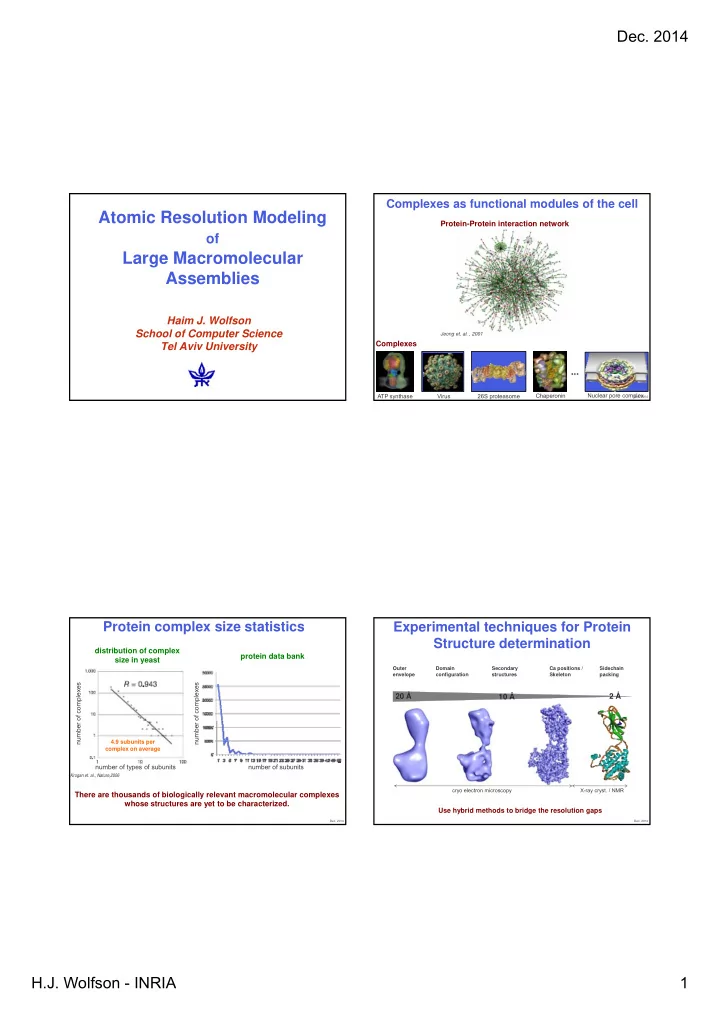
Protein-Protein interaction network

Complexes as functional modules of the cell

Jeong et. al. , 2001

Chaperonin Virus ATP synthase Nuclear pore complex

Complexes

26S proteasome

...

  • Dec. 2014

Protein complex size statistics

  • f complexes

distribution of complex size in yeast protein data bank

  • f complexes

Krogan et. al., Nature,2006

number number of subunits number number of types of subunits

4.9 subunits per complex on average

There are thousands of biologically relevant macromolecular complexes whose structures are yet to be characterized.

  • Dec. 2014

Experimental techniques for Protein Structure determination

20 Å 10 Å 2 Å

Ca positions / Skeleton Secondary structures Sidechain packing Outer envelope Domain configuration cryo electron microscopy X-ray cryst. / NMR

Use hybrid methods to bridge the resolution gaps

  • Dec. 2014
slide-2
SLIDE 2
  • Dec. 2014

H.J. Wolfson - INRIA 2

Analogy

Multi-molecular assembly is analogous to the solution of 3D puzzles –a classical spatial Pattern Discovery task.

High resolution data Low resolution data

  • Dec. 2014

Puzzle Assembly in Computer Vision and Robotics 1 9 8 6 Circa

  • Dec. 2014

Additional Low Resolution Data Sources

  • FRET
  • Existence of di-sulfide bonds
  • MasSpec (e.g.distance constraints by chemical

cross linking).

  • SAXS
  • SAXS
  • Interaction Data (Y2H, gene fusion, similarity with

known complexes, etc.)

  • and more…
  • Dec. 2014

SPECI AL FREQUENT CASE:

Structure Prediction of ( cyclically) Sym m etric Multi-Molecular Assem blies

  • D. Schneidman-Duhovny et al., Proteins, 60, 217--223, (2005).
  • D. Schneidman-Duhovny et al., NAR 33 (web server issue), W363—W367,

(2005).

slide-3
SLIDE 3
  • Dec. 2014

H.J. Wolfson - INRIA 3

Exploiting the Symmetry Constraints

  • A trivial “naïve” approach – perform “regular”

multimolecular docking and discard non-symmetric solutions.

  • A more sophisticated approach – use the symmetry

constraints as an integral part of the algorithm to reduce complexity and improve accuracy complexity and improve accuracy.

  • Observation – if point A in the protein is matched after

the symmetry rotation to point B, one can detect a plane to which the symmetry axis is perpendicular and its location is restricted to a known circle in that plane.

  • Dec. 2014

Cyclic Sym m etry Cyclic Sym m etry

side view top view

symmetry axis

  • Cyclic symmetry is defined by rotation of a single unit around

an axis.

  • The angle is determined by a number of units n.
  • Dec. 2014

r A

2 tan 2  r d AB d  

Geometric Analysis

α

 AB l l

B

2 cot 2 2 2  d r r      R rotation) a is R and

  • n

translati a is (T' R T' T where ) T( B A

r is a function of d and α only l is tangent to a circle C of radius r which is centered at (A+B)/2 and lies

  • n a plane orthogonal to AB
  • Dec. 2014

l

C

A

The Algorithm

  • For each pair of matching interest points A

and B

– Calculate CABα

  • For δ = 0 to 360-∆ step ∆
  • Calculate lCδ
  • Calculate Tlα

B

  • If T is valid add T to the candidate

transformation list

  • Cluster transformations
  • Calculate the score for transformations,

which are cluster representatives

  • Dec. 2014
slide-4
SLIDE 4
  • Dec. 2014

H.J. Wolfson - INRIA 4

Chaperon: 2.5 Å RMSD prediction for the homo-heptamer.

  • Dec. 2014

CAPRI Target 1 0 : 9 .0 Å RMSD prediction for the hom o-trim er of a viral coat protein

Our Prediction Crystal Structure

  • Dec. 2014

Structural models of the subunits at atomic level Low/Medium resolution EM density map

Exploit Low Resolution Info – EM, SAXS, FRET etc.

  • Dec. 2014

Previous Work

Early work : Fitting of atomic structures to the density map by cross-correllation. In essence – structural alignment at different resolutions. Recent work : Hybrid Methods.

  • Dec. 2014
slide-5
SLIDE 5
  • Dec. 2014

H.J. Wolfson - INRIA 5

Publications

  • W. Wriggers, R.A. Milligan, J.A. McCammon, Situs: a

package for docking crystal structures into low resolution maps for electron microscopy, J. Struct. Biol. 125, (1999), 185—195.

  • Z. Yang, K. Lasker, D. Schneidman-Duhovny, B. Webb,

C.C. Huang, E.F. Petersen, T. D. Goddard, E.C. Meng, A. C.C. Huang, E.F. Petersen, T. D. Goddard, E.C. Meng, A. Sali, T.E. Ferrin, UCSF Chimera MODELLER, and IMP: An integrated modeling system, J. Struct. Biol. 179, (2011), 269—278.

  • E. Karaca, A.S.J. Melquiond, S.J. deVries, P.L. Kastritis

and A.M.J.J. Bonvin, Building Macromolecular Assemblies by Information-driven Docking : Introducing the HADDOCK MultiBody docking server, Mol. Cel. Proteomics 9, (2010), 1784—1794.

  • Dec. 2014

MultiFit

Find the placements ( translation and orientation) of atomic components in the density map of their association.

Lasker, Topf, Sali, Wolfson, JMB 2009 Lasker, Sali, Wolfson, Proteins 2010

  • Dec. 2014

MultiFit - Example of a Task :Assemble the Arp2/3 structure

simulated at 20 Å resolution

component %seq id C RMSD Rpb1 40 5.1 Rpb2 48 2.5 ARPC1 16 6.1 ARPC2 29 21.4 ARPC3 99 0.4 ARPC4 29 14.3 ARPC5 94 5.5

COMPONENT STRUCTURE – OUTPUT of HOMOLOGY MODELING

  • Dec. 2014

MultiFit: A geometric view

Number of protein subunits and their structural models Low resolution density map of the entire assembly

Input: Goal: Determine the assembly configuration optimizing Goal: Determine the assembly configuration

Geometric complementarity Fitting score Envelope penetration

Find the placements ( translation and orientation) of atomic components in the density map that minimizes the scoring function

resolution Structural accuracy

S =

docking docking Structural alignment

  • ptimizing
  • Dec. 2014
slide-6
SLIDE 6
  • Dec. 2014

H.J. Wolfson - INRIA 6

Few representative reasons for the difficulty of multiple fitting

  • Scoring
  • Cross-correlation measure alone is not always sufficient

to place a component in the map.

  • Cross-correlation score does not check for geometric

complementary between interacting components.

  • Docking alone is problematic, since the accuracy of docking

methods depends on the accuracy of the individual atomic methods depends on the accuracy of the individual atomic structures

  • Optimization
  • Sequential fitting or sequential pairwise docking may not result in

the right configuration in the general case.

  • Enumerating all possible configurations of components of large

assemblies is too expensive

Pair of components Pairwise docking rank ARP3/ARPC2 12185 ARP3/ARPC3 854 ARP3/ARPC4 5888 ARPC1/ARP2 4663 ARPC1/ARPC5 5504

Solution: use a scoring function that considers fitting and geometric complementarity simultaneously

  • Dec. 2014

Focus the subunit placement search around anchor points

  • anchor graph: a low-resolution description of the assembly.
  • nodes: points in 3D that approximate the centroid positions of the

assembly components.

  • edges: between nodes that are close in space.
  • The anchor graph was constructed using a Gaussian Mixture

Model segmentation of the density map Model segmentation of the density map.

The anchor graph Sampling of subunit centroids at anchor graph pts

  • Dec. 2014

Reduce the multiple fitting problem to optimization

  • f a subunit location and orientation graph
  • 1. Represent the scoring function as a weighted graph.

Geometric complementarity Fitting score Envelope penetration

S =

Geometric complementarity Fitting score & Envelope penetration

Complexity ???!!!

  • Dec. 2014

Graphical Models

  • Use a belief propagation type algorithm to detect the
  • ptimal solution.
  • Apply the algorithm both in the placement stage and
  • rientation refinement stages.
  • Utilise the Junction Graph structure

Utilise the Junction Graph structure.

  • Dec. 2014
slide-7
SLIDE 7
  • Dec. 2014

H.J. Wolfson - INRIA 7

DOMINO: Optimize large systems by optimization of smaller tractable sub‐systems

sequential message passing / Belief propagation / dynamic programming

minP(x1,....,xN )

1 2 N i j S b i i i i S b i i i i Subset minimization Subset minimization Passing messages on a (junction) tree 1 2 N i j i

  • Dec. 2014

Reducing the complexity of the scoring graph

Given a mapping of components to the nodes of the anchor graph, we can eliminate interaction terms between nodes that are far in space.

Geometric complementarity Fitting score & Envelope penetration

Geometric complementarity Fitting score Envelope penetration

S =

  • Dec. 2014

MultiFit / DOMINO

Lasker, Topf, Sali, and Wolfson. J. Mol. Biol. 388, 180-194, 2009. Input: components, map Map segmented into anchor graph Discretize map Iterate over all mappings of components to anchor nodes via branch-and-bound “Decoupled” subsets of components. Sample subsets “independently”. Scoring function as a graph. Component fits in vicinity of their anchor nodes. Decompose set

  • f components

Output: component configuration, to be refined. Gather subset solutions into best global solutions

  • Dec. 2014

Refinement by docking partner enrichment

Sample the placements of each component by constrained rigid pairwise docking (PatchDock). For each of the top 50 configuration solutions Gather subset solutions into the best possible global solutions.

PatchDock: Duhovny-Schneidman, Nussinov, Wolfson , WABI 2002.

  • Dec. 2014
slide-8
SLIDE 8
  • Dec. 2014

H.J. Wolfson - INRIA 8

Summary of MultiFit

Place sparse anchors, remove distant edges high resolution subunit models Low resolution assembly image

INPUT SEGMENTATION CONFIGURATION

In top ranked configurations each unit is enriched by K- best docked neighbor conformations. Repeat DOMINO optimization.

Associate components to anchors and find a coarse assembly configuration by DOMINO

Output The assembly configuration

REFINEMENT

  • Dec. 2014
  • 1. Represent the scoring function as a graph.
  • 2. Decompose the set of components into

relatively decoupled subsets (a junction tree algorithm from graph theory).

Geometric complementarity Fitting score & Envelope penetration

Configuration stage

Efficient mapping iteration by branch and bound

  • 3. Sample the placements of each

component by local fitting in the vicinity of the corresponding anchor point

  • 4. Gather subset solutions into

the best possible global solutions (message passing algorithms from graph theory; eg, belief-propagation) using the scoring function.

  • Dec. 2014

Refinement stage

Enrich the placements of neighboring components by constrained rigid pairwise docking. For each of the top 50 configuration solutions Gather subset solutions into the best possible global solutions.

  • Dec. 2014

Results - Arp2/3

simulated at 20 Å resolution

DOMINO decomposition

  • Dec. 2014
slide-9
SLIDE 9
  • Dec. 2014

H.J. Wolfson - INRIA 9

Arp2/3 Example: Optimization stages

(10.8 Å, 136°) (7.1 Å, 25°)

Assembly placement score Assembly placement score

  • Dec. 2014

Benchmark results

Lasker, Sali and Wolfson. Proteins, 78, 3205-3211, 2010

density maps simulated to 20Å no proteomics data was used as input Best model within the top 10 models

  • Dec. 2014

2011 EM Modeling challenge

Participating methods

  • Dec. 2014

2011 EM modeling challenge: GroEL

model on map Example input

23.5 Å 7.7 Å 4 Å

Using SymmMultiFit

model on reference

GroEL/GroES GroEL/GroES GroEL resolution (Å) 23.5 7.7 4 cross-correlation 0.97 (0.97) 0.88(0.9) 0.9 (0.93) Ca-RMSD to reference 2.05 1.3 0.7

  • Dec. 2014
slide-10
SLIDE 10
  • Dec. 2014

H.J. Wolfson - INRIA 10

2011 EM modeling challenge: MmCpn

model on map

mmcpn opened mmcpn closed resolution (Å) 8 4.3 cross-correlation 0.9 (0.94) 0.78 (0.81) C-RMSD to reference 1.7 0.8

  • Dec. 2014

3D D-

  • MOSAIC

MOSAIC

  • D. Cohen, N. Amir, H.J. Wolfson - submitted
  • Dec. 2014
  • Capitalizes on the steady improvement in EM

map resolution to sub-nanometer accuracy.

  • Fits simultaneously numerous atomic

resolution subunits into intermediate resolution Cryo-EM maps

New New Multimolecular Multimolecular Assembly Method: Assembly Method: 3D D-

  • Mosaic

Mosaic

  • Dec. 2014

Advantages of 3D-Mosaic

  • Requires no prior segmentation of the EM map.
  • Handles “missing” subunits.
  • Highly efficient handling of a large number of

multiple structurally homologous copies of complex subunits.

  • Efficient new method for integrative simultaneous
  • Efficient new method for integrative simultaneous

modeling of large multi-molecular assemblies by formulating the optimization task as an Integer Linear Program (ILP).

  • Incorporates both EM and X-link information into the

same framework.

  • D. Cohen, N. Amir, H.J. Wolfson, 3D-MOSAIC: An

efficient method for integrative modeling of large multimolecular assemblies, (to be submitted).

  • Dec. 2014
slide-11
SLIDE 11
  • Dec. 2014

H.J. Wolfson - INRIA 11

Results Results -

  • GroEL

GroEL

  • Protein chaperonin important for proper protein folding
  • 14 subunits, 2 unique subunits x 7 copies
  • @4.2A resolution :
  • RMSD of solution : 2.5A
  • All units placed correctly

p y

  • Run time :
  • Placement: 10min
  • Optimization: 15sec
  • Measured on 12 core, 3.06GHz

Ubuntu 12.04 machine

  • Dec. 2014

Results : Results : 20 20S S Proteasome Proteasome – – experimental map experimental map

  • Breakdown of proteins
  • 28 subunits, 2 unique subunits x 14 copies
  • @6.8A resolution :
  • RMSD of solution : 1.5A
  • All units placed correctly

p y

  • Run time :
  • Placement: 2-4min
  • Optimization: 1min
  • Dec. 2014

Current Major Challenge

Modeling a multimolecular assembly from sequence data alone by threading the sequences on the EM structural scaffold.

  • Dec. 2014