ASTs AST node classes The parsers output is an abstract syntax tree - - PDF document

asts ast node classes
SMART_READER_LITE
LIVE PREVIEW

ASTs AST node classes The parsers output is an abstract syntax tree - - PDF document

ASTs AST node classes The parsers output is an abstract syntax tree (AST) Each node in an AST is an instance of an AST class representing the grammatical structure of the parsed input IfStmt , AssignStmt , AddExpr , VarDecl , etc. ASTs


slide-1
SLIDE 1

Craig Chambers 86 CSE 401

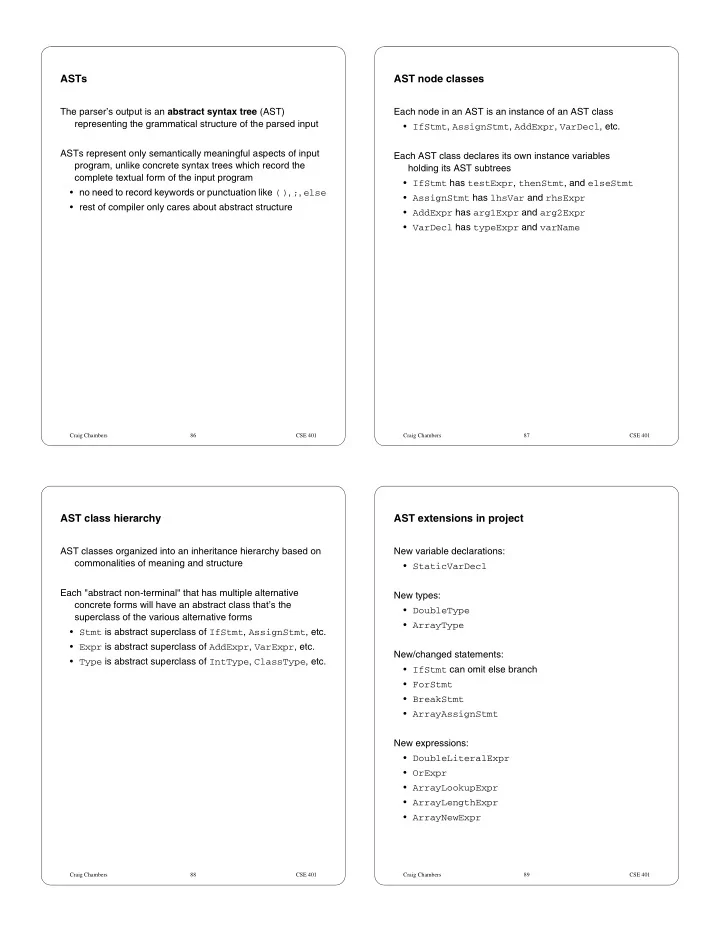
ASTs

The parser’s output is an abstract syntax tree (AST) representing the grammatical structure of the parsed input ASTs represent only semantically meaningful aspects of input program, unlike concrete syntax trees which record the complete textual form of the input program

  • no need to record keywords or punctuation like ( ), ;, else
  • rest of compiler only cares about abstract structure

Craig Chambers 87 CSE 401

AST node classes

Each node in an AST is an instance of an AST class

  • IfStmt, AssignStmt, AddExpr, VarDecl, etc.

Each AST class declares its own instance variables holding its AST subtrees

  • IfStmt has testExpr, thenStmt, and elseStmt
  • AssignStmt has lhsVar and rhsExpr
  • AddExpr has arg1Expr and arg2Expr
  • VarDecl has typeExpr and varName

Craig Chambers 88 CSE 401

AST class hierarchy

AST classes organized into an inheritance hierarchy based on commonalities of meaning and structure Each "abstract non-terminal" that has multiple alternative concrete forms will have an abstract class that’s the superclass of the various alternative forms

  • Stmt is abstract superclass of IfStmt, AssignStmt, etc.
  • Expr is abstract superclass of AddExpr, VarExpr, etc.
  • Type is abstract superclass of IntType, ClassType, etc.

Craig Chambers 89 CSE 401

AST extensions in project

New variable declarations:

  • StaticVarDecl

New types:

  • DoubleType
  • ArrayType

New/changed statements:

  • IfStmt can omit else branch
  • ForStmt
  • BreakStmt
  • ArrayAssignStmt

New expressions:

  • DoubleLiteralExpr
  • OrExpr
  • ArrayLookupExpr
  • ArrayLengthExpr
  • ArrayNewExpr
slide-2
SLIDE 2

Craig Chambers 90 CSE 401

Automatic parser generation in MiniJava

We use the CUP tool to automatically create a parser from a specification file, Parser/minijava.cup The MiniJava Makefile automatically rebuilds the parser whenever its specification file changes A CUP file has several sections:

  • introductory declarations included with the generated

parser

  • declarations of the terminals and nonterminals with their

types

  • the AST node or other value returned when finished parsing that

nonterminal or terminal

  • precedence declarations
  • productions + actions

Craig Chambers 91 CSE 401

Terminal and nonterminal declarations

Terminal declarations we saw before: /* reserved words: */ terminal CLASS, PUBLIC, STATIC, EXTENDS; ... /* tokens with values: */ terminal String IDENTIFIER; terminal Integer INT_LITERAL; Nonterminals are similar: nonterminal Program Program; nonterminal MainClassDecl MainClassDecl; nonterminal List/*<...>*/ ClassDecls; nonterminal RegularClassDecl ClassDecl; ... nonterminal List/*<Stmt>*/ Stmts; nonterminal Stmt Stmt; nonterminal List/*<Expr>*/ Exprs; nonterminal List/*<Expr>*/ MoreExprs; nonterminal Expr Expr; nonterminal String Identifier;

Craig Chambers 92 CSE 401

Precedence declarations

Can specify precedence and associativity of operators

  • equal precedence in a single declaration
  • lowest precedence textually first
  • specify left, right, or nonassoc with each declaration

Examples: precedence left AND_AND; precedence nonassoc EQUALS_EQUALS, EXCLAIM_EQUALS; precedence left LESSTHAN, LESSEQUAL, GREATEREQUAL, GREATERTHAN; precedence left PLUS, MINUS; precedence left STAR, SLASH; precedence left EXCLAIM; precedence left PERIOD;

Craig Chambers 93 CSE 401

Productions

All of the form: LHS ::= RHS1 {: Java code 1 :} | RHS2 {: Java code 2 :} | ... | RHSn {: Java code n :}; Can label symbols in RHS with :var suffix to refer to its result value in Java code

  • varleft is set to line in input where var symbol was

E.g.: Expr ::= Expr:arg1 PLUS Expr:arg2 {: RESULT = new AddExpr( arg1,arg2,arg1left); :} | INT_LITERAL:value {: RESULT = new IntLiteralExpr( value.intValue(),valueleft); :} | Expr:rcvr PERIOD Identifier:message OPEN_PAREN Exprs:args CLOSE_PAREN {: RESULT = new MethodCallExpr( rcvr,message,args,rcvrleft); :} | ... ;

slide-3
SLIDE 3

Craig Chambers 94 CSE 401

Error handling

How to handle syntax error? Option 1: quit compilation + easy

  • inconvenient for programmer

Option 2: error recovery + try to catch as many errors as possible on one compile

  • avoid streams of spurious errors

Option 3: error correction + fix syntax errors as part of compilation

  • hard!!

Craig Chambers 95 CSE 401

Panic mode error recovery

When find a syntax error, skip tokens until reach a “landmark”

  • landmarks in MiniJava: ;, ), }
  • once a landmark is found,

hope to have gotten back on track In top-down parser, maintain set of landmark tokens as recursive descent proceeds

  • landmarks selected from terminals later in production
  • as parsing proceeds, set of landmarks will change,

depending on the parsing context In bottom-up parser, can add special error nonterminals, followed by landmarks

  • if syntax error, then will skip tokens till see landmark, then

reduce and continue normally E.g. Stmt ::= ... | error ; | { error } Expr ::= ... | ( error )