ASTROPHYSICAL GROUNDS FOR THE STELLAR BLACK HOLE HYPOTHESIS - - PowerPoint PPT Presentation

astrophysical grounds for the stellar black hole
SMART_READER_LITE
LIVE PREVIEW

ASTROPHYSICAL GROUNDS FOR THE STELLAR BLACK HOLE HYPOTHESIS - - PowerPoint PPT Presentation

HIGH ENERGY SOURCES IN THE RE-IONIZATION EPOCH: Stellar Black Holes: Microquasars Flix Mirabel CEA-Saclay-France & CONICET-Argentina At the crossroads of Stellar Evolution, High Energy Astrophysics & Cosmology HOW WAS THE IGM


slide-1
SLIDE 1

HIGH ENERGY SOURCES IN THE RE-IONIZATION EPOCH: Stellar Black Holes: Microquasars

Félix Mirabel CEA-Saclay-France & CONICET-Argentina
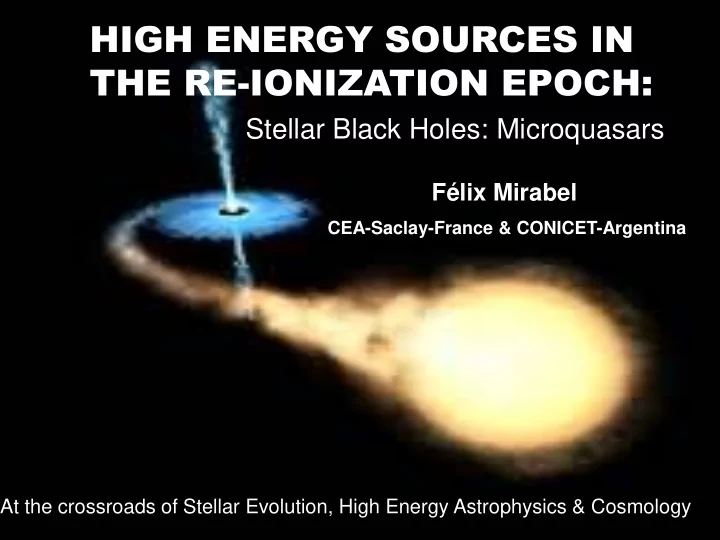
At the crossroads of Stellar Evolution, High Energy Astrophysics & Cosmology

slide-2
SLIDE 2

HOW WAS THE IGM RE-IONIZED?

  • ROLE OF HIGH ENERGY SOURCES (AGN, SNe, LGRBs, XRBs)?

Based on recent results from Stellar evolution and high energy astrophysics:

  • Proposal: In galaxies at z>10 a large fraction of Pop III-II stars end as

StBHs StBHs in in HMXBs HMXBs  important feedback in the form of X-rays & jets

  • X-rays overtake the HII regions produced by UVs, heating

and partially ionizing the IGM over large volumes of space.

  • The IGM was fully ionized by the UV

from the first stars (Pop III & II)  HII regions expanding at < 100 Km/s.

THE « SWISS CHEESE » MODEL

for the re-ionization of the IGM: Gunn-Peterson effect Dark age

slide-3
SLIDE 3

ASTROPHYSICAL GROUNDS FOR THE STELLAR BLACK HOLE HYPOTHESIS

THEORETICAL GROUNDS

  • MOST POP III & II STARS WERE FORMED AS MULTIPLE SYSTEMS

Turk+Science 2009; Krumholz+ Science 2009; Clark+ Science 2011; Stacy+…etc.

  • STARS OF LOW Z WIT

WITH H M M > > 20 M 20 M END AS BHs DIRECTLY

Fryer,1999;Heger+2003;Georgy+2009;Woosley+2008;Nomoto+2010; Linden,Kalogera+2011

  • NO ENERGETIC SNe  STELLAR BHs REMAIN BOUND TO DONORS

Mirabel & Rodrigues, Science 2003; Mirabel+ Nature 2008

OBSERVATIONAL GROUNDS

  • MOST ULXs & LGRBs ARE HOSTED IN LOW Z-HIGH-SSFR GALAXIES

Feng & Soria,2011;LeFloc’h,Duc,Mirabel;2003;Fruchter+ Nature, 2006; But are caveats!

  • Lx/SFR EVOLUTION WITH z IS DRIVEN BY Z EVOLUTION IN HMXBs

Fragos+2012; Basu-Zych+2012

  • IN LOW Z GALAXIES Lx/SFR IS LARGER THAN IN MAIN-S GALAXIES

Thuan+ 2004; Kaaret+ 2014; Douna, Pellizza, Mirabel, 2014 (in progress)

slide-4
SLIDE 4

FROM STUDIES OF HMXBs IN LOCAL UNIVERSE IT IS INFERRED

THE COSMIC EVOLUTION OF METALLICITY

 A COSMIC EVOLUTION OF BH-HMXBs

. At low metallicities (Z<Z-5

) there should be an increase of:

  • The mass of stellar BHs because the progenitor cores are more massive
  • The number of BH-HMXBs since massive stars form BHs by direct collapse
  • The X-ray luminosity of BH-HMXBs…an issue to be investigated further.
  • Mirabel. Invited Review. Proceedings of IAU Symp. 275 (2011)

(arXiV:1012.4944v1 [astro-ph.CO] 22 Dec 2010)

slide-5
SLIDE 5

Ionization by BH-HMXB vs massive star

Mirabel, Dijkstra, Laurent, Loeb, Pritchard (A&A 2011)  N&V in Nature (2011)

Counting photons

฀ N,BH N,*  0.6 N phot 64000      

1 MBH

M*       fedd 0.1       tacc 20Myr       E  keV        

1

fesc,* 0.1      

1 fesc,BH

1.0       ,

Nphot = number of ionizing photons emitted per atom of H nucleus fedd = fraction of Eddington luminosity for a time tacc <E>= mean photon energy emitted by the accreting BH fesc,* (fesq,BH) = fraction of ionizing photons that escape

For fiducially values of the model parameters:

AN ACCRETING STELLAR BLACK HOLE EMITS A NUMBER OF X-RAY PHOTONS COMPARABLE TO THE UV PHOTONS FROM ITS PROGENITOR STAR

  • But in a fully neutral medium Nsec* = 25 (E/1 keV), where E is the photon energy

However, not all stars will be massive and lead to the formation of BH-HMXBs…

slide-6
SLIDE 6

HMXBs & HI TOMOGRAPHY DURING THE EoR

Gas Temperature l21cm line Mirabel+ (2011) Mirabel+ (2011) Fialkov+ Nature, 2014

l21cm line X-ray hard spectrum

fx at z > 6 must increase as Z < 10-5 Z BH-HMXBs HEATED THE IGM TO ~104 K OVER LARGE VOLUMES CONCLUSION:

X-RAYS HAVE LONGER MEAN FREE PATH THAN UVs. THEY HEAT THE GAS FAR FROM THE GALAXIES AND PARTIALLY IONIZE THE BULK OF THE IGM.

slide-7
SLIDE 7

X-RAY IMPACT ON THE FIRST STARS & GALAXIES

  • THE DOMINANT POP III STARS HAVE MASSES OF 3-30 M

(Hummel, Stacy, Jeon, Oliveri, Bromm, 2014) For n < 1 cm-3 X-ray heating dominates & enhance the formation of H2 For n > 100 cm-3 H2 accelerates cooling, collapse & fragmentation

  • DWARF GALAXIES WITH <10

109

9 M COUL

COULD D NO NOT T FORM FORM Mirabel, Dijkstra, Laurent, Loeb, Pritchard (A&A 2011)

Mmin ~ 109 (r/100rc)-1/2 (m/0.6)3/2[T(K)/104]3/2[(1+z)/10]-3/2 M rc = critical mass density for a flat universe, r = mass density in the galaxy

m = mean molecular weight, z = redshift, T = temperature of the IGM

  • THE THERMAL HISTORY OF THE IGM DETERMINED BY

X-RAYS FROM HMXBs LIMITED THE MASS OF POP III-II STARS & THE NUMBERS OF DWARF GALAXIES RELATIVE TO THE NUMBERS PREDICTED BY THE lCDM

slide-8
SLIDE 8

IMPLICATIONS OF THE BH-HMXB HYPOTHESIS

  • I) l21cm tomography of HI with LOFAR, SKA…may show

a a smoot smoother end t her end to the dar

  • the dark

k ages ges

  • II) The X-rays from BH-HMXBs may contribute to the

10 10-20 20% % unr unresolv esolved har ed hard X d X-ray ay bac backg kground

  • und
  • III) Stellar mass BH-BH binaries may be the more likely

detected sour sources ces of

  • f gravita

vitational tional waves es

(e.g. Belczynski+2011;Ziosi+2014)

  • IV) Feedback from AGN at the centre of clusters

sto stop the unlimited p the unlimited growth of wth of galaxies galaxies (Fabian+); feedback from stellar BHs reduce the lCDM predicted number number of

  • f d

dwarf arf galaxies galaxies

  • VI) Ther

here is e is a a popula population of tion of nak naked ed dar dark ma k matter tter haloes haloes with M <109 M