Astrophysical and Instrumental Noise Sources: Transits Sagan - - PowerPoint PPT Presentation

astrophysical and instrumental noise sources transits
SMART_READER_LITE
LIVE PREVIEW

Astrophysical and Instrumental Noise Sources: Transits Sagan - - PowerPoint PPT Presentation

Astrophysical and Instrumental Noise Sources: Transits Sagan Workshop July 19 2016 Jessie Christiansen NASA Exoplanet Science Institute/Caltech Why do we care about noise? Take the example of the Kepler mission the primary goal was


slide-1
SLIDE 1

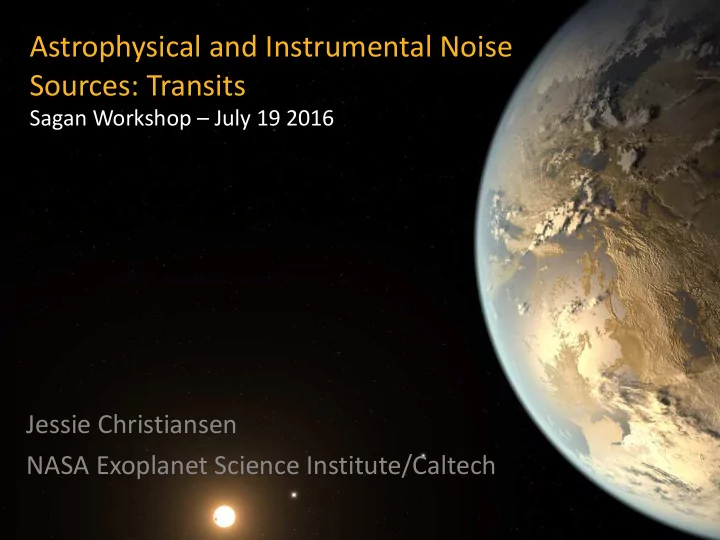
Astrophysical and Instrumental Noise Sources: Transits

Sagan Workshop – July 19 2016

Jessie Christiansen NASA Exoplanet Science Institute/Caltech

slide-2
SLIDE 2

Why do we care about noise?

Take the example of the Kepler mission – the primary goal was determining the occurrence rate

  • f Earth-like planets around sun-like stars

That’s hard! Earth creates a 85ppm deep transit Mission design has to account for all the known sources of noise – error budget of 20ppm in 6.5h How big a telescope do we need to build? How faint a star can we look at? What kind of stars can we look at? How expensive a detector do we need to buy? What is the overall noise floor achievable?

slide-3
SLIDE 3

Overview

Credit: Dan Foreman-Mackay, Davos Stars do stuff! Spacecraft do stuff!

slide-4
SLIDE 4

Overview

Credit: Dan Foreman-Mackay, Davos Stars do stuff! Telescopes do stuff! Detectors do stuff! (Planets do stuff, too!)

atmosphere

Atmospheres do stuff!

slide-5
SLIDE 5

Stars do stuff…

Credit: Xavier Dumusque

slide-6
SLIDE 6

Oscillations (<15 minutes, <1%) Granulation (15min-2days,<0.1%) Magnetic activity

  • spots (2days to weeks, <10%))
  • flares (stochastic,<few%)

Pulsations (mins to yrs, <10s of %) Eclipses (hrs to yrs, <50%)

Stars do stuff…

Credit: Arcetri Solar Physics Group/NSO Paz-Chinchon+2015 Credit: NASA/SDO

Davenport et al. 2014 Molner+2014

Christiansen, PhD thesis, 2007

slide-7
SLIDE 7

Different stars do different stuff… Christiansen+2012

FGK dwarf stars;

Oscillations,

Granulation,

Spots

Subgiant, giant stars; Oscillations, pulsations M dwarf stars;

Spots, flares

slide-8
SLIDE 8

Telescopes do stuff…

They typically have pointing jitter

  • Intra-pixel variations, e.g. Spitzer, K2 (not Kepler!)

Christiansen+2010 irachpp.spitzer.caltech.edu

slide-9
SLIDE 9

Telescopes do stuff…

They typically have pointing jitter

  • Intra-pixel variations, e.g. Spitzer, K2 (not Kepler!)

Vanderburg+2016

slide-10
SLIDE 10

Telescopes do stuff…

They typically have pointing jitter

  • Intra-pixel variations, e.g. Spitzer, K2 (not Kepler!)
  • Inter-pixel variations, e.g. EPOCh

Christiansen+2010 Ballard+2010

slide-11
SLIDE 11

They typically have pointing jitter

  • Intra-pixel variations, e.g. Spitzer, K2 (not Kepler!)
  • Inter-pixel variations, e.g. EPOCh

They experience thermal variations, e.g. Kepler

Telescopes do stuff…

Smith+2012 Christiansen+2013

slide-12
SLIDE 12

The atmosphere does stuff…

Essentially it changes transparency as a function

  • f time, via
  • Airmass (colour-dependent extinction)
  • Humidity (precipitable water vapour)
  • Variable sky background, cloud cover

And the point-spread-function of the light also changes

  • Seeing (temperature, airmass, windspeed);

similar effects to thermal changes Often on similar timescales to transits L Generally affect all stars, can be treated with common mode models (PCA, SVD, etc) J

Christiansen, PhD thesis, 2007 Berta+2012 Christiansen+2013

slide-13
SLIDE 13

Detectors do stuff…

slide-14
SLIDE 14

Detectors do stuff…

slide-15
SLIDE 15

Detectors do stuff…

Tenenbaum+2014

log(Period(days))

372 days!

3 years of data… 4 years of data…

slide-16
SLIDE 16

Summary

There is a lot standing between you and a clean transit signal! You can make clever choices in order to minimise/mitigate/isolate noise sources (or at least the timescales of those noise sources)

  • Target selection
  • Stability of instrument
  • The more the merrier, for treating common

mode systematics) For remaining (and sometimes unavoidable) noise sources, exoplaneteers have been relying on increasingly sophisticated noise models (e.g. Gaussian process) – see rest of #sagan2016!