SLIDE 1 Belgrade, 19.02.2014 DKTI Bioenergy Serbia
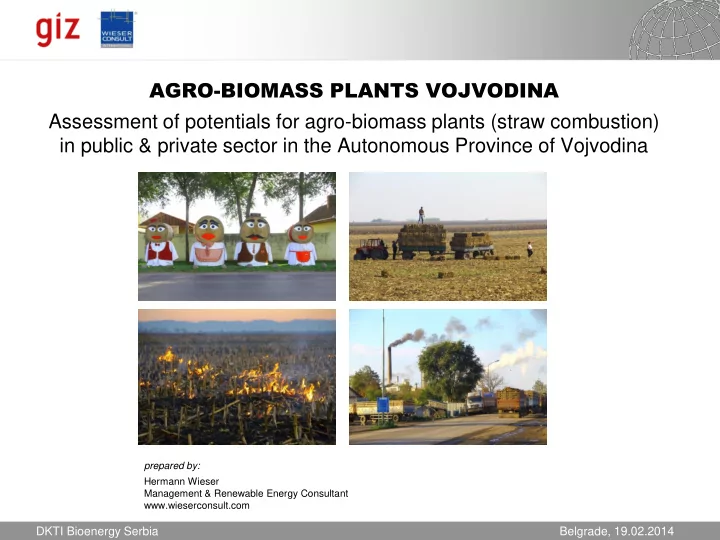
AGRO-BIOMASS PLANTS VOJVODINA Assessment of potentials for agro-biomass plants (straw combustion) in public & private sector in the Autonomous Province of Vojvodina
prepared by: Hermann Wieser Management & Renewable Energy Consultant www.wieserconsult.com
SLIDE 2 Belgrade, 19.02.2014 2 DKTI Bioenergy Serbia
Structure of the Presentation
- Basic data of Province of Vojvodina
- Agro-biomass potential
- Local experience in collection and logistics of agro-biomass
and identified biomass plants
- Assessment of potentials for agro-biomass projects in selected Municipalities
- Agro-biomass: Strength – Weakness Analysis
- Conclusions and recommendations
SLIDE 3
Belgrade, 19.02.2014 3 DKTI Bioenergy Serbia
Basic data of the Autonomous Province of Vojvodina Agriculture relevant for agro-biomass Land area 2.150.000 ha Forest land 150.000 ha Arable land 1.780.000 ha Wheat & other cereals 325.700 ha Corn 903.100 ha Soya 148.000 ha Sunflower 153.000 ha
Source: Statistical data provided by Chamber of Commerce Vojvodina, Secretariat for Agriculture & Food Industry, average ha 2009 - 2011
SLIDE 4
Belgrade, 19.02.2014 4 DKTI Bioenergy Serbia
Basic data on structure of the energy sector in the Autonomous Province of Vojvodina Population
~ 2.00 million inhabitants
Total energy consumption
184,7 PJ
Domestic sources
76,83 PJ (42%)
Imported sources
107,94 PJ (58%)
Hydro (installed capacity) Wind (installed capacity) Solar thermal (installed capacity)
2.233 m2; 1.5 MW
Biomass for combustion < 100 kW
~ 100 ÷ 200
Biomass for combustion > 100 kW
26
Biomass for electricity Biogas (number of units; MW)
4; 4,1 MW
Source: Autonomous Province of Vojvodina, Provincial Secretariat for Energy and Mineral Resources
SLIDE 5 Belgrade, 19.02.2014 5 DKTI Bioenergy Serbia
Structure of the Presentation
- Basic data of Province of Vojvodina
- Agro-biomass potential
- Local experience in collection and logistics of agro-biomass
and identified biomass plants
- Assessment of potentials for agro-biomass projects in selected Municipalities
- Agro-biomass: Strength – Weakness Analysis
- Conclusions and recommendations
SLIDE 6 Belgrade, 19.02.2014 6 DKTI Bioenergy Serbia
Agro-biomass potential of selected crops
Crop *)
Surface [ha] Yield of grain [t/ha] Mass of grain [t/ha] Ratio of masses [t/t] Yield of straw [t/ha] Mass of straw [t/year]
Wheat 262.900 3.7 972.730 1:1 3.7 972.730 Other cereals 62.800 3.0 188.400 1:1 3.0 188.400 Corn
(stalk + corncob)
903.100 5.2 4.700.000 1:1 5.2 4.700.000
1.04 940.000 Sunflower
(stalk + head)
153.000 2.0 306.000 1:2 4.0 612.000
0.6 91.800 Soya 148.000 2.4 355.200 1:2 4.8 710.400 Oilseed rape 4,204 2.090 8,786 1:2 4.180 17.500 Tobacco 4,321 1.475 6,373 1:0.35 0.516 2.230 Total 1.538.325 4.25 6.537.489 1:1,2 4.76 7.295.060
Source: Statistical Yearbook of Serbia, Study “Razvoj Trzista Biomase u Vojvodini”, Prof. Dr. Dusan Gvozdenac, 2012, Chamber of Economy of Vojvodina, Secretariat for Agriculture & Food Industry, average ha 2009 - 2011 *) Due to the focus of the present study in the sector of agro-biomass the resources in term of forestry biomass, agricultural biomass related to energy crops (oil, sugar, starch crops), livestock waste as well as industrial and household waste are not of subject in the table above.
SLIDE 7
Belgrade, 19.02.2014 7 DKTI Bioenergy Serbia
Realistic potential of agro-biomass for sustainable generation of heat and electricity in Province of Vojvodina
Realistic agro-biomass potential 30% - 50% of total production (7.295,060 tons straw/year) 2,2 – 3,6 mn tons/year Realistic agro-biomass potential in GWh 8.800 – 14.400 GWh Realistic agro-biomass potential in Petajoule 31,7 – 51,8 PJ Potential share of contribution to heat and electricity production for total energy consumption
(Total = 184,77 PJ; fuel utilization rate 70%)
12% - 19% Sustainable potential for replacement of heating oil in toe/year 756.666 – 1.238.117 toe Realistic potential of CO2 reduction in toe/year 1.967 – 3.219 toe
SLIDE 8 Belgrade, 19.02.2014 8 DKTI Bioenergy Serbia
Structure of the Presentation
- Basic data of Province of Vojvodina
- Agro-biomass potential
- Local experience in collection and logistics of agro-biomass
and identified biomass plants
- Assessment of potentials for agro-biomass projects in selected Municipalities
- Agro-biomass: Strength – Weakness Analysis
- Conclusions and recommendations
SLIDE 9 Belgrade, 19.02.2014 9 DKTI Bioenergy Serbia
Collection and logistics of agro-biomass (straw)
- In many cases straw is still burned on the fields even it is prohibited by law
SLIDE 10 Belgrade, 19.02.2014 10 DKTI Bioenergy Serbia
Collection and logistics of agro-biomass (straw)
- Straw collection and logistic usually done with old tractors and balers by local farmers
- Straw sold to local companies for heating and drying of cereals
- Straw and corn cobs collected by farmers for household and farm heating
SLIDE 11 Belgrade, 19.02.2014 11 DKTI Bioenergy Serbia
Collection and logistics of agro-biomass (straw)
- But also professional straw collection and logistic companies already
present on market
- Pictures below show straw collection and storage by company
“Hollo Farm” in Dorodoslovo
SLIDE 12 Belgrade, 19.02.2014 12 DKTI Bioenergy Serbia
Collection and logistics of agro-biomass (straw)
- Straw collection and storage by company “Hollo Farm” in Dorodoslovo
SLIDE 13 Belgrade, 19.02.2014 13 DKTI Bioenergy Serbia
Identified agro-biomass (straw) heating plants
- CHP-plants fired with agro-biomass NOT identified
- Status of implementation of heating plants in Province of Vojvodina can be
characterised for mainly three categories:
- 1. Small-scaled and old firing systems manufactured by local boiler
producers in the past
- 2. Scientific and research plants at smaller scale
- 3. Newly invested plants for heating and process heat with advanced
technology
SLIDE 14
Belgrade, 19.02.2014 14 DKTI Bioenergy Serbia
Identified agro-biomass (straw) heating plants - Examples
1. Small-scaled and old firing systems manufactured by local boiler producers in the past
2 x 250 kW heating boiler (25 years old) fired with soya straw used by agricultural cooperative “Mladiborac” in Municipality of Apatin for drying of cereals and farm heating Boilers manufactured by old train wagon factory in Subotica (shut down) Assumption that some similar boilers are used in Province of Vojvodina
2. Scientific and research plants at small scale
Research heating plant installed at PKB premises near Belgrade The heating plant is fired by soya straw for supplying thermal energy to green houses
Project managed by the Innovation Center, Faculty of Mechanical Engineering, Belgrade University, Associate of Nuclear Institute Vinca - Laboratory for Thermal Engineering and Energy
SLIDE 15 Belgrade, 19.02.2014 15 DKTI Bioenergy Serbia
Identified agro-biomass (straw) heating plants - Examples
- 3. Newly invested plants for heating and process heat with advanced technology
3.1. Sremska Mitrovica: 18 MW heating plant connected to district heating Fired with sunflower shells In the ownership of Serbian state-owned power producer Elektroprivreda Srbije (EPS) and operated by regional arm Panonske Termoelektrane-Toplane 3.2. Victoria Group Company in recent years installed a capacity of around 40 MW thermal Heating plants fired by different agro-biomass fuels Thermal energy used in processing plants of company group 3.3. JKP Suboticka Toplana (project in development) District heating company of the City of Subotica plans to invest in biomass CHP-plant with capacity of 5,0 MWel and 9,2 MWth Project supported by KfW
SLIDE 16
Belgrade, 19.02.2014 16 DKTI Bioenergy Serbia
Identified agro-pellets producer
1. Pellet Plant Dorodoslovo d.o.o.
Capacity of the factory is 100.000 tons of agro-pellets per year from corn straw Corn straw bales are produced by “Hollo Farm” located in Dorodoslovo
2. Small-scaled agro-pellets and briquetts producers
Several small-scaled agro-pellets producers exist on market Due to lack of standardisation and weak local market sector does not develop very well
SLIDE 17 Belgrade, 19.02.2014 17 DKTI Bioenergy Serbia
Identified biogas plant in City of Vrbas
- Biomass plant in the ownership of Mirotin Energo d.o.o.
1 MWel in operation; expansion of 0,5 MWel in preparation Fuel basis:
27.000 tons cattle manure 10.000 tons corn silage Residues from sugar beet and green waste
SLIDE 18 Belgrade, 19.02.2014 18 DKTI Bioenergy Serbia
Serbian Energy law and feed-in tariff for biomass
The energy policy of Serbia is defined by the Energy Law considering the promotion of using renewable energy sources. On 20.11.2009 feed-in tariffs for renewable energy had been adopted. The provisions entered in to force on 1.1.2010. Amendments to the feed-in tariffs are expected for next periods. The feed-in tariff for biomass is shown in the table below Installed capacity in MW Tariff c€/1kWh
until 1 MW 13,26 from 1 MW up to 10 MW 13,82 – 0,56*R
(R = installed capacity)
Over 10 MW 8,22
SLIDE 19 Belgrade, 19.02.2014 19 DKTI Bioenergy Serbia
Structure of the Presentation
- Basic data of Province of Vojvodina
- Agro-biomass potential
- Local experience in collection and logistics of agro-biomass
and identified biomass plants
- Assessment of potentials for agro-biomass projects in selected Municipalities
- Agro-biomass: Strength – Weakness Analysis
- Conclusions and recommendations
SLIDE 20
Belgrade, 19.02.2014 20 DKTI Bioenergy Serbia
Assessment of potentials for agro-biomass projects in selected Municipalities in public & private sector in the Province of Vojvodina Selection criteria
NOT to interfere with the KfW-Project “Pre-Feasibility for 15 District Heating Companies on Biomass CHP in Serbia” Size of the Municipalities/Cities Presumption of existing district heating Strong agricultural background Approach Arrangement of meetings by GIZ back-office in Belgrade Request for representatives of Municipality, development agencies, energy supply, agriculture, industry Presentation/Introduction of project “Development of a Sustainable Bioenergy Market in Serbia” and it’s TA Components Identification of existing energy supply and potential for future development Visits of premises and photo documentation according to disposability
SLIDE 21
Belgrade, 19.02.2014 21 DKTI Bioenergy Serbia
Assessment of potentials for agro-biomass projects in selected Municipalities in public & private sector in the Province of Vojvodina Selected Municipalities/Cities
Selected Municipalities Apatin Becej Indjija Kula Vrbas Vrsac
SLIDE 22
Belgrade, 19.02.2014 22 DKTI Bioenergy Serbia
Short profile of Municipalities
Subject
Apatin Becej Indjija Kula Vrbas Vrsac
Population Municipality
28.900 37.351 47.400 43.100 42.100 54.200
Population City
17.400 23.895 26.000 26.800 24.100 35.700
Total area
333 km2 487 km2 384 km2 481 km2 376 km2 424 km2
Agricultural land
24.000 ha 41.500 ha 29.000 45.000 ha 33.000 ha 57.000 ha
District heating
no Yes No No *) No *) Yes
Major companies **)
+ + ***) + ++ +++ *) Cities actually without district heating but having intentions to implement district heating systems **) Situation in terms of major agricultural and industrial processing companies in the City with demand of thermal energy and interest for potential investment an agro-biomass plant project ***) Industrial parks with gas grid systems for room heating; light industry with minor need of process heat
SLIDE 23 Belgrade, 19.02.2014 23 DKTI Bioenergy Serbia
Potential of agro-biomass (straw) supply in Municipalities
Municipalities Agro-biomass crop farming in ha *) Potential of straw supply in t/year Realistic straw potential in t/year Apatin
16.500 75.600 23.000
Becej
32.500 146.600 44.000
Indjija
24.000 113.400 34.000
Kula
32.000 147.500 44.500
Vrbas
28.000 129.000 39.000
Vrsac
50.500 205.000 61.500
*) Farming of major crops for agro-biomass (straw) production; medium local yields and grain-straw proportion
Crop variety Medium crop yield tons/ha Medium grain-straw proportion Wheat & other cereals
3,7 1:1
Corn
5,1 1:1
Soya
2,4 1:2
Sunflower
2,0 1:2
SLIDE 24
Belgrade, 19.02.2014 24 DKTI Bioenergy Serbia
Selected potentials for project development/investments in selected Cities
1. Energy supply in City of Becej 2. Companies in the Industrial Zone of Vrbas
SLIDE 25 Belgrade, 19.02.2014 25 DKTI Bioenergy Serbia
Energy supply in City of Becej
- District heating network in operation based on gas
- Energy switch from fossil to renewables is a committed target of the City Council
- Basic data of Toplana Becej (district heating company) are as follows:
Basic data
Connected households 1.100 households with total 110 km2 heated area Distribution network 22 km Energy demand/year 13 million kWhth Fuel Natural gas Production cost EUR 100 per MWhth Uptime Autumn to spring, no supply in summer Heat metering Among one of the four DHN in Serbia using metering system
Location Outskirts of town, existing location too small for construction
- f new agro-biomass plant, alternative location available
SLIDE 26
Belgrade, 19.02.2014 26 DKTI Bioenergy Serbia
Selected pictures of Toplana Becej
SLIDE 27 Belgrade, 19.02.2014 27 DKTI Bioenergy Serbia
Selected data and pictures of Industrial Zone of Vrbas
- The industrial zones of Vrbas in total are covering 180 hectares. Following major
companies are located in the industrial zone:
Sunoko (known as former sugar factory Backa), member of MK Group (www.sunoko.rs) Carnex, meat processing factory, member of MK Group (www.carnex.rs) Vital, edible oil and vegetable fat factory (www.vital.rs)
SLIDE 28 Belgrade, 19.02.2014 28 DKTI Bioenergy Serbia
Structure of the Presentation
- Basic data of Province of Vojvodina
- Agro-biomass potential
- Local experience in collection and logistics of agro-biomass
and identified biomass plants
- Assessment of potentials for agro-biomass projects in selected Municipalities
- Agro-biomass: Strength – Weakness Analysis
- Conclusions and recommendations
SLIDE 29 Belgrade, 19.02.2014 29 DKTI Bioenergy Serbia
Agro-Biomass: Strength-Weakness Analysis
Str trength th Rati ting Support rt me measu sures res for for furthe further r imp mprov roveme ment t
Sustainable production of up-to-now mostly unused agro-fuel feasible High GIZ: Policy advice, Biomass supply CO2-neutral fuel with realistic potential for replacement of fossils high GIZ: Policy advice, Biomass supply and Project development KfW and Financial institutions Cost-efficient fuel
(lower price per kWh than fossils)
medium GIZ: Policy advice Structure of Vojvodina agriculture with high potential and medium to large-sized farmers support sustainable supply high GIZ: Biomass supply Regional supply – local use for firing “Principal of short ways/logistics” high GIZ: Policy advice, Biomass supply Agricultural residues do not compete with food and feed “Food is for people – waste for energy” high GIZ: Policy advice
SLIDE 30 Belgrade, 19.02.2014 30 DKTI Bioenergy Serbia
Agro-Biomass: Strength-Weakness Analysis
We Weakness Ratin Rating Support rt me measure res
Lack of standardisation of agro-biomass high GIZ: Policy advice Insufficient legal framework conditions high GIZ: Policy advice Investments in harvesting, transport, storage and conditioning facilities necessary high KfW, EBRD, EIF, Renewable Energy Funds, Investment subsidies, Tax incentives Risk of insufficient quantities of agro-biomass supply (weather conditions, lack of professional farming) medium GIZ: Biomass supply Variations in quantity of agro-biomass (moisture content, deterioration, inadequate storage) medium GIZ: Biomass supply Fuel properties different to wood-biomass but innovative and approved combustion technology available low GIZ: Demonstration Projects Risk in change of legal framework especially for the feed-in tariff for biomass medium GIZ: Policy advice Lack of financial resources in public & private sector for project development and investment high KfW, EBRD, EIF, Renewable Energy Funds, Investment subsidies, Tax incentives Up to now minor activities in research and development medium GIZ: Policy advice
SLIDE 31 Belgrade, 19.02.2014 31 DKTI Bioenergy Serbia
Structure of the Presentation
- Basic data of Province of Vojvodina
- Agro-biomass potential
- Local experience in collection and logistics of agro-biomass
and identified biomass plants
- Assessment of potentials for agro-biomass projects in selected Municipalities
- Agro-biomass: Strength – Weakness Analysis
- Conclusions and recommendations
SLIDE 32 Belgrade, 19.02.2014 32 DKTI Bioenergy Serbia
Conclusions and recommendations
GI GIZ Z TA: : Polic
y Advice dvice
Assessment results: Legal framework, standards for collection and logistics as well as incentives for agro-biomass production are insufficient or do not exist. Recommendations Establishment of a working group on national and regional level for transfer of EU legislation Collaboration with the Provincial Secretariat for Energy and Mineral Resources (PSEMR) and their intentions to prepare a renewable energy Master Plan for Vojvodina Considering the quite unique agricultural framework conditions in the Autonomous Province of Vojvodina with dominance of agricultural biomass Transfer of experience and know-how for legislation and standards from EU countries in which agricultural biomass plays an important role
SLIDE 33 Belgrade, 19.02.2014 33 DKTI Bioenergy Serbia
Conclusions and recommendations
GIZ GIZ TA: : Biom iomass ass Suppl Supply y
Assessment results: The agro-biomass market is undeveloped even some companies started collection and trading activities in recent years. Theoretical and practical knowledge in terms of collection, storage and logistic of biomass is insufficient. Incentives and subsidies for acquisition of adequate technology for efficient agro-biomass supply do not exist. Recommendations Setting up working groups on regional and local level for theoretical and practical training for efficient agro-biomass supply chain management Organisation of study visits to countries with experience in agro-biomass supply management Arranging of field days for demonstration of collection, logistic and storage
Supporting the access to financing of biomass collection, logistics and storage technology and implementation of pilot projects for dissemination of know-how
SLIDE 34 Belgrade, 19.02.2014 34 DKTI Bioenergy Serbia
Conclusions and recommendations
GIZ T TA: A: Demons Demonstr tration tion pr projects
Assessment results: Project developments for agro-biomass heating and CHP plants are already ongoing in several Municipalities and in private sector. On closer analysis of these projects it came up that the technical and commercial conditions considered may not comply with the expectations for a bankable project. The lack of a legal framework and standardisation, the insufficient knowledge in terms
- f straw as a quite crucial fuel and the undeveloped biomass market are the main
reasons for the insecurity of potential public and private investors for agro-biomass
- plants. The effect is that financial resources for project development in order to
elaborate bankable projects are not mobilised or hold back.
SLIDE 35 Belgrade, 19.02.2014 35 DKTI Bioenergy Serbia
Conclusions and recommendations
GIZ T TA: A: Demons Demonstr tration tion pr projects
Recommendations
Assistance of public and private investors in access to financial resources and providing technical assistance for project development and implementation of agro- biomass plants as foreseen in the GIZ project. Supporting project development and investment for demonstration projects on following levels: Small-scaled agro-biomass plants on farm and/or village level for heating
- f public buildings, farm buildings and drying of cereals in the sense of
“Neighbourhood heating” Medium scaled agro-biomass plant for district heating Larger-scaled agro-biomass CHP plant for providing process heat and steam for industry and thermal energy for DH
SLIDE 36 Belgrade, 19.02.2014 36 DKTI Bioenergy Serbia
Hey, the GIZ project “Development
ainabl able e Bioe
ergy gy Market rket in Serbia” is an excellent instrument to suppor port t the Provin
ce of Vojvodina dina!