Assessing and Reporting Heterogeneity of Treatment Effect in - - PowerPoint PPT Presentation

assessing and reporting heterogeneity of treatment effect
SMART_READER_LITE
LIVE PREVIEW

Assessing and Reporting Heterogeneity of Treatment Effect in - - PowerPoint PPT Presentation

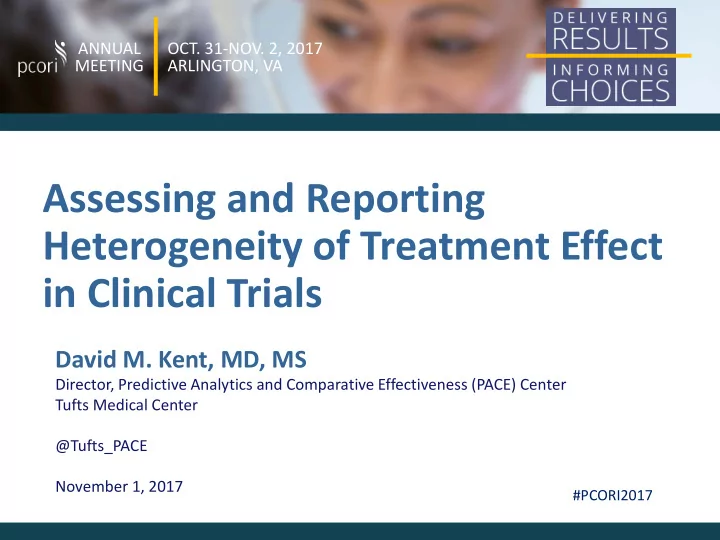
ANNUAL OCT. 31-NOV. 2, 2017 MEETING ARLINGTON, VA Assessing and Reporting Heterogeneity of Treatment Effect in Clinical Trials David M. Kent, MD, MS Director, Predictive Analytics and Comparative Effectiveness (PACE) Center Tufts Medical


slide-1
SLIDE 1

ANNUAL MEETING

  • OCT. 31-NOV. 2, 2017

ARLINGTON, VA

#PCORI2017

Assessing and Reporting Heterogeneity of Treatment Effect in Clinical Trials

David M. Kent, MD, MS

Director, Predictive Analytics and Comparative Effectiveness (PACE) Center Tufts Medical Center @Tufts_PACE November 1, 2017

slide-2
SLIDE 2

ANNUAL MEETING | #PCORI2017

2

Background

  • Person-level heterogeneity of treatment effects (HTE)

is ubiquitous.

  • Group-level HTE is rarely reliably identifiable in clinical

trials.

slide-3
SLIDE 3

ANNUAL MEETING | #PCORI2017

3

Problems with conventional subgroup analysis

  • Patients have too many attributes
  • Low power
slide-4
SLIDE 4

ANNUAL MEETING | #PCORI2017

4

  • Risk is a known mathematical determinant of

treatment effect.

Why privilege risk-based HTE analysis?

slide-5
SLIDE 5

ANNUAL MEETING | #PCORI2017

5

Common measures of treatment effect

Risk Reduction (RR) Definition Absolute RR EER-CER Relative RR 1 - EER CER Odds Ratio EER/(1-EER) CER/(1-CER)

CER=control event rate EER=experimental event rate

slide-6
SLIDE 6

ANNUAL MEETING | #PCORI2017

6

Why privilege risk-based HTE analysis?

  • Risk is a known mathematical determinant of

treatment effect.

  • When baseline risk heterogeneity is present (and the

treatment effect is non-zero), there is always HTE.

  • Risk provides a summary measure that takes into

account multiple variables that are relevant and provides “patient-centered” evidence.

slide-7
SLIDE 7

7 Kent DM, et al. J Gen Intern Med 2002; 17:887-94.

slide-8
SLIDE 8

8 Kent DM, et al. J Gen Intern Med 2002; 17:887-94.

slide-9
SLIDE 9

1.0% 16.3%

Kent DM, et al. J Gen Intern Med 2002; 17:887-94.

slide-10
SLIDE 10

ANNUAL MEETING | #PCORI2017

10

DANAMI-2

Thune JJ, et al. Circulation 2005,112:2017-2021.

High Risk Low Risk

slide-11
SLIDE 11

ANNUAL MEETING | #PCORI2017

11

Predicted risk distributions in RCTs

Kent DM et al. Int J Epidemiol. 2016 Jul 3. pii: dyw118.

slide-12
SLIDE 12

ANNUAL MEETING | #PCORI2017

12

Relative risk reduction across risk quartiles

  • Treatment effect

heterogeneity on the proportional scale across patients at different baseline risk was rare.

slide-13
SLIDE 13

ANNUAL MEETING | #PCORI2017

13

Absolute risk reduction across risk quartiles

  • Substantial differences in

absolute treatment effects were common.

  • Displaying results across

subgroups defined by risk is feasible and can lead to clinically important findings.

slide-14
SLIDE 14

ANNUAL MEETING | #PCORI2017

14

Diabetes Prevention Program (DPP) Randomized Controlled Trial

  • Participants: 3060 non-diabetic persons with evidence of

impaired glucose metabolism

  • Intervention: Intervention groups received metformin or a

lifestyle-modification program

  • Main outcome measure: Development of diabetes

The DPP study was conducted by the DPP Investigators and supported by the National Institute of Diabetes and Digestive and Kidney Diseases (NIDDK).

slide-15
SLIDE 15

ANNUAL MEETING | #PCORI2017

15

DPP Risk Stratified Results: Hazard Ratios

15

p-value = 0.0008 p-value = not statistically significant

slide-16
SLIDE 16

ANNUAL MEETING | #PCORI2017

16

DPP Risk Stratified Results: Absolute Risk

slide-17
SLIDE 17

ANNUAL MEETING | #PCORI2017

17

Improving Diabetes Prevention with Benefit- Based Tailored Treatment

  • Making the risk model available at the point of care
  • Stakeholder partners:
  • AMGA (formerly American Medical Group Association)
  • Project teams:
  • Mercy (St. Louis) – 3,000 providers
  • Premier Medical Associates (Pittsburgh) – 100 providers
  • Incorporating EHR-compatible model
  • Epic (Mercy)
  • Allscripts (Premier)
slide-18
SLIDE 18

ANNUAL MEETING | #PCORI2017

18

Redevelopment of DPP risk model in EHR

  • Model developed and geographically validated in OptumLabs
  • Risk factors: age, gender, race, ethnicity, height, BMI, smoking

status, hypertension, A1c, FPG, triglycerides, HDL, SBP

c-statistic = 0.763 E = 1.48% E90 = 1.73% validation n = 1,075,833 c-statistic = 0.735 E = 0.92% E90 = 2.25% development n = 1,076,983

slide-19
SLIDE 19

ANNUAL MEETING | #PCORI2017

19

slide-20
SLIDE 20

ANNUAL MEETING | #PCORI2017

20

Questions?

slide-21
SLIDE 21

ANNUAL MEETING | #PCORI2017

21

Thank You!

David M Kent, MD, MS

Director, Predictive Analytics and Comparative Effectiveness (PACE) Center Tufts Medical Center @Tufts_PACE November 1, 2017

slide-22
SLIDE 22

ANNUAL MEETING | #PCORI2017

22

Learn More

  • www.pcori.org
  • info@pcori.org
  • #PCORI2017