Assessing and Accounting for Student Achievements: The Quest to - - PowerPoint PPT Presentation

assessing and accounting for student achievements
SMART_READER_LITE
LIVE PREVIEW

Assessing and Accounting for Student Achievements: The Quest to - - PowerPoint PPT Presentation

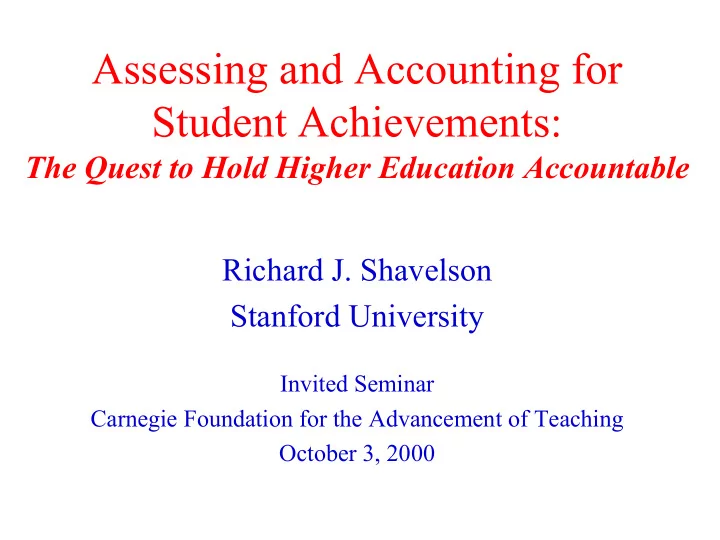
Assessing and Accounting for Student Achievements: The Quest to Hold Higher Education Accountable Richard J. Shavelson Stanford University Invited Seminar Carnegie Foundation for the Advancement of Teaching October 3, 2000 Overview of Talk


slide-1
SLIDE 1

Assessing and Accounting for Student Achievements:

The Quest to Hold Higher Education Accountable Richard J. Shavelson Stanford University

Invited Seminar Carnegie Foundation for the Advancement of Teaching October 3, 2000

slide-2
SLIDE 2

October 3, 2000 Carnegie Seminar on Assessment & Accountability 2

Overview of Talk

  • Motivation for and overview of study
  • Accountability for achievements
  • Assessment of achievements

Assessment of achievements

– Conceptual framework – Examples of cognitive assessments – Role of technology – Links with Carnegie

  • Areas for collaboration

Primary focus of talk

slide-3
SLIDE 3

October 3, 2000 Carnegie Seminar on Assessment & Accountability 3

Motivation for Study

  • Increased demand for accountability

– New York’s Report Card – Virginia’s audit – Developments in England, New Zealand, Australia, Hong Kong

  • Lessons from K-12 education: Benefits & Costs

– Benefits include increased content achievement primarily in basic skills (Tennessee, Texas) and some teacher responsiveness – Costs include narrowing educational goals, reduced flexibility, teaching to the test, and cheating

  • Problematic application to education--outputs are often

distal proxies for desired outcomes

slide-4
SLIDE 4

October 3, 2000 Carnegie Seminar on Assessment & Accountability 4

Overview of Study

  • Historical, political, social and conceptual background

for study

– Precollege: beginning with common school movement – College: beginning with land grant institutions

  • Framework for and case studies of assessing learning:

– Cognitive – Civic responsibility and other “non-cognitive”

  • Framework for and cases studies of accountability
  • Options for alternative accountability systems from the

decision maker’s perspective

slide-5
SLIDE 5

October 3, 2000 Carnegie Seminar on Assessment & Accountability 5

Accountability and Assessment

  • Accountability is a procedure by which a polity’s (citizen, politician,

public manager, or client) acts to have public agencies account for the resources they use and the values they create.

  • Assessment is “theory-driven” measurement and/or description of

variables that provide data on or describe inputs (resources), processes (use of resources), outputs (products) and outcomes (valued consequences)

  • An accountability system is a routine, systematic, “theory-driven” effort
  • pen to public debate intended to:

– Collect data on 2 or more organizations – Transform those data into information relevant to evaluating performance – Transmit this information to some audience external to the organization through scores (often ratings or rankings) and sometimes (case) descriptions

slide-6
SLIDE 6

October 3, 2000 Carnegie Seminar on Assessment & Accountability 6

Framework for Thinking About Accountability

  • Locus of information bearing on accountability

– Inputs (resources) – Processes (use of resources) – Outputs (direct products such as achievement scores) – Outcomes (valued consequences

  • Criteria for evaluating accountability systems

– Validity (Fidelity of output assessment(s) to desired outcomes) – Comprehensiveness (includes relevant variables) – Comprehensibility (to potential users) – Relevance (to needs of potential user) – Reasonableness (demands on organization) – Functionality (leads to appropriate behavior)

Source: Gromley & Weimer, 1999

slide-7
SLIDE 7

October 3, 2000 Carnegie Seminar on Assessment & Accountability 7

Models of Output (Achievement) Accountability Systems

  • Absolute Standard:

Performance of a system is measured against some internal or external standard of minimally acceptable (or highly respectable) level of performance.

  • Relative Standard:
  • Value-Added where a system’s performance is compared against its expected

performance given the nature of its inputs.

  • Time-Series that monitors system indicators (e.g., graduation rates, achievement scores)
  • ver time.
  • Internal Audit that links assessment of learning with the teaching and learning mission
  • f the institution, with an externally verifiable internal quality-control mechanism.
  • External Audit that ties a system’s funding to ranking of indicators such as graduation

rates, retention rates, and faculty teaching and research productivity.

  • Approximation Standard:

Model that evaluates a system against predictors of a system’s outcomes over time such as active learning, student-faculty interaction, and student time on task.

slide-8
SLIDE 8

October 3, 2000 Carnegie Seminar on Assessment & Accountability 8

Actors in the Accountability Drama

Top Down Accountability Citizens Politicians Public Managers

Service Providers

Source: Gromley & Weimer (1999)

Corporate Purchasers Government Purchasers Clients Bottom Up Accountability

slide-9
SLIDE 9

October 3, 2000 Carnegie Seminar on Assessment & Accountability 9

Framework for Tracking Consequences

Accountability Information

(Market Shares)

Manager

resources prestige

(Budgets)

Overseers Consumers

(Prices) (Discretion)

Organizational Flexibility Organizational Responses Functional

Process Improvement Input Reallocation Managerial Focusing Mission Enhancement ***

Dysfunctional

Self Selection Cream Skimming Teach to Test Deception Blame Messenger

Source: Gromley & Weimer (1999)

slide-10
SLIDE 10

October 3, 2000 Carnegie Seminar on Assessment & Accountability 10

Assessment: Framework for Cognitive Outputs

Declarative Procedural Strategic Knowledge Knowledge Knowledge

(Knowing the “that”) (Knowing the “how”) (Knowing the “which,” “when,” and “why”)

Proficiency

Low High

Extent

(How much?)

Structure

(How is it organized?)

Others

(Precision? Efficiency? Automaticity?)

Cognitive Cognitive Tools: Tools:

Planning Planning Monitoring Monitoring

Domain-specific content:

  • facts
  • concepts
  • principles

Domain-specific production systems Problem schemata/ strategies/

  • peration systems
slide-11
SLIDE 11

October 3, 2000 Carnegie Seminar on Assessment & Accountability 11

Assessment of Declarative Knowledge: Multiple-Choice--TIMSS Pop. 2

Air is made up of many gases. Which gas is found in the greatest amount?

  • A. Nitrogen
  • B. Oxygen
  • C. Carbon Dioxide
  • D. Hydrogen
slide-12
SLIDE 12

October 3, 2000 Carnegie Seminar on Assessment & Accountability 12

Assessment of Declarative Knowledge Structure: Eleven-Year-Old’s Concept Map

water rain rivers clouds soil sun

  • ceans

is falling water comes from contain goes into rivers flow to contain shines on

From White & Gunstone: “Probing Understanding” (1992, p. 16)

slide-13
SLIDE 13

October 3, 2000 Carnegie Seminar on Assessment & Accountability 13

Assessment of Procedural Knowledge:

Performance of a Daytime Astronomy Investigation

Flashlight Sticky Towers Student Notebooks and Pencils

Students are asked to model the path of the sun from sunrise to sunset and use direction, length, and angles of shadows to solve location problems.

slide-14
SLIDE 14

October 3, 2000 Carnegie Seminar on Assessment & Accountability 14

Assessment of Strategic Knowledge: Mental Models

  • (A) A rocket is moving along sideways in deep space, with its engine off, from point A

to point B. It is not near any planets or other outside forces. Its engine is fired at point B and left on for 2 sec while the rocket travels from point B to point C. Draw in the shape of the path from B to C. (Show your best guess for this problem even if you are unsure of the answer.)

  • (B) Show the path from C after the engine is turned off on the same drawing.

B C A C B

A

Correct Incorrect

Source: Clement, J. (1982). Students’ preconceptions in introductory mechanics. American Journal of Physics, 50(1), 66-71.

slide-15
SLIDE 15

October 3, 2000 Carnegie Seminar on Assessment & Accountability 15

Linking Assessments to Achievement Components

Declarative Procedural Strategic Knowledge Knowledge Knowledge

Performance Assessments Concept Maps

  • Performance

Assessments

  • Interviews
  • M-C Tests
  • Multiple-Choice
  • Fill-in

Procedure Maps Models/ Mental Maps

Extent Structure

Others

slide-16
SLIDE 16

October 3, 2000 Carnegie Seminar on Assessment & Accountability 16

Some Empirical Evidence on Links between Knowledge and Measurement Methods

Correlations from Shultz’s Dissertation (N=109 6th Graders Studying Ecology):

– Reading and Multiple-Choice: 0.69 – Reading and Concept Map: 0.53 – M-C and CM: 0.60 – Reading and Performance Assessment: 0.25 – M-C and PA: 0.33 – CM and PA: 0.43

Declarative Knowledge Declarative vs. Procedural Knowledge

slide-17
SLIDE 17

October 3, 2000 Carnegie Seminar on Assessment & Accountability 17

Role of Technology:

Cost Reduction and Scoring Efficiency

  • Computer adaptive testing--testing extent of

declarative and (perhaps) strategic knowledge

  • Computer concept and cognitive mapping--

testing structural knowledge

  • Computer simulation of an investigation--

testing procedural and/or strategic knowledge

slide-18
SLIDE 18

October 3, 2000 Carnegie Seminar on Assessment & Accountability 18

Links with Carnegie: The Carnegie Teaching Academy

  • What are the assessment practices of faculty in

the sciences, social sciences and humanities?

(Linda Suskie of AAHE says no good studies! She and Ted Marchese studied practices considered exemplary by North Central--very few!)

  • What are the assessment practices of the

Carnegie fellows (infer from their studies of teaching)? Source of case studies?

  • What do you all know about assessment

practices?

slide-19
SLIDE 19

October 3, 2000 Carnegie Seminar on Assessment & Accountability 19

Areas for Collaboration

  • Assessment practices of Carnegie Fellows
  • Assessment practices more generally
  • Case studies
  • Role of assessment of learning and teaching

in accountability models

  • Ongoing advice greatly appreciated!!!!

Ongoing advice greatly appreciated!!!!