Assembly (part 1) arrays include elements sizeof includes elements - - PowerPoint PPT Presentation

assembly part 1
SMART_READER_LITE
LIVE PREVIEW

Assembly (part 1) arrays include elements sizeof includes elements - - PowerPoint PPT Presentation

Assembly (part 1) arrays include elements sizeof includes elements HW generally due next week at noon (partial credit on many labs is very generous) on future labs, please always submit what you have lab generally due after 11PM on the lab


slide-1
SLIDE 1

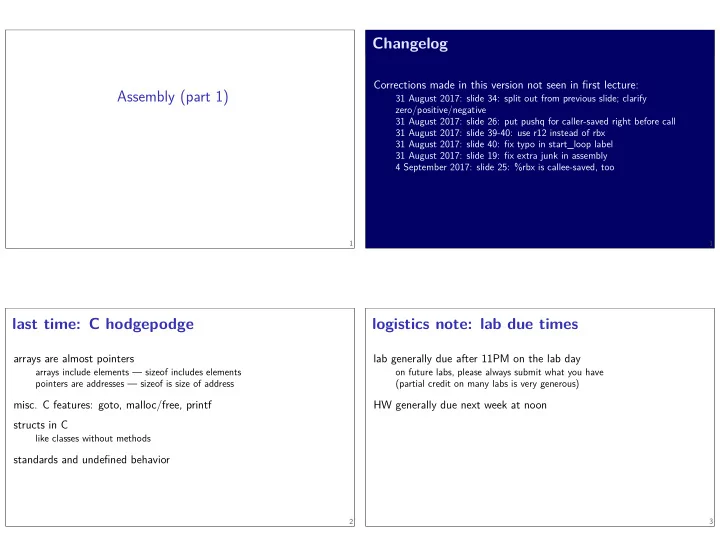
Assembly (part 1)

1

Changelog

Corrections made in this version not seen in fjrst lecture:

31 August 2017: slide 34: split out from previous slide; clarify zero/positive/negative 31 August 2017: slide 26: put pushq for caller-saved right before call 31 August 2017: slide 39-40: use r12 instead of rbx 31 August 2017: slide 40: fjx typo in start_loop label 31 August 2017: slide 19: fjx extra junk in assembly 4 September 2017: slide 25: %rbx is callee-saved, too

1

last time: C hodgepodge

arrays are almost pointers

arrays include elements — sizeof includes elements pointers are addresses — sizeof is size of address

  • misc. C features: goto, malloc/free, printf

structs in C

like classes without methods

standards and undefjned behavior

2

logistics note: lab due times

lab generally due after 11PM on the lab day

  • n future labs, please always submit what you have

(partial credit on many labs is very generous)

HW generally due next week at noon

3

slide-2
SLIDE 2

some lists

short sentinel = -9999; short *x; x = malloc(sizeof(short)*4); x[3] = sentinel; ...

x

x[0] x[1] x[2] x[3]

1 2 3 −9999

typedef struct range_t { unsigned int length; short *ptr; } range; range x; x.length = 3; x.ptr = malloc(sizeof(short)*3); ...

x len: 3 ptr: 1 2 3

typedef struct node_t { short payload; list *next; } node; node *x; x = malloc(sizeof(node_t)); ...

x payload: 1 ptr: *x

  • n stack
  • r regs
  • n heap

4

some lists

short sentinel = -9999; short *x; x = malloc(sizeof(short)*4); x[3] = sentinel; ...

x

x[0] x[1] x[2] x[3]

1 2 3 −9999

typedef struct range_t { unsigned int length; short *ptr; } range; range x; x.length = 3; x.ptr = malloc(sizeof(short)*3); ...

x len: 3 ptr: 1 2 3

typedef struct node_t { short payload; list *next; } node; node *x; x = malloc(sizeof(node_t)); ...

x payload: 1 ptr: *x

← on stack

  • r regs
  • n heap →

4

structs aren’t references

typedef struct { long a; long b; long c; } triple; ... triple foo; foo.a = foo.b = foo.c = 3; triple bar = foo; bar.a = 4; // foo is 3, 3, 3 // bar is 4, 3, 3

… return address callee saved registers foo.c foo.b foo.a bar.c bar.b bar.a

5

x86-64 refresher

6

slide-3
SLIDE 3

AT&T versus Intel syntax (1)

AT&T syntax: movq $42, (%rbx) Intel syntax: mov QWORD PTR [rbx], 42 efgect (pseudo-C): memory[rbx] <- 42

7

AT&T syntax example (1)

movq $42, (%rbx) // memory[rbx] ← 42

destination last ()s represent value in memory constants start with $ registers start with % q (‘quad’) indicates length (8 bytes)

l: 4; w: 2; b: 1 sometimes can be omitted

8

AT&T syntax example (1)

movq $42, (%rbx) // memory[rbx] ← 42

destination last ()s represent value in memory constants start with $ registers start with % q (‘quad’) indicates length (8 bytes)

l: 4; w: 2; b: 1 sometimes can be omitted

8

AT&T syntax example (1)

movq $42, (%rbx) // memory[rbx] ← 42

destination last ()s represent value in memory constants start with $ registers start with % q (‘quad’) indicates length (8 bytes)

l: 4; w: 2; b: 1 sometimes can be omitted

8

slide-4
SLIDE 4

AT&T syntax example (1)

movq $42, (%rbx) // memory[rbx] ← 42

destination last ()s represent value in memory constants start with $ registers start with % q (‘quad’) indicates length (8 bytes)

l: 4; w: 2; b: 1 sometimes can be omitted

8

AT&T syntax example (1)

movq $42, (%rbx) // memory[rbx] ← 42

destination last ()s represent value in memory constants start with $ registers start with % q (‘quad’) indicates length (8 bytes)

l: 4; w: 2; b: 1 sometimes can be omitted

8

AT&T versus Intel syntax (2)

AT&T syntax: movq $42, 100(%rbx,%rcx,4) Intel syntax: mov QWORD PTR [rbx+rcx*4+100], 42 efgect (pseudo-C): memory[rbx + rcx * 4 + 100] <- 42

9

AT&T versus Intel syntax (2)

AT&T syntax: movq $42, 100(%rbx,%rcx,4) Intel syntax: mov QWORD PTR [rbx+rcx*4+100], 42 efgect (pseudo-C): memory[rbx + rcx * 4 + 100] <- 42

9

slide-5
SLIDE 5

AT&T versus Intel syntax (2)

AT&T syntax: movq $42, 100(%rbx,%rcx,4) Intel syntax: mov QWORD PTR [rbx+rcx*4+100], 42 efgect (pseudo-C): memory[rbx + rcx * 4 + 100] <- 42

9

AT&T versus Intel syntax (2)

AT&T syntax: movq $42, 100(%rbx,%rcx,4) Intel syntax: mov QWORD PTR [rbx+rcx*4+100], 42 efgect (pseudo-C): memory[rbx + rcx * 4 + 100] <- 42

9

AT&T syntax: addressing

100(%rbx): memory[rbx + 100] 100(%rbx,8): memory[rbx * 8 + 100] 100(,%rbx,8): memory[rbx * 8 + 100] 100(%rcx,%rbx,8): memory[rcx + rbx * 8 + 100]

10

AT&T versus Intel syntax (3)

r8 ← r8 - rax Intel syntax: sub r8, rax AT&T syntax: subq %rax, %r8 same for cmpq

11

slide-6
SLIDE 6

AT&T syntax: addresses

addq 0x1000, %rax // Intel syntax: add rax, QWORD PTR [0x1000] // rax ← rax + memory[0x1000] addq $0x1000, %rax // Intel syntax: add rax, 0x1000 // rax ← rax + 0x1000

no $ — probably memory address

12

AT&T syntax in one slide

destination last () means value in memory disp(base, index, scale) same as memory[disp + base + index * scale]

  • mit disp (defaults to 0)

and/or omit base (defaults to 0) and/or scale (defualts to 1)

$ means constant plain number/label means value in memory

13

recall: x86-64 general purpose registers

Figure: Immae via Wikipedia

14

  • verlapping registers (1)

setting 32-bit registers — clears corresponding 64-bit register movq $0xFFFFFFFFFFFFFFFF, %rax movl $0x1, %eax %rax is 0x1 (not 0xFFFFFFFF00000001)

15

slide-7
SLIDE 7
  • verlapping registers (2)

setting 8/16-bit registers: don’t clear 64-bit register movq $0xFFFFFFFFFFFFFFFF, %rax movb $0x1, %al %rax is 0xFFFFFFFFFFFFFF01

16

labels (1)

labels represent addresses

17

labels (2)

addq string, %rax // intel syntax: add rax, QWORD PTR [label] // rax ← rax + memory[address of "a string"] addq $string, %rax // intel syntax: add rax, OFFSET label // rax ← rax + address of "a string" string: .ascii "a ␣ string"

addq label: read value at the address addq $label: use address as an integer constant

18

  • n LEA

LEA = Load Efgective Address

efgective address = computed address for memory access

syntax looks like a mov from memory, but… skips the memory access — just uses the address leaq 4(%rax), %rax ≈ addq $4, %rax “address of memory[rax + 4]” = rax + 4

20

slide-8
SLIDE 8
  • n LEA

LEA = Load Efgective Address

efgective address = computed address for memory access

syntax looks like a mov from memory, but… skips the memory access — just uses the address leaq 4(%rax), %rax ≈ addq $4, %rax “address of memory[rax + 4]” = rax + 4

20

LEA tricks

leaq (%rax,%rax,4), %rax rax ← rax × 5 rax ← address-of(memory[rax + rax * 4]) leaq (%rbx,%rcx), %rdx rdx ← rbx + rcx rdx ←address-of(memory[rbx + rcx])

21

x86-64 calling convention

registers for fjrst 6 arguments:

%rdi (or %edi or %di, etc.), then %rsi (or %esi or %si, etc.), then %rdx (or %edx or %dx, etc.), then %rcx (or %ecx or %cx, etc.), then %r8 (or %r8d or %r8w, etc.), then %r9 (or %r9d or %r9w, etc.)

rest on stack return value in %rax don’t memorize: Figure 3.28 in book

22

x86-64 calling convention example

int foo(int x, int y, int z) { return 42; } ... foo(1, 2, 3); ... ... // foo(1, 2, 3) movl $1, %edi movl $2, %esi movl $3, %edx call foo // call pushes address of next instruction // then jumps to foo ... foo: movl $42, %eax

23

slide-9
SLIDE 9

call/ret

call:

push address of next instruction on the stack

ret:

pop address from stack; jump

24

callee-saved registers

functions must preserve these %rsp (stack pointer), %rbx, %rbp (frame pointer, maybe) %r12-%r15

25

caller/callee-saved

foo: pushq %r12 // r12 is caller-saved ... use r12 ... popq %r12 ret ...

  • ther_function:

... pushq %r11 // r11 is caller-saved callq foo popq %r11

26

question

pushq $0x1 pushq $0x2 addq $0x3, 8(%rsp) popq %rax popq %rbx

What is value of %rax and %rbx after this? a. %rax = 0x2, %rbx = 0x4 b. %rax = 0x5, %rbx = 0x1 c. %rax = 0x2, %rbx = 0x1 d. the snippet has invalid syntax or will crash e. more information is needed f. something else?

27

slide-10
SLIDE 10
  • n %rip

%rip (Instruction Pointer) = address of next instruction movq 500(%rip), %rax

rax ← memory[next instruction address + 500]

label(%rip) label

difgerent ways of writing address of label in machine code (with %rip — relative to next instruction)

28

  • n %rip

%rip (Instruction Pointer) = address of next instruction movq 500(%rip), %rax

rax ← memory[next instruction address + 500]

label(%rip) ≈ label

difgerent ways of writing address of label in machine code (with %rip — relative to next instruction)

28

things we won’t cover (today)

fmoating point; vector operations (multiple values at once)

special registers: %xmm0 through %xmm15

segmentation (special registers: %ds, %fs, %gs, …) lots and lots of instructions

29

authoriative source

30

slide-11
SLIDE 11

if-to-assembly (1)

if (b >= 42) { a += 10; } else { a *= b; } if (b >= 42) goto after_then; a += 10; goto after_else; after_then: a *= b; after_else:

31

if-to-assembly (1)

if (b >= 42) { a += 10; } else { a *= b; } if (b >= 42) goto after_then; a += 10; goto after_else; after_then: a *= b; after_else:

31

if-to-assembly (2)

if (b >= 42) { a += 10; } else { a *= b; }

// a is in %rax, b is in %rbx cmpq $42, %rbx // computes rbx - 42 to 0 jl after_then // jump if rbx - 42 < 0 // AKA rbx < 42 addq $10, %rax // a += 1 jmp after_else after_then: imulq %rbx, %rax // rax = rax * rbx after_else:

32

condition codes

x86 has condition codes set by (almost) all arithmetic instructions

addq, subq, imulq, etc.

store info about last arithmetic result

was it zero? was it negative? etc.

33

slide-12
SLIDE 12

condition codes and jumps

jg, jle, etc. read condition codes named based on interpreting result of subtraction 0: equal; negative: less than; positive: greater than

34

condition codes example (1)

movq $−10, %rax movq $20, %rbx subq %rax, %rbx // %rbx - %rax = 10 // result > 0: %rbx was > %rax jle foo // not taken; 30 > 0

35

condition codes and cmpq

“last arithmetic result”??? then what is cmp, etc.? cmp does subtraction (but doesn’t store result) similar test does bitwise-and testq %rax, %rax — result is %rax

36

condition codes example (2)

movq $−10, %rax movq $20, %rbx cmpq %rax, %rbx jle foo // not taken; %rbx - %rax > 0

37

slide-13
SLIDE 13

loop (1)

int x = 99; do { foo() x--; } while (x >= 0); int x = 99; start_loop: foo() x--; if (x >= 0) goto start_loop;

38

loop (1)

int x = 99; do { foo() x--; } while (x >= 0); int x = 99; start_loop: foo() x--; if (x >= 0) goto start_loop;

38

loop (2)

int x = 99; do { foo() x--; } while (x >= 0); movq $99, %r12 // register for x start_loop: call foo subq $1, %r12 cmpq $0, %r12 // computes r12 - 0 = r12 jge start_loop // jump if r12 - 0 >= 0

39

  • mitting the cmp

movq $99, %r12 // register for x start_loop: call foo subq $1, %r12 cmpq $0, %r12 // compute r12 - 0 + sets cond. codes jge start_loop // r12 >= 0? // or result >= 0? movq $99, %r12 // register for x start_loop: call foo subq $1, %r12 // new r12 = old r12 - 1 + sets cond. codes jge start_loop // old r12 >= 1? // or result >= 0?

40

slide-14
SLIDE 14

condition codes example (3)

movq $−10, %rax movq $20, %rbx subq %rax, %rbx jle foo // not taken, %rbx - %rax > 0 -> %rbx > %rax movq $20, %rbx addq $−20, %rbx je foo // taken, result is 0 // x - y = 0 -> x = y

41

condition codes examples (4)

movq $20, %rbx addq $−20, %rbx // result is 0 movq $1, %rax // irrelevant je foo // taken, result is 0

42

setting condition codes

most instructions that compute something set condition codes some instructions only set condition codes:

cmp ∼ sub test ∼ and (bitwise and — next week) testq %rax, %rax — result is %rax

some instructions don’t change condition codes:

lea, mov control fmow: jmp, call, ret, jle, etc.

43

exercise

movq $3, %rax movq $2, %rbx start_loop: addq %rbx, %rbx cmpq $3, %rbx subq $1, %rax jg start_loop What is the value of %rbx after this runs?

  • A. 2
  • D. 16
  • B. 4
  • E. 32
  • C. 8
  • F. something else

44

slide-15
SLIDE 15

logical operators

return 1 for true or 0 for false

( 1 && 1 ) == 1 ( 1 || 1 ) == 1 ( 2 && 4 ) == 1 ( 2 || 4 ) == 1 ( 1 && 0 ) == 0 ( 1 || 0 ) == 1 ( 0 && 0 ) == 0 ( 0 || 0 ) == 0 (-1 && -2) == 1 (-1 || -2) == 1 ("" && "") == 1 ("" || "") == 1 ! 1 == 0 ! 4 == 0 !-1 == 0 ! 0 == 1

46

recall: short-circuit (&&)

1 #include <stdio.h> 2 int zero() { printf("zero()\n"); return 0; } 3 int one() { printf("one()\n"); return 1; } 4 int main() { 5 printf("> ␣ %d\n", zero() && one()); 6 printf("> ␣ %d\n", one() && zero()); 7 return 0; 8 }

zero() > 0

  • ne()

zero() > 0 AND false true false false false true false true

47

recall: short-circuit (&&)

1 #include <stdio.h> 2 int zero() { printf("zero()\n"); return 0; } 3 int one() { printf("one()\n"); return 1; } 4 int main() { 5 printf("> ␣ %d\n", zero() && one()); 6 printf("> ␣ %d\n", one() && zero()); 7 return 0; 8 }

zero() > 0

  • ne()

zero() > 0 AND false true false false false true false true

47

recall: short-circuit (&&)

1 #include <stdio.h> 2 int zero() { printf("zero()\n"); return 0; } 3 int one() { printf("one()\n"); return 1; } 4 int main() { 5 printf("> ␣ %d\n", zero() && one()); 6 printf("> ␣ %d\n", one() && zero()); 7 return 0; 8 }

zero() > 0

  • ne()

zero() > 0 AND false true false false false true false true

47

slide-16
SLIDE 16

recall: short-circuit (&&)

1 #include <stdio.h> 2 int zero() { printf("zero()\n"); return 0; } 3 int one() { printf("one()\n"); return 1; } 4 int main() { 5 printf("> ␣ %d\n", zero() && one()); 6 printf("> ␣ %d\n", one() && zero()); 7 return 0; 8 }

zero() > 0

  • ne()

zero() > 0 AND false true false false false true false true

47

recall: short-circuit (&&)

1 #include <stdio.h> 2 int zero() { printf("zero()\n"); return 0; } 3 int one() { printf("one()\n"); return 1; } 4 int main() { 5 printf("> ␣ %d\n", zero() && one()); 6 printf("> ␣ %d\n", one() && zero()); 7 return 0; 8 }

zero() > 0

  • ne()

zero() > 0 AND false true false false false true false true

47

&& to assembly

return foo() && bar(); result = foo(); if (result == 0) goto skip_bar; result = bar(); skip_bar: result = (result != 0);

48

&& to assembly

return foo() && bar(); result = foo(); if (result == 0) goto skip_bar; result = bar(); skip_bar: result = (result != 0);

48

slide-17
SLIDE 17

x86-64 manuals

Intel manuals:

https://software.intel.com/en-us/articles/intel-sdm 24 MB, 4684 pages Volume 2: instruction set reference (2190 pages)

AMD manuals:

https://support.amd.com/en-us/search/tech-docs “AMD64 Architecture Programmer’s Manual”

49

example manual page

50

Linux x86-64 calling convention

51

hello.s

.section .rodata.str1.1,"aMS",@progbits,1 .LC0: .string "Hello, World!" .text .globl main main: subq $8, %rsp movl $.LC0, %edi call puts movl $0, %eax addq $8, %rsp ret

52

slide-18
SLIDE 18

hello.o

hello.o: file format elf64-x86-64 SYMBOL TABLE: 0000000000000000 g F .text 0000000000000018 main 0000000000000000 *UND* 0000000000000000 puts RELOCATION RECORDS FOR [.text]: OFFSET TYPE VALUE 0000000000000005 R_X86_64_32 .rodata.str1.1 000000000000000a R_X86_64_PC32 puts-0x0000000000000004 Contents of section .text: 0000 4883ec08 bf000000 00e80000 0000b800 H............... 0010 00000048 83c408c3 ...H.... Contents of section .rodata.str1.1: 0000 48656c6c 6f2c2057 6f726c64 2100 Hello, World!.

53

strings in C

int main() { const char *hello = "Hello World!"; ... } 0x4005C0

hello (on stack/register)

…'H''e''l''l''o'' ␣''W''o''r''l''d''!''\0'…

read-only data 54

exercise explanation

better style: *pointer = 'z'; better style: foo[1] = 'a';

1 char foo[4] = "foo"; 2 // {'f', 'o', 'o', '\0'} 3 char *pointer; 4 pointer = foo; 5 *pointer = 'b'; 6 pointer = pointer + 2; 7 pointer[0] = 'z'; 8 *(foo + 1) = 'a';

'f''o''o''\0'

foo (on stack)

pointer foo + 1 == &foo[0] + 1

55

exercise explanation

better style: *pointer = 'z'; better style: foo[1] = 'a';

1 char foo[4] = "foo"; 2 // {'f', 'o', 'o', '\0'} 3 char *pointer; 4 pointer = foo; 5 *pointer = 'b'; 6 pointer = pointer + 2; 7 pointer[0] = 'z'; 8 *(foo + 1) = 'a';

'f''o''o''\0'

foo (on stack)

pointer foo + 1 == &foo[0] + 1

55

slide-19
SLIDE 19

exercise explanation

better style: *pointer = 'z'; better style: foo[1] = 'a';

1 char foo[4] = "foo"; 2 // {'f', 'o', 'o', '\0'} 3 char *pointer; 4 pointer = foo; 5 *pointer = 'b'; 6 pointer = pointer + 2; 7 pointer[0] = 'z'; 8 *(foo + 1) = 'a';

'b''o''o''\0'

foo (on stack)

pointer foo + 1 == &foo[0] + 1

55

exercise explanation

better style: *pointer = 'z'; better style: foo[1] = 'a';

1 char foo[4] = "foo"; 2 // {'f', 'o', 'o', '\0'} 3 char *pointer; 4 pointer = foo; 5 *pointer = 'b'; 6 pointer = pointer + 2; 7 pointer[0] = 'z'; 8 *(foo + 1) = 'a';

'b''o''o''\0'

foo (on stack)

pointer foo + 1 == &foo[0] + 1

55

exercise explanation

better style: *pointer = 'z'; better style: foo[1] = 'a';

1 char foo[4] = "foo"; 2 // {'f', 'o', 'o', '\0'} 3 char *pointer; 4 pointer = foo; 5 *pointer = 'b'; 6 pointer = pointer + 2; 7 pointer[0] = 'z'; 8 *(foo + 1) = 'a';

'b''o''z''\0'

foo (on stack)

pointer foo + 1 == &foo[0] + 1

55

exercise explanation

better style: *pointer = 'z'; better style: foo[1] = 'a';

1 char foo[4] = "foo"; 2 // {'f', 'o', 'o', '\0'} 3 char *pointer; 4 pointer = foo; 5 *pointer = 'b'; 6 pointer = pointer + 2; 7 pointer[0] = 'z'; 8 *(foo + 1) = 'a';

'b''a''z''\0'

foo (on stack)

pointer foo + 1 == &foo[0] + 1

55

slide-20
SLIDE 20

middle of blocks?

Examples of things not allowed in 1989 ANSI C:

printf("Before calling malloc()\n"); int *pointer = malloc(sizeof(int) * 100);

pointer must be declared earlier

for (int x = 0; x < 10; ++x)

x must be declared earlier

56

pointer arithmetic

…'H''e''l''l''o'' ␣' 'W''o''r''l''d''!''\0'…

read-only data

hello + 0 0x4005C0 hello + 5 0x4005C5 *(hello + 0) is 'H' *(hello + 5) is ' ␣' hello[0] is 'H' hello[5] is ' ␣'

57

pointer arithmetic

…'H''e''l''l''o'' ␣' 'W''o''r''l''d''!''\0'…

read-only data

hello + 0 0x4005C0 hello + 5 0x4005C5 *(hello + 0) is 'H' *(hello + 5) is ' ␣' hello[0] is 'H' hello[5] is ' ␣'

57

pointer arithmetic

…'H''e''l''l''o'' ␣' 'W''o''r''l''d''!''\0'…

read-only data

hello + 0 0x4005C0 hello + 5 0x4005C5 *(hello + 0) is 'H' *(hello + 5) is ' ␣' hello[0] is 'H' hello[5] is ' ␣'

57