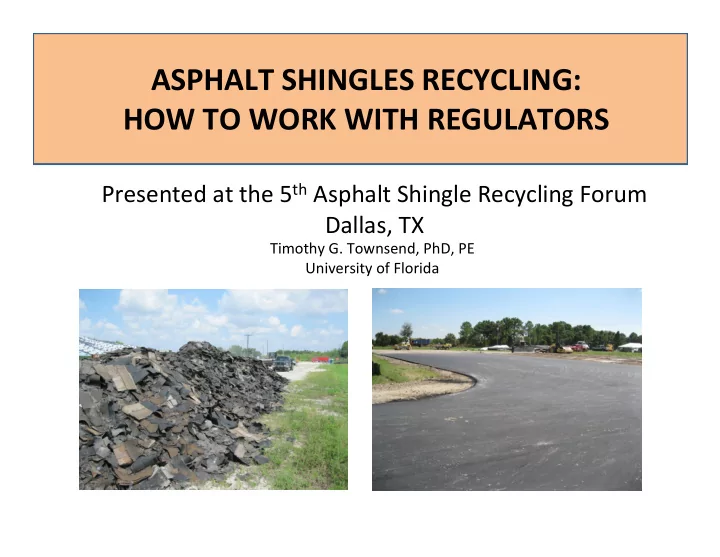
SLIDE 1 ASPHALT SHINGLES RECYCLING: HOW TO WORK WITH REGULATORS
Presented at the 5th Asphalt Shingle Recycling Forum Dallas, TX
Timothy G. Townsend, PhD, PE University of Florida
SLIDE 2
SLIDE 3
SLIDE 4
Comment on Environmental Regulations
Federal Regulations US EPA
Defines solid waste Recycled materials remain solid waste Requirements for managing ACM No specific rule or requirement on shingle recycling
State Regulations State Agency
Follow federal rules when available Possibly develop new rules when rules are not available Protect human health and the environment Shingle recycling is primarily a state issue
SLIDE 5
Why is Shingle Recycling Even Regulated?
Discarded shingles meet the definition of solid waste under most regulatory programs. Unless otherwise specifically exempted, materials recovered by recycling remain a solid waste during the process of collection, storage, and processing. When is the exit point? If done poorly, shingle recycling can have a negative impact on human health and the environment.
SLIDE 6
Note on Local Government Requirements
Though not common, some local governments will have their own environmental regulations and agencies. Land use and zoning requirements must be considered.
SLIDE 7
Implications of Being Regulated
State specific Potential elements
Notification or permit application Agreement to comply with rules and permit conditions Reporting State Regulatory Agency Air Resources Waste Management Other
SLIDE 8
Common Components of Waste Processing Facility Permit
Site plan and identification of storage and processing areas Operations plan Restrictions on waste and product storage Stormwater control provisions Plans for controlling dust, visible emissions, noise, and odor
SLIDE 9
Common Components of Waste Processing Facility Permit
Sample testing requirements Reporting requirements Space to remove and store prohibited materials Closure steps Financial assurance
SLIDE 10 Typical Problems
Failure to notify or to
Too large of a stockpile Not properly controlling stormwater No evidence of segregation
SLIDE 11 Definition of Speculative Accumulation from the EPA Hazardous Waste Rules
A material is “accumulated speculatively” if it is accumulated before being recycled. A material is not accumulated speculatively, however, if the person accumulating it can show that the material is potentially recyclable and has a feasible means of being recycled; and … the amount of material that is recycled,
- r transferred to a different site for recycling,
equals at least 75 percent by weight or volume
- f the amount of that material accumulated at
the beginning of the period.
SLIDE 12
SLIDE 13
SLIDE 14 Chapter 10. Organic Waste Management
SLIDE 15 Chapter 8. Municipal Solid Waste Management
SLIDE 16 Chapter 8. Municipal Solid Waste Management
SLIDE 17
Why a Concern with Stockpiles?
Fires
Size of pile Insufficient to move fire response equipment around
Water contamination Abandonment
SLIDE 18 Example Damage Case Related to Asphalt Shingles Recycling
Speculative stockpiling – several thousand
- tons. Operator not able to finance project to
process and sell ground shingles to end users. Site eventually abandoned, land owner paid for clean-up.
SLIDE 19
Material Storage Limits - Colorado
6 CCR 1007-2, Part 1. 8.3.1(A): “After an initial accumulation period a recycling facility must be able to show that the quantity of recyclable materials that were recycled during each successive calendar year was at least 75% of the quantity of recyclable materials in inventory. The accumulation period is based on a 3-year rolling average of the facility’s stock of the recyclable material at the end of the previous calendar year in order to allow for variations in the market.”
SLIDE 20 Material Storage Limits - Texas
- Title 30, Part 1, Chapter 328, Subchapter A, Rule §328.4(b):
(b) Recyclable material may be accumulated or stored at a recycling facility only under the following conditions: (1) the facility accumulating it can show that the material is potentially recyclable and has an economically feasible means of being recycled; (2) within 270 days after the effective date of this rule, or 270 days from the commencement of a new facility's operations, the amount of material recycled, or transferred to a different site for recycling, equals at least 25% by weight or volume of the material accumulated 90 days from the effective date of this rule or 90 days from the commencement of a new facility's operation; and (3) during each subsequent six-month period, the amount of material that is recycled, or transferred to a different site for recycling, equals at least 50% by weight or volume of the material accumulated at the beginning of the period.
SLIDE 21
Material Storage Limits - Florida
As stated in 62-701.710(2)(e), a Waste Processing Facility Permit Application shall include:
“Identification and capacity of any on-site storage areas for recyclable materials, non-processable wastes, unauthorized wastes, and residues.”
SLIDE 22
Specific Considerations for Asphalt Shingles Recycling
SLIDE 23 Possible Permitting Needs Specific to Asphalt Shingles
Waste Processing Facility
permit
- Air section permit
- Possible local
permits
HMA Facility
- Air section permit
- Possibly solid waste if
material stockpiled or processed on site
SLIDE 24 Asbestos and Asphalt Shingles
Strong evidence that asphalt shingles will rarely contain asbestos, but attached materials may Frequency of “other” materials showing asbestos presence is low
Database collected for the “Environmental Issues” CMRA white paper showed asbestos detection in 1.5% of more than 28,000 samples
SLIDE 25
Regulatory Needs with Respect to Sampling
The goal is assess whether target material will exceed a regulatory threshold
For some waste materials, the concern is the average content of problematic constituent For other materials, the concern is never allowing material above a certain content to be processed
Typical steps
Baseline sampling Routine sampling
SLIDE 26
Asbestos Sampling Approach – Bulk, Unprocessed Shingles
Who conducts? How to conduct? Sampling frequency? Analysis method?
PLM TEM?
SLIDE 27 Examples of Sampling Frequencies for Asbestos in Asphalt Shingles
STATE SAMPLING FREQUENCY Colorado
- No minimum published1
- Roof to Roads: 3 for roof <1,000 sq. ft;
5 for roofs 1,000 to 5,000 sq. ft; 7 for roofs >5,000 sq. ft
- Other project-specific requirements
have included 1 sample per 500 tons Florida
- No minimum published in rules
- Pilot project: 1 sample per 25 tons
Georgia
- 1 sample for PLM per 1,000 tons1
Maine
- No sampling required for residential2
- One composite sample per load
required for commercial2
1. Colorado Department of Public Health and Environment 2. Georgia DOT (2001). Section 402 – Recycled Hot Mix Asphaltic Concrete. 3. Shinglerecycling.org.
SLIDE 28
Summary
Asphalt shingle meet the normal definition of solid waste, even when recycled, and thus appropriate regulations need to be considered. Regulations pertaining to asphalt shingle recycling vary by state. It is important to discuss your project with the regulatory community early in the process.
SLIDE 29
Summary
Be prepared to discuss successful examples of shingle recycling. Propose a facility and operation plan that employs state-of-the-practice techniques and good housekeeping practices. Recognize past concerns with excessive stockpiles of waste and be proactive with your plan. Asbestos is likely to remain an issue of concern. Acknowledge this concern but be prepared to educate using the large and growing database available.