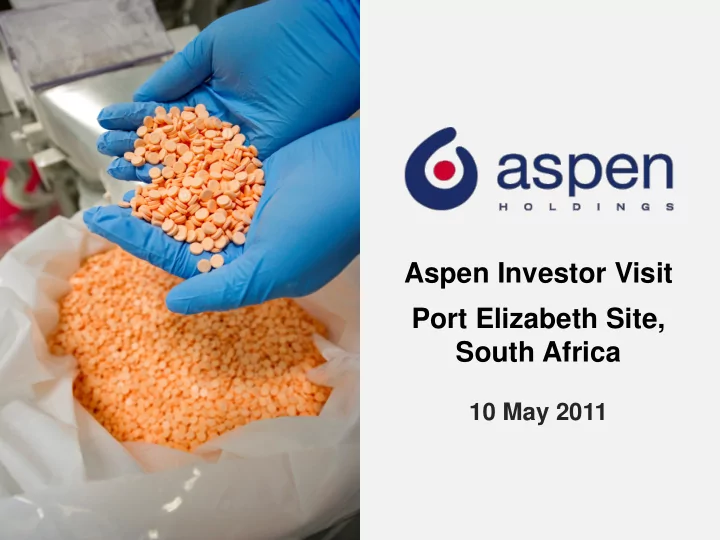
Aspen Investor Visit Port Elizabeth Site, South Africa 10 May 2011 - - PowerPoint PPT Presentation

aspen investor visit port elizabeth site south africa
SMART_READER_LITE
LIVE PREVIEW

Aspen Investor Visit Port Elizabeth Site, South Africa 10 May 2011 - - PowerPoint PPT Presentation

Aspen Investor Visit Port Elizabeth Site, South Africa 10 May 2011 Aspens Global Footprint C = Combined sales, marketing, distribution and manufacturing centres G = Group headquarters M = Manufacturing centres S = Sales, marketing and


slide-1
SLIDE 1

Aspen Investor Visit Port Elizabeth Site, South Africa

10 May 2011

slide-2
SLIDE 2

2

Aspen’s Global Footprint

1. G Durban, South Africa 2. C Cape Town, South Africa 3. C Johannesburg, South Africa 4. M Port Elizabeth, South Africa 5. M East London, South Africa 6. M Toluca, Mexico 7. S Mexico City, Mexico 8. S Caracas, Venezuela 9. S Rio de Janeiro, Brazil 10. M Vittoria, Brazil 11. S Dublin, Ireland 12. M Bad Oldesloe, Germany 13. C Nairobi, Kenya 14. S Kampala, Uganda 15. C Dar es Salaam, Tanzania 16. S Dubai, United Arab Emirates 17. S Grand Bay, Mauritius 18. S Quarry Bay, Hong Kong 19. C Sydney, Australia 20. M Melbourne, Australia

8 9 7 17 16 12 10 6 3 18 11 13 15 14 1 19 2 4 5

C = Combined sales, marketing, distribution and manufacturing centres G = Group headquarters M = Manufacturing centres S = Sales, marketing and distribution centres

20

slide-3
SLIDE 3

We remain committed to making a meaningful difference in the health of all those using Aspen medicines globally, and to increase our contribution to the lives of people in the many markets we serve across the globe through the manufacture and supply of high-quality, affordable medicines in a responsible manner.

3

slide-4
SLIDE 4

4

Aspen’s Manufacturing Competitive Advantages

Manufacturing capacity and capability is aligned to the Group’s growth strategy

  • Aspen’s strength lies in its ability to supply high volumes of products reliably with 4.8 billion tablets being

manufactured currently

  • Manufacturing capabilities at the Port Elizabeth and East London facilities have been rationalised
  • Homogenous product types are produced at designated facilities
  • Manufacturing capacity in the tabletting can be trebled by 7% increase in the expense base with the addition
  • f only incremental variable costs
  • Accreditations received from South African and relevant international authorities
  • Sufficient manufacturing capacity exists to produce required volumes for the domestic and international

markets as well to accommodate the introduction of global brands and Sigma products

  • Focus on economies of scale
  • international volumes are being transferred to Port Elizabeth to reduce

reliance on the public sector volumes

  • Effective procurement strategies ensure that materials are purchased at competitive prices
  • There is a committed focus on manufacturing efficiency projects – benefits have already been realised, and

initiatives are already in progress to conserve energy and environmental management

Our world class South African Operations team has created Aspen’s sustainably efficient and competitive manufacturing platform

slide-5
SLIDE 5

5

Evolution of Aspen’s Manufacturing Base

  • Aspen General Facility has been on the present site for approximately 70 years
  • Acquired by Aspen from South African Druggists in March 1999, together with facilities in East London and

Johannesburg

  • Mainly supplied the South African market
  • Within 12 years, Aspen has transformed from being a domestically accredited supplier to an international

pharmaceutical manufacturer with the developed capability to supply various dosage forms to any pharmaceutical market in the world

  • In the last 5 years, more than R2 billion has been invested in the Group’s South African facilities for

infrastructural expansion and enhancements to improve compliance to the relevant regulatory standards, and in order to support Aspen’s sustained supply to both its domestic and diverse international markets

  • More than 2700 people are permanently employed at Aspen’s Port Elizabeth, East London and Nutritionals

manufacturing facilities

slide-6
SLIDE 6

6

Current Allocation of Domestic and International Volumes

South Africa 87% International 13%

  • Manufactured products are supplied to Europe, Latin America and China
  • Additional international volumes are in the process of being introduced to the Port Elizabeth

facility

 Regulatory approvals are required by the relevant territory, per product, before commercial production can

take place

slide-7
SLIDE 7

Boehringer Ingelheim Nevirapine GSK Lamivudine, Zidovudine, Combivir, Epivir & Others BMS Stavudine, Didanosine, Atazanavir Gilead Tenofovir & Emtricitabine MSD Efavirenz Iroko Aldomet and Indocid Eli Lilly Cycloserine and Capreomycin Bayer Nur- Isterate Injection Prestige Brands Murine & Murine Plus Range of Eye Drop Products

Strategic Manufacturing Partnerships

7

slide-8
SLIDE 8

8

Aerial view of Aspen’s Global Manufacturing Base in Port Elizabeth

UNIT 3 : Ge ne r a l F a c ility UNIT 2 : Or a l Solids Ste r ile L yophillisa tion & E ye dr

  • p F

a c ility UNIT 1 : Or a l Solids T e c hnic a l Ce ntr e UNIT 1 : Bottling Pla nt Ste r ile Wa r e house UNIT 1 : Pa c king

slide-9
SLIDE 9

9

Regulatory Authorities Relevant to South African Operations

Regulatory Authority Unit 1 Unit 2 Unit 3 SVP MP SVP HP East London ADC ACW MCC X X X X X X X X FDA X # # # X MHRA X # # # X WHO X # # # X TGA X # # # X Anvisa (Brazil) X # # # X High volume solid manufacturing for domestic and export markets Small to medium volume solid manufacturing for domestic and export markets: fluid-bed dried products (2A) &

  • ven dried products

(2B) End state solid packing for domestic market Eye drops, lyophilized vials for domestic and export markets High potency (incl. hormonal) injectables for domestic and export markets Semi-solids, liquids and oral contraceptives for domestic market Warehousing for domestic and export markets Warehousing for domestic market

x = Approved # = Inspection planned

slide-10
SLIDE 10

10

Strategic Rationalisation Initiatives

Significant efficiencies and cost reductions have been realised through the consolidation of the Port Elizabeth site management systems:

  • Site management and facilities support functions have been consolidated under a single

management structure

 Historically two separate entities with individual management structures  Significant rationalisation of redundant costs

  • Consolidation of engineering stores and warehouse management systems

 Integrated site stock management systems and hence focussed working capital management

  • Consolidation of ERP systems for all facilities into a single Baan system

 Provides access to a single reporting platform  Facilitates focussed review, analysis and stratification of site information  Assists with effective optimisation of resources and capability

  • Consolidation of the purchasing systems

 Reduced number of purchase orders  Lower average purchase price per order due to combined volumes  Reduced number of lab tests required on incoming materials due to purchase order rationalisation

slide-11
SLIDE 11

11

Unit 1 – Oral Solid Dosage Facility

  • In 2005, an investment was made in the construction of an FDA-approved facility in response to

the HIV/AIDS pandemic in Africa

  • High volume production of tablets and capsules
  • The facility was successfully re-inspected by FDA, MRHA and WHO in 2010

 No major findings reported

  • Unit 1 currently manufactures 2.8 billion tablets
  • A granulation capacity expansion project to the value of R178 million is nearing completion

(first suite in operation, with second and third suites in final stages)

 This will more double current granulation capacity to increase tabletting capacity

slide-12
SLIDE 12

12

Unit 2 – Oral Solid Dosage Facility

Unit 2

  • 2.0 billion tablets are manufactured in this area
  • Total capacity = 3 billion tablets

Part 2A – Fluid Bed Dried (FBD) products

  • Small to medium volume solids production for selected regulated markets
  • Reformulated products and investment in new equipment
  • Improved process flow and hence more efficient manufacturing process
  • Increased automation and improved yields
  • Reduction in conversion costs
  • 96 tabletted products have been transferred into Unit 2A; 40 products will be transferred by July 2011

Part 2B – Oven dried products

  • Small volume solids production for selected regulated markets
  • Investment in new equipment
  • Increased automation and improved yields
  • 6 products have been transferred into Unit 2B
  • 61 products remain to be transferred by April 2012
slide-13
SLIDE 13

13

Unit 3 – General Facility

  • A phased process for the transfer of products to Unit 1 and Unit 2 is in progress
  • Bulk tablet manufacturing at Unit 3 will be decommissioned by end June 2011
  • Semi-solids (creams, ointments and suppositories) and Liquid Lennon Dutch

Medicines have been transferred to East London

  • Packing for the local market remains in this area
slide-14
SLIDE 14

14

Flow Diagram of the Tabletting Processes

Dispensing Blending Fluidised Bed Dryer Coating / Capsule fill Compression Packaging Magnesium Stearate Granulation Sieving Sieving Air Air

Scale

slide-15
SLIDE 15

15

Focus on Continuous Improvement Initiatives

Introduction of the Fluid Bed Drying Process

  • The older oven drying technology

 Wet granule obtained during tablet manufacture is dried by spreading materials onto trays inside an oven 

Process time is relatively long, requiring an average of 8 - 16 hour drying time

  • The newer FBD technology

 Wet granule obtained during tablet manufacture is sieved into a drying chamber and hot air is passed

through the chamber at relatively high speeds, resulting in fluidisation of the granule

Faster process, requiring 2 - 3 hour drying time

  • All key and high volume products have been reformulated and are now manufactured in this

area Impact: The benefits of this technology have been extracted and improvements in manufacturing and cost efficiencies have been realised

slide-16
SLIDE 16

16

Focus on Continuous Improvement Initiatives

  • Doubling of batch sizes to reduce set-up time between batches and thereby optimise

equipment utilisation

 All Unit 1 manufactured and all Unit 1/3 packed products completed  Unit 2 manufactured products in progress

Impact: Reduction of total annual set up time by 50%

  • Automation of end-of-line packing to match the increased rate of manufactured output /

manual packing processes transferred to automated equipment

 Blister and bottle packing completed, and patient ready packing nearing completion  Further projects targeted

Impact: 30% Output improvement in patient-ready packs with a reduction in temporary staff

  • Modification of batch manufacturing records to improve process documentation flow and

move to Electronic Batch Documentation has been initiated Impact: Expected reduction in administration time and headcount

  • Barcode inventory management system introduced in warehousing and now being rolled out to

production management Impact: 16% Reduction in headcount achieved to date

slide-17
SLIDE 17

17

Focus on Continuous Improvement Initiatives

  • Barcode status labelling of materials implemented to reduce handling activities

Impact: More efficient process through an instantaneous scanning process. Reduction in labelling time - manual capturing and labelling change used take up to one shift

  • Evaluation of shared packing tooling in progress

Impact: Will reduce set-up and changeover time significantly to unlock additional capacity

  • Re-evaluation of automated (new IBC wash-station) and manual cleaning activities (additional

wash-bays at place-of-work and transfer trolleys) in progress Impact: Will reduce cleaning times to unlock additional capacity

  • Evaluation of compression set-up and run-rate parameters proceeding well

Impact: Increases in run rates of 20% achieved in Unit 1

slide-18
SLIDE 18

18

In-house Manufacturing Cost Analysis

Labour 58% Electricity 7% Depreciation 17% Other 18%

Allocation of Conversion costs

Materials cost 64% Conversion costs 36%

Allocation of Production Costs (including ARV’s)

Materials cost 53% Conversion costs 47%

Allocation of Production Costs ( excluding ARV’s)

slide-19
SLIDE 19

19

Impact of Continuous Improvement on Recoveries

2007 2008 2009 2010

+120% +78% +39%

Unit 1 Recoveries

slide-20
SLIDE 20

20

Prospects in Solids Manufacturing at the Port Elizabeth Site

  • The redundant areas in Unit 3 will be converted into specialised manufacturing areas including

 High potency suite (HPS)  Toxic suite (TS)

  • Following approval of the final design, construction of the HPS and TS will commence in the

2012 year

 High potency and toxic products both require contained manufacturing areas with the air handling and

employee health, safety and protective clothing requirements being more stringent in a toxic manufacturing area

  • Approximately 4 billion tablets will be transferred into Unit 1, 2, HPS and TS including

 Selected global brands from Europe  Selected products from Sigma

  • Transfer of these products to Port Elizabeth will almost double manufactured volumes to 8.8

billion tablets (currently 4.8 billion tablets are produced in Unit 1 and 2)

 Economies of scale will be further improved  The additional volumes will be added with only 50% of incremental variable costs being added. The fixed

cost base will remain unchanged

slide-21
SLIDE 21

21

East London Site

An employee in the Oral Contraceptives facility wearing the necessary protective clothing Oral Contraceptives General Manufacture API Store Aerial view of East London plant

slide-22
SLIDE 22

22

East London Multi-Purpose Site

General Facility

  • Highly flexible, small volume, niche, solids manufacture, including low dose drugs
  • Significant investment has been made into upgrading the East London facility for the

manufacture of semi-solids and Dutch medicines Oral Contraceptive Facility

  • The Oral Contraceptive Facility provides a contained manufacturing area for the production
  • f high volume oral contraceptives for the public and private sector
slide-23
SLIDE 23

23

The Steriles Facility

  • Project commenced in 2007, presenting challenging complexities of design, technology,

technical compliance requirements and specialist skills

  • Specialist facility for the manufacture of eye drops, lyophilised vials and sterile injectables,

including hormonal vials and ampoules (a niche capability to supply female contraceptives and HRT products)

  • The facility commenced with the production of eye drops for the US market in July 2009
  • The lyophilised vials area was commercialised in September 2010
  • Approved by the MCC for the manufacture of sterile eye drops and lyophilised vials, with

WHO approval for Capreomycin being targeted

  • Export certificates were granted by the FDA and MCC for the supply of eye drops into the USA
  • The sterile facility represents a niche and complex manufacturing
slide-24
SLIDE 24

24

Steriles Facility – Multi-Product Suite

Lines 1 and 2

  • High volume eye drops with an annual capacity of 42 million units
  • Close to 30 million units being exported to US and Canada under a manufacturing contract with

Prestige Brands

  • Aspen’s Eye Gene range has been introduced; remaining Aspen range of eye drops, i.e. Safyr

Bleu and Oculerge in progress Line 3

  • Lypophilised vials have been introduced into this area, starting with Capreomycin, a product for

MDR TB

 Vancomycin, Clarithromycin and other lyophilised products will be introduced in 2011

  • Capacity for lyophilised vials is approximately 2.4 million units
  • Additional capacity exists for 2.9 million liquid filled vials

 Vitamin B Co, Vitamin B12 and Thiamine liquid filled vials are currently being introduced

  • Additional space exists to cater for the introduction of further capabilities - an engineering and

design feasibility study has been completed

slide-25
SLIDE 25

25

Steriles Facility – High Potency Suite

Line 4

  • High volume ampoule filling capability for hormonal injectables - a niche capability for filling and

packing oily solutions which is very relevant to emerging markets

 Validation batches of Bayer Nur-Isterate are scheduled for 2011

  • Aspen’s Lenasone, Betanoid and Decasone are currently being introduced. The MCC have been

invited to inspect and approve this area of the facility, where after full commercial production will commence

  • Annual capacity for 30 million ampoules

Line 5

  • High volume vial filling capability for hormonal injectables - a unique aseptic suspension filling

capability

  • Aspen’s Medroxyprogesterone is envisaged to be manufactured for SA, emerging markets and

WHO territories; a global formulation is being developed for world wide supply

  • Offtake initially forecast at 20 million vials, annual capacity for vial filling of approximately 45

million units

  • Application has recently been made to MCC for inspection of this area in order to facilitate

commercial production

slide-26
SLIDE 26

26

Procurement Initiatives

  • Comprehensive understanding of products / materials, driving factors and market factors
  • Ability to effectively benchmark product prices, quality and supplier service to ensure that we

are procuring optimally

  • Longstanding relationships have been established with international API and packaging

suppliers

  • Ability to source competitively from developing markets
  • Only reputed and validated suppliers are approved for use
  • Alternate suppliers are in place to mitigate supply risk and leverage pricing
slide-27
SLIDE 27

27

Allocation of Procurement Currencies

USD 61% ZAR 33% EUR 5% Other 1%

  • Most API’s and excipients are purchased mainly from Asia:

 India  China

  • Packaging materials are largely purchased

from South African suppliers

  • Aspen received an A-rating from

Empowerdex in the preferential procurement category

slide-28
SLIDE 28

28

Training and Development

  • 140 new/ongoing 2010/11 Learnerships are in place, covering

the fields of Business Administration, Equipment Setting and Operation, Safety Controls, Pharmaceutical Controls, etc.

  • Additional Laboratory and Warehousing Learnerships are in

development for 2011/2012

  • 20 additional bursaries have been awarded towards tertiary

studies in 2011

  • 4 Pharmacist are receiving internships in 2011
  • In 2010, 10 Apprentices as Fitters and 22 learners as

Pharmacist Assistants were qualified PMA LEARNERSHIP ARTISAN APPRENTICESHIP ABET

slide-29
SLIDE 29

29

Environmental Sustainability Initiatives

Carbon Footprint

  • Sophisticated air handling systems are in place to purify and filter the air discharged from the

production areas

  • Sampling was done in Port Elizabeth and East London for Sulphur Dioxide, Nitrous Oxide, Volatile

Organic Compounds and particulate emissions: quantities were largely undetectable, or else, negligible

  • Aspen is participating in a Carbon Disclosure Project, reporting using internationally accepted

greenhouse gas accounting and reporting standards Water Conservation

  • The Port Elizabeth facility is currently re-using Reverse Osmosis reject water to feed its cooling

towers and ablution facilities, coupled with switching off rotoclones when not in use, the project has yielded an average of 8% reduction in monthly water consumption

  • East London is reusing cooling water, with a saving of 4% in monthly consumption
slide-30
SLIDE 30

30

Environmental Sustainability Initiatives

Conservation of Electricity

  • A target of 4% reduction in monthly energy consumption has been achieved through the

installation of energy saving lighting in Liquids and Solids packing areas, and installation of lighting-off motion detectors across Port Elizabeth Administration Office Sites

  • East London has achieved a 1% reduction in electricity consumption

through installation of energy saving lights in the warehouses

  • A feasibility study is in progress to evaluate the possibilities of generating and

making use of alternative renewable energy sources

slide-31
SLIDE 31

31

Social Sustainability Initiatives

  • We have secured job security for our permanent employees despite recessionary pressures facing

manufacturers in South Africa

  • No permanent employees were made redundant by the implemented

continuous improvement initiatives

  • The Disabling Frequency Ratio of 0.63 against a tolerance of

1.00 demonstrates the effectiveness of safety standards at the facility

  • More than 950 employees participated in the 2010 voluntary

HIV/AIDS testing and counselling programme

 5% were HIV positive and are receiving the necessary treatment and support

  • In addition to extensive on-the-job procedural and technical training

that all staff receive in all aspects of operation, including GMP, SOPs and equipment operation, more than 10% of all Operations employees received external, specialised skills training in the six months to December 2010

slide-32
SLIDE 32

32

Risks and Challenges

  • Realisation of awarded public sector volumes

Mitigation: International volumes are being introduced to Port Elizabeth

  • Impact of inflation and currency movements on cost of goods

Mitigation: Benefits from continuous improvement initiatives and effective procurement strategies are being realised

  • Shortage of scarce skills – pharmacists and artisan

Mitigation: Pharmacists retention programmes are in place, and investment is made in learnership programmes for assistance pharmacists and apprenticeships for artisans

  • Increased competition from foreign suppliers

Mitigation:

 Cost of goods are benchmarked against international prices  Aspen’s successful performance in the recent ARV tender demonstrates competitiveness  Aspen has proven to be a reliable supplier  Significant investment has been made in creating flexible and diverse manufacturing capability to respond

to current and future requirements

slide-33
SLIDE 33

Generics Bulletin Report : May 2010

Aspen incl Sigma (17,18, 19)

1 000 2 000 3 000 4 000 5 000 6 000 7 000 8 000 9 000 10 000 11 000 12 000 13 000 14 000 Orchid(15, 27) Strides(15) Impax Taro Adcock(18, 24,25) Torrent(10,15) Towa(10, 25) Glenmark(15,20) Biocon(10,15) Sawai(10,25) Egis(23,24) Hikma Aurobindo(15,20) Pharmastandard(21,22) Zylus Cadila(10,15) Wockhardt(15) Sun(15,20) Lupin(10,15) Orion(4) Par Alapis(4,16) Cipla(10,15) Covidien(13,14) Krka(4) Gideon Richter(4) Sanofi[Winthrop] (4,12) Fresenius Kabi (4,11,12) Ranbaxy Dr Reddy(10,15) Greenstone[Pfizer](9) Perrigo(7,8) Hospira(6) Stada(4) Watson(3) Mylan(2) Sandoz Teva [incl Ratiopharm] (1,4,5) Generics API's Brands Other Turnover (USD'millions) (1) Sales exclude Ratiopharm; brand sales include Copaxone sales of USD2.83 million (2) Generics sales growth was 9.2% (3) Includes Arrow from December 2009 (4) Reported in Euros, converted at EUR1=USD1.4 (5) Excludes Mepha, which was sold separately to Cephalon for about USD600million (6) Speciality injectable sales only (7) Financial year end 27 June 2009 (8) Includes OTC sales of USD1.64 billion (9) IMS Health figures for US only (10) Financial year end 31 March 2010 (11) Injectables sales only (12) Organic growth quoted (13) Speciality Pharma and API sales only (14) Financial year ended 25 September 2009 (15) Reported in Indian rupees; converted at USD1 =Rs45 (16) Human health sales only, including brands distributed for third parties (17) Financial year end 30 June 2009 (18) Reported in South African rand; converted at USD1 = R7.5 (19) Transaction completed 31 January 2011. Reported Sigma sales to financial year end 31 January 2010, converted at USD1=AUD1 (20) Fourth quarter of 2009-9 plus nine months of 2009-2010 (21) Reported in Russian roubles; converted at USD1=RUR30 (22) Includes OTC sales of USD 493 million (23) Reported in Hungarian forints; converted at USD1=Huf190 (24) Financial year to September 2009 (25) Reported in Japanese yen; converted at USD1=Y92 (26) Pharmaceutical sales only, including OTC sales of USD 172 million (27) Financial year to 21 March 2009

Figures have been quoted for 2009 calendar year wherever possible, showing growth compared with previous year. Results not reported in dollars have been converted at the rates shown, but growth figures are as reported. Business breakdowns are mostly according to companies' own definitions (Source - Company reports)

33