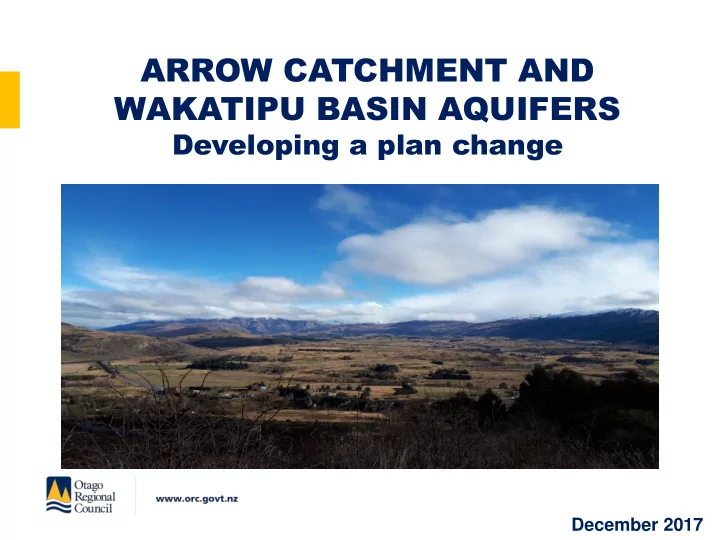
SLIDE 1 ARROW CATCHMENT AND WAKATIPU BASIN AQUIFERS
Developing a plan change
December 2017
SLIDE 2
About
▪ Overview ▪ What we heard last time ▪ Background ▪ The options ▪ Upcoming consultation ▪ Where to next
SLIDE 3
Arrow catchment and Wakatipu Basin aquifers
SLIDE 4
Community Community values values
▪ Most common:
▪ Recreation use (including fishing, swimming, walking, cycling) ▪ Physical and visual character ▪ Water supply for community and irrigation use
▪ Other points
▪ Environmental bottom line as a starting point ▪ Low flows could impact negatively on recreation values
SLIDE 5 The pr he process
1. Consultation on values 2 Reports on surface water, instream habitat and groundwater 3. Identify options for the plan change 4. Identify social and economic effects of options
5. Consultation on options
6. Identify preferred option and draft the plan change 7. Consultation on the draft plan change 8. Notify the plan change and seek submissions 9. Hearing
- 10. Commissioner deliberations
- 11. Plan change decision
- 12. Resolve any appeals
SLIDE 6
Options Options Consulta Consultation tion
▪ Options development, has considered:
▪ Values consultation ▪ Scientific and environmental analysis ▪ Cultural values assessment
▪ Economic and social analysis on options ▪ Seeking feedback on a preferred option
SLIDE 7 The he Ar Arrow w Ca Catc tchme hment nt – Surf Surfac ace e Wate ter r
Photo courtesy of Arrow Irrigation Company
SLIDE 8
The Ar he Arrow w ca catc tchment hment
▪ Flow statistics: ▪ Flowing river that does not dry naturally. ▪ Flows are highest from May to Nov and lowest Jan to April. ▪ Naturalised 7-day Mean Annual Low Flow (MALF) is 1.43-1.44 m3/s)
SLIDE 9
The Ar he Arrow w ca catc tchment hment
Water takes:
Number of consented takes Number of deemed permits Consented allocation Actual Takes
22 14 2.03m3/s 0.596 m3/s
SLIDE 10
The Ar he Arrow w ca catc tchment hment
Habitat modelling for the following values was undertaken: ▪ Native fish – single record of Koaro. ▪ Trout ▪ both brown and rainbow trout ▪ locally significant sports-fish habitat. ▪ Periphyton ▪ Food production (invertebrates)
SLIDE 11 Flow requirements to maintain instream values
Instream Value Season
habitat retention Flow to maintain suggested habtitat retention (l/s) Flow below which habitat rapidly declines (l/s) Optimum flow (l/s)
Adult trout All year
70% 553
Juvenile trout All year
70% 198 500 900
Brown trout – spawning Winter
70% 44 400 600
Rainbow trout – spawning All year
70% 127 400 600
Food producing All year
70% 392 600 900
Avoid Long Filamentous algae Summer
<150% >755 800
SLIDE 12
Minimum Flow Options
SLIDE 13
Primar Primary y Alloca Allocation tion Options Options
SLIDE 14
Waka akati tipu B pu Basin asin Aqui Aquifer ers
SLIDE 15 Ar Arrow w Bush Bush Rib Ribbon, bon, Kaw Kawar arau au & & Shot Shotover er Alluvial Alluvial Rib Ribbon bon Aquif Aquifer ers ▪ In the Water Plan groundwater takes allocated to the surface water body/connected river. ▪ Aquifers located in alluvium and interacting with the associated river.
Source : F. Richard Hauer et al. Sci Adv 2016;2:e1600026
SLIDE 16
Wak akatipu tipu Bas Basin in aq aquif uifer ers s – Sur Surfac ace e wate ter r
▪ Arrow-Bush Ribbon aquifer ▪ Shotover Alluvial Ribbon aquifer ▪ Kawarau Alluvial Ribbon aquifer
SLIDE 17
Other W Other Waka akatipu Basin tipu Basin Aquif Aquifer ers
These aquifers: ▪ Unconfined Aquifers located in river deposits and glacial outwash. ▪ Functioning independently. ▪ Two main recharge sources: rainfall and rivers / streams.
▪ Upper Mill Creek ▪ Mid Mill Creek ▪ Morven ▪ Windemeer / Ladies Mile ▪ Frankton Flats ▪ Speargrass – Hawthorn ▪ Fitzpatrick
SLIDE 18 Alloca Allocation tion Limits Limits
Aquifers Water Volumes (Mm3)
Groundwater Maximum Allocation Value Consented Groundwater Takes Groundwater Available
Fitzpatrick Aquifer
0.105 0.058 0.047
Frankton Aquifer
0.210 0.210
Windemeer / Ladies Mile Aquifer
0.240 0.138 0.102
Mid Mill Creek Aquifer
0.510 0.016 0.494
Morven Aquifer
0.185 0.010 0.175
Speargrass-Hawthorn Aquifer
0.230 0.041 0.189
Upper Mill Creek Aquifer
0.785 0.022 0.763
SLIDE 19
Allo Alloca cation tion limit limit Optio ptions ns
SLIDE 20
SLIDE 21
Social a Social and Economic nd Economic Assessments Assessments
▪ Social
▪ Two Focus groups ▪ Existing flows acceptable for landscape, scenic and recreation values. ▪ Support for the use of water for tourism and recreation. ▪ Reluctance to explore additional water takes.
▪ Economic
▪ Considerable value attributed to amenity and tourism. ▪ Difficult to monetise the value water availability.
SLIDE 22 Format of Today’s Session
▪ Opportunity for Q and A ▪ Discussion to learn more about the options and identify issues and concerns ▪ Opportunity to provide feedback on preferred
SLIDE 23 Ho How can y w can you
provide vide feedbac eedback? k?
▪ Provide your feedback today ▪ Fill in a feedback form (email or post) ▪ Fill in an on-line feedback form ▪ Feedback is required by Friday 26 January 2017
SLIDE 24 Ne Next steps xt steps
▪ Review and summarise feedback. ▪ Finalise our assessment of the
▪ Identify a preferred option. ▪ Prepare draft plan change. ▪ Community and stakeholder consultation in April 2018
SLIDE 25
Thank-you