Arrays (contd) Arrays (contd) The previous example creates - - PDF document

arrays cont d arrays cont d
SMART_READER_LITE
LIVE PREVIEW

Arrays (contd) Arrays (contd) The previous example creates - - PDF document

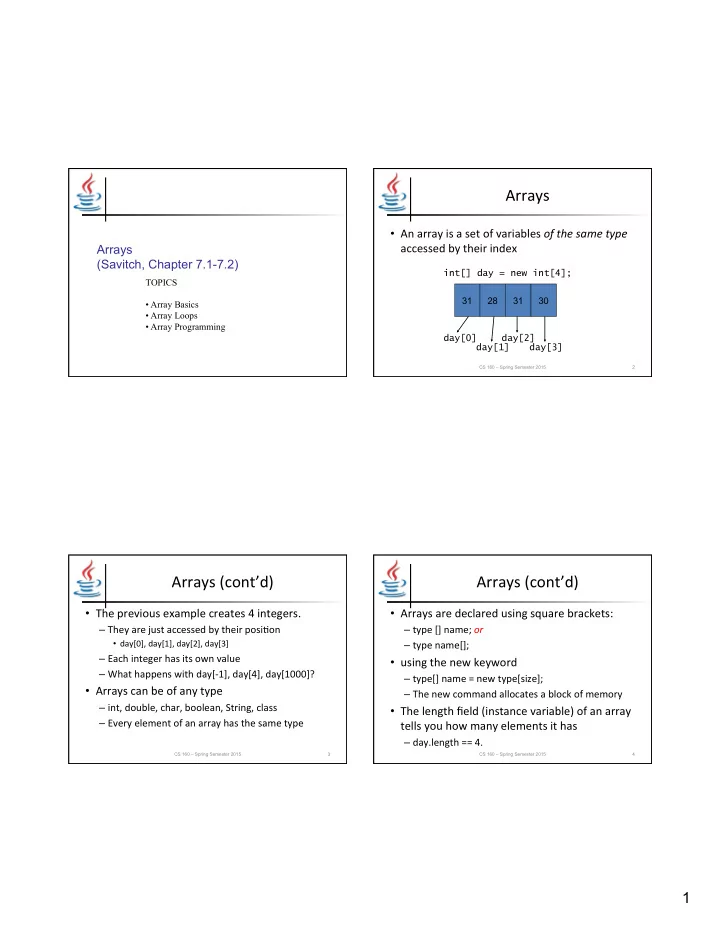
Arrays An array is a set of variables of the same type accessed by their index Arrays (Savitch, Chapter 7.1-7.2) int[] day = new int[4]; TOPICS 31 28 31 30 Array


slide-1
SLIDE 1

1

Arrays (Savitch, Chapter 7.1-7.2)

TOPICS

  • Array Basics
  • Array Loops
  • Array Programming

Arrays ¡

  • An ¡array ¡is ¡a ¡set ¡of ¡variables ¡of ¡the ¡same ¡type ¡

accessed ¡by ¡their ¡index ¡

31 28 31 30 int[] day = new int[4]; day[0] day[1] day[2] day[3]

CS 160 – Spring Semester 2015 2

Arrays ¡(cont’d) ¡

  • The ¡previous ¡example ¡creates ¡4 ¡integers. ¡

– They ¡are ¡just ¡accessed ¡by ¡their ¡posi?on ¡

  • day[0], ¡day[1], ¡day[2], ¡day[3] ¡

– Each ¡integer ¡has ¡its ¡own ¡value ¡ – What ¡happens ¡with ¡day[-­‑1], ¡day[4], ¡day[1000]? ¡

  • Arrays ¡can ¡be ¡of ¡any ¡type ¡

– int, ¡double, ¡char, ¡boolean, ¡String, ¡class ¡ – Every ¡element ¡of ¡an ¡array ¡has ¡the ¡same ¡type ¡

CS 160 – Spring Semester 2015 3

Arrays ¡(cont’d) ¡

  • Arrays ¡are ¡declared ¡using ¡square ¡brackets: ¡

– type ¡[] ¡name; ¡or ¡ – type ¡name[]; ¡

  • using ¡the ¡new ¡keyword ¡

– type[] ¡name ¡= ¡new ¡type[size]; ¡ – The ¡new ¡command ¡allocates ¡a ¡block ¡of ¡memory ¡

  • The ¡length ¡field ¡(instance ¡variable) ¡of ¡an ¡array ¡

tells ¡you ¡how ¡many ¡elements ¡it ¡has ¡

– day.length ¡== ¡4. ¡

CS 160 – Spring Semester 2015 4

slide-2
SLIDE 2

2

Loops ¡+ ¡arrays: ¡challenge ¡ problem ¡

  • Task: ¡read ¡words ¡from ¡input ¡un?l ¡the ¡word ¡

‘quit’ ¡appears. ¡Then ¡print ¡out ¡how ¡many ¡?mes ¡ each ¡lowercase ¡leWer ¡appeared. ¡

  • Ques?on: ¡where ¡do ¡you ¡start? ¡How ¡do ¡you ¡

approach ¡this ¡problem? ¡

CS 160 – Spring Semester 2015 5

Step ¡1: ¡Decomposi?on ¡

  • What ¡has ¡to ¡be ¡done? ¡
  • Ini?alize ¡counters! ¡– ¡another ¡loop ¡ ¡

– Read ¡strings ¡from ¡terminal ¡ – For ¡each ¡string, ¡ ¡

  • For ¡each ¡character, ¡

– Increment ¡counter ¡for ¡that ¡character ¡ ¡

– Print ¡out ¡counts ¡per ¡character ¡

Nested loops Another loop

CS 160 – Spring Semester 2015 6

Steps ¡2-­‑4: ¡

  • Tackle ¡each ¡step ¡individually ¡

– Ini?alize ¡counters ¡

  • Declare ¡the ¡counters ¡first ¡
  • But ¡there ¡are ¡26 ¡of ¡them… ¡
  • … ¡so ¡use ¡an ¡array! ¡

¡

int[] alphaCounters = new int[26];

CS 160 – Spring Semester 2015 7

Step ¡2 ¡(con?nued) ¡

  • S?ll ¡ini?alizing ¡counters… ¡

– The ¡counters ¡count ¡how ¡oden ¡each ¡leWer ¡appears ¡ – So ¡we ¡need ¡to ¡ini?alize ¡all ¡26 ¡of ¡them ¡to ¡zero! ¡ – So ¡we ¡use ¡a ¡for ¡loop ¡with ¡26 ¡itera?ons ¡ for(int i=0; i < 26; i++) { alphaCounters[i] = 0; }

CS 160 – Spring Semester 2015 8

slide-3
SLIDE 3

3

Step ¡2 ¡(yet ¡again) ¡

  • So ¡pueng ¡it ¡together, ¡we ¡need ¡to ¡declare ¡and ¡

ini?alize ¡a ¡counter ¡for ¡every ¡leWer ¡in ¡the ¡ alphabet: ¡ int[] alphaCounters = new int[26]; for(int i=0; i < 26; i++) { alphaCounters[i] = 0; }

CS 160 – Spring Semester 2015 9

Step ¡2 ¡(one ¡more ¡?me!) ¡

  • Actually, ¡hard-­‑coding ¡’26’ ¡is ¡a ¡bad ¡idea ¡

– What ¡if ¡we ¡want ¡to ¡include ¡capitals ¡later? ¡ – What ¡if ¡we ¡want ¡to ¡re-­‑use ¡this ¡code? ¡

  • We ¡want ¡to ¡ini?alize ¡the ¡array, ¡and ¡nothing ¡more: ¡

int[] alphaCounters = new int[26]; for (int i=0; i < alphaCounters.length; i++) { alphaCounters[i] = 0; }

¡

CS 160 – Spring Semester 2015 10

Does ¡it ¡work? ¡

  • Did ¡we ¡declare ¡and ¡ini?alize ¡the ¡counters ¡correctly? ¡

– Never ¡assume ¡something ¡is ¡correct ¡ – Test ¡each ¡step ¡before ¡moving ¡on ¡

  • How? ¡

– Method ¡#1: ¡Use ¡the ¡debugger ¡

  • Run ¡the ¡code ¡(so ¡far) ¡step-­‑by-­‑step ¡
  • Check ¡that ¡the ¡array ¡has ¡26 ¡elements ¡
  • Check ¡that ¡each ¡is ¡set ¡to ¡zero ¡

– Method ¡#2: ¡Write ¡the ¡code ¡to ¡print ¡counters ¡

  • Test ¡it ¡before ¡you ¡start ¡coun?ng ¡leWers ¡

CS 160 – Spring Semester 2015 11

Prin?ng ¡the ¡Counters ¡

  • So ¡prin?ng ¡the ¡counters ¡is ¡another ¡loop: ¡

– Why ¡the ¡trailing ¡println()? ¡

for(int i=0; i < 26; i++) { System.out.print(alphaCounters[i]+”,”); } System.out.println();

CS 160 – Spring Semester 2015 12

slide-4
SLIDE 4

4

Your ¡First ¡Test ¡Code ¡

  • What ¡should ¡this ¡print? ¡

// Declare & Initialize Counters int[] alphaCounters = new int[26]; for(int i=0; i < 26; i++) { alphaCounters[i] = 0; } // Print Counters for(int i=0; i < 26; i++) { System.out.print(alphaCounters[i]+”,”); } System.out.println();

CS 160 – Spring Semester 2015 13

Running ¡Your ¡First ¡Test ¡

public static void main(String[] args) {

// Declare and initialize counters

int[] alphaCounters = new int[26]; for(int i=0; i < 26; i++) { alphaCounters[i] = 0; } // Print Counters for(int i=0; i < 26; i++) { System.out.print(alphaCounters[i]+”,”); } System.out.println(); }

CS 160 – Spring Semester 2015 14

Reading ¡Strings ¡& ¡Coun?ng ¡ LeWers ¡

  • The ¡next ¡step ¡has ¡two ¡parts: ¡

– Read ¡strings ¡(un?l ¡“quit”) ¡ – Increment ¡leWer ¡counters ¡

  • Decompose ¡the ¡(sub)problem ¡

– Either ¡read ¡strings… ¡

  • Assuming ¡you ¡can ¡count ¡leWers ¡once ¡you ¡have ¡them ¡

– Or ¡count ¡leWer ¡instances ¡

  • Given ¡a ¡string ¡(assume ¡you ¡can ¡get ¡strings ¡somehow) ¡

Don’t try to do two things at once!

CS 160 – Spring Semester 2015 15

One ¡approach… ¡

  • We’ve ¡already ¡wriWen ¡a ¡loop ¡to ¡read ¡un?l ¡“quit” ¡

– Remember ¡the ¡Echo ¡program? ¡

  • So ¡let ¡us ¡start ¡with ¡that: ¡

Scanner in = new Scanner(System.in); while (true) { String s = in.next(); if (s.equals(“quit”)) break; System.out.println(s); // Replace with counting }

CS 160 – Spring Semester 2015 16

slide-5
SLIDE 5

5

Wait! ¡Stop! ¡Test ¡this ¡First! ¡

  • How? ¡

– Use ¡a ¡print ¡statement ¡to ¡make ¡sure ¡you ¡are ¡ geeng ¡the ¡right ¡strings, ¡or… ¡ – Use ¡the ¡debugger! ¡

CS 160 – Spring Semester 2015 17

Coun?ng ¡LeWers ¡

  • Given ¡a ¡string, ¡we ¡need ¡to ¡increment ¡a ¡counter ¡

for ¡every ¡leWer. ¡

– Nested ¡loop ¡inside ¡the ¡get ¡string ¡loop ¡

for(int i=0; i < s.length(); i++) { char letter = s.charAt(i); OK, ¡increment ¡le-er ¡count ¡here… ¡ }

CS 160 – Spring Semester 2015 18

Coun?ng ¡LeWers ¡(II) ¡

  • Now ¡increment ¡the ¡appropriate ¡counter ¡

for(int i=0; i < s.length(); i++) { char letter = s.charAt(i); switch(letter) { case ‘a’: alphaCounters[0]++; break; case ‘b’: alphaCounters[1]++; break; case ‘c’: alphaCounters[2]++; break; // 23 more cases… }

CS 160 – Spring Semester 2015 19

Coun?ng ¡LeWers ¡(alt) ¡

  • The ¡previous ¡code ¡is ¡clean ¡but ¡long. ¡
  • Java ¡supports ¡ASCII ¡char ¡subtrac?on ¡

char first_char = ‘a’; char second_char = ‘b’; int offset = second_char – first_char; // 1

for(int i=0; i < s.length(); i++) { char letter = s.charAt(i); int offset = letter – ‘a’; if ((offset >= 0) && (offset < 26)) { alphaCounters[offset]++; } }

CS 160 – Spring Semester 2015 20

slide-6
SLIDE 6

6

Put ¡it ¡all ¡together ¡

public static void main(String[] args) { // Declare and initialize counters int[] alphaCounters = new int[26]; for(int i=0; i < 26; i++) { alphaCounters[i] = 0; } // Create scanner Scanner in = new Scanner(System.in);

CS 160 – Spring Semester 2015 21

All ¡together ¡(II) ¡

// Count letters

while (true) { String s = in.next(); if (s.equals(“quit”)) break; for(int i=0; i < s.length(); i++) { char letter = s.charAt(i); int offset = letter – ‘a’; if ((offset >= 0) && (offset < 26)) alphaCounters[offset]++; } }

CS 160 – Spring Semester 2015 22

All ¡Together ¡(III) ¡

// Close scanner

in.close(); // Print Counters for(int i=0; i < 26; i++) { System.out.print(alphaCounters[i]+”,”); } System.out.println(); } }

CS 160 – Spring Semester 2015 23

Done ¡Yet? ¡No! ¡

  • Test ¡your ¡program: ¡

– Make ¡up ¡some ¡input ¡ – Count ¡the ¡leWers ¡by ¡hand ¡ – Double ¡check ¡your ¡program’s ¡results ¡

  • Make ¡Hard ¡Tests ¡

– Include ¡characters ¡that ¡aren’t ¡leWers ¡ – Test ¡the ¡case ¡where ¡the ¡first ¡input ¡is ¡‘quit’ ¡ – Test ¡really ¡long ¡inputs ¡ – …. ¡

  • Hint: ¡it ¡can ¡be ¡good ¡to ¡think ¡of ¡test ¡cases ¡first. ¡

CS 160 – Spring Semester 2015 24

slide-7
SLIDE 7

7

Methodology ¡Review ¡

1. Get ¡a ¡problem ¡defini?on ¡

– Designing ¡hard ¡test ¡cases ¡can ¡help ¡refine ¡the ¡ problem ¡statements ¡

2. Break ¡the ¡problem ¡into ¡pieces ¡

– AWack ¡each ¡piece ¡separately ¡ – If ¡a ¡piece ¡is ¡big, ¡break ¡it ¡up ¡again ¡

3. Test ¡each ¡piece ¡before ¡moving ¡on ¡

– This ¡may ¡require ¡temporary ¡code ¡ – The ¡debugger ¡can ¡help ¡

CS 160 – Spring Semester 2015 25