Armand Bayou I-Plan Education, Outreach, Recreation and Residential - - PowerPoint PPT Presentation

armand bayou i plan
SMART_READER_LITE
LIVE PREVIEW

Armand Bayou I-Plan Education, Outreach, Recreation and Residential - - PowerPoint PPT Presentation

Armand Bayou I-Plan Education, Outreach, Recreation and Residential Work Group Aubin Phillips, Houston Galveston Area Council Jurisdictions Involved Harris County City of Pasadena City of La Porte City of Houston City of Deer Park Taylor


slide-1
SLIDE 1

Armand Bayou I-Plan

Education, Outreach, Recreation and Residential Work Group
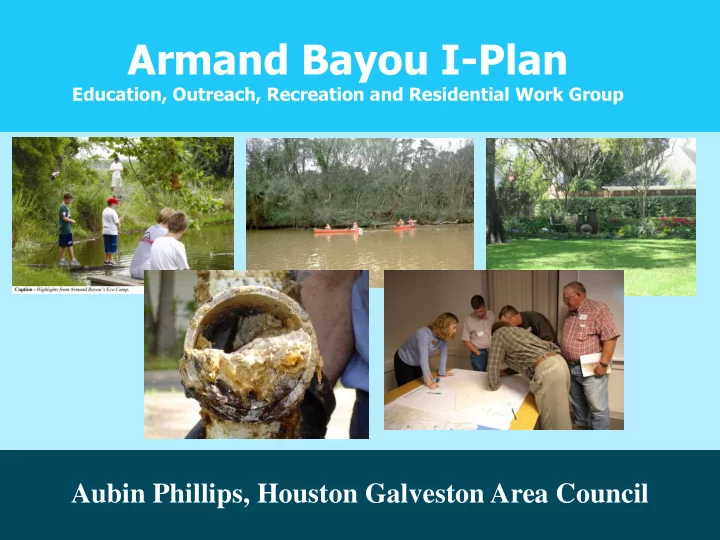
Aubin Phillips, Houston Galveston Area Council

slide-2
SLIDE 2

Jurisdictions Involved

Harris County City of Pasadena City of La Porte City of Houston City of Deer Park Taylor Lake Village

Ellington Air Field Johnson Space Center Armand Bayou Nature Center University of Houston Clear Lake

slide-3
SLIDE 3

Issues Raised

  • Residential Lawns
  • Large lots with livestock (horses, chickens)
  • Dog waste
  • Fertilizer and trash from yards
  • Boat sewage
slide-4
SLIDE 4

Option to Join the BIG I-Plan

  • The Coordination Committee has discussed

the possibility of joining the BIG I-Plan as

  • pposed to creating their own I-Plan

– This would require having a completed TMDL and could be discussed at the next BIG annual meeting in May 2014

  • The Coordination Committee has also

discussed using the BIG I-Plan as a “menu”

slide-5
SLIDE 5

Examples From Other Plans

  • Expand Homeowner Education Efforts Throughout Project

Area Sub-activity 8.1.1: Continue or begin a homeowner education program based on existing models Sub-activity 8.1.2: Conduct pilot studies to evaluate results of education efforts

  • Implementation Activity 3.4: Continue and Expand Stream

Team Volunteer Sampling

  • Implementation Activity 5.4: Expand and Install Dog Parks
  • Implementation Activity 5.7: Promote Domestic Oil Recycling

Programs

  • Implementation Activity 5.8: Hold Household Hazardous

Waste Collection Event

slide-6
SLIDE 6

Example From Other Plans

  • Research Priority 10.1: Evaluate the Effectiveness
  • f Storm Water Implementation Activities

Research Priority 10.2: Further Evaluate Persistence and Regrowth Research Priority 10.3: Determine Appropriate Indicators Research Priority 10.4: Additional Research Topics

slide-7
SLIDE 7

Example 9 Element Table

slide-8
SLIDE 8

Requirements of the Clean Water Act (1972)

  • Identify impaired water

bodies

  • Develop Plans (Total

Maximum Daily Loads) to determine extent of problem

  • Complete TMDLs and

Implementation Plans to bring the water up to standards

slide-9
SLIDE 9

Total Maximum Daily Load (TMDL) Has Two Meanings

A TMDL is a tool which: Determines the maximum amount of a Particular pollutant (load) that a water body can absorb and still maintain its standards

A TMDL is also a document submitted to the EPA that:

Identifies the pollutant of concern and its sources, specifies the allowable amount and serves as a framework for corrective action

slide-10
SLIDE 10

Elements of an Implementation Plan (I-Plan)

  • Management

Measures

  • Implementation

Schedule

  • Follow-up Monitoring

Plan

  • Voluntary

Implementation on Non-Point Source Pollution

  • Measurable Outcomes
slide-11
SLIDE 11

Basic Contents of the Final I-Plan Report

Summary of the TMDL Implementation Strategy (adaptive management, check-ins) Management Measures and Control Actions (implementation activities)

Sustainability (tracking progress over time) Water Quality Indicators (monitoring results) Communication Strategy (information out to the public)

slide-12
SLIDE 12

Areas Where I-Plans are Completed

slide-13
SLIDE 13
  • Mechanism to address

regulated sources

  • Mechanism to address

complex water quality issues

  • f NPS pollution
  • Promote intergovernmental

cooperation

  • Require community support

and input Process Conclusions

slide-14
SLIDE 14

Project Timeline and Milestones January to April 2013

Coordination Committee Forms Appoint Work Groups

April to May 2013

Work Groups Begin Meeting Work Groups Develop Recommendations

May to August 2013

Report drafting, editing, building support

slide-15
SLIDE 15

Thank You!

Thank You!