ARINC 653 Credits: An Avionics Standard for Safe, Partitioned - - PDF document

arinc 653
SMART_READER_LITE
LIVE PREVIEW

ARINC 653 Credits: An Avionics Standard for Safe, Partitioned - - PDF document

Introduction ARINC 653 Credits: An Avionics Standard for Safe, Partitioned Systems Wind River 2008 IEEE CS Seminar Masmano et al. - ARINC-653 APEX based on XtratuM Ananda et al. - ARINC 653 API and its application An


slide-1
SLIDE 1

1

ARINC 653

Introduction

  • Credits:
  • An Avionics Standard for Safe, Partitioned Systems

– Wind River 2008 – IEEE CS Seminar

  • Masmano et al. - ARINC-653 APEX based on

XtratuM

  • Ananda et al. - ARINC 653 API and its application –

An insight into Avionics System Case Study

  • Samolej - ARINC Specification 653 Based Real-

Time Software Engineering

Introduction

  • More functionalities, more connectivity,…, in less

space, weight, and power (SWaP)

Introduction

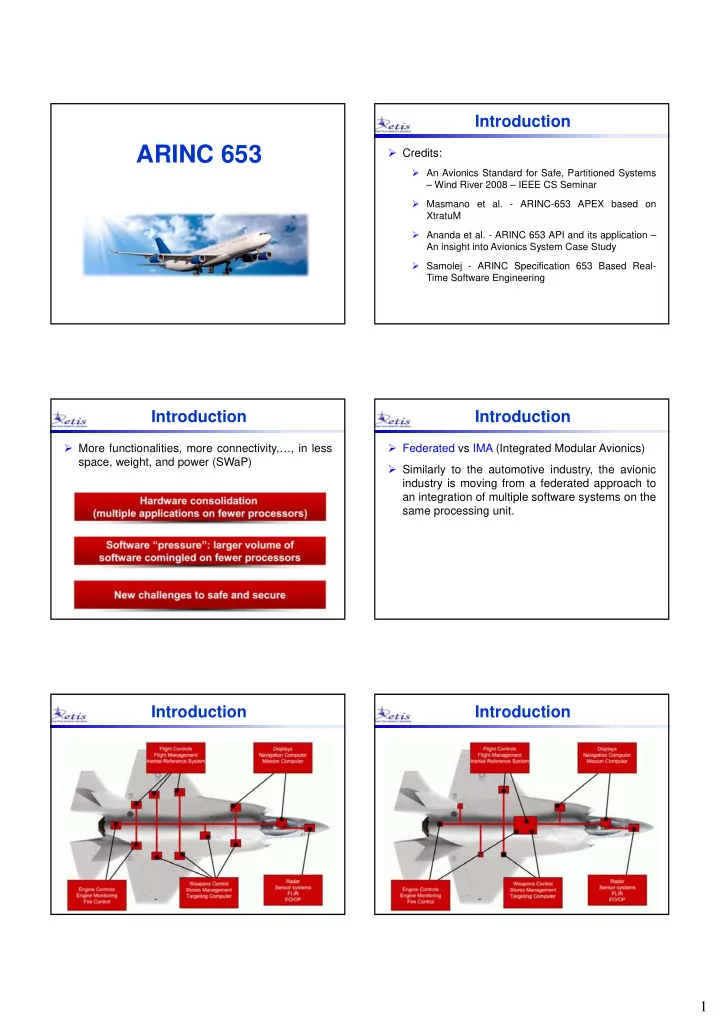
  • Federated vs IMA (Integrated Modular Avionics)
  • Similarly to the automotive industry, the avionic

industry is moving from a federated approach to an integration of multiple software systems on the same processing unit.

Introduction Introduction

slide-2
SLIDE 2

2

Introduction

PROs

  • Traditional methodology
  • Relative “easy” design and certification
  • Existing supply chain

CONs

  • SWaP
  • Poor SW reuse
  • Poor portability
  • Poor modularity

Federated

Introduction

PROs

  • SWaP
  • Excellent SW reuse
  • Excellent portability
  • Excellent modularity

CONs

  • Modern methodology
  • Complexity of design and certification
  • Supply chain not setup for IMA projects

IMA

Introduction

Federated vs IMA – The reality of today

  • They will co-exist for some time;
  • E.g.,

flight controls (highly critical) are still preferred to be served by a dedicated execution unit

ARINC 653 IMA and ARINC 653

  • Integrating

different systems into

  • ne

CPU environment

  • Multiple vendors using the same processor;
  • Safety-critical

control systems (potentially with different criticality levels);

  • Integrated platform with multiple OSes

IMA and ARINC 653

  • Real IMA systems are extremely complex
  • Large number of applications: 10+
  • Large application: 2000000+ lines of code
  • Large configuration data: 40000+ configuration entries
  • Development cycles are shorter and shorter…
slide-3
SLIDE 3

3

IMA and ARINC 653

  • ARINC 653 OS and applications are typically

certified for DO-178B;

  • DO-178B is a document dealing with the safety of

software used in certain airborne systems.

  • Different partitions can be certified to different

DO-178B levels.

IMA and ARINC 653

DO-178B levels (in decreasing criticality order)

  • Catastrophic – Failure may cause a crash. Error
  • r loss of critical function required to safely fly

and land aircraft.

  • Hazardous – Failure has a large negative impact
  • n safety or performance, or reduces the ability of

the crew to operate the aircraft due to physical distress or a higher workload, or causes serious

  • r fatal injuries among the passengers.

IMA and ARINC 653

  • Major – Failure is significant, but has a lesser

impact than a Hazardous failure (for example, leads to passenger discomfort rather than injuries) or significantly increases crew workload.

  • Minor – Failure is noticeable, but has a lesser

impact than a Major failure (for example, causing passenger inconvenience or a routine flight plan change).

  • No Effect – Failure has no impact on safety, aircraft
  • peration, or crew workload.

IMA and ARINC 653

  • The aviation industry developed ARINC 653 as a

standardized RTOS interface definition between the RTOS

  • f

an avionics computer resource and the application software.

  • This benefits both the software developers as

well as the hardware platform suppliers.

IMA and ARINC 653

  • To meet software certification requirement of DO-

178B, 3 main needs have been identified

  • Safety-critical – according to a law
  • Real-Time – response times must be within a

predetermined time period

  • Deterministic – results of the execution must be

predictable and repeatable

  • ARINC

653’s RTOS guarantee an interface boundary for avionics software development, thus allowing independence of the avionics software applications.

IMA and ARINC 653

  • ARINC 653 is a specification used for integrating

avionics systems on a modern aircraft;

  • APEX - API of 51 routines
  • Time and space (memory) partitioning;
  • Health monitoring (error detection and reporting);
  • Communications via “ports”.
  • API available for C and Ada.
slide-4
SLIDE 4

4

ARINC 653 Services

  • The ARINC 653 APEX API provides of services to

the applications.

  • Partition management
  • Partitioning is the main concept of ARINC-653: execution

environment with separate memory space and strictly protected in time;

  • All the resources used by a partition have to be defined at

system configuration time, and created and defined in the initialization phase of the partition.

  • Example of services: get partition status, set partition mode, …

ARINC 653 Services

  • Process management
  • A partition comprises one or more processes;
  • Typically the processes are scheduled according to Fixed-

Priority preemptive (or limited preemptive) policy;

  • An ARINC 653 process can be in one of 4 available states
  • Dormant – ineligible for scheduling;
  • Waiting – not able to execute;
  • Ready – able to be executed;
  • Running – currently executing.

ARINC 653 Services

  • Process management – typical operations
  • create process and collect process status or ID;
  • start, stop, suspend or resume the process;
  • prevent process pre-emption;
  • change the process priority.

ARINC 653 Services

  • Time management
  • From the standard: “Time is unique and independent of

partition execution within a core module. All values

  • r

capacities are related to this unique time and are not relative to any partition execution.”

  • GET_TIME to read the current system time;
  • Wait and time-out mechanism;
  • Budget management for hard real-time tasks (time capacity);
  • Periodicity specification.

ARINC 653 Services

  • Inter-partition communication
  • Communication between two or more partitions via messages;
  • Two types of communication services are available:
  • Sampling

Port – allows a partition to access to a channel

  • f

communication configured to operate in sampling mode;

  • Queuing port – channel of communication with an associated queue of

data.

  • In

system configuration are specified channels, ports, maximum message size, maximum number of messages,…

ARINC 653 Services

  • Intra-partition communication
  • Communication and synchronization between processes within

the same partition;

  • Communication: Black-boards and buffers with static size
  • Synchronization: Semaphores (with FIFO- and priority-ordered

queues) and events.

  • Blocking API to access resources with time-out
slide-5
SLIDE 5

5

ARINC 653 Services

  • Health monitoring
  • Reporting and monitoring errors and exceptions;
  • The error handling is the highest priority process and it is

invoked whenever a fault takes place;

  • Error handlers must be defined to manage an error, defining

how a partition should respond.

ARINC 653 Services

  • Health monitoring – Example of error handling

I. Log the error; II. Stop or restart the failed process; III. Eventually stop or restart the entire partition; IV. Invoke the registered handler for the specific error code

ARINC 653 Services

  • All the OS configurations are specified through

XML;

  • XML specifications are also used for testing,

verification and certification of the system;

  • Existence of tools (from WindRiver) to keep track
  • f

software requirements in the system configuration

ARINC 653 OS

ARINC 653 OS ARINC 653 OS

  • Spatial partitioning – must ensure that software in
  • ne partition

cannot change the software

  • r

private data of another partition, nor command the private devices

  • r

actuators

  • f other

partitions.

  • Temporal partitioning – must ensure that the

service received from shared resources by the software in one partition cannot be affected by the software in another partition in terms of rate, latency, jitter, and duration of scheduled access to it.

slide-6
SLIDE 6

6

ARINC 653 OS ARINC 653 OS

  • The partitions are divided into two categories,

application partition and system partition.

  • The

application partitions execute avionic applications and interact with the environment by means of the APEX interface.

  • The system partitions are optional and their main

role is to provide services not available in APEX, such as device drivers or fault management, actually bypassing the APEX interface.

ARINC 653 OS ARINC 653 OS

  • Time-Division based scheduling of predetermined

set of partitions

, ,…,

  • time

Major Cycle

  • ARINC 653 OS
  • Hierarchical scheduling – On top of each partition

runs a specific OS scheduler (tipically Fixed- Priority)

  • time

Major Cycle FP FP

  • ARINC 653 OS
  • Example – 2 partitions with

4, 2

(1,7) (5,14) (5,50)

priority priority

(1,8) (2,11)

slide-7
SLIDE 7

7

ARINC 653 OS

  • Example – 2 partitions with

4, 2

(1,7) (5,14) (5,50)

priority priority

(1,8) (2,11) deadline miss deadline miss

Certification Issues

  • To certify an ARINC 653 system to DO-178B:
  • Write human-readable requirements;
  • Write and run tests to prove the requirements are

met

  • How to certify the configuration data?
  • There are tools to check whether the configuration

matches the requirements

Certification Issues ARINC 653 OS – Config. ARINC 653 OS – Config.

T hank yo u!

Ale ssandro Bio ndi ale ssandro .bio ndi@sssup.it