Ariane 5.01 failure Patriot failure Mars orbiter loss (overflow) - - PowerPoint PPT Presentation

ariane 5 01 failure patriot failure mars orbiter loss
SMART_READER_LITE
LIVE PREVIEW

Ariane 5.01 failure Patriot failure Mars orbiter loss (overflow) - - PowerPoint PPT Presentation

Motivation (1 mn) . . . . . . . . . . . . . . . . . . . . . . . . . . . . . . . . . . . . . . . . . 3 Abstract interpretation, reminder (10 mn) . . . . . . . . . . . . . . . . . . 6 Applications of abstract interpretation (2 mn) . . . . . . . . .


slide-1
SLIDE 1

Motivation (1 mn) . . . . . . . . . . . . . . . . . . . . . . . . . . . . . . . . . . . . . . . . . 3 Abstract interpretation, reminder (10 mn) . . . . . . . . . . . . . . . . . . 6 Applications of abstract interpretation (2 mn) . . . . . . . . . . . . . 21 A practical application to the ASTRÉE static analyzer (15 mn) 24 Examples of abstractions in ASTRÉE (15 mn) . . . . . . . . . . . . 40 Conclusion (2 mn) . . . . . . . . . . . . . . . . . . . . . . . . . . . . . . . . . . . . . . . . 56

x x

§

x

  • x

x x

§

x

  • x

x

IBM Research January 20, 2006 — 2 — ľ P. Cousot IBM Research January 20, 2006 — 3 — ľ P. Cousot

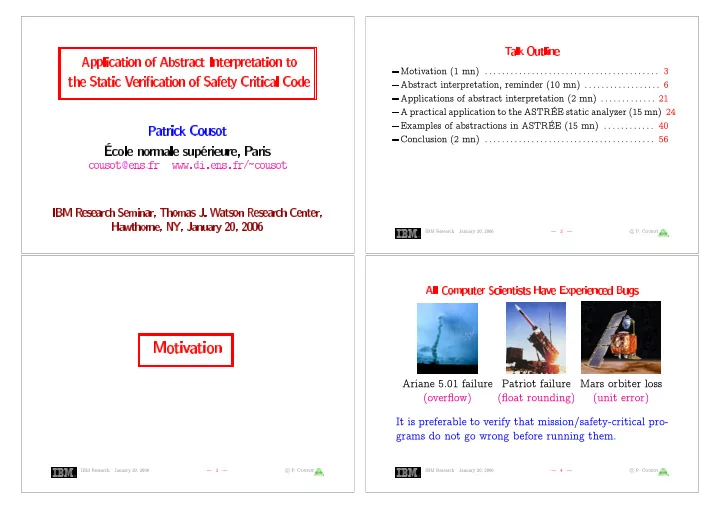
Ariane 5.01 failure Patriot failure Mars orbiter loss (overflow) (float rounding) (unit error) It is preferable to verify that mission/safety-critical pro- grams do not go wrong before running them.

IBM Research January 20, 2006 — 4 — ľ P. Cousot

slide-2
SLIDE 2

analyze the program at compile-time to verify a program runtime property (e.g. the absence

  • f some categories of bugs)

Undecidability ` ! effectively compute an abstraction/ sound approximation of the program semantics, which is precise enough to imply the desired property, and coarse enough to be efficiently computable.

IBM Research January 20, 2006 — 5 — ľ P. Cousot

Reference [POPL ’77]

  • P. Cousot and R. Cousot. Abstract interpretation: a unified lattice model for static analysis of

programs by construction or approximation of fixpoints. In 4th ACM POPL. [Thesis ’78]

  • P. Cousot. Méthodes itératives de construction et d’approximation de points fixes d’opérateurs

monotones sur un treillis, analyse sémantique de programmes. Thèse ès sci. math. Grenoble, march 1978. [POPL ’79]

  • P. Cousot & R. Cousot. Systematic design of program analysis frameworks. In 6th ACM POPL.

IBM Research January 20, 2006 — 6 — ľ P. Cousot

X

variables X 2 X

T

types T 2 T

E

arithmetic expressions E 2 E

B

boolean expressions B 2 B

D ::= T X j T X D0 C ::= X E;

commands C 2 C

j B C0 j B C0 C00 j C1 . . . Cn

, (n – 0)

P ::= D C

program P 2 P

IBM Research January 20, 2006 — 7 — ľ P. Cousot

x(t) t

  • R

SPR

IBM Research January 20, 2006 — 8 — ľ P. Cousot

slide-3
SLIDE 3

Values of given type: VT : values of type T 2 T Vint

def

= fz 2 Z j min_int » z » max_intg Program states ˚P 1: ˚D C

def

= ˚D ˚T X

def

= fXg 7! VT ˚T X D

def

= (fXg 7! VT) [ ˚D

1 States  2 ˚P of a program P map program variables X to their values (X)

IBM Research January 20, 2006 — 9 — ľ P. Cousot

Concrete semantic domain for reachability properties: DP

def

= }(˚P) sets of states i.e. program properties where „ is implication, ; is false, [ is disjunction.

IBM Research January 20, 2006 — 10 — ľ P. Cousot

SX E; R

def

= f[X EE] j  2 R \ dom(E)g [X v](X)

def

= v; [X v](Y )

def

= (Y ) Sif B C0R

def

= SC0(BBR) [ B:BR BBR

def

= f 2 R \ dom(B) j B holds in g Sif B C0 else C00R

def

= SC0(BBR) [ SC00(B:BR) Swhile B C0R

def

= let W =

„ ; –X R [ SC0(BBX)

in (B:BW) SfgR

def

= R SfC1 : : : CngR

def

= SCn ‹ : : : ‹ SC1 n > 0 SD CR

def

= SC(˚D) (uninitialized variables) Not computable (undecidability).

IBM Research January 20, 2006 — 11 — ľ P. Cousot

hD]P; v; ?; ti such that: hDP; „i ` ` `! ` ! ` ` ` `

¸ ‚

hD]P; vi i.e. 8X 2 DP; Y 2 D]P : ¸(X) v Y ( ) X „ ‚(Y ) hence hD]P; v; ?; ti is a complete lattice such that ? = ¸(;) and tX = ¸([ ‚(X))

IBM Research January 20, 2006 — 12 — ľ P. Cousot

slide-4
SLIDE 4

Traces: set of finite or infinite maximal sequences of states for the operational transition semantics

¸

! Strongest liberal postcondition: final states s reachable from a given precondition P ¸(X) = –P fs j 9ff0ff1 : : : ffn 2 X : ff0 2 P ^ s = ffng We have (˚: set of states, _ „ pointwise): h}(˚1); „i ` ` `! ` ! ` ` ` `

¸ ‚

h}(˚)

[

7` ! }(˚); _ „i

IBM Research January 20, 2006 — 13 — ľ P. Cousot

Traces: set of finite or infinite maximal sequences of states for the operational transition semantics

¸1

! Set of reachable states: set of states appearing at least

  • nce along one of these traces (global invariant)

¸1(X) = fffi j ff 2 X ^ 0 » i < jffjg

¸2

! Partitionned set of reachable states: project along each control point (local invariant) ¸2(fhci; ii j i 2 ´g) = –c fi j i 2 ´ ^ c = cig

IBM Research January 20, 2006 — 14 — ľ P. Cousot

¸3

! Partitionned cartesian set of reachable states: project along each program variable (relationships between vari- ables are now lost) ¸3(–c fi j i 2 ´cg) = –c –X fi(X) j i 2 ´cg

¸4

! Partitionned cartesian interval of reachable states: take min and max of the values of the variables 2 ¸4(–c –X fvi j i 2 ´c;Xg = –c –X hminfvi j i 2 ´c;Xg; maxfvi j i 2 ´c;Xgi ¸1, ¸2, ¸3 and ¸4, whence ¸4 ‹ ¸3 ‹ ¸2 ‹ ¸1 are lower- adjoints of Galois connections

2 assuming these values to be totally ordered.

IBM Research January 20, 2006 — 15 — ľ P. Cousot

To combine abstractions hD; „i ` ` ` ! ` ` `

¸1 ‚1

hD]

1; v1i and hD; „i `

` ` ! ` ` `

¸2 ‚2

hD]

2; v2i

the reduced product is ¸(X)

def

= ufhx; yi j X „ ‚1(x) ^ X „ ‚2(y)g such that v

def

= v1 ˆ v2 and hD; „i ` ` ` ` ` `! ` ! ` ` ` ` ` ` `

¸ ‚1ˆ‚2

h¸(D); vi Example: x 2 [1; 9] ^ x mod 2 = 0 reduces to x 2 [2; 8] ^

x mod 2 = 0

IBM Research January 20, 2006 — 16 — ľ P. Cousot

slide-5
SLIDE 5

F F Concrete domain Abstract domain F F F F F F F

  • F
  • F
  • F
  • Approximation

relation ⊥ ⊥

  • ]
  • F ‹ ‚ v ‚ ‹ F ] )

F v ‚( F ])

IBM Research January 20, 2006 — 17 — ľ P. Cousot

S]X E; R

def

= ¸(f[X EE] j  2 ‚(R) \ dom(E)g) S]if B C0R

def

= S]C0(B]BR) t B]:BR B]BR

def

= ¸(f 2 ‚(R) \ dom(B) j B holds in g) S]if B C0 else C00R

def

= S]C0(B]BR) t S]C00(B]:BR) S]while B C0R

def

= let W =

v ? –X R t S]C0(B]BX)

in (B]:BW) S]fgR

def

= R S]fC1 : : : CngR

def

= S]Cn ‹ : : : ‹ S]C1 n > 0 S]D CR

def

= S]C(>) (uninitialized variables)

IBM Research January 20, 2006 — 18 — ľ P. Cousot

F Concrete domain Abstract domain F F F F F F Approximation relation ⊥ ⊥

  • ]
  • F
  • F
  • F
  • F
  • IBM Research

January 20, 2006 — 19 — ľ P. Cousot

3

S]X E; R

def

= ¸(f[X EE] j  2 ‚(R) \ dom(E)g) S]if B C0R

def

= S]C0(B]BR) t B]:BR B]BR

def

= ¸(f 2 ‚(R) \ dom(B) j B holds in g) S]if B C0 else C00R

def

= S]C0(B]BR) t S]C00(B]:BR) S]while B C0R

def

= let F] = –X let Y = R t S]C0(B]BX) in if Y v X then X else X

  • Y

and W =

v ? F]

in (B]:BW) S]fgR

def

= R S]fC1 : : : CngR

def

= S]Cn ‹ : : : ‹ S]C1 n > 0 S]D CR

def

= S]C(>) (uninitialized variables)

3 Note: F] not monotonic!

IBM Research January 20, 2006 — 20 — ľ P. Cousot

slide-6
SLIDE 6

IBM Research January 20, 2006 — 21 — ľ P. Cousot

[POPL ’77], [POPL ’78], [POPL ’79] including [POPL ’79], [POPL ’00], [FPCA ’95], [Manna’s festschrift ’03], . . . [TCS 290(1) 2002] [POPL ’92], [TCS 277(1–2) 2002] [POPL ’97]

IBM Research January 20, 2006 — 22 — ľ P. Cousot

[POPL ’00] [POPL ’02] [POPL ’04] [RT-ESOP ’04] All these techniques involve sound approximations that can be formalized by abstract interpretation

IBM Research January 20, 2006 — 23 — ľ P. Cousot

Reference [1]

IBM Research January 20, 2006 — 24 — ľ P. Cousot

slide-7
SLIDE 7

Application Domain: large safety critical embedded real- time synchronous software for non-linear control of very complex control/command systems. C programs: with basic numeric datatypes, structures and arrays pointers (including on functions), floating point computations tests, loops and function calls limited branching (forward , , )

IBM Research January 20, 2006 — 25 — ľ P. Cousot

without dynamic memory allocation recursive function calls backward branching conflicting side effects C libraries, system calls (parallelism)

IBM Research January 20, 2006 — 26 — ľ P. Cousot

International norm of C (ISO/IEC 9899:1999) restricted by implementation-specific behaviors depend- ing upon the machine and compiler (e.g. representation and size of integers, IEEE 754-1985 norm for floats and doubles) restricted by user-defined programming guidelines (such as no modular arithmetic for signed integers, even though this might be the hardware choice) restricted by program specific user requirements (e.g. , execution stops on first runtime error 4)

4 semantics of C unclear after an error, equivalent if no alarm

IBM Research January 20, 2006 — 27 — ľ P. Cousot

Reachable states for the concrete trace operational se- mantics Volatile environment is specified by a trusted configu- ration file. Requirements: Soundness: absolutely essential Precision: few or no false alarm 5 (full certification) Efficiency: rapid analyses and fixes during develop- ment

5 Potential runtime error signaled by the analyzer due to overapproximation but impossible in any actual program run.

IBM Research January 20, 2006 — 28 — ľ P. Cousot

slide-8
SLIDE 8

No violation of the norm of C (e.g. array index out of bounds, division by zero) No implementation-specific undefined behaviors (e.g. maximum short integer is 32767, NaN) No violation of the programming guidelines (e.g. static variables cannot be assumed to be initialized to 0) No violation of the programmer assertions (must all be statically verified).

IBM Research January 20, 2006 — 29 — ľ P. Cousot

Primary flight control software of the Airbus A340 fam- ily/A380 fly-by-wire system C program, automatically generated from a proprietary high-level specification (à la Simulink/Scade) A340 family: 132,000 lines, 75,000 LOCs after preprocess- ing, 10,000 global variables, over 21,000 after expansion

  • f small arrays

A380: ˆ 3

IBM Research January 20, 2006 — 30 — ľ P. Cousot

;

Task scheduling is static: Requirements: the only interrupts are clock ticks; Execution time of loop body less than a clock tick [EMSOFT ’01].

IBM Research January 20, 2006 — 31 — ľ P. Cousot

Size: > 100 kLOC, > 10 000 variables Floating point computations including interconnected networks of filters, non linear control with feedback, interpolations... Interdependencies among variables: Stability of computations should be established Complex relations should be inferred among nu- merical and boolean data Very long data paths from input to outputs

IBM Research January 20, 2006 — 32 — ľ P. Cousot

slide-9
SLIDE 9

compile time analysis (6= run time analysis Rational Purify, Parasoft Insure++) analyzes programs not micromodels of programs (6= PROMELA in SPIN or Alloy in the Alloy Analyzer) no end-user intervention needed (6= ESC Java, ESC Java 2) covers the whole state space (6= MAGIC, CBMC) so never omit potential errors (6= UNO, CMC from coverity.com) or sort most probable ones (6= Splint)

IBM Research January 20, 2006 — 33 — ľ P. Cousot

uses many numerical/symbolic abstract domains (6= symbolic constraints in Bane or the canonical abstraction of TVLA) all abstractions use infinite abstract domains with widening/narrowing (6= model checking based analyzers such as VeriSoft, Bandera, Java PathFinder) always terminate (6= counterexample-driven au- tomatic abstraction refinement BLAST, SLAM)

IBM Research January 20, 2006 — 34 — ľ P. Cousot

can easily incorporate new abstractions (and reduction with already existing abstract domains) (6= general-purpose analyzers PolySpace Verifier) knows about control/command (e.g. dig- ital filters) (as opposed to specialization to a mere programming style in C Global Surveyor) the precision/cost can be tailored to user needs by options and directives in the code

IBM Research January 20, 2006 — 35 — ľ P. Cousot

the generation of parametric directives in the code can be programmed (to be specialized for a specific application domain) an analyzer instance is built by selection of O- CAML modules from a collection each implement- ing an abstract domain very few or no false alarm when adapted to an application domain ` ! it is a VERIFIER!

IBM Research January 20, 2006 — 36 — ľ P. Cousot

slide-10
SLIDE 10

IBM Research January 20, 2006 — 37 — ľ P. Cousot

132,000 lines, 75,000 LOCs after preprocessing Comparative results (commercial software): 4,200 (false?) alarms, 3.5 days; Our results: alarms, 40mn on 2.8 GHz PC, 300 Megabytes ` ! A world première!

IBM Research January 20, 2006 — 38 — ľ P. Cousot

350,000 lines alarms (Nov. 2004), 7h 6 on 2.8 GHz PC, 1 Gigabyte ` ! A world grand première!

6 We are still in a phase where we favour precision rather than computation costs, and this should go down. For example, the A340 analysis went up to 5 h, before being reduced by requiring less precision while still getting no false alarm.

IBM Research January 20, 2006 — 39 — ľ P. Cousot IBM Research January 20, 2006 — 40 — ľ P. Cousot

slide-11
SLIDE 11

X Y Intervals:  1 » x » 9 1 » y » 20 Octagons [10]: 8 > > < > > : 1 » x » 9 x + y » 77 1 » y » 20 x ` y » 04 Difficulties: many global variables, arrays (smashed or not), IEEE 754 floating-point arithmetic (in program and analyzer) [POPL ’77, 10, 11]

IBM Research January 20, 2006 — 41 — ľ P. Cousot

(x + a) ` (x ` a) 6= 2a

IBM Research January 20, 2006 — 42 — ľ P. Cousot

(x + a) ` (x ` a) 6= 2a

IBM Research January 20, 2006 — 42 — ľ P. Cousot

(1)

x

  • x
  • x
  • x
  • (2)

x

  • x

x x

  • IBM Research

January 20, 2006 — 43 — ľ P. Cousot

slide-12
SLIDE 12

Approximate arbitrary expressions in the form [a0; b0] + P

k([ak; bk] ˆ Vk)

Example: is linearized as

Z = ([0:749 ´ ´ ´ ; 0:750 ´ ´ ´]ˆX)+(2:35 ´ ´ ´ 10`38ˆ[`1; 1])

Allows simplification even in the interval domain

if 2 [-1,1], we get jZj » 0:750 ´ ´ ´ instead of jZj » 1:25 ´ ´ ´

Allows using a relational abstract domain (octagons) Example of good compromize between cost and preci- sion

IBM Research January 20, 2006 — 44 — ľ P. Cousot

Interval analysis: if x 2 [a; b] and y 2 [c; d] then x`y 2 [a ` d; b ` c] so if x 2 [0; 100] then x ` x 2 [`100; 100]!!! The symbolic abstract domain propagates the symbolic values of variables and performs simplifications; Must maintain the maximal possible rounding error for float computations (overestimated with intervals);

IBM Research January 20, 2006 — 45 — ľ P. Cousot

Code Sample:

  • The boolean relation abstract do-

main is parameterized by the height

  • f the decision tree (an analyzer
  • ption) and the abstract domain at

the leafs

IBM Research January 20, 2006 — 46 — ľ P. Cousot

Code Sample:

found invariant `100 » » 100

Control point partitionning: Trace partitionning:

Fork Join

Delaying abstract unions in tests and loops is more precise for non-distributive abstract domains (and much less expensive than disjunctive completion).

IBM Research January 20, 2006 — 47 — ľ P. Cousot

slide-13
SLIDE 13

2d Order Digital Filter:

j

Switch

  • a

b i z-1

Unit delay

z-1 B

+ + +

t x(n)

Unit delay Switch Switch

Computes Xn =  ¸Xn`1 + ˛Xn`2 + Yn In The concrete computation is bounded, which must be proved in the abstract. There is no stable interval or octagon. The simplest stable surface is an ellipsoid.

X U F(X) X F(X) F(X) X X U F(X)

execution trace unstable interval stable ellipsoid

IBM Research January 20, 2006 — 48 — ľ P. Cousot IBM Research January 20, 2006 — 49 — ľ P. Cousot

7

Abstract domain: (R+)5 Concretization: ‚ 2 (R+)5 7` ! }(N 7! R) ‚(M; a; b; a0; b0) = ff j 8k 2 N : jf(k)j » “ –x ax + b ‹ (–x a0x + b0)k” (M)g i.e. any function bounded by the arithmetic-geometric progression.

7 here in R

IBM Research January 20, 2006 — 50 — ľ P. Cousot

potential overflow!

IBM Research January 20, 2006 — 51 — ľ P. Cousot

slide-14
SLIDE 14

IBM Research January 20, 2006 — 52 — ľ P. Cousot

All abstract domains of ASTRÉE are parameterized, e.g. variable packing for octagones and decision trees, partition/merge program points, loop unrollings, thresholds in widenings, . . . ; End-users can either parameterize by hand (analyzer

  • ptions, directives in the code), or

choose the automatic parameterization (default options, directives for pattern-matched predefined program schemata).

IBM Research January 20, 2006 — 53 — ľ P. Cousot

A textual file over 4.5 Mb with 6,900 boolean interval assertions (x 2 [0; 1]) 9,600 interval assertions (x 2 [a; b]) 25,400 clock assertions (x+clk 2 [a; b]^x`clk 2 [a; b]) 19,100 additive octagonal assertions (a » x + y » b) 19,200 subtractive octagonal assertions (a » x ` y » b) 100 decision trees 60 ellipse invariants, etc . . . involving over 16,000 floating point constants (only 550 appearing in the program text) ˆ 75,000 LOCs.

IBM Research January 20, 2006 — 54 — ľ P. Cousot

In case of false alarm, the imprecision can come from: Abstract transformers (not best possible) ` ! improve algorithm; Automatized parametrization (e.g. variable packing) ` ! improve pattern-matched program schemata; Iteration strategy for fixpoints ` ! fix widening

8;

Inexpressivity i.e. indispensable local inductive invari- ant are inexpressible in the abstract ` ! add a new abstract domain to the reduced product (e.g. filters).

8 This can be very hard since at the limit only a precise infinite iteration might be able to compute the proper abstract invariant. In that case, it might be better to design a more refined abstract domain.

IBM Research January 20, 2006 — 55 — ľ P. Cousot

slide-15
SLIDE 15

IBM Research January 20, 2006 — 56 — ľ P. Cousot

Most applications of abstract interpretation tolerate a small rate (typically 5 to 15%) of false alarms: Program transformation ! do not optimize, Typing ! reject some correct programs, etc, WCET analysis ! overestimate; Some applications require no false alarm at all: Program verification. Theoretically possible [SARA ’00], practically feasible [PLDI ’03]

Reference [SARA ’00]

  • P. Cousot. Partial Completeness of Abstract Fixpoint Checking, invited paper. In 4th Int. Symp.

SARA ’2000, LNAI 1864, Springer, pp. 1–25, 2000. [PLDI ’03]

  • B. Blanchet, P. Cousot, R. Cousot, J. Feret, L. Mauborgne, A. Miné, D. Monniaux, and X. Rival.

A static analyzer for large safety-critical software. PLDI’03, San Diego, June 7–14, ACM Press, 2003.

IBM Research January 20, 2006 — 57 — ľ P. Cousot

Forthcoming (1 year): More gereral memory model (

)

Future (5 years): Asynchronous concurrency (for less critical software) Functional properties (reactivity) Industrialization Grand challenge: Verification from specifications to machine code (verify-

ing compiler)

Verification of systems (quasi-synchrony, distribution)

IBM Research January 20, 2006 — 58 — ľ P. Cousot

More references at URL .

IBM Research January 20, 2006 — 59 — ľ P. Cousot

slide-16
SLIDE 16

[2] [4, 5, 6, 7, 8, 9, 10, 11, 12] [3]

  • P. Cousot.

Méthodes itératives de construction et d’approximation de points fixes d’opérateurs monotones sur un treillis, analyse sémantique de programmes. Thèse d’État ès sciences mathéma- tiques, Université scientifique et médicale de Grenoble, Grenoble, France, 21 March 1978. [4]

  • B. Blanchet, P. Cousot, R. Cousot, J. Feret, L. Mauborgne, A. Miné, D. Monniaux, and X. Ri-

val. Design and implementation of a special-purpose static program analyzer for safety-critical real-time embedded software. The Essence of Computation: Complexity, Analysis, Transformation. Essays Dedi- cated to Neil D. Jones, LNCS 2566, pp. 85–108. Springer, 2002. [5]

  • B. Blanchet, P. Cousot, R. Cousot, J. Feret, L. Mauborgne, A. Miné, D. Monniaux, and X. Rival.

A static analyzer for large safety-critical software. PLDI’03, San Diego, pp. 196–207, ACM Press, 2003. [POPL ’77]

  • P. Cousot and R. Cousot.

Abstract interpretation: a unified lattice model for static analysis of programs by construction or approximation of fixpoints. In Conference Record of the Fourth Annual ACM SIGPLAN-SIGACT Symposium on Principles of Programming Languages, pages 238–252, Los Angeles, California, 1977. ACM Press, New York, NY, USA. [PACJM ’79]

  • P. Cousot and R. Cousot. Constructive versions of Tarski’s fixed point theorems. Pacific Journal
  • f Mathematics 82(1):43–57 (1979).

[POPL ’78]

  • P. Cousot and N. Halbwachs.

Automatic discovery of linear restraints among variables of a pro-

  • gram. In Conference Record of the Fifth Annual ACM SIGPLAN-SIGACT Symposium on Principles of

Programming Languages, pages 84–97, Tucson, Arizona, 1978. ACM Press, New York, NY, U.S.A.

IBM Research January 20, 2006 — 60 — ľ P. Cousot

[POPL ’79]

  • P. Cousot and R. Cousot. Systematic design of program analysis frameworks. In Conference Record
  • f the Sixth Annual ACM SIGPLAN-SIGACT Symposium on Principles of Programming Languages, pages

269–282, San Antonio, Texas, 1979. ACM Press, New York, NY, U.S.A. [POPL ’92]

  • P. Cousot and R. Cousot. Inductive Definitions, Semantics and Abstract Interpretation. In Con-

ference Record of the 19th ACM SIGACT-SIGMOD-SIGART Symposium on Principles of Programming Languages, pages 83–94, Albuquerque, New Mexico, 1992. ACM Press, New York, U.S.A. [FPCA ’95]

  • P. Cousot and R. Cousot. Formal Language, Grammar and Set-Constraint-Based Program Analysis

by Abstract Interpretation. In SIGPLAN/SIGARCH/WG2.8 7th Conference on Functional Programming and Computer Architecture, FPCA’95. La Jolla, California, U.S.A., pages 170–181. ACM Press, New York, U.S.A., 25-28 June 1995. [POPL ’97]

  • P. Cousot. Types as Abstract Interpretations. In Conference Record of the 24th ACM SIGACT-

SIGMOD-SIGART Symposium on Principles of Programming Languages, pages 316–331, Paris, France,

  • 1997. ACM Press, New York, U.S.A.

[POPL ’00]

  • P. Cousot and R. Cousot. Temporal abstract interpretation. In Conference Record of the Twen-

tyseventh Annual ACM SIGPLAN-SIGACT Symposium on Principles of Programming Languages, pages 12–25, Boston, Mass., January 2000. ACM Press, New York, NY. [POPL ’02]

  • P. Cousot and R. Cousot. Systematic Design of Program Transformation Frameworks by Abstract
  • Interpretation. In Conference Record of the Twentyninth Annual ACM SIGPLAN-SIGACT Symposium on

Principles of Programming Languages, pages 178–190, Portland, Oregon, January 2002. ACM Press, New York, NY. [TCS 277(1–2) 2002] P. Cousot. Constructive Design of a Hierarchy of Semantics of a Transition System by Abstract Interpretation. Theoretical Computer Science 277(1–2):47–103, 2002.

IBM Research January 20, 2006 — 61 — ľ P. Cousot

[TCS 290(1) 2002]

  • P. Cousot and R. Cousot. Parsing as abstract interpretation of grammar semantics. Theo-
  • ret. Comput. Sci., 290:531–544, 2003.

[Manna’s festschrift ’03]

  • P. Cousot. Verification by Abstract Interpretation. Proc. Int. Symp. on Verification –

Theory & Practice – Honoring Zohar Manna’s 64th Birthday, N. Dershowitz (Ed.), Taormina, Italy, June 29 – July 4, 2003. Lecture Notes in Computer Science, vol. 2772, pp. 243–268. ľ Springer-Verlag, Berlin, Germany, 2003. [6]

  • P. Cousot, R. Cousot, J. Feret, L. Mauborgne, A. Miné, D. Monniaux, and X. Rival. The ASTRÉE analyser.

ESOP 2005, Edinburgh, LNCS 3444, pp. 21–30, Springer, 2005. [7]

  • J. Feret. Static analysis of digital filters. ESOP’04, Barcelona, LNCS 2986, pp. 33—-48, Springer, 2004.

[8]

  • J. Feret. The arithmetic-geometric progression abstract domain. In VMCAI’05, Paris, LNCS 3385, pp. 42–

58, Springer, 2005. [9] Laurent Mauborgne & Xavier Rival. Trace Partitioning in Abstract Interpretation Based Static Analyzers. ESOP’05, Edinburgh, LNCS 3444, pp. 5–20, Springer, 2005. [10]

  • A. Miné. A New Numerical Abstract Domain Based on Difference-Bound Matrices. PADO’2001, LNCS

2053, Springer, 2001, pp. 155–172. [11] A. Miné. Relational abstract domains for the detection of floating-point run-time errors. ESOP’04, Barcelona, LNCS 2986, pp. 3—17, Springer, 2004. [12]

  • A. Miné. Weakly Relational Numerical Abstract Domains. PhD Thesis, École Polytechnique, 6 december

2004.

IBM Research January 20, 2006 — 62 — ľ P. Cousot

[POPL ’04]

  • P. Cousot and R. Cousot. An Abstract Interpretation-Based Framework for Software Watermarking.

In Conference Record of the Thirtyfirst Annual ACM SIGPLAN-SIGACT Symposium on Principles of Programming Languages, pages 173–185, Venice, Italy, January 14-16, 2004. ACM Press, New York, NY. [DPG-ICALP ’05] M. Dalla Preda and R. Giacobazzi. Semantic-based Code Obfuscation by Abstract Interpretation. In Proc. 32nd Int. Colloquium

  • n

Automata, Languages and Pro- gramming (ICALP’05 – Track B). LNCS, 2005 Springer-Verlag. July 11-15, 2005, Lisboa, Portugal. To appear. [EMSOFT ’01]

  • C. Ferdinand, R. Heckmann, M. Langenbach, F. Martin, M. Schmidt, H. Theiling, S. Thesing,

and R. Wilhelm. Reliable and precise WCET determination for a real-life processor. EMSOFT (2001), LNCS 2211, 469–485. [RT-ESOP ’04]

  • F. Ranzato and F. Tapparo. Strong Preservation as Completeness in Abstract Interpretation.

ESOP 2004, Barcelona, Spain, March 29 - April 2, 2004, D.A. Schmidt (Ed), LNCS 2986, Springer, 2004,

  • pp. 18–32.

IBM Research January 20, 2006 — 63 — ľ P. Cousot