Are st udent s really reading t he web pages I direct t hem t o? - - PowerPoint PPT Presentation

are st udent s really reading t he web pages i direct t
SMART_READER_LITE
LIVE PREVIEW

Are st udent s really reading t he web pages I direct t hem t o? - - PowerPoint PPT Presentation

http:/ / www.tomgauld.com/ index.php? / news/ news-archive/ Are st udent s really reading t he web pages I direct t hem t o? Lorena O English Washingt on S t at e Universit y Libraries @ wsulorena oenglish@ wsu.edu WS U Academic Out


slide-1
SLIDE 1

Are st udent s really reading t he web pages I direct t hem t o?

Lorena O’ English Washingt on S t at e Universit y Libraries @ wsulorena oenglish@ wsu.edu WS U Academic Out reach and Innovat ion Teaching Innovat ion Forum 2/ 17/ 2020

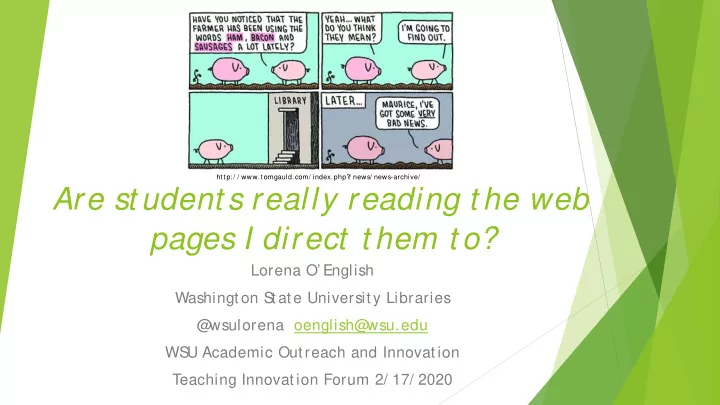
http:/ / www.tomgauld.com/ index.php? / news/ news-archive/

slide-2
SLIDE 2

Annotation: Analog versus Digital

 Analog annotation

“ Marginalia”

 Highlighting  S

ymbols

 Notes  Digital annotation  Highlighting  S

ymbols

 Notes

“ Currently, applications such as Evernote, S ticky Notes, and Notability can facilitate close reading, but students have yet to annotate their digital texts with the same enthusiasm had they owned a copy of the

  • book. Close reading on paper remains a personalized interaction with

the text that readers have been practicing for as long as there has been print on paper, a sentiment immortalized in Billy Collins’s poem, “ Marginalia” : Even Irish monks in t heir cold script oria j ot t ed along t he borders of t he Gospels brief asides about t he pains of copying, . . . (95) It remains to be seen if digital annotation will be as productive and useful (and last as long) as its paper counterpart, and if it will accomplish the same, or greater, purposes for readers. For digital annotation to grow into more compelling, reflective practice, we must instruct and then expect our young online readers to read and annotate

  • nline texts as fervently and closely as they would a Collins poem. Only

then will we have a right to expect more from students’ online discourse.”

Pape, Raymond. “Preparing Our Close Readers for the New Literacies.” English Journal 105.2 (2015): 75.

slide-3
SLIDE 3

Why Annotate? Why Do S

  • cial Annotation?

 Annotating is reading for understanding and for discussion  S

  • cial Annotating is that too, but also conversations with and between

texts and people, showing engagement (and providing a persistent record)

1.

Conventions - S hort term: Review and understanding

2.

Comprehending

3.

Contextualizing - Long term: S ignificance

4.

Classifying

5.

Critiquing - Longer term: Development of expertise & dialogue

6.

Connecting

slide-4
SLIDE 4

[Open] Web Annotation

 Web Comments

1.

Disqus

 Fisking  Web Annotation

1.

In original vision of the Web (Mosaic)

2.

Now a Web standard developed by the W3C Web Annotation Working

Group (2/ 23/ 2017)

a.

Open source

b.

Interoperable

What are Web Annotations? “ Traditional annotations are marginalia, errata, and highlights in printed books, maps, picture, and

  • ther physical media. Web annotations are an

attempt to recreate and extend that functionality as a new layer of interactivity and linking on top of the Web. It will allow anyone to annotate anything anywhere, be it a web page, an ebook, a video, an image, an audio stream, or data in raw or visualized form. Web annotations can be linked, shared between services, tracked back to their

  • rigins, searched and discovered, and stored

wherever the author wishes; the vision is for a decentralized and open annotation infrastructure.” https:/ / www.w3.org/ annotation/
slide-5
SLIDE 5

Web Annotation Architecture

htps:/ / www.w3.org/ annotation/ diagrams/ annotation-architecture.svg

slide-6
SLIDE 6

Hypothesis Animated Intro Video

Hypothesis Animated Intro

slide-7
SLIDE 7

Annotating with Hypothes.is

#OpenAnnotation #S

  • cialAnnotation

#CollectiveAnnotation

 Light , pret t y low threshold; can be

implement ed/ assigned/ used wit h minimal advance preparat ion

 The most broadly and scholarly engaged of

web annot at ion syst ems; part of a coalit ion

  • f publishers, professional associat ions,

libraries, and more.

 Open source, int eroperable  Privat e, public, or group-only annot at ions;

t hreaded replies ; t agging; embedded media #

 Chrome/ Edge ext ension, Firefox

bookmarklet , proxy, embed code

 (Includes online/ local PDF annot at ion)

https:/ / hypothes.is/ roadmap/

slide-8
SLIDE 8

More Annotating with Hypothes.is

#OpenAnnotation #S

  • cialAnnotation #CollectiveAnnotation

 Making a push for use in the classroom (high school and higher education)  Making a push for use as a mode of post-publication critique and peer

review

1.

For bot h of t hese, t he abilit y t o annot at e scholarly art icles on t heir original publisher plat forms is valuable

 Making a push as a way to counter misinformation and “ fake news”  Making a push for LMS

integration (we’ re j ust gonna ignore t hat … )

slide-9
SLIDE 9

Hypothesis.is S earch

Y

  • u can hypothesis.is search here

at this link

Journal Example

slide-10
SLIDE 10

Hypothesis.is S earch (cont.)

Y

  • u can hypothesis.is search here

at this link

Another annotation Example

slide-11
SLIDE 11

Issues with Web Annotation

 Identity/ Privacy  Harassment/ S

ecurity

 Intellectual Property

1.

Hypot hes.is: Prevent ing Abuse

2.

Hypot hes.is: Involving Page Owners in Annot at ion (t here is an opt -out script )

 Link Rot/ Orphan Annotations

Romano, Aja. “A Blog Post about Herpes Led to Fierce Debate about Annotations, Harassment, and the Open Web.” Vox. 31 Mar. 2016. link: http://www.vox.com/2016/3/31/11336852/genius-annotation-controversy

slide-12
SLIDE 12

S

Are st udent s really reading t he web pages I direct t hem t o?

 Can web annotation help determine this?

1.

“ Persistent and open annotations have the potential for providing significant value for teaching, learning, and research in all scholarly disciplines.

2.

Annotation makes it easier to keep track of what you [and your students] read by enabling notes and critiques attached via anchors that can later be searched by text or tag.

O’ English, Lorena. http:/ / www.ala.org/ acrl/ publications/ keeping_up_with/ web_annotation (2019)

slide-13
SLIDE 13

S

Are st udent s really reading t he web pages I direct t hem t o? (cont .)

 Can web annotation help determine this?

1.

Groups of students and/ or researchers can collaboratively annotate a document (scholarly or popular), learning from and engaging with each other in a conversation that they can return to over time.

2.

[S tudents and] researchers can engage with disciplinary research – S taines and Martone note that commenting capability is slowly disappearing from the scholarly web, and

  • pen annotation offers a way to make that “ community

feedback” happen in a way that provides more and richer affordances then the original commenting capability and creates more value for the larger scholarly record. It also

  • ffers interesting possibilities for peer review…

O’ English, Lorena. http:/ / www.ala.org/ acrl/ publications/ keeping_up_with/ web_annotation (2019)

slide-14
SLIDE 14

Are st udent s really reading t he web pages I direct t hem t o?

Lorena O’ English Washingt on S t at e Universit y Libraries @ wsulorena oenglish@ wsu.edu WS U Academic Out reach and Innovat ion Teaching Innovat ion Forum 2/ 17/ 2020

http:/ / www.tomgauld.com/ index.php? / news/ news-archive/