Architecture, Citizenship, Space: British Architecture from the 1920s - - PDF document
Architecture, Citizenship, Space: British Architecture from the 1920s to the 1970s 15-16 June 2017, Oxford Brookes University Where and How to Live Chair : Professor John Gold, Oxford Brookes University By 1939 a consensus had emerged that Bri5sh
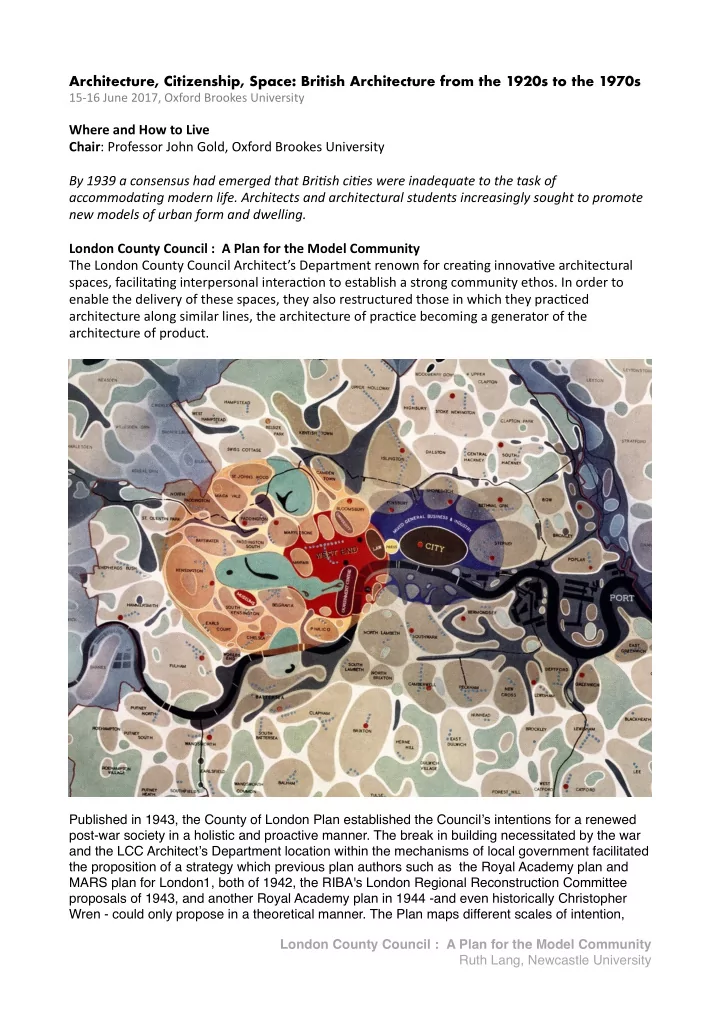
from citywide planning to aspirations for housing, industry, commerce, open spaces, with the small scale interventions informing the intentions for the overall scheme – one could not have been considered without the other. It was not intended as just a physical urban rewiring, but as an "assessment of London's physical, economic and social conditions", rooted in an understanding of the material and immaterial parameters of its context.
Its central tenet was to restructure the County to create healthier, well planned neighbourhoods which would enable future generaLons to build communiLes with a strong interpersonal ethos. Addressing the overcrowding and toxic industries which blighted exisLng residenLal areas required relocaLon under the powers of the new compulsory purchase powers of the 1947 Town and Country Planning Act, to create new green spaces and revived housing estates. Within the self- contained enLLes of these nodal neighbourhoods, each connected by a rewired transportaLon network, 6 000-10 000 ciLzens would be appropriately educated, well housed, and provided with places to work, meet and relax. These were to be developed incrementally, despite the urgency of housing provision, imbued with the foresight for building community bonds in the longterm, the strategy thereby addressing their intenLons for both "immediate provision and future possibiliLes ".
2
At the heart of these neighbourhoods - both geographically and socially – were the Council’s proposals to address the requirements of the burgeoning 1944 EducaLon Act. The size of the estates forming each neighbourhood were set by the esLmated number of pupils living there who would feed this school, and who would not need to cross any main roads on their way to and from their homes.
London County Council : A Plan for the Model Community Ruth Lang, Newcastle University
Neighbourhood Plan
County of London Plan, 1943
Due to compact nature of London’s urban fabric, this was not always implemented as an ideal translaLon of the intended diagram beyond the wholescale RegeneraLon Areas such as in Stepney and Poplar, where plans for slum clearance and extensive bomb damage combined to free the architects from the constraints of the exisLng urban fabric. As the plan for Effra Primary School in Lambeth shows, the LCC’s sites were o\en far from the ideal, open sites surrounded by playing fields which were intended to be inhabited by the Ministry
- f EducaLon. Instead, a sensiLvity to retained community infrastructure and the density of exisLng
development provided new parameters within which to operate. The LCC’s 1947 Plan of London Schools proposed that school provision would be more concentrated within the neighbourhood layout providing densely populated Comprehensive,
3
Primary, Secondary and Technical schools in place of more dispersed educaLonal buildings.
London County Council : A Plan for the Model Community Ruth Lang, Newcastle University
Plan for Effra Primary School
Lambeth Council
Much of the exisLng building stock had been inherited from the previous School Board , which had
4
been “built before 1920 and [was] now out of date” (London County Council, 1947). These old schools were at odds with the new educaLonal intenLons, which proposed “an element of reacLon against the ideas which have gone before[…] [to] use our school buildings differently from a few years ago, to match our changing and developing educaLonal ideas” (Morrell et al, 1960, 15). One of these educaLonal ideals was the integrated provision of educaLon for pupils for newly defined categories of disability. This was to be made within a specialist insLtuLon, with environments designed specifically to accommodate the effects and requirements of physical, learning and mental handicaps . The challenge here was to establish an appropriate typological
5
precedent appropriate to the new parameters of use this entailed.
Although guidance was published by the Ministry of EducaLon for these new typologies in Building BulleLn, a non-statutory magazine published by HMSO on an ad hoc basis for an audience
- f architects, teachers, schools inspectors and “all those whom
architects regard as their clients” , the architects had a fairly open
6
remit in terms of delivery, with few parameters to constrain their creaLvity.
Project architect, Bob Giles, notes that “There were no design guides within the Division. I took the lead from exisLng school plans and current educaLon theory”.
7
The intenLon outlined in the London School Plan had been for schools for physically handicapped children to be located
- n the edge of the County, in order for them to afford them
beier access to “the light and air that they need”.
London County Council : A Plan for the Model Community Ruth Lang, Newcastle University
London School Plan
London County Council
Yet for central schools such as the proposed Bromley Hall in Bow, the industrial context of the site idenLfied for its construcLon necessitated a novel response. a series of courtyard spaces were integrated within the plan of the proposed school. London County Council : A Plan for the Model Community Ruth Lang, Newcastle University
Building Bulletin
Spatial arrangement guidance Ministry of Education 1955 onwards
These spaces were to provide disLncLve relaLonships between inside and outside, and enable enLre classrooms to be opened up, providing a conLnuaLon of the Open Air School design philosophies experimented with by the LCC at Bostal Wood School in 1907 and evidenced in the school’s precursor.
8
Mindful of meeLng the constraints of the number of pupils, to be delivered at a cost-per-head also determined by the Ministry, Giles was able to dictate the form of the school based on his
- wn experience on comparaLve
- schemes. His familiarity with the “New
Empiricism” and “funcLonal tradiLon”
9
led to the use of engineering brick - a material choice appropriate to the physical requirements of a school for students with heavy wheelchair use, and with small-scale spaces in response to the new ethos of child- centric tectonic design. The quality and experimental nature of the scheme has been appraised by English Heritage and afforded Grade II lisLng (though soon to be refurbished) for being “one of the architecturally
- utstanding schools of the 1960s […] combining inLmate, child-scaled interiors with bold,
expressive external forms reflecLng the local industrial vernacular.” (BriLsh Listed Buildings, 2014)
London County Council : A Plan for the Model Community Ruth Lang, Newcastle University
Bromley Hall Open Air School
previous location
Schools such as Bromley Hall School were able to achieve such levels of ingenuity thanks to the COLP’s co-author Forshaw’s restructuring of the architect’s Department at LCC. A restructuring which mirrors the restructuring he’d proposed for the county itself.
It was important to establish how these groups operated internally, but also how they would communicate with each other - in much the same way that the overall infrastructure was essenLal to the successful establishment of introspecLve Neighbourhood units set out in the Plan.
London County Council : A Plan for the Model Community Ruth Lang, Newcastle University
Bromley Hall School
Leven Road, Bow, E14 0GQ Bob Giles, LCC Architect’s Department, 1964-68
Individual groups, mini communiLes – Giles was working in a studio atmosphere which was a conLnuaLon of Studio environment akin to the university environments many had just come directly from, through teaching links with the AA, Regents Street Polytecnic, Edinburgh. The small scale enabled the architects to have close contact with their Group Leaders such as Peter Moro and Colin Lucas, who had been looked up to in educaLon. This was complemented by the encouragement of a conLnuing educaLon , with visits organised by the Council from Le Corbusier,
10
Walter Gropius and Frank Lloyd Wright. These were thought of as small studios, rather than faceless bureaucrats. Forshaw’s structure - later expanded by Robert Maihew, and restructured again under Hubert Bennei and Leslie MarLn in 1956 - created “streams” of reporLng between the Chief Architect,
11
divisional heads , Group Leaders and the individual architects who worked these studio teams of
12
12-16 , a scale more familiar to private pracLce than the structures of governmental bureaucracy.
13
The human links were made essenLal due to the spaLal separaLon of the Department’s operaLon
- groups forming the Schools Division worked in groups of two to thirty three across rooms 275,
14
667, 668, 669, 670, 671, 766, 768, 769 of North Block (and sub-rooms thereof). Michael Powell - the Schools Division Head architect of the Lme - was based in room 666, and Chief Architect Hubert Bennei in room 172.
London County Council : A Plan for the Model Community Ruth Lang, Newcastle University
George Finch
Architectural Association, 1950
ROSEMARY Stjernstedt
Housing Division, 1950s
In its locaLon a\er the Council moved from Spring Gardens to the site at County Hall, the architect’s department was posiLoned alongside the other primary funcLons of the council, with proximate access to the educaLonal, housing and planning commiiees which operated within it, as well as internal quality surveying, regulatory, and research resources – as well as the services of a sociologist, Margaret Willis, development laboratories - thus establishing physical support infrastructure of ameniLes of the department. The pracLces they adopted parallel the bureaucraLc working pracLces outlined by Henry Russell Hitchcock, depending “not on the architectural genius of one man, […] but in the organisaLonal genius which can establish a fool-proof system of rapid and complete producLon. ” But rather than homogenising the
15
- utput, this process encouraged greater experimentaLon
through the autonomy it imbued. The work of the LCC was inherently pluralisLc, not individualist - much to Frank Lloyd Wright’s chagrin upon visiLng . Yet it was
16
able to project an image of operaLng as a coherent whole, accommodaLng variety of lives of the inhabitants.
London County Council : A Plan for the Model Community Ruth Lang, Newcastle University
Clockwise, from top left administrative support, staff canteen, library, laboratory
As its staff and its remit grew, the LCC reached a criLcal mass by which “The LCC organisaLon, carrying out numerous types of projects, staffed by over 3000 people, was too big for any strict raLonalisaLon .” In the mid-1950s, 585 architects were working in the Department, with a
17 18
support staff of around twice this number. SpaLal and interpersonal relaLonships in County Hall, enabled strategic separaLon, but also moments of meeLng together, as for the County of London Plan – can be seen as a microcosm. The Department’s relocaLon to the North Block extension in 1958 developed a more insular, specialist community, the structure of reporLng became more important to maintain this ethos of coordinaLon to balance their creaLvity, despite physical separaLon. But as for the realizaLon of the County of London Plan, issues arose whereby these communiLes became rather insular, with liile crossover between
- groups. In contrast to the seeming homogeneity and
anonymity of the Department and the spirit of collaboraLon at its heart, this served to create a large number of what are frequently referred to as “Prima Donnas”. The renowned architectural freedom and potenLal influence of social beierment , and the development of architecturally and financially significant schemes had
19
drawn a series of strong personaliLes to the Department. Ostensibly the anonymity of authorship
20
- f each scheme to the outside world opposed this, though an internal sense of compeLLon was
insLlled in its place, forged by the employees’ awareness of their own privileged posiLon and
21
London County Council : A Plan for the Model Community Ruth Lang, Newcastle University
- experLse. While the size and nature of the Department
could have proven oppressive, it instead empowered its employees. They were felt to be far from a sense of overall control – this was a shi\ from being seen as an innovaLve avant garde, to being considered Prima Donnas, their power and renegade nature in the face of higher authority reflecLng the issues seen with the LCC and later GLC, which brought about its dissoluLon. The Department’s locaLon, and the social and interpersonal connecLons it embued, insLgated an ethos of creaLvity for the community it contains, which facilitated their creaLon of such innovaLve architecture. We can see that it is not only the material manifestaLon and disposiLon of our buildings, but also the immaterial strategic approach. The architects of LCC were experimenLng with the composiLon
- f spaLal arrangements not only in the schemes they designed, but also in how they approached
their pracLce. This spaLal consideraLon translates from the urban plan, to architectural development, to building interpersonal connecLons, and back out again. From this we can see how architecture as product, architecture as pracLce, are intertwined, and how Lewis Silkin’s spirit of friendship, neighborliness and comradeship, translates through to how good ciLzens build good architecture, and vice versa. —
. A. Korn and F.J. Samuely, A master plan for London, Architectural Review, 91, January (1942). 143–150 This was authored by Arthur 1 Korn, Maxwell Fry, Arthur Ling and Felix Samuely. Despite the crossover in collaboration - and in explicit employment of Ling within the LCC's team developing the Plan - these were developed independently, and parallels with the MARS Plan for London are denied by Ling himself. Yet this enabled the integration of a broader range of expertise than those available in-house. . Forshaw, J. H., and Patrick Abercrombie. 1943. County of London Plan. First Edition. Macmillan. 2
- p. iv
The numbers of students to be provided for of course having a symbiotic relationship with the neighbourhood proposals themselves, 3 and the quantity of housing (and potential residents) they accommodated. The inheritance of the built legacy and reaction to it, as quoted from Britain’s New Schools. 4 A section on the varying parameters dependent on type was outlined by their in house publication Replanning London Schools 5 (London County Council, 1947) Building Bulletin No.1 (second Edition). 1955. P.1. HMSO. Institute of Education.
6
Bob Giles, e-mail message to author, January 21, 2015 7 An outline of the ascertained benefits and related experimental schemes are outlined in England’s Schools (Harwood, 2010) 8 Reference is given to Arne Jacobsen’s Munkegård School of 1948-57 in Dyssegård, Copenhagen, Aldo van Eyck’s orphanage at 9 Amsterdam of 1960-61 and Erich Mendelsohn's Hermann Hat Factory in Luckenwalde, Germany (British Listed Buildings, 2014) although Giles cites Colin St John Wilson’s “The Other Tradition of Modern Architecture” as a key reference in developing his familiarity with similar such works. (Bob Giles, e-mail message to author, January 21, 2015)
London County Council : A Plan for the Model Community Ruth Lang, Newcastle University
North Block EXTENSION County Hall
Chicheley Street, Built 1955-8
See also CONTRACT chapter for elaboration of working practices established for sabbaticals, teaching, and lunchtime gallery visits 10 characteristic of employment at LCC.
- REF PJM archive : Percy Johnson Marshall’s archival notes regarding reshuffles to the Department structure
11 introduced by Martin to Schools and Housing Divisions. Saint, Andrew. 1987. Towards a Social Architecture: Role of School 12 Buildings in Post-War England. 1st edition. New Haven: Yale University Press. P .186 Deemed “the most that could be managed by a senior architect” Harwood, Elain. 2013. “London County Council Architects (act. c. 13 1940–1965).” Oxford National Dictionary of Biography. Oxford University Press. http://www.oxforddnb.com/templates/theme-print.jsp? articleid=97268 This article notes that Group Working had been popular since the 1930s, but substantiative evidence of when this was implemented at LCC has not been forthcoming. The work of the Department reflected the educational background of many of the architects who worked there, who had come from the Architectural Association with the LCC seen as a “finishing school” following their studies. E A A Rowse, the principal since 1935, had introduced acceptance for the submission of collaborative rather than independent projects. “London County Council Architect’s Department Telephone Directory.” 1958. Percy Johnson-Marshall archive, University of 14 Edinburgh. Hitchcock, Henry-Russell. 1947. “The Architecture of Bureaucracy and the Architecture of Genius.” Architectural Review, January. 15 P .4 As documented 16
- [Classey p.91 / Architect & Building News 3 Sept 1971, P.10]
17 Exact numbers differ - this figure is taken from an internal memorandum: T J Jones, letter to F Holland, Deputy Comptroller of the 18 Council, 25 May 1951, Ref: LCC/CL/ESTAB/01/195. However, this excludes large number of “temporary” staff not yet employed for 2 years : Council's policy in relation to staff, London Metropolitan Archives, Ref: LCC/CL/ESTAB/01/105 This overall figure differs from the “1,577 staff (of which 350 were professional architects and trainees)” in 1953 noted by Elain Harwood, for which the source is not identified. Harwood, Elain. 2013. Oxford National Dictionary of Biography “London County Council Architects (act. c.1940–1965)”. Oxford University Press. http://www.oxforddnb.com/templates/theme-print.jsp?articleid=97268 Furneaux Jordan, R. 1956. “LCC New Standards in Official Architecture.” Architectural Review, November. P .324 19 along with recruitment strategies 20 In comparison with the teamwork evident in the Hertfordshire Architects’ Department, the autonomy this created at LCC meant that 21
- ften “groups consisted of individual architects trying to produce the avant grade on a competitive basis.”Classey, Eric. 2008. “The
Architecture of the Urban School : London’s Comprehensive Schools 1945-1986”. PhD, University of East London. P .91