
SLIDE 1
U.S. Department of Commerce | National Oceanic and Atmospheric Administration | NOAA Fisheries | Page 1
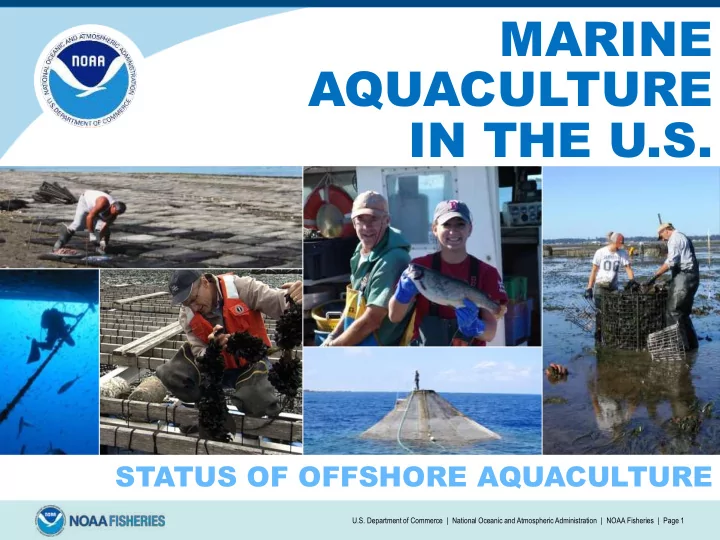
AQUACULTURE IN THE U.S. GROWING OUR DOMESTIC SEAFOOD STATUS OF - - PowerPoint PPT Presentation
MARINE AQUACULTURE IN THE U.S. GROWING OUR DOMESTIC SEAFOOD STATUS OF OFFSHORE AQUACULTURE U.S. Department of Commerce | National Oceanic and Atmospheric Administration | NOAA Fisheries | Page 1 U.S. has not reached full potential in
U.S. Department of Commerce | National Oceanic and Atmospheric Administration | NOAA Fisheries | Page 1
U.S. Department of Commerce | National Oceanic and Atmospheric Administration | NOAA Fisheries | Page 2
200 400 600 800 1000 1200 1400
1950 1953 1956 1959 1962 1965 1968 1971 1974 1977 1980 1983 1986 1989 1992 1995 1998 2001 2004 2007 2010 2013
USA and Norway Production
(all units 1,000 metric tons)
Norway USA
Source - FAO FishStat Plus
U.S. Department of Commerce | National Oceanic and Atmospheric Administration | NOAA Fisheries | Page 3
Bay and elsewhere
5
U.S. Department of Commerce | National Oceanic and Atmospheric Administration | NOAA Fisheries | Page 7
nations in offshore potential when considering environmental and economic factors
Source: Kapetsky et. Al 2013 (UN FAO Report)
Social license
Complicated costly regulatory process High costs of recirculating systems High coastal land values No regulatory framework for federal waters Traditional agency mandates
U.S. Department of Commerce | National Oceanic and Atmospheric Administration | NOAA Fisheries | Page 8
U.S. Department of Commerce | National Oceanic and Atmospheric Administration | NOAA Fisheries | Page 9
U.S. Department of Commerce | National Oceanic and Atmospheric Administration | NOAA Fisheries | Page 10
rivoliana) or “Kampachi”
Commericial Farm off Kona, Hawaii
Project”- Demonstration Project- Geodesic Cage moored to drifting vessel.
Credit Bryce Groark
Mussel Aquaculture
U.S. Department of Commerce | National Oceanic and Atmospheric Administration | NOAA Fisheries | Page 12
U.S. Department of Commerce | National Oceanic and Atmospheric Administration | NOAA Fisheries | Page 13
Ranch, offshore mussel farm, set to begin operations
Fisheries Proposed Project- finfish in federal waters
U.S. Department of Commerce | National Oceanic and Atmospheric Administration | NOAA Fisheries | Page 14
Benefits
Islands, Mid Atlantic?)
U.S. Department of Commerce | National Oceanic and Atmospheric Administration | NOAA Fisheries | Page 15
Modeling
Director, Office of Aquaculture Michael.Rubino@noaa.gov 301-427-8331 http://aquaculture.noaa.gov