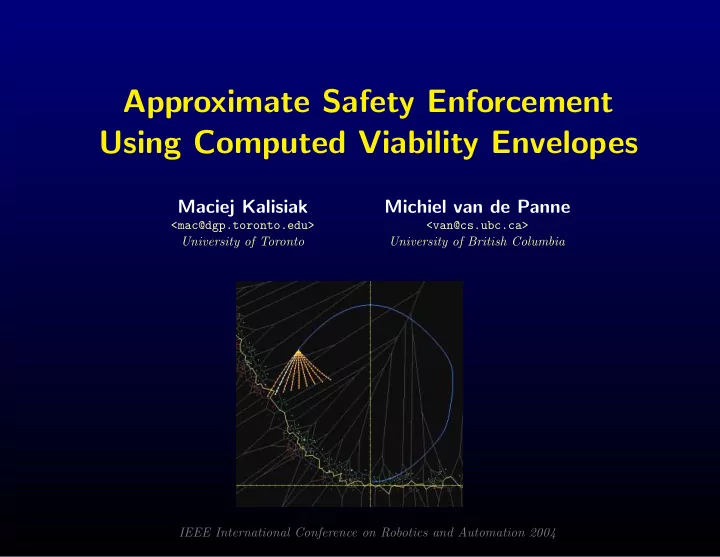
Approximate Safety Enforcement Using Computed Viability Envelopes - - PowerPoint PPT Presentation

approximate safety enforcement using computed viability
SMART_READER_LITE
LIVE PREVIEW

Approximate Safety Enforcement Using Computed Viability Envelopes - - PowerPoint PPT Presentation

Approximate Safety Enforcement Using Computed Viability Envelopes Maciej Kalisiak Michiel van de Panne <mac@dgp.toronto.edu> <van@cs.ubc.ca> University of Toronto University of British Columbia IEEE International Conference on


slide-1
SLIDE 1

Approximate Safety Enforcement Using Computed Viability Envelopes

Maciej Kalisiak Michiel van de Panne

<mac@dgp.toronto.edu> <van@cs.ubc.ca> University of Toronto University of British Columbia IEEE International Conference on Robotics and Automation 2004

slide-2
SLIDE 2

Problem & General Idea

✤ problem: user input can lead to failure ✤ idea: computer intervenes when necessary ✤ [movie of desired result (4-obstacle example)]

Approximate Safety Enforcement Using Computed Viability Envelopes slide: 1/19 ◭ ◭ ◭ ◮ ◮ ◮

slide-3
SLIDE 3

Na¨ ıve Implementation

✤ if user’s input leads to failure within some given

time horizon, override it with a failure-free input

Approximate Safety Enforcement Using Computed Viability Envelopes slide: 2/19 ◭ ◭ ◭ ◮ ◮ ◮

slide-4
SLIDE 4

Na¨ ıve Implementation: Problem

✤ problem: one can get trapped in a “dead-end” ✤ dead-end > time horizon always possible

failure failure

Approximate Safety Enforcement Using Computed Viability Envelopes slide: 3/19 ◭ ◭ ◭ ◮ ◮ ◮

slide-5
SLIDE 5

Viability Envelope

✤ strategy: mark all such “unavoidable failure” states as

“out of bounds”, then stay within bounds

✤ viability envelope

= this bound = set of all “points of no return”

a slice of viability envelope for orientation =

Approximate Safety Enforcement Using Computed Viability Envelopes slide: 4/19 ◭ ◭ ◭ ◮ ◮ ◮

slide-6
SLIDE 6

Viability Envelope (ctd.)

✤ the envelope is a manifold in the system’s state-space ✤ for the simple car, state-space is 3D: (x, y, orientation) ✤ [movie: 3D tumble of 4-obstacle envelope]

Approximate Safety Enforcement Using Computed Viability Envelopes slide: 5/19 ◭ ◭ ◭ ◮ ◮ ◮

slide-7
SLIDE 7

Applicability

✤ applicable to any dynamical system with known dynamics

UFO 3000

???

Approximate Safety Enforcement Using Computed Viability Envelopes slide: 6/19 ◭ ◭ ◭ ◮ ◮ ◮

slide-8
SLIDE 8

– Framework Details –

Approximate Safety Enforcement Using Computed Viability Envelopes slide: 7/19 ◭ ◭ ◭ ◮ ◮ ◮

slide-9
SLIDE 9

Single-step Containment

✤ correct the control input when about to cause a breach ✤ disadvantage: harsh and abrupt corrections

Approximate Safety Enforcement Using Computed Viability Envelopes slide: 8/19 ◭ ◭ ◭ ◮ ◮ ◮

slide-10
SLIDE 10

Multi-step Containment

✤ use predictive look-ahead, act on breaches earlier ✤ result: milder corrections

Approximate Safety Enforcement Using Computed Viability Envelopes slide: 9/19 ◭ ◭ ◭ ◮ ◮ ◮

slide-11
SLIDE 11

Time to Envelope Breach

✤ Teb(x, u): “time to envelope breach” ✤ how long until control input u causes breach from state x ✤ assumption: u is held constant

Approximate Safety Enforcement Using Computed Viability Envelopes slide: 10/19 ◭ ◭ ◭ ◮ ◮ ◮

slide-12
SLIDE 12

Time to Envelope Breach

✤ Teb(x, u): “time to envelope breach” ✤ how long until control input u causes breach from state x ✤ assumption: u is held constant ✤ very distant breaches irrelevant ✤ clamp Teb at Th, the “time horizon” (i.e., Teb ≤ Th or Teb = ∞)

Approximate Safety Enforcement Using Computed Viability Envelopes slide: 10/19 ◭ ◭ ◭ ◮ ◮ ◮

slide-13
SLIDE 13

Time to Envelope Breach

✤ Teb(x, u): “time to envelope breach” ✤ how long until control input u causes breach from state x ✤ assumption: u is held constant ✤ very distant breaches irrelevant ✤ clamp Teb at Th, the “time horizon” (i.e., Teb ≤ Th or Teb = ∞) ✤ “breach-free” implies “... within Th”

Approximate Safety Enforcement Using Computed Viability Envelopes slide: 10/19 ◭ ◭ ◭ ◮ ◮ ◮

slide-14
SLIDE 14

System Meta-states and Control Policy

✤ four meta-states (think: “severity”, “DEFCON”): ✤ L1:

user’s control input is breach-free

✤ L2:

L1 false, but a different input is breach-free

✤ L3:

L2 false, but system still within envelope

✤ L4:

L3 false (i.e., containment failed)

✤ control input actually applied: ✤ L1 → user’s control input ✤ L2 → the breach-free control “closest” to user’s ✤ L3 → the control input with largest Teb† ✤ L4 → N/A†

( †: see “least detrimental” control) Approximate Safety Enforcement Using Computed Viability Envelopes slide: 11/19 ◭ ◭ ◭ ◮ ◮ ◮

slide-15
SLIDE 15

– Practical Approximations –

Approximate Safety Enforcement Using Computed Viability Envelopes slide: 12/19 ◭ ◭ ◭ ◮ ◮ ◮

slide-16
SLIDE 16

Envelope Approximation

✤ unlikely to have analytic representation ✤ must approximate (from samples, other data) ✤ used: Nearest Neighbor machine learning method

Approximate Safety Enforcement Using Computed Viability Envelopes slide: 13/19 ◭ ◭ ◭ ◮ ◮ ◮

slide-17
SLIDE 17

Discretization of Control Input

✤ often need to search or map over the input space, U

(e.g., finding maximal Teb(x, u))

✤ intractable if U is large or continuous ✤ instead, work with a discretized subset,

U

Approximate Safety Enforcement Using Computed Viability Envelopes slide: 14/19 ◭ ◭ ◭ ◮ ◮ ◮

slide-18
SLIDE 18

– Some Results –

Approximate Safety Enforcement Using Computed Viability Envelopes slide: 15/19 ◭ ◭ ◭ ◮ ◮ ◮

slide-19
SLIDE 19

Rocket

✤ [movies: world-space, state-space]

Approximate Safety Enforcement Using Computed Viability Envelopes slide: 16/19 ◭ ◭ ◭ ◮ ◮ ◮

slide-20
SLIDE 20

Bike

✤ [movie]

Approximate Safety Enforcement Using Computed Viability Envelopes slide: 17/19 ◭ ◭ ◭ ◮ ◮ ◮

slide-21
SLIDE 21

Future Work

✤ evaluate with more complex systems (higher D) ✤ multi-dimensional inputs: how to spread corrections

across the dimensions?

✤ incorporate haptics, literally do “pushing the envelope” ✤ what if only local environment known?

Approximate Safety Enforcement Using Computed Viability Envelopes slide: 18/19 ◭ ◭ ◭ ◮ ◮ ◮

slide-22
SLIDE 22

Summary & Take-away

✤ real-time constraint of dynamical system to viable region ✤ predictive look-ahead using constant inputs ✤ Teb, the “time to envelope breach” (clamped to Th, the

“time horizon”)

✤ used to choose among four control policies ✤ http://www.dgp.toronto.edu/~mac/viab_env

Approximate Safety Enforcement Using Computed Viability Envelopes slide: 19/19 ◭ ◭ ◭ ◮ ◮ ◮

slide-23
SLIDE 23

— ❦ End ❦ —

(supplementary material follows) Approximate Safety Enforcement Using Computed Viability Envelopes slide: 20/19 ◭ ◭ ◭ ◮ ◮ ◮

slide-24
SLIDE 24

Grace Period

✤ a method to combat NN surface “noise” ✤ Tgr: max time system is allowed to cross NN envelope

before being identified as a “true transition”

Approximate Safety Enforcement Using Computed Viability Envelopes slide: 21/19 ◭ ◭ ◭ ◮ ◮ ◮

slide-25
SLIDE 25

Why multi-step leads to milder corrections

✤ more time and space to maneuver ✤ can do no worse: at worst apply the same control signal

as with a shorter time horizon

Approximate Safety Enforcement Using Computed Viability Envelopes slide: 22/19 ◭ ◭ ◭ ◮ ◮ ◮

slide-26
SLIDE 26

Why the “constant-input” assumption

✤ in calculating Teb(x, u), need to make assumption about

future values of u

✤ for non-constant input signals, no guiding principle to

select the “optimal” one

✤ viability theory: generalized inertia principle ✤ also, user input tends to change slowly, relative to the

time scale in question (Th)

✤ hence assume constant-input

Approximate Safety Enforcement Using Computed Viability Envelopes slide: 23/19 ◭ ◭ ◭ ◮ ◮ ◮

slide-27
SLIDE 27

“Least detrimental” emergency control

✤ problem: meta-state L4 can be reached ✤ due to envelope approximation error ✤ when all “recovery” trajectories out of an L3 state

require non-constant input

✤ “solution”: apply the control which spends least time

  • utside envelope

Approximate Safety Enforcement Using Computed Viability Envelopes slide: 24/19 ◭ ◭ ◭ ◮ ◮ ◮

slide-28
SLIDE 28

Constructing Envelopes

✤ Nearest Neighbor used to approximate envelope ✤ possible NN sample sources: heuristic, empirical, analytic ✤ other forms can converted to NN samples through queries ✤ also can compute directly from dynamics (slow)

Approximate Safety Enforcement Using Computed Viability Envelopes slide: 25/19 ◭ ◭ ◭ ◮ ◮ ◮

slide-29
SLIDE 29

Scalability

✤ online algorithm: O(|

U | · Th)

✤ offline algorithm (envelope construction): ✤ # of NN samples for equivalent-quality envelope tends

to grow exponentially with state-space dimensionality

✤ envelope geometry tends to be simple, relative to # of

dimensions

✤ perhaps other learning methods can give better

scalability (SVM?)

Approximate Safety Enforcement Using Computed Viability Envelopes slide: 26/19 ◭ ◭ ◭ ◮ ◮ ◮

slide-30
SLIDE 30

Car – track

✤ [movie]

Approximate Safety Enforcement Using Computed Viability Envelopes slide: 27/19 ◭ ◭ ◭ ◮ ◮ ◮

slide-31
SLIDE 31

Leftovers

Approximate Safety Enforcement Using Computed Viability Envelopes slide: 28/19 ◭ ◭ ◭ ◮ ◮ ◮

slide-32
SLIDE 32

Motivation (short)

✤ problem: direct human control of dynamical systems is

  • ften difficult, prone to error and failure

(e.g., control-by-wire of a bike) ✤ particularly difficult for users unfamiliar with system ✤ idea: computer aids the user by keeping system

controllable

✤ motivation: “pushing the envelope” metaphor

Approximate Safety Enforcement Using Computed Viability Envelopes slide: 29/19 ◭ ◭ ◭ ◮ ◮ ◮

slide-33
SLIDE 33

Overview

✤ Framework ✤ taxonomy of state-space ✤ containment strategy ✤ Teb, system meta-states, and control policy

Approximate Safety Enforcement Using Computed Viability Envelopes slide: 30/19 ◭ ◭ ◭ ◮ ◮ ◮

slide-34
SLIDE 34

Overview

✤ Framework ✤ taxonomy of state-space ✤ containment strategy ✤ Teb, system meta-states, and control policy ✤ Practical approximations ✤ approximating envelopes with Nearest Neighbor ✤ discretization of control input

Approximate Safety Enforcement Using Computed Viability Envelopes slide: 30/19 ◭ ◭ ◭ ◮ ◮ ◮

slide-35
SLIDE 35

Overview

✤ Framework ✤ taxonomy of state-space ✤ containment strategy ✤ Teb, system meta-states, and control policy ✤ Practical approximations ✤ approximating envelopes with Nearest Neighbor ✤ discretization of control input ✤ Some results

Approximate Safety Enforcement Using Computed Viability Envelopes slide: 30/19 ◭ ◭ ◭ ◮ ◮ ◮

slide-36
SLIDE 36

Taxonomy of State-space

✤ a landing rocket with bounded thrust (z = altitude)

‘‘viability envelope’’ dz dt

z

nominal

  • peration

failure inevitable failed (crashed) unreachable

Approximate Safety Enforcement Using Computed Viability Envelopes slide: 31/19 ◭ ◭ ◭ ◮ ◮ ◮

slide-37
SLIDE 37

Car

✤ [movie]

Approximate Safety Enforcement Using Computed Viability Envelopes slide: 32/19 ◭ ◭ ◭ ◮ ◮ ◮