
SLIDE 1
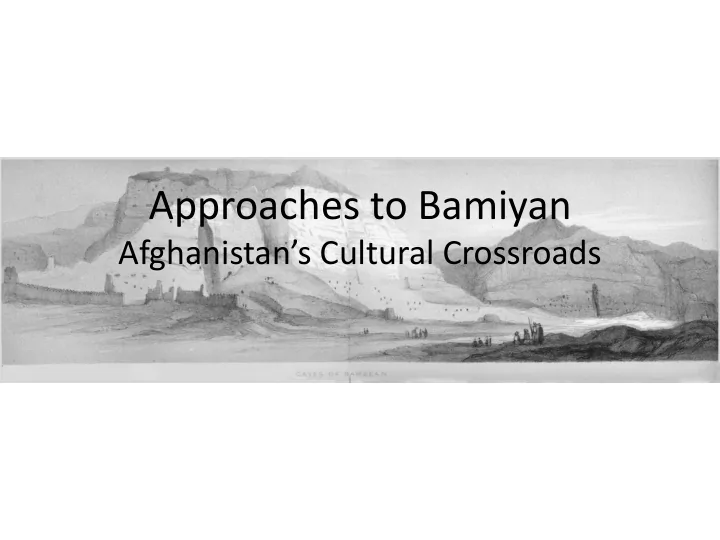
Approaches to Bamiyan Afghanistans Cultural Crossroads 2001 On the - - PowerPoint PPT Presentation
Approaches to Bamiyan Afghanistans Cultural Crossroads 2001 On the basis of consultations between the religious leaders of the Islamic Emirate of Afghanistan, religious judgments of the ulama [senior clergy] and rulings of the Supreme Court
2001
On the basis of consultations between the religious leaders of the Islamic Emirate of Afghanistan, religious judgments of the ulama [senior clergy] and rulings of the Supreme Court of the Islamic Emirate of Afghanistan, all statues and non-Islamic shrines located in different parts of the Islamic Emirate of Afghanistan must be destroyed. These statues have been and remain shrines of unbelievers and these unbelievers continue to worship and respect them. God Almighty is the only real shrine and all fake idols should be destroyed. Therefore, the supreme leader of the Islamic Emirate of Afghanistan has
Ministry of Promotion of Virtue and Suppression of Vice and the Ministries of Information to destroy all the statues. As
Court of the Islamic Emirate of Afghanistan all the statues must be destroyed so that no one can worship or respect them in the future. EDICT of Mullah Omar, Feb 26 2001
550 Carving of smaller Buddha 615 Carving of larger Buddha 622 Islamic era begins 629 Visit of Xuanzang 750-900 Conversion of Bamiyan 900 Heyday of the Barmakids 973-1048 Life of Al-Biruni 1528 Visit of Sultan Mohammad 1832 Visit of Charles Masson 1842 British hostages in Bamiyan 1922 Visit of Alfred Foucher
“To the north-east of the royal city, on the side of the mountain, there is a stone statue of the standing Buddha. It is 140-50 feet high, of a dazzling gold colour and resplendent with ornamentation
east of it is a monastery built by an earlier king of the country. East of this is a standing image of Shakyamuni Buddha, more than 100 feet high, made of brass, the pieces of which have been cast separately and then assembled to make up the statue.”
“The people of India [i.e. non- Muslims] go on pilgrimages to these two [idols], bearing with them
them from a distance, a man would be obliged to lower his eyes,
attention or careless when he sees them, it is necessary for him to return to a place from which he cannot view them and then to approach them, seeking them as an
reverence for them.” FROM the Fihrist of Al-Nadim
a.k.a Jaffar, evil vizier in The Thief of Bagdad (1940)
“The writer of these words, when he was headed for Kabul from the city of Balkh, came to this place on Tuesday the 14th of Rabi‘ al-Thani in the year 935 [26th December 1528]. As a result of wind and
niche of the male idol. I recall that the caravan had close to two hundred horses, and a hundred men with the camels and mules were contained in this niche, and another group of about three hundred men and horses and mules found rest in the other niche of the female idol. And near to these two huge idols two small idols are carved in the
girl, and the other the appearance of a slave boy.” Sultan Muhammad, Majma‘ al-ghara‘ib
“The superior idol has or had the same facilities
visit the lower caves near it were occupied by an unaccommodating Tajik, who had stowed in the passage his stock of provender. We could not prevail on him by menace or entreaty to
he had never heard of one.”
Charles Masson Alexander Burnes
Jean Carl Aurel Stein