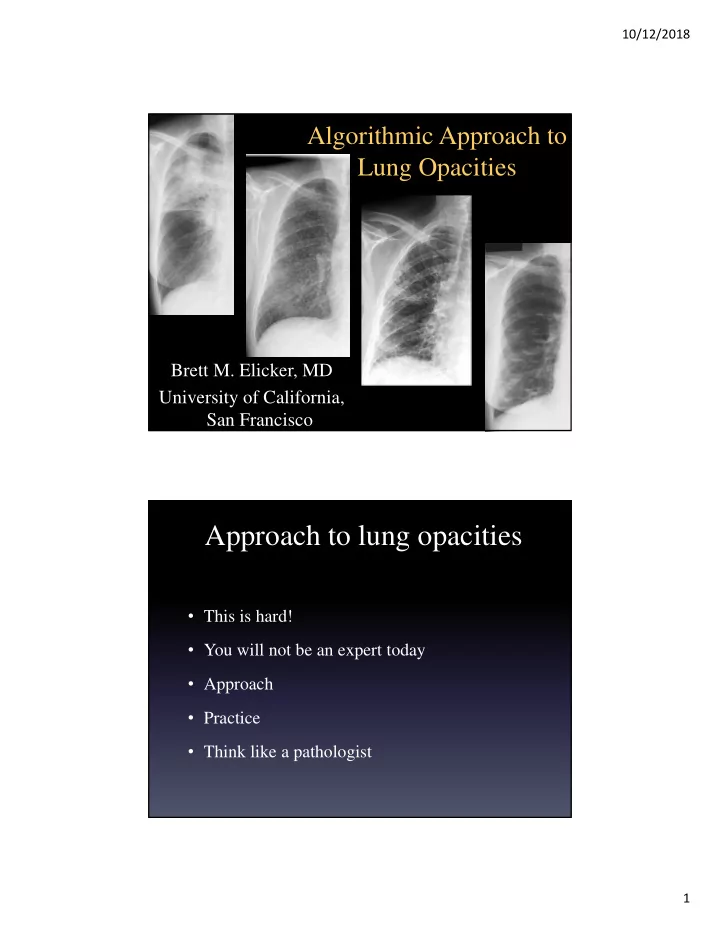
Approach to lung opacities This is hard! You will not be an expert - - PDF document

approach to lung opacities
SMART_READER_LITE
LIVE PREVIEW

Approach to lung opacities This is hard! You will not be an expert - - PDF document

10/12/2018 Algorithmic Approach to Lung Opacities Brett M. Elicker, MD University of California, San Francisco Approach to lung opacities This is hard! You will not be an expert today Approach Practice Think like a


slide-1
SLIDE 1

10/12/2018 1

Algorithmic Approach to Lung Opacities

Brett M. Elicker, MD University of California, San Francisco

Approach to lung opacities

  • This is hard!
  • You will not be an expert today
  • Approach
  • Practice
  • Think like a pathologist
slide-2
SLIDE 2

10/12/2018 2

Categories of lung opacities

  • 1. Consolidation
  • 2. Interstitial (diffuse lines or nodules)
  • 3. Airways
  • 4. One or a few nodules
slide-3
SLIDE 3

10/12/2018 3

Alveolar

Interstitial

slide-4
SLIDE 4

10/12/2018 4

Airways

Not applicable

slide-5
SLIDE 5

10/12/2018 5

Consolidation

  • Confluent opacity
  • Fluffy around periphery
  • Air bronchograms
  • Lack of volume loss

Confluent opacity, no volume loss

slide-6
SLIDE 6

10/12/2018 6

Air bronchograms

slide-7
SLIDE 7

10/12/2018 7

Well-defined: interstitial Ill-defined: alveolar

Consolidation

  • Acute vs. chronic symptoms
  • Distribution
  • Acuity of changes
  • Differential diagnosis in acute setting

– Focal: pneumonia/aspiration, hemorrhage – Diffuse: edema, acute lung injury, pneumonia, hemorrhage

slide-8
SLIDE 8

10/12/2018 8

2 month f/u

slide-9
SLIDE 9

10/12/2018 9

Invasive mucinous adenocarinoma 4 month f/u Chronic alveolar disease

  • Tumor

– Invasive mucinous adenocarinoma (aka multifocal bronchoalveolar CA) – Lymphoma (recurrent or 1° pulmonary)

  • Inflammatory

– Organizing pneumonia – Chronic eosinophilic pneumonia – Sarcoidosis

  • Other

– Lipoid pneumonia – Alveolar proteinosis

slide-10
SLIDE 10

10/12/2018 10

Comparison

slide-11
SLIDE 11

10/12/2018 11

Signs of atelectasis: volume loss

Fissure displacement Elevated diaphragm Deviation of mediastinal structures

Rapid change

slide-12
SLIDE 12

10/12/2018 12

? atelectasis or an alveolar process

Atelectasis (types)

  • Obstructive/resorptive (obstruction of bronchus)
  • Passive (compression of lungs)
  • Cicatricial (related to scarring)
  • Adhesive (surfactant deficiency)
slide-13
SLIDE 13

10/12/2018 13

Lung cancer (Golden S sign)

slide-14
SLIDE 14

10/12/2018 14

Lower lobe atelectasis Combined RML/RLL atelectasis

slide-15
SLIDE 15

10/12/2018 15

Left upper lobe collapse

  • 1. Veil-like density
  • 2. Volume loss

– Elevated diaphragm – Elevated left PA

  • Luftsichel sign
slide-16
SLIDE 16

10/12/2018 16

Nodules Lines

Interstitial opacities

slide-17
SLIDE 17

10/12/2018 17

Nodules: diff dx

  • Hematogenous spread

– Miliary tuberculosis – Miliary fungal infection (e.g. cocci) – Metastases

  • Lymphatic spread

– Sarcoidosis – Lymphangitic spread of tumor – Pneumoconioses (e.g. silica)

Histoplasmosis

slide-18
SLIDE 18

10/12/2018 18

Miliary tuberculosis Interstitial: lines

slide-19
SLIDE 19

10/12/2018 19

Causes of interstitial lines

  • Edema
  • Malignancy
  • Fibrotic lung diseases (this

is a long list)

Kerley-b lines may be present These lines are typically thick, wavy and irregular

Linear opacities

slide-20
SLIDE 20

10/12/2018 20

Pulmonary edema (kerley-b lines)

slide-21
SLIDE 21

10/12/2018 21

Reticular opacities (distribution)

  • Lower lobe predominant

– Idiopathic pulmonary fibrosis – Connective tissue disease – Drugs – Asbestosis – Hypersensitivity pneumonitis

  • Upper lobe predominant

– Sarcoidosis – Prior TB/fungus – Pneumoconioses

slide-22
SLIDE 22

10/12/2018 22

Idiopathic pulmonary fibrosis Hypersensitivity pneumonitis

slide-23
SLIDE 23

10/12/2018 23

Tuberculosis

slide-24
SLIDE 24

10/12/2018 24

Airways disease

  • Circular
  • Tubular
slide-25
SLIDE 25

10/12/2018 25

Differential diagnosis of airways disease

  • Mild:

– Asthma – Viral infection – Chronic bronchitis – Etc.

  • Severe:

– Bronchiolitis obliterans – Immunodeficiency – Ciliary dyskinesia – Cystic fibrosis – ABPA – Tuberculosis – Cartilage diseases

slide-26
SLIDE 26

10/12/2018 26

Cystic fibrosis

Which compartment of lung is affected?

slide-27
SLIDE 27

10/12/2018 27

Solitary pulmonary nodule: differential diagnosis

  • Granuloma
  • Hamartoma
  • Primary bronchogenic carcinoma
  • Metastasis
  • Lots of others
slide-28
SLIDE 28

10/12/2018 28

Which one is malignant? Nodules: benign vs. malignant

Benign Malignant Small size Large size Smooth border Spiculated border Diffuse calcification No or irregular calcification Stability over time Growth over time

slide-29
SLIDE 29

10/12/2018 29

Nodule: size Nodule: calcification

slide-30
SLIDE 30

10/12/2018 30

Nodule borders So you see a nodule on CXR…

  • 1. Is it actually a nodule?
slide-31
SLIDE 31

10/12/2018 31

? nodule Shallow obliques

slide-32
SLIDE 32

10/12/2018 32

? nodule Apical lordotic

slide-33
SLIDE 33

10/12/2018 33

So you see a nodule on CXR…

  • 1. Is it actually a nodule?
  • 2. Look for prior films?
  • 3. Is diffuse calcification present?

Dual energy subtraction x-ray

slide-34
SLIDE 34

10/12/2018 34

So you see a nodule on CXR…

  • 1. Is it actually a nodule?
  • 2. Look for prior films?
  • 3. Is diffuse calcification present?
  • 4. Get a CT scan or a follow-up CXR

Category Subcategory CXR features Common causes Alveolar

  • Confluent opacities
  • Air bronchograms
  • Fluffy edges
  • Edema
  • Acute lung injury
  • Infection

Interstitial Nodules

  • Small, well‐defined nodules
  • Opacities not confluent
  • Normal lung between nodules
  • Tuberculosis
  • Fungal infection
  • Metastases
  • Sarcoidosis

Lines (kerley‐b)

  • Thin, fine, delicate lines
  • Lines at periphery of lung

(kerley‐b)

  • Pulmonary edema
  • Cancer

Lines (reticular)

  • Thick, wavy, irregular lines
  • Fibrotic lung

disease Airways

  • Circular or tubular
  • Thin or thick walled
  • Numerous causes

Not in a single compartment

  • One or a few nodules (≤3 cm) or

masses (>3 cm)

  • Lung cancer
  • Metastasis
  • Granuloma
  • Hamartoma
slide-35
SLIDE 35

10/12/2018 35

Algorithmic Approach to Lung Opacities

On to the cases…

slide-36
SLIDE 36

10/12/2018 36

slide-37
SLIDE 37

10/12/2018 37

slide-38
SLIDE 38

10/12/2018 38