APPROACH FOR REMOVING REGIONAL TRADE BARRIERS IN SOUTH ASIA 1 - - PowerPoint PPT Presentation

approach for
SMART_READER_LITE
LIVE PREVIEW

APPROACH FOR REMOVING REGIONAL TRADE BARRIERS IN SOUTH ASIA 1 - - PowerPoint PPT Presentation

PROMOTING PARTICIPATORY APPROACH FOR REMOVING REGIONAL TRADE BARRIERS IN SOUTH ASIA 1 Average Overall Bilateral Trade Cost (2010) (In% Of Domestic Value Of Expor ted Goods In Expor ters Ter ritor y) Ideal Trade Cost Ideal Trade Cost


slide-1
SLIDE 1

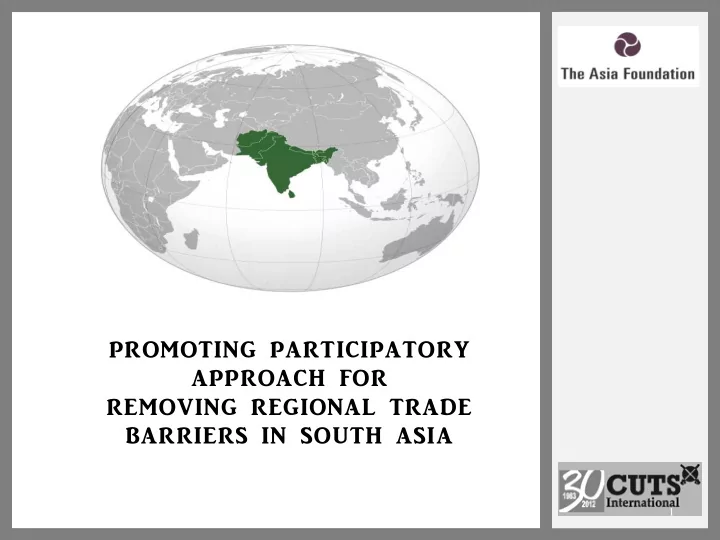
PROMOTING PARTICIPATORY APPROACH FOR REMOVING REGIONAL TRADE BARRIERS IN SOUTH ASIA

1
slide-2
SLIDE 2

Average Overall Bilateral Trade Cost (2010)

(In% Of Domestic Value Of Expor ted Goods In Expor ter’s Ter ritor y)

Country Ideal Trade Cost within South Asia Ideal Trade Cost with World Bangladesh

114.44 (India) 99.50 (Hong Kong)

India

107.38 (Sri Lanka) 84.37 (Malaysia)

Nepal

99.42 (India) 99.42 (India)

Pakistan

145.07 (India) 111.60 (Malaysia)

Sri Lanka

107.38 (India) 100.94 (Maldives)

SA Average

114.74 99.17

Source: Calculated from World Bank-UNESCAP, Trade Cost Database, 2012

2

slide-3
SLIDE 3

Country Ideal Tariff Cost within South Asia Ideal Tariff Cost with World Bangladesh

14.72 (Sri Lanka) 2.11 (Kazakhstan)

India

5 (Sri Lanka) 4.41 (Singapore)

Nepal

12.78 (Sri Lanka) 2.52 (Slovak Republic)

Pakistan

10.6 (Sri Lanka) 5.43 (Georgia)

Sri Lanka

5 (India) 2.67 (Slovenia)

SA Average

9.62 3.43

Source: Calculated from World Bank- UNESCAP, Trade Cost Database, 2012

Average Bilateral Tariff Cost (2010)

(In% of Domestic Value of Expor ted Goods in Expor ter’s Ter ritor y)

3

slide-4
SLIDE 4

Country Ideal Non-Tariff Trade Cost within South Asia Ideal Non-Tariff Trade Cost with World Bangladesh

82.28 (India) 81.87 (Hong Kong)

India

97.51 (Sri Lanka) 63.18 (Malaysia)

Nepal

74.26 (India) 74.26 (India)

Pakistan

121.12 (India) 82.32 (Malaysia)

Sri Lanka

97.51 (India) 78.01 (Maldives)

SA Average

94.54 75.93

Source: Calculated from World Bank-UNESCAP, Trade Cost Database, 2012

Average Bilateral Non-tariff Trade Cost (2010)

(In% of Domestic Value of Expor ted Goods in Expor ter’s Ter ritor y)

4

slide-5
SLIDE 5

Two Pillar Approach

Selection of Potential Products for Intraregional Trade CUTS (2012) Trade Policy Strategy Supply Capacity through National Trade Policies Market Access through Trade Agreements Usage of instruments in National Trade Policies to build supply capacity in selected products Usage of SAFTA provisions to enhance market access in selected products

5

slide-6
SLIDE 6

Trade Barriers Policy Treatment Plan Limitations of Production Capacity All South Asian countries need financial and technical assistance to support potential sectors for regional trade:

  • Assistance to focus products in India’s National Foreign Trade Policy under

Market development Assistance, Technical Up-gradation Fund Scheme, and preference to such products in Export Promotion Industrial Zone (2009-14)

  • Assistance under Export Processing Zone facilitation plan and Export

Development Fund in perspective plan of Bangladesh and proposed Comprehensive Trade Policy.(2012-17)

  • Assistance under Technology Development Fund and Special Economic

Zone’s in Ten-Year Horizon Development Framework of Sri Lanka (2006- 16)

  • Assistance under product development schemes and proposed Special

Economic Zones in Trade Policy of Nepal (2009)

Supply Capacity

6

slide-7
SLIDE 7

Supply Capacity

Trade Barriers Policy Treatment Plan Limitations of Regional Market connectivity

  • Exporters from SAARC countries get less assistance to explore

regional markets under market access support schemes under their respective national trade policies, with the following exceptions:

  • Nepal has recognized SAARC countries under Trade Policy (2009)
  • Sri Lanka has recognized India and Pakistan under TYHDF (2006-

16)

  • Bangladesh has recognized India under proposed Comprehensive

Trade Policy (2012-17)

  • Pakistan has recognized Sri Lanka under Strategic trade Policy

Framework (2012-15) as focus countries.

  • All member states should recognise SAARC countries as

focus/target countries and make market access assistance to focus products under relevant schemes

7

slide-8
SLIDE 8

Issues Policy Treatment Plan

Harmonisation of Product Code

  • SAFTA Ministerial Council (SMC) should immediately appoint a

task force to develop unified SAARC product code system.

  • On priority basis, all members should submit a list of their top

priority focus products and sub-sectors to the appointed task force.

  • Task force should be entrusted as the appellate authority for

complaints related to product code discrepancies for all member states. Compliance with Standards

  • Each member states must submit standards applied on top ten focus

products and SMC should review issues reported on recognition of testing and related issues of compliance with standards.

  • SMC should issue directives to importing countries for assisting

compliance related problems faced by exporting countries on these top priority sectors.

Trade Agreement (SAFTA)

8

slide-9
SLIDE 9

Issues Policy Treatment Plan

Banking and Trade Financing

  • All SAARC member countries should allow licence of operation within

their territories for at least one branch of native bank of the SAARC trading partners.

  • SMC should convene a meeting of respective central financial regulatory

authorities at the SAARC Secretariat. Business Travel permits

  • All SAARC members should adopt a special mechanism for SAARC

Business Visa. SMC should pass a resolution for the same.

  • Business Visa may be applied by individual traders through registered

membership in an apex national business association.

  • Business associations must have the authority to conduct preliminary

verification and should be made responsible for security breaches, if any.

  • All SAARC members should initiate liaison between respective

governmental authorities for visa issuance and recognised apex business association.

Trade Agreement (SAFTA)

9

slide-10
SLIDE 10
  • Establishment of electronic documentation and single window clearance

at the most important land custom stations

(Attari, Petrapole, Raxaul, Jogbani, Sutarkhandi, Chandrabangha)

  • Fast track establishment of ICPs (Integrated Check Posts) at 5 most

important land custom stations

  • Adoption of the Automated System for Customs Data (ASYCUDA), so

as to reduce load factor at main custom stations

  • All product-specific regulatory limitations - such as land route

restrictions imposed by Pakistan on 137 products from India - imposed

  • n transportation through land routes should be removed

Transport Connectivity through Land Route

10

slide-11
SLIDE 11
  • Portals should be developed by governments for hosting comprehensive

intra-regional trade related information:

  • SAARC trade procedures
  • SAARC trade assistance measures
  • SAARC rules and regulations
  • Market information on focus products and sectors
  • South Asia specific webpages should be hosted by apex business

associations containing

  • Sector-wise detailed data on imports and exports
  • Contact details of members
  • Virtual open forum for prospective traders

Business Information and virtual connectivity

11

slide-12
SLIDE 12

Issues Policy Treatment Plan Inclusion of business associations in the NTB reform process at the national level All SAARC members must initiate regular national level consultative mechanism between governments and national level apex business chambers for:

  • Collecting relevant feedback from their members on NTBs in intra-

regional trade

  • Allocating responsibilities (related to implementation of NTB reforms)

Inclusion of business associations in the NTB reform process at the regional level SAARC CCI should:

  • Seek assistance from national governments to enhance its capacity
  • Take initiative to broaden its membership
  • Have regular liaison with SAFTA Committee of Experts
  • Conduct annual meetings involving its members to discuss NTB reforms
  • Nominate representatives to a Joint Task Force on reforming NTBs, which

is to be initiated by SMC

Call for a Participatory Approach

12

slide-13
SLIDE 13

Thank You

Coming together is a beginning. Keeping together is progress. Working together is success. Henry Ford (From 5% to 15%)

13