Applied Bayesian Inference in R Using MCMCpack Andrew D. Martin - - PowerPoint PPT Presentation

applied bayesian inference in r using mcmcpack
SMART_READER_LITE
LIVE PREVIEW

Applied Bayesian Inference in R Using MCMCpack Andrew D. Martin - - PowerPoint PPT Presentation

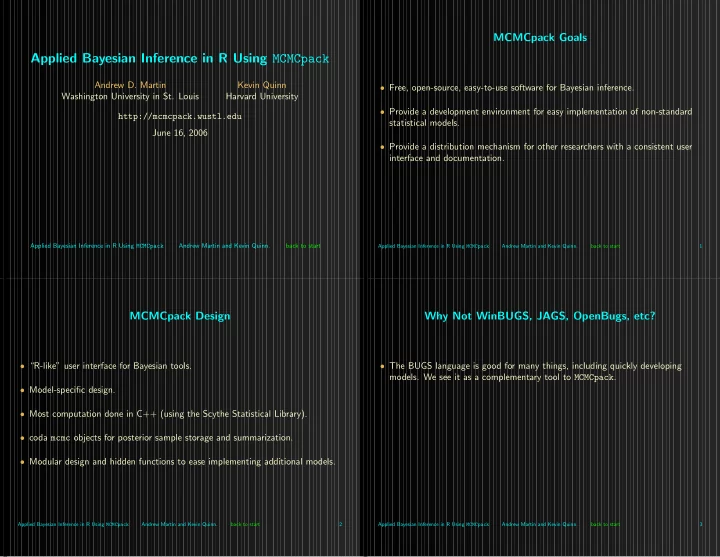
MCMCpack Goals Applied Bayesian Inference in R Using MCMCpack Andrew D. Martin Kevin Quinn Free, open-source, easy-to-use software for Bayesian inference. Washington University in St. Louis Harvard University Provide a development


slide-1
SLIDE 1

Applied Bayesian Inference in R Using MCMCpack

Andrew D. Martin Washington University in St. Louis Kevin Quinn Harvard University http://mcmcpack.wustl.edu June 16, 2006

Applied Bayesian Inference in R Using MCMCpack Andrew Martin and Kevin Quinn. back to start

MCMCpack Goals

  • Free, open-source, easy-to-use software for Bayesian inference.
  • Provide a development environment for easy implementation of non-standard

statistical models.

  • Provide a distribution mechanism for other researchers with a consistent user

interface and documentation.

Applied Bayesian Inference in R Using MCMCpack Andrew Martin and Kevin Quinn. back to start 1

MCMCpack Design

  • “R-like” user interface for Bayesian tools.
  • Model-specific design.
  • Most computation done in C++ (using the Scythe Statistical Library).
  • coda mcmc objects for posterior sample storage and summarization.
  • Modular design and hidden functions to ease implementing additional models.

Applied Bayesian Inference in R Using MCMCpack Andrew Martin and Kevin Quinn. back to start 2

Why Not WinBUGS, JAGS, OpenBugs, etc?

  • The BUGS language is good for many things, including quickly developing
  • models. We see it as a complementary tool to MCMCpack.

Applied Bayesian Inference in R Using MCMCpack Andrew Martin and Kevin Quinn. back to start 3

slide-2
SLIDE 2

However . . .

Applied Bayesian Inference in R Using MCMCpack Andrew Martin and Kevin Quinn. back to start 4

However . . .

  • . . . as noted in the WinBUGS manual:

[P]otential users are reminded to be extremely careful if using this program for serious statistical analysis. . . If there is a problem, WinBUGS might just crash, which is not very good, but it might well carry on and produce answers that are wrong, which is even worse (p. 1).

Applied Bayesian Inference in R Using MCMCpack Andrew Martin and Kevin Quinn. back to start 4

However . . .

  • . . . as noted in the WinBUGS manual:

[P]otential users are reminded to be extremely careful if using this program for serious statistical analysis. . . If there is a problem, WinBUGS might just crash, which is not very good, but it might well carry on and produce answers that are wrong, which is even worse (p. 1).

  • The BUGS language can be slow (especially for large problems), and the

WinBUGS engine does not work for certain problems.

Applied Bayesian Inference in R Using MCMCpack Andrew Martin and Kevin Quinn. back to start 4

However . . .

  • . . . as noted in the WinBUGS manual:

[P]otential users are reminded to be extremely careful if using this program for serious statistical analysis. . . If there is a problem, WinBUGS might just crash, which is not very good, but it might well carry on and produce answers that are wrong, which is even worse (p. 1).

  • The BUGS language can be slow (especially for large problems), and the

WinBUGS engine does not work for certain problems.

  • The various flavors of BUGS require the user to do some modest programming

which increases the opportunities for something to go wrong.

Applied Bayesian Inference in R Using MCMCpack Andrew Martin and Kevin Quinn. back to start 4

slide-3
SLIDE 3

Example 1: Inference for an Item Response Theory (IRT) Model

Consider: yij ∼ Bernoulli(πij), i = 1, . . . , I j = 1, . . . , J with πij = Φ(−αj + βjθi) Typically, i indexes test-takers (subjects) and j indexes test items.

Applied Bayesian Inference in R Using MCMCpack Andrew Martin and Kevin Quinn. back to start 5

Prior distributions for the model parameters are: (αj, βj)′ ∼ N(a0, A−1

0 )

j = 1, . . . , J and θi ∼ N(0, 1) i = 1, . . . , I

Applied Bayesian Inference in R Using MCMCpack Andrew Martin and Kevin Quinn. back to start 6

To fit this model to some test data from http://work.psych.uiuc.edu/irt/downloads.asp using MCMCpack one can do the following. post.irt <- MCMCirt1d(testdata, burnin=5000, mcmc=100000, thin=10, AB0=.001, store.item=TRUE, store.ability=TRUE, verbose=5000, theta.constraints=list(SUBJECT368="+", SUBJECT356="-"))

Applied Bayesian Inference in R Using MCMCpack Andrew Martin and Kevin Quinn. back to start 7

To fit this model to some test data from http://work.psych.uiuc.edu/irt/downloads.asp using MCMCpack one can do the following. post.irt <- MCMCirt1d(testdata, burnin=5000, mcmc=100000, thin=10, AB0=.001, store.item=TRUE, store.ability=TRUE, verbose=5000, theta.constraints=list(SUBJECT368="+", SUBJECT356="-")) To look at some traceplots and marginal density estimates one can use: plot(post.irt) which produces:

Applied Bayesian Inference in R Using MCMCpack Andrew Martin and Kevin Quinn. back to start 7

slide-4
SLIDE 4

2e+04 6e+04 1e+05 0.5 Iterations

Trace of theta.SUBJECT1

1 2 3 0.0 1.0 N = 10000 Bandwidth = 0.06919

Density of theta.SUBJECT1

2e+04 6e+04 1e+05 −1.5 Iterations

Trace of theta.SUBJECT2

−1.5 −1.0 −0.5 0.0 0.5 0.0 1.4 N = 10000 Bandwidth = 0.04892

Density of theta.SUBJECT2

2e+04 6e+04 1e+05 0.5 Iterations

Trace of theta.SUBJECT3

0.0 0.5 1.0 1.5 2.0 2.5 3.0 0.0 N = 10000 Bandwidth = 0.06251

Density of theta.SUBJECT3

2e+04 6e+04 1e+05 0.5 4.0 Iterations

Trace of theta.SUBJECT4

1 2 3 4 0.0 0.8 N = 10000 Bandwidth = 0.07911

Density of theta.SUBJECT4

Applied Bayesian Inference in R Using MCMCpack Andrew Martin and Kevin Quinn. back to start 8

Subject 436 and subject 447 both got 75% of the test items correct. Which subject has higher ability? The posterior probability that subject 436 has higher ability than subject 447 can be calculated with: mean(post.irt[,436] > post.irt[,447]) which evaluates to 0.65.

Applied Bayesian Inference in R Using MCMCpack Andrew Martin and Kevin Quinn. back to start 9

We might also be interested in which test items do a good job of discriminating between high and low ability subjects. The β parameters provide this information. We can calculate the posterior expection of each of the discrimination parameters with: beta.post <- post.irt[,seq(from=452, to=530, by=2)] print(sort(colMeans(beta.post))) which produces:

Applied Bayesian Inference in R Using MCMCpack Andrew Martin and Kevin Quinn. back to start 10

beta.ITEM18 beta.ITEM28 beta.ITEM16 beta.ITEM37 beta.ITEM19 beta.ITEM32

  • 0.033332789

0.007374421 0.084904972 0.217837674 0.276428999 0.315174596 beta.ITEM8 beta.ITEM20 beta.ITEM40 beta.ITEM21 beta.ITEM1 beta.ITEM34 0.331350234 0.411436261 0.418098884 0.419030043 0.439532906 0.460505549 beta.ITEM7 beta.ITEM10 beta.ITEM22 beta.ITEM14 beta.ITEM35 beta.ITEM31 0.462356437 0.472680964 0.481691248 0.482167728 0.514685111 0.564987099 beta.ITEM39 beta.ITEM36 beta.ITEM33 beta.ITEM3 beta.ITEM4 beta.ITEM27 0.601600337 0.623693132 0.627042964 0.634003442 0.641052025 0.672391363 beta.ITEM29 beta.ITEM2 beta.ITEM6 beta.ITEM11 beta.ITEM30 beta.ITEM13 0.689009747 0.706951188 0.723142300 0.762149494 0.772004859 0.779142756 beta.ITEM9 beta.ITEM38 beta.ITEM5 beta.ITEM23 beta.ITEM25 beta.ITEM17 0.851232006 0.901117855 0.902609937 0.969587117 1.039535127 1.041296658 beta.ITEM12 beta.ITEM26 beta.ITEM24 beta.ITEM15 1.099500195 1.217643770 1.282921879 1.377932523

Applied Bayesian Inference in R Using MCMCpack Andrew Martin and Kevin Quinn. back to start 11

slide-5
SLIDE 5

We can also calculate the posterior expected ranks of the discrimination parameters: beta.post.ranks <- matrix(NA, nrow(beta.post), ncol(beta.post)) colnames(beta.post.ranks) <- colnames(beta.post) for (i in 1:nrow(beta.post)){ beta.post.ranks[i,] <- rank(beta.post[i,]) } print(sort(colMeans(beta.post.ranks)))

Applied Bayesian Inference in R Using MCMCpack Andrew Martin and Kevin Quinn. back to start 12

beta.ITEM18 beta.ITEM28 beta.ITEM16 beta.ITEM37 beta.ITEM19 beta.ITEM32 1.4852 1.9182 2.8395 4.7514 5.8596 7.0272 beta.ITEM8 beta.ITEM20 beta.ITEM21 beta.ITEM40 beta.ITEM1 beta.ITEM34 7.5302 10.7339 11.1222 11.1408 12.1650 13.1280 beta.ITEM7 beta.ITEM10 beta.ITEM22 beta.ITEM14 beta.ITEM35 beta.ITEM31 13.2174 13.6764 14.0879 14.1981 15.8325 18.3422 beta.ITEM39 beta.ITEM36 beta.ITEM33 beta.ITEM3 beta.ITEM4 beta.ITEM27 20.1938 21.2814 21.4698 21.7877 22.1645 23.6409 beta.ITEM29 beta.ITEM2 beta.ITEM6 beta.ITEM11 beta.ITEM30 beta.ITEM13 24.4503 25.2602 25.9368 27.5372 27.9766 28.2097 beta.ITEM9 beta.ITEM38 beta.ITEM5 beta.ITEM23 beta.ITEM25 beta.ITEM17 30.6817 32.0941 32.1787 33.7927 35.0096 35.2362 beta.ITEM12 beta.ITEM26 beta.ITEM24 beta.ITEM15 36.2589 37.8847 38.5471 39.3517

Applied Bayesian Inference in R Using MCMCpack Andrew Martin and Kevin Quinn. back to start 13

Example 2: Calculating Bayes Factors for Model Comparison

Suppose that the observed data y could have been generated under one of two models M1 and M2. A natural thing to ask from the Bayesian perspective is, “what is the posterior probability that M1 is true (assuming either M1 or M2 is true)?” How can we calculate this? Well, using Bayes theorem we can write: Pr(Mk|y) = p(y|Mk) Pr(Mk) p(y|M1) Pr(M1) + p(y|M2) Pr(M2), k = 1, 2 The key quantities here are p(y|M1) and p(y|M2) which are called marginal likelihoods or integrated likelihoods.

Applied Bayesian Inference in R Using MCMCpack Andrew Martin and Kevin Quinn. back to start 14

It is instructive to look at the posterior odds in favor of one model (say M1): Pr(M1|y) Pr(M2|y) = p(y|M1) p(y|M2) × Pr(M1) Pr(M2) What this means is that if we want to move from the prior odds in favor of M1 to the posterior odds in favor of M1 we simply multiply the prior odds by: B12 = p(y|M1) p(y|M2) which is called the Bayes factor for M1 relative to M2. In words, posterior odds = Bayes factor × prior odds

Applied Bayesian Inference in R Using MCMCpack Andrew Martin and Kevin Quinn. back to start 15

slide-6
SLIDE 6

Since the posterior odds equal the Bayes factor when the models are equally likely a priori, the Bayes factor is a measure of how much support is available in the data for one model relative to another.

Applied Bayesian Inference in R Using MCMCpack Andrew Martin and Kevin Quinn. back to start 16

It is now possible to calculate Bayes factors and posterior probabilities of models with MCMCpack. data(birthwt) model1 <- MCMCregress(bwt~age+lwt+as.factor(race) + smoke + ht, data=birthwt, b0=c(2700, 0, 0, -500, -500, -500, -500), B0=c(1e-6, .01, .01, 1.6e-5, 1.6e-5, 1.6e-5, 1.6e-5), c0=10, d0=4500000, marginal.likelihood="Chib95", mcmc=50000) model2 <- MCMCregress(bwt~age+lwt+as.factor(race) + smoke, data=birthwt, b0=c(2700, 0, 0, -500, -500, -500), B0=c(1e-6, .01, .01, 1.6e-5, 1.6e-5, 1.6e-5), c0=10, d0=4500000, marginal.likelihood="Chib95", mcmc=50000)

Applied Bayesian Inference in R Using MCMCpack Andrew Martin and Kevin Quinn. back to start 17

model3 <- MCMCregress(bwt~as.factor(race) + smoke + ht, data=birthwt, b0=c(2700, -500, -500, -500, -500), B0=c(1e-6, 1.6e-5, 1.6e-5, 1.6e-5, 1.6e-5), c0=10, d0=4500000, marginal.likelihood="Chib95", mcmc=50000) BF <- BayesFactor(model1, model2, model3) mod.probs <- PostProbMod(BF)

Applied Bayesian Inference in R Using MCMCpack Andrew Martin and Kevin Quinn. back to start 18

print(BF) The matrix of Bayes Factors is: model1 model2 model3 model1 1.000 14.08 7.289 model2 0.071 1.00 0.518 model3 0.137 1.93 1.000 The matrix of the natural log Bayes Factors is: model1 model2 model3 model1 0.00 2.645 1.986 model2

  • 2.64

0.000 -0.658 model3

  • 1.99

0.658 0.000 print(mod.probs) model1 model2 model3 0.82766865 0.05878317 0.11354819

Applied Bayesian Inference in R Using MCMCpack Andrew Martin and Kevin Quinn. back to start 19

slide-7
SLIDE 7

Example 3: Single Block Metropolis Sampling for a User-Defined Model

MCMCpack also has some facilities for fitting user-specified models. The MCMCmetrop1R() function uses a random walk Metropolis algorithm to sample from a user-defined log-posterior density. Suppose one is interested in fitting a Bayesian negative binomial regression to the Ornstein data in the car package. One could do the following:

Applied Bayesian Inference in R Using MCMCpack Andrew Martin and Kevin Quinn. back to start 20

negbinlogpost<- function(theta, y, X, b0, B0, c0, d0){ ## log of inverse gamma density logdinvgamma <- function(sigma2, a, b){ logf <- a * log(b) - lgamma(a) + -(a+1) * log(sigma2) + -b/sigma2 return(logf) } ## log of multivariate normal density logdmvnorm <- function(theta, mu, Sigma){ d <- length(theta) logf <- -0.5*d * log(2*pi) - 0.5*log(det(Sigma)) - 0.5 * t(theta - mu) %*% solve(Sigma) %*% (theta - mu) return(logf) } k <- length(theta) beta <- theta[1:(k-1)] alpha <- exp(theta[k]) mu <- exp(X %*% beta) ## evaluate log-likelihood at (alpha, beta) log.like <- sum( lgamma(y+alpha) - lfactorial(y) - lgamma(alpha) +

Applied Bayesian Inference in R Using MCMCpack Andrew Martin and Kevin Quinn. back to start 21

alpha * log(alpha/(alpha+mu)) + y * log(mu/(alpha+mu)) ) ## evaluate log prior at (alpha, beta) ## note Jacobian term necessary b/c of transformation log.prior <- logdinvgamma(alpha, c0, d0) + theta[k] + logdmvnorm(beta, b0, B0) return(log.like+log.prior) } library(car) data(Ornstein) yvec <- Ornstein$interlocks Xmat <- model.matrix(~sector+nation, data=Ornstein) post.negbin <- MCMCmetrop1R(negbinlogpost, theta.init=rep(0,14), X=Xmat, y=yvec, thin=2, mcmc=50000, burnin=1000, tune=rep(.7,14), verbose=500, logfun=TRUE, optim.maxit=100, b0=0, B0=diag(13)*1000, c0=1, d0=1)

Applied Bayesian Inference in R Using MCMCpack Andrew Martin and Kevin Quinn. back to start 22

summary(post.negbin) Iterations = 1001:50999 Thinning interval = 2 Number of chains = 1 Sample size per chain = 25000

  • 1. Empirical mean and standard deviation for each variable,

plus standard error of the mean: Mean SD Naive SE Time-series SE beta.(Intercept) 2.34860 0.1602 0.0010132 0.003964 beta.sectorBNK 1.70677 0.4014 0.0025385 0.010942 beta.sectorCON

  • 0.59210 0.5526 0.0034949

0.015653 beta.sectorFIN 0.99221 0.2653 0.0016778 0.007198 beta.sectorHLD 0.30736 0.4251 0.0026884 0.011383 beta.sectorMAN 0.12265 0.2226 0.0014077 0.005949 beta.sectorMER 0.23269 0.2728 0.0017253 0.007095 beta.sectorMIN 0.66688 0.2121 0.0013413 0.006118 beta.sectorTRN 0.89300 0.2779 0.0017578 0.006900 beta.sectorWOD 0.67976 0.2752 0.0017403 0.008080 beta.nationOTH

  • 0.07207 0.2985 0.0018882

0.008870 beta.nationUK

  • 0.56004 0.2736 0.0017304

0.008131 beta.nationUS

  • 0.84186 0.1511 0.0009559

0.004240

Applied Bayesian Inference in R Using MCMCpack Andrew Martin and Kevin Quinn. back to start 23

slide-8
SLIDE 8

log(alpha) 0.07750 0.1070 0.0006764 0.003525

  • 2. Quantiles for each variable:

2.5% 25% 50% 75% 97.5% beta.(Intercept) 2.0484 2.23548 2.34587 2.4571 2.668864 beta.sectorBNK 0.9810 1.42833 1.68293 1.9583 2.555186 beta.sectorCON

  • 1.6220 -0.96827 -0.59939 -0.2372

0.538723 beta.sectorFIN 0.4877 0.81116 0.98990 1.1638 1.539247 beta.sectorHLD

  • 0.4815

0.02123 0.29320 0.5806 1.182072 beta.sectorMAN

  • 0.3233 -0.02640

0.12499 0.2735 0.557485 beta.sectorMER

  • 0.2974

0.05259 0.22863 0.4068 0.776510 beta.sectorMIN 0.2526 0.52381 0.66726 0.8065 1.088377 beta.sectorTRN 0.3814 0.70355 0.88244 1.0776 1.448740 beta.sectorWOD 0.1624 0.49518 0.67317 0.8621 1.244756 beta.nationOTH

  • 0.6499 -0.27512 -0.07392

0.1272 0.512434 beta.nationUK

  • 1.0953 -0.74036 -0.56804 -0.3831 -0.005212

beta.nationUS

  • 1.1399 -0.94211 -0.84336 -0.7415 -0.539916

log(alpha)

  • 0.1357

0.00676 0.07577 0.1511 0.287035

Applied Bayesian Inference in R Using MCMCpack Andrew Martin and Kevin Quinn. back to start 24

Future Plans

  • add more models (generalized linear mixed models, Dirichlet process mixture

models, dynamic linear models, other models suggested by users)

  • add more options for prior specifications
  • add additional flexible sampling engines (more complicated Metropolis-Hastings

methods, slice sampling, etc.)

  • improve performance
  • add vignettes
  • add enhancements to coda mcmc objects to allow for sampling from posterior

and prior predictive distributions

Applied Bayesian Inference in R Using MCMCpack Andrew Martin and Kevin Quinn. back to start 25

Acknowledgements

National Science Foundation Program in Methodology, Measurement, and Statistics (Grants SES-0350646 and SES-0350613) Washington University, Department of Political Science, and the Weidenbaum Center on the Economy, Government, and Public Policy http://wc.wustl.edu Harvard University, Department of Government, and the Institute for Quantitative Social Science http://www.iq.harvard.edu

Applied Bayesian Inference in R Using MCMCpack Andrew Martin and Kevin Quinn. back to start 26