Applications & transport Example client/server systems and - - PowerPoint PPT Presentation

applications
SMART_READER_LITE
LIVE PREVIEW

Applications & transport Example client/server systems and - - PowerPoint PPT Presentation

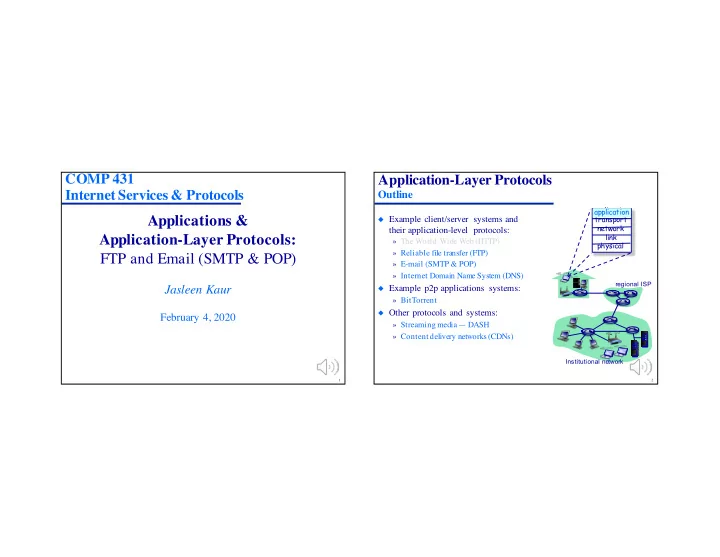
COMP 431 Application-Layer Protocols Internet Services & Protocols Outline application application Applications & transport Example client/server systems and network their application-level protocols: link Application-Layer


slide-1
SLIDE 1

1

COMP 431 Internet Services & Protocols

Applications & Application-Layer Protocols: FTP and Email (SMTP & POP)

Jasleen Kaur

February 4, 2020

2

Application-Layer Protocols

Outline

◆ Example client/server systems and

their application-level protocols:

» The World-Wide Web (HTTP) » Reliable file transfer (FTP) » E-mail (SMTP & POP) » Internet Domain Name System (DNS)

◆ Example p2p applications systems:

» BitTorrent

◆ Other protocols and systems:

» Streaming media — DASH » Content delivery networks (CDNs)

application transport network link physical application

regional ISP Institutional network

slide-2
SLIDE 2

3

Application-Layer Protocols

FTP: The Internet file transfer protocol (RFC 959)

◆ FTP is used to transfer a file to/from remote host ◆ FTP uses a client/server model

» Client: side that initiates transfer (either to/from remote) » Server: remote host

◆ FTP server listens for connections on port 21

File Transfer

FTP server FTP user interface FTP client

Local file system Remote file system User at host

4

FTP Protocol Design

Control and data sockets

◆ FTP client contacts FTP server on port 21, using TCP as the

transport protocol

◆ Two parallel TCP connections opened:

» A control connection for exchanging commands, responses (“out of band control”) » n data connections for transferring file data to/from server

◆ FTP server maintains “state”

» Remembers current directory, earlier authentication FTP client FTP server

TCP control connection (port 21) TCP data connection (port 20)

slide-3
SLIDE 3

5

FTP Protocol Design

FTP commands, responses

◆ Sample commands:

» Sent as ASCII text on control socket

◆ Sample return codes

» Status code and phrase (as in HTTP)

USER <username> PASS <password> LIST Return list of file in current directory RETR <filename> Retrieves (gets) file STOR <filename> Stores (puts) file onto remote host

331 Username OK, password required 125 data connection already open; transfer starting 425 Can’t open data connection 452 Error writing file

6

user agent mail server

SMTP

user agent mail server

SMTP

mail server user agent user agent

Application-Layer Protocols

Electronic mail

◆ Major components:

» User agents » Mail servers » Mailboxes

◆ Protocols:

» Simple Mail Transfer Protocol (SMTP) delivers mail to servers

❖ From clients to local mail

server

❖ Inter-mail server delivery

SMTP SMTP SMTP SMTP SMTP POP POP

» Post Office Protocol (POP) for user access to delivered email

❖ (Also IMAP! More later…)

slide-4
SLIDE 4

7

Electronic Mail

Mail servers

user mailbox

  • utgoing

message queue user agent mail server

SMTP

mail server user agent user agent

SMTP SMTP SMTP POP POP ◆Servers maintain:

» A message queue of outgoing email messages » A mailbox containing incoming messages for each user

◆SMTP protocol is run between

mail agents and servers to send email messages

» Client — the sending mail server or agent » Server — the receiving mail server

8

mail server

Remote Mail Server

Electronic Mail

The email delivery process

◆ User’s mail agent contacts its local mail server

Mail Sender

Protocol flow Email flow

mail server user agent

SMTP SMTP POP IMAP

Local Mail Server

◆ Local mail server contacts the destination mail server(s) ◆ Destination mail server places the mail into the

appropriate user’s mailbox

◆ User retrieves mail via a mail access protocol

Mail Recipient

user agent

slide-5
SLIDE 5

9

mail server

Remote Mail Server

Electronic Mail

The “webmail” delivery process

◆ User’s browser sends components of email message via HTTP to a

“webmail” server

◆ Web server is either also an SMTP server or it contacts its local

mail server

◆ To read mail, the mail access protocol is ultimately HTTP

User Sender

Protocol flow Email flow

mail server web browser

Mail Recipient

web browser

HTTP SMTP POP? IMAP?

Local Mail Server

SMTP

Web Server Web Server

HTTP

10

The Email Delivery Process

SMTP [RFC 821]

◆ SMTP uses a TCP socket on port 25 to transfer email reliably

from client to server

◆ Email is temporarily stored on the local server and eventually

transferred directly to receiving server

» Intermediate relay is a special case

◆ Three phases of the protocol:

» Handshaking (“greeting”) » Transfer of messages » Closure

◆ Client/server interaction follows a command/response paradigm

» commands: ASCII text <CRLF> » response: status code and phrase <CRLF>

» Command and response lines terminated with CRLF ◆ messages must be in 7-bit ASCII

slide-6
SLIDE 6

11

The Email Delivery Process

Sample SMTP interaction

Server: 220 hamburger.edu Client: HELO crepes.fr S: 250 Hello crepes.fr, pleased to meet you C: MAIL FROM: <alice@crepes.fr> S: 250 alice@crepes.fr... Sender ok C: RCPT TO: <bob@hamburger.edu> S: 250 bob@hamburger.edu ... Recipient ok C: DATA S: 354 Enter mail, end with "." on a line by itself C: Do you like ketchup? C: How about pickles? C: . S: 250 Message accepted for delivery C: QUIT S: 221 hamburger.edu closing connection

Line with single ‘.’ is the message delimiter

◆ SMTP client establishes TCP connection to server

hamburger.edu at port 25

» (SMTP is non-standard in that the server “talks first”)

12

Electronic Mail

Mail message format (RFC 822)

◆ Header lines, e.g.,

» From: » To: » Subject:

these are different from SMTP commands!

◆ Body

» The “message”, ASCII characters only header body

blank line

slide-7
SLIDE 7

13

Mail Message Format

MIME — Multimedia mail extensions (RFC 2045, 2056)

◆ SMTP requires all data to be 7-bit ASCII characters

» All non-ASCII data must be encoded as ASCII strings

◆ Additional lines in the message header declare MIME content type From: alice@crepes.fr To: bob@hamburger.edu Subject: Picture

  • f

yummy crepe. MIME-Version: 1.0 Content-Transfer-Encoding: base64 Content-Type: image/jpeg base64 encoded data ..... ......................... ......base64 encoded data

MIME version Method used to encode data Multimedia data type, subtype, parameter declaration ASCII encoded data

14

MIME Multimedia Mail Extensions

MIME types

◆ Text

» Subtypes: plain, html

◆ Image

» Subtypes: jpeg, gif

◆ Audio

» Subtypes: basic (8-bit µ-law encoded), 32kadpcm (32 kbps ADPCM)

◆ Video

» Subtypes: mpeg, quicktime

◆ Application

» Other data that must be processed by reader before it is “viewable” » Subtypes: msword,

  • ctet-stream

Content-Type: <type>/<subtype>[; <parameters>]

(optional, type-dependent)

Content-Type: text/plain; charset=us-ascii Content-Type: application/pdf; filename=foo.pdf

slide-8
SLIDE 8

15

MIME Types

Multipart Type

From: alice@crepes.fr To: bob@hamburger.edu Subject: Picture of yummy crepe. MIME-Version: 1.0 Content-Type: multipart/mixed; boundary=98766789

  • -98766789

Content-Transfer-Encoding: quoted-printable Content-Type: text/plain Dear Bob, Please find a picture of a crepe.

  • -98766789

Content-Transfer-Encoding: base64 Content-Type: image/jpeg base64 encoded data ..... ......................... ......base64 encoded data

  • -98766789--

MIME version Header/Body separators

16

MIME Types

Multipart Type

From: alice@crepes.fr To: bob@hamburger.edu Subject: Picture of yummy crepe. MIME-Version: 1.0 Content-Type: multipart/mixed; boundary=98766789

  • -98766789

Content-Transfer-Encoding: quoted-printable Content-Type: text/plain Dear Bob, Please find a picture of a crepe.

  • -98766789

Content-Transfer-Encoding: base64 Content-Type: image/jpeg base64 encoded data ..... ......................... ......base64 encoded data

  • -98766789--

MIME version Indicates multiple, mixed types

1 part

Encoding & type specified for each part Defines parts separator

1 part

slide-9
SLIDE 9

17

Electronic Mail

SMTP notes

◆ SMTP uses persistent connections ◆ SMTP is a “push” protocol ◆ SMTP requires that message (header & body) be in 7-bit ASCII

» All binary objects must be ASCII encoded » Certain character strings are not permitted in a message » Message has to be encoded if these strings are used

◆ With MIME extensions, multiple objects can be sent in a single

multipart message

◆ SMTP server uses CRLF.CRLF to determine end of message

18

Electronic Mail

Mail access protocols

◆ SMTP: Delivery to receiver’s server ◆ Mail access protocol: Retrieval from server by a user

» POP [RFC 1939] — Authorization and download » IMAP (Internet Mail Access Protocol) [RFC 1730]

❖ More features (more complex) ❖ Manipulation of stored messages on server

» HTTP: Hotmail , Yahoo! Mail, Gmail, etc.

mail server

Remote Mail Server Mail Sender

mail server user agent

SMTP SMTP POP IMAP

Local Mail Server Mail Recipient

user agent

slide-10
SLIDE 10

19

Mail Access Protocols

The POP-3 protocol

◆ Authorization phase

» Client commands:

❖ user: declare

username

❖ pass: password

» Server responses

❖ +OK ❖ -ERR

◆ Transaction phase

» list: list message numbers » retr: retrieve message by number » dele: delete » quit

C: list S: 1 498 S: 2 912 S: . C: retr 1 S: <message 1 contents> S: . C: dele 1 C: retr 2 S: <message 1 contents> S: . C: dele 2 C: quit S: +OK S: +OK POP3 server ready C: user alice S: +OK C: pass hungry S: +OK

20

Application-Layer Protocols

HTTP v. SMTP

◆ HTTP is a “pull” protocol (mostly), SMTP is a “push”

protocol

◆ Persistence:

» SMTP uses persistent connections » HTTP may or may not

◆ Message/object content:

» Both have ASCII command/response interaction and status codes » SMTP requires that messages be in 7-bit ASCII — multiple

  • bjects message sent in a multipart message

» HTTP can transfer anything —each object is encapsulated in its own response headers