Application of Biota Assessment Approach to a Site With a Past - - PowerPoint PPT Presentation

application of biota assessment approach to a site
SMART_READER_LITE
LIVE PREVIEW

Application of Biota Assessment Approach to a Site With a Past - - PowerPoint PPT Presentation

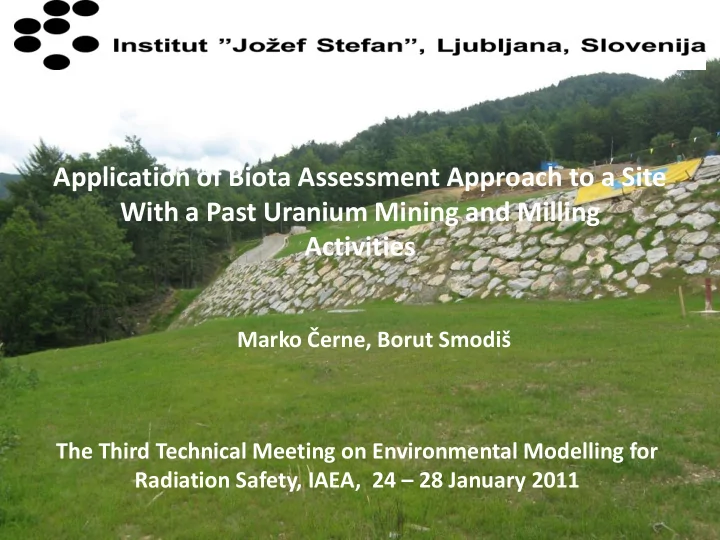
Application of Biota Assessment Approach to a Site With a Past Uranium Mining and Milling Activities Marko erne, Borut Smodi The Third Technical Meeting on Environmental Modelling for Radiation Safety, IAEA, 24 28 January 2011 OUTLINE


slide-1
SLIDE 1

Application of Biota Assessment Approach to a Site With a Past Uranium Mining and Milling Activities

The Third Technical Meeting on Environmental Modelling for Radiation Safety, IAEA, 24 – 28 January 2011 Marko Černe, Borut Smodiš

slide-2
SLIDE 2

OUTLINE

  • INTRODUCTION → Former uranium mine, biota assessment approach
  • MATERIALS AND METHODS → field work, assessment with ERICA Tool
  • RESULTS → Dose rates to biota , radiological risk to biota
  • CONCLUSION
slide-3
SLIDE 3

INTRODUCTION

  • Uranium mining and milling activities in Slovenia were in full
  • peration from 1985 to 1990 when 600.000 tons of uranium
  • re were processed during that time
  • The mine has two disposal sites with U-mill tailings deposited

at the Boršt and and red mud with spoil and lower grade ore at the Jazbec site

slide-4
SLIDE 4
  • Emission of natural radionuclides to the nearby habitats has
  • ften occured due to flow of tailings and mine waters to the

local streams (Todraščica and Brebovščica)

U-mill tailings Red mud with spoil and lower grade ore Brebovščica stream Todraščica stream The mine entrance

slide-5
SLIDE 5

Mill tailings disposal site:

0.6 Mt (375,000 m3, 4.11 ha) of hydro- metallurgical tailings (residue of U ore processing: SiO2, CaCO3, SO4

2- salts):

1.0 Bq/g 238U, 4 Bq/kg

230Th and 8.6 Bq/g 226Ra

Minor waste rock piles:

70 kt, 143 kt

Waste rock pile:

1.5 Mt of waste rock plus red mud (50 kt; precipitate of U leaching solution produced by neutralisation with lime): CaSO4, Fe(OH)3, 0.5 Bq/g 238U, 62 Bq/g 230Th and 0.2 Bq/g 226Ra Panoramic view at the Žirovski vrh area, size 4 x 4 km – view towards south

slide-6
SLIDE 6
  • Mine area was under constant monitoring surveillance from

the beginning of mine operation, with aimed to measure critical radionuclides, such us U-238, Ra-226 and Pb-210 in water, sediment, soil, fish and lichens

  • Due to long-term radioactivity discharge to the local streams

the potential radiological risk to frehwater and terrestrial biota could be observed

  • Biota risk assessment should be performed
slide-7
SLIDE 7

MATERIALS AND METHODS

  • ERICA Tool, level Tier 2 was applied for the biota risk evaluation
  • Native aquatic and terrestrial species, such us Brown trout,

Stone crayfish, Soft rush, Marsh marigolds and Tall Moor Grass were assumed as target organism exposed to potential radiation impact

  • Ra-226, U-238 and Pb-210 for aquatic biota and Ra-226, U-238

and Th-230 for plants were included in the assessment

  • Monitoring data were used as input data for the assessment
slide-8
SLIDE 8
  • A case of assessed biota in the vicinity of a former uranium

mine Marsh marigolds Soft rush Brown trout Tall Moor Grass Stone crayfish

slide-9
SLIDE 9

Sampled plants Tailings pile Todraščica stream Tailings pile Contaminated marsh Contaminated marsh Sampling site for tailings waters Contaminated marsh

slide-10
SLIDE 10
  • Monitoring and ERICA default CR values were applied in the

model

  • The screeening dose value of 400 µG h⁻¹ was used in the

assessment as recommended by the IAEA and U.S. DOE for aquatic organisms and terrestrial plants

  • Target organisms used in the model were created using real

geometry and mass data

slide-11
SLIDE 11

RESULTS

  • Aquatic biota→ total dose rates per organism
slide-12
SLIDE 12
  • Aquatic biota→ total dose rates per organism
slide-13
SLIDE 13
  • Terrestrial plants → total dose rates per organism
slide-14
SLIDE 14
  • Biota risk evaluation - no environmental risk from ionising

radiation to aquatic and terrestrial biota was observed as screening value 400 µGy h⁻¹ was not exceeded

  • Stone crayfish would be exposed to environmental risk in the

case of ERICA screening dose value (10 µGy h⁻¹) but in our case this would be negligible due to application of higher dose limit for the assessed organisms

slide-15
SLIDE 15

CONCLUSIONS

  • Assessment revealed that no environmental risk to aquatic

biota and terrestrial plants was observed due to radioactivity discharge into the local streams

  • Predicted dose rates to aquatic biota were the highest during

the mine operation in both streams

  • Todraščica stream resulted in higher biota dose rates

compared to Brebovščica stream

  • Stone crayfish received evidently higher dose rate compared

to Brown trout

slide-16
SLIDE 16
  • Soft rush received the highest dose rate among terrestrial

plants

  • Other organisms should be assessed due to their presence in

the local streams

  • Application of other models is suggested to compare the

results

slide-17
SLIDE 17

0,0E+00 5,0E-06 1,0E-05 1,5E-05 2,0E-05 2,5E-05 3,0E-05 3,5E-05 4,0E-05 2001 2002 2003 2004 2005 2006 2007 2008 leto koncentracija (Bq/m3) U-238 Ra-226

Average yearly concentrations in air at the Todraž site

slide-18
SLIDE 18

1 2 3 4 5 6 7

Sampling sites for Rn using track detectors (FK, Karlsruhe)

slide-19
SLIDE 19

povprečna vrednost 1 2 3 4 5 6 7 8 9 10 11 12 Povprečje 1993- 1999 2000 2001 2002 2003 2004 2005 2006 2007 2008 leto Koncenntracija rudniškega radona (Bq/m3)

Contribution of the mine Rn

slide-20
SLIDE 20

5 10 15 20 25 30 35 40 45 1995 1996 1997 1998 1999 2000 2001 2002 2003 2004 2005 2006 2007 2008 leto Koncentracija radona (Bq(m3) Todraž

  • Gor. Dobrava
  • Dol. Dobrava

Gorenja vas Ljubljana

Average yearly Rn concentrations using charcoal adsorbers

slide-21
SLIDE 21

20 40 60 80 100 120 140 2004 2005 2006 2007 2008 Leto Koncentracija radona (Bq/m

3)

MP Jazbec MP Boršt Rn concentrations (track detectors) at two waste piles

slide-22
SLIDE 22

50 100 150 200 250 300 1994 1995 1996 1997 1998 1999 2000 2001 2002 2003 2004 2005 2006 2007 2008 Koncentracija (Bq/m

3)

Brebovščica Todraščica Brebovščica - povprečje Todraščica - povprečje

Average yearly concentrations of U in Brebovščica and Todražčica streams

slide-23
SLIDE 23

5 10 15 20 25 30 35 40 1994 1995 1996 1997 1998 1999 2000 2001 2002 2003 2004 2005 2006 2007 2008 Koncentracija (Bq/m

3)

Brebovščica Todraščica Brebovščica - povprečje Todraščica - povprečje

Average yearly concentrations of Ra in Brebovščica and Todražčica streams

slide-24
SLIDE 24

5 10 15 20 25 30 35 40 1994 1995 1996 1997 1998 1999 2000 2001 2002 2003 2004 2005 2006 2007 2008 Koncentracija (Bq/m

3)

Brebovščica Todraščica Brebovščica - povprečje Todraščica - povprečje

Average yearly concentrations of Pb-210 in Brebovščica and Todražčica streams

slide-25
SLIDE 25

5 10 15 20 25 30 2001 2002 2003 2004 2005 2006 2007 2008 Leto Koncentracija (Bq/m3) U-238 Ra-226 Pb-210

Concentrations in one of the wells

slide-26
SLIDE 26

20 40 60 80 100 120 140 160 1994 1995 1996 1997 1998 1999 2000 2001 2002 2003 2004 2005 2006 2007 2008

Koncentracija (Bq/kg)

Brebovščica po Todraščica po Sora po Brebovščica po-povprečje 1994 - 2008

Activity concentrations of U-238 in sediments

slide-27
SLIDE 27

100 200 300 400 500 600 700 1994 1995 1996 1997 1998 1999 2000 2001 2002 2003 2004 2005 2006 2007 2008 Koncentracija (Bq/kg) Brebovščica po Todraščica po Sora po Brebovščica po-povprečje 1994 - 2008

Activity concentrations of Ra-226 in sediments

slide-28
SLIDE 28

50 100 150 200 250 300 350 400 450 500 1994 1995 1996 1997 1998 1999 2000 2001 2002 2003 2004 2005 2006 2007 2008 Leto Koncentracija (Bq/kg) Brebovščica po Todraščica po Sora po Brebovščica po-povprečje 1994 - 2008

Activity concentrations of Pb-210 in sediments

slide-29
SLIDE 29

2 4 6 8 10 12 14 16 18 20 2000 2001 2002 2003 2004 2005 2006 2007 2008 Leto Efektivna doza (µSv)

Effective dose due to inhallation of long-lived radionuclides

slide-30
SLIDE 30

50 100 150 200 250 300 2000 2001 2002 2003 2004 2005 2006 2007 2008 Leto Efektivna doza (µSv)

Effective dose due to inhallation of short-lived Rn progenies

slide-31
SLIDE 31

5 10 15 20 25 30 35 2000 2001 2002 2003 2004 2005 2006 2007 2008 Leto Efektivna doza (µSv)

Effective dose due to drinking river water

slide-32
SLIDE 32

Povprečje 0,05 0,1 0,15 0,2 0,25 0,3 0,35 0,4 1991 1992 1993 1994 1995 1996 1997 1998 1999 2000 2001 2002 2003 2004 2005 2006 2007 2008 Leto Efektivna doza (mSv)

Overall effective dose due to RŽV

slide-33
SLIDE 33

THANK YOU FOR YOUR ATTENTION!