Appendectomy vs. Antibiotics The CODA Randomized Trial Presenter - - PDF document

appendectomy vs antibiotics the coda randomized trial
SMART_READER_LITE
LIVE PREVIEW

Appendectomy vs. Antibiotics The CODA Randomized Trial Presenter - - PDF document

#17872818.0 6/1/2018 Appendectomy vs. Antibiotics The CODA Randomized Trial Presenter Name x, for the CODA Collaborative Maine Medical Appendicitis: Significance and Background Lifetime risk is 7-12% Appendectomy is most common


slide-1
SLIDE 1

6/1/2018 1

Appendectomy vs. Antibiotics The CODA Randomized Trial

Presenter Name x, for the CODA Collaborative Maine Medical

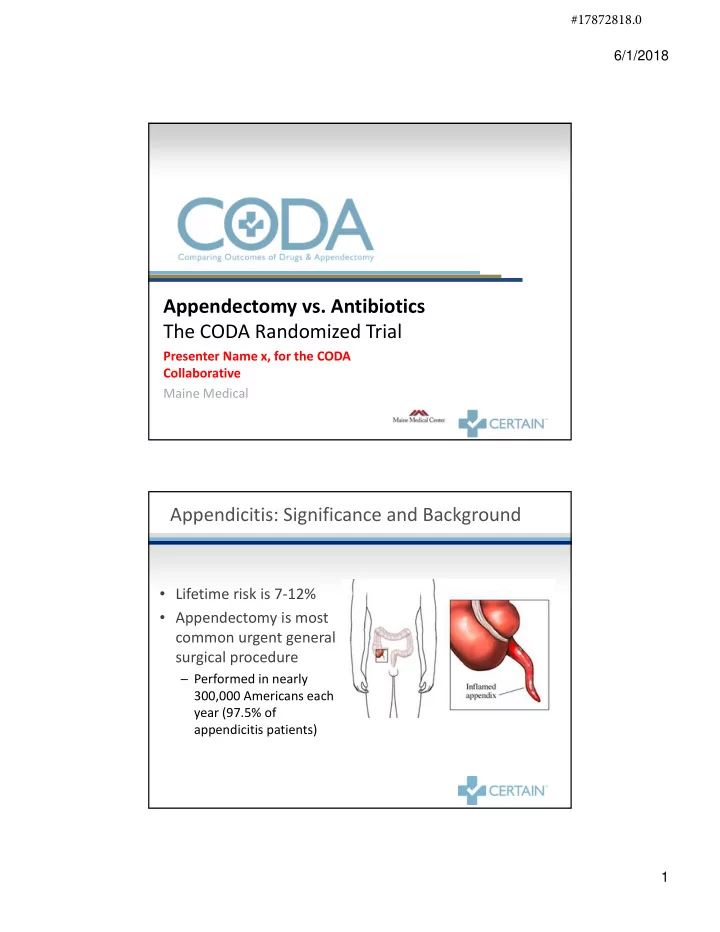
Appendicitis: Significance and Background

  • Lifetime risk is 7-12%
  • Appendectomy is most

common urgent general surgical procedure

─ Performed in nearly 300,000 Americans each year (97.5% of appendicitis patients) #17872818.0

slide-2
SLIDE 2

6/1/2018 2

Appendicitis: Significance and Background

A Look at the Evidence

  • N=1,724
  • Common outcomes

─ Complications higher for surgery ─ Less pain for antibiotics ─ Fewer days away from work for antibiotics ─ Length of stay is similar

  • Outcomes unique to one arm

─ All surgical patients undergo appendectomy ─ By 1 year, 25-40% of those randomized to antibiotics had an appendectomy ─ No higher rate of perforation

slide-3
SLIDE 3

6/1/2018 3

Evidence Gaps

  • Selection bias
  • Inconsistent or unstandardized diagnostic criteria
  • Inadequate antibiotic coverage
  • High rates of open surgery (44-95%)
  • Outcome dependent on treatment strategy
  • No standardized use of PROs

Stakeholder Perspective: Why Rock the Boat?

  • Patients
  • Hospital
  • Surgeon
  • Payer
slide-4
SLIDE 4

6/1/2018 4

CODA Research Proposal Development

  • Engaged patients, clinicians, healthcare

administrators, funders and researchers across WA State

  • Used multi-modal approach to engagement
  • Planning took place over 7 months
  • Non-funded work

What Matters to Patients

Are the benefits of avoiding surgery outweighed by the potential burdens?

  • Recurrence of appendicitis and eventual surgical

intervention

  • Lingering symptoms
  • Anxiety and uncertainty impacting quality of life and

return to work/school

  • Long-term antibiotics
slide-5
SLIDE 5

6/1/2018 5

CODA: Research Questions

  • 1. Are antibiotics as effective as

appendectomy for uncomplicated appendicitis?

  • 2. Which patients are most likely

to have a successful outcome with antibiotics-first?

  • Aim 1. Compare patient reported outcomes (PROs) in

patients randomized to the antibiotics or appendectomy strategy.

  • Sub Aim 1. Compare PROs in patients without appendicolith

randomized to the antibiotics or appendectomy strategy.

  • Exploratory Aim A. Assess the rate of eventual

appendectomy after starting the antibiotics treatment regimens in the first week, early (1-4 weeks) and late (2-24 months) periods and identify patient clinical characteristics (e.g., appendicolith) as well as clinician and practice site characteristics associated with eventual appendectomy in the antibiotic therapy group.

CODA: Study Aim 1

slide-6
SLIDE 6

6/1/2018 6

CODA: Study Aim 2

  • Aim 2. Compare clinical outcomes in patients

randomized to antibiotics versus appendectomy.

─ Sub Aim 2. Compare clinical outcomes in patients without appendicolith randomized to the antibiotics or appendectomy strategy.

  • Exploratory Aim B. Compare randomized patients to

those in a concurrent observational cohort to identify selection characteristics and outcome differences between the two groups.

  • Randomized-controlled trial
  • Large-scale (n=1,552)
  • Non-inferiority based
  • Antibiotics “just as good as”

appendectomy

  • Pragmatic
  • Routine clinical practice settings,

heterogeneous population

  • Parallel observational cohort

(n=500)

CODA Study Design

1552 Randomized 1552 Randomized Antibiotic Antibiotic Appendectomy Appendectomy 500 non-randomized (250 antibiotics/250 appendectomy) All patients with uncomplicated appendicitis approached for participation

Accept Decline

slide-7
SLIDE 7

6/1/2018 7

How is this study pragmatic?

  • “Real world” setting and practice

─ Routine practice

  • European vs. American

─ Open vs. laparoscopic surgery ─ Outpatient vs. inpatient management ─ Antibiotics adherence

  • Antibiotics-first approach requires 7 days of treatment at home

─ Antibiotics regimen

  • Flexibility in antibiotics choice
  • Heterogeneity of treatment effect

─ Large sample/site size ─ Patients ─ Clinicians and healthcare settings

CODA: Study Population

  • Consecutive patients recruited across 8 sites in 2

states

  • Diverse demographics – CERTAIN Network

─ Urban and rural ─ Includes non-English speakers (Spanish) ─ Populations not typically engaged in research ─ Varying socioeconomic status

slide-8
SLIDE 8

6/1/2018 8

Inclusion & Exclusion Criteria

  • A≥18 years; speaks English or Spanish
  • Presenting with a diagnosis of uncomplicated appendicitis,

imaging confirmed (CT, ultrasound, or MRI)

  • Without contraindication to either:

Antibiotics (Known severe allergy or reaction to all of the proposed antibiotics, septic shock or diffuse peritonitis) Appendectomy (Advanced disease related to appendicitis such that patient is ineligible for surgery, e.g., severe phlegmon, abscess)

Patient Measures at Follow-Up

At regular quarterly intervals through 12 months, then at 18 months and 24 months, phone, mail, or web-based surveys will be used to assess:

  • Complications, signs and symptoms related to appendicitis

and related healthcare utilization, time spent in healthcare, time away from work/school, out of pocket expenses (3, 6, 9, 12, 18, 24 months);

─ Work Productivity Index (3 months); ─ EQ-5D20 and 10-PROMIS21 (3, 6, 9, 12,18, 24 months); ─ GIQLI22 (3,12,18, 24 months); and ─ Decision Regret Scale23 (3,12 months).
slide-9
SLIDE 9

6/1/2018 9

Site Expansion

East Coast:

  • NYU-Tisch And Bellevue

Hospital Centers

  • Beth Israel Deaconess

Medical Center (BIDMC)

  • Boston University Medical

Center (BMC)

  • Columbia University Medical

Center

  • Weill Cornell Medicine
  • Maine Medical Center

South:

  • University of Mississippi
  • Vanderbilt Medical

Center

  • UT Health & LBJ Medical

Center (TX) Midwest:

  • University of

Michigan

  • The Ohio State

University

  • Henry Ford Health

Systems

Bolded sites have already launched *Potential sites

West:

  • University of Colorado

Denver*

Site launches

  • UT Health, LBJ & Maine Medical expected

launch April/May

  • Cornell expected launch this summer
slide-10
SLIDE 10

6/1/2018 10

  • UW Medical Center
  • Harborview Medical Center
  • Madigan Army Medical Center
  • UCLA Medical Center – Olive View
  • UCLA Medical Center – Harbor
  • University of Mississippi Medical

Center

  • Beth Israel Deaconess Medical Center
  • Columbia University Irving Medical

Center

  • Vanderbilt University Medical Center
  • Boston Medical Center (Boston

University)

  • Virginia Mason Medical Center
  • Providence Regional Medical Center

– Everett

  • Swedish Medical Center – First Hill
  • University of Michigan Medical

Center

  • Tisch Hospital NYU Langone Medical

Center

  • Bellevue Hospital Center NYU School
  • f Medicine
  • Henry Ford Health System
  • The Ohio State Wexner Medical

Center

CODA Current Study Sites

  • Improves communication to patients

─ Clear message regarding treatment

  • Need to normalize options
  • Improve patient expectations
  • Decrease crossover

Standardized Information & Informed Consent Tool

slide-11
SLIDE 11

6/1/2018 11

Standardizing Patient Information

  • Challenge: deliver

standardized patient information across all sites

─ Urban and rural ─ Academic and private ─ Variation in information

  • Doctors (residents, ED,

surgeons); nurses (ED, triage); radiology (imaging techs, radiologists)

  • Solution: 6-minute

video given to all patients diagnosed with appendicitis

Standardizing Patient Information

  • English and Spanish
  • Collaborative development:

surgeons, ED docs, media team and patient advisors

slide-12
SLIDE 12

6/1/2018 12

Our Progress to Date

  • $12.9 million funded last year
  • Protocol development and IRB complete
  • May 2016: Enrollment began in English at UW

Medical Center and Harborview Medical Center

  • June-October 2016: Enrollment began in English and

Spanish at all remaining sites

Questions and Information

codastudy.org