
Appen Appendix ix B - B - R
- Rt. 3
. 33 R Recrea eatio tion F Fiel eld, d, Po Portsmo smouth, th, N NH
Syn Synthe heti tic Tu c Turf I Infill O Opti tion
- ns
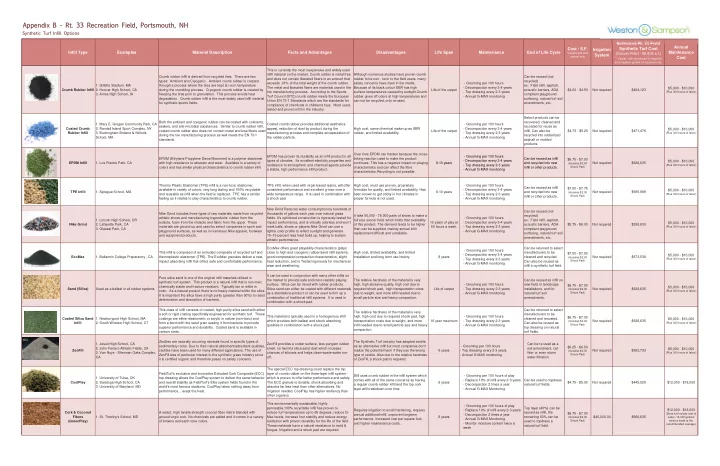
Infill Type Examples Material Description Facts and Advantages Disadvantages Life Span Maintenance End of Life Cycle Cost / S.F.
*Carpet and Infill system only
Irrigation System Estimated Rt. 33 Field Synthetic Turf Cost
(Soccer Field - 89,805 s.f.) * Carpet, infill, shock pad (if required)
and irrigation system (if required) only.
Annual Maintenance Cost
Crumb Rubber Infill
- 1. Gillette Stadium, MA
- 2. Hoover High School, CA
- 3. Ames High School, IA
Crumb rubber infill is derived from recycled tires. There are two types: Ambient and Cryogenic. Ambient crumb rubber is created through a process where the tires are kept at room temperature during the crumbling process. Cryogenic crumb rubber is created by freezing the tires prior to granulation. This process avoids heat
- degradation. Crumb rubber infill is the most widely used infill material
for synthetic sports fields. This is currently the most inexpensive and widely used infill material on the market. Crumb rubber is metal free and does not contain liberated fibers in an amount that exceeds .01% of the total weight of the crumb rubber. The metal and liberated fibers are materials used in the tire manufacturing process. According to the Sports Turf Council (STC) crumb rubber meets the European Union EN 73-1 Standards which are the standards for compliance of chemicals in children's toys. Most used, tested and proven infill in the industry. Although numerous studies have proven crumb rubber to be non - toxic to the field users, many safety concerns have risen in the media. Because of its black colour SBR has high surface temperatures caused by sunlight.Crumb rubber gives off odors at high temperatures and can not be recycled, only re-used. Life of the carpet
- Grooming per 100 hours
- Decompaction every 3-4 years
- Top dressing every 2-3 years
- Annual G-MAX monitoring
Can be reused (not recycled) ex: Field infill, asphalt, acoustic barriers, ADA compliant playground surfacing, natural turf soil amendments, etc. $4.00 - $4.50 Not required $404,123 $5,000 - $10,000
(Plus 300 hours of labor)
Coated Crumb Rubber Infill
- 1. Mary E. Grogan Community Park, CA
- 2. Randall Island Sport Complex, NY
- 3. Buckingham Browne & Nichols
School, MA Both the ambient and cryogenic rubber can be coated with colorants, sealers, and anti-microbial substances. Similar to crumb rubber infill, coated crumb rubber also does not contain metal and lose fibers used during the tire manufacturing process as well meets the EN 73-1 standards. Coated crumb rubber provides additional aesthetics appeal, reduction of dust by product during the manufacturing process and complete encapsulation of the rubber particle. High cost, same chemical make-up as SBR rubber, and limited availability. Life of the carpet
- Grooming per 100 hours
- Decompaction every 3-4 years
- Top dressing every 2-3 years
- Annual G-MAX monitoring
Select products can be recovered, cleaned and recoated for reuse as
- infill. Can also be
recycled into rubberized asphalt or molded products. $4.75 - $5.25 Not required $471,476 $5,000 - $10,000
(Plus 300 hours of labor)
EPDM Infill
- 1. Los Prados Park, CA
EPDM (Ethylene Propylene Diene Monomer) is a polymer elastomer with high resistance to abrasion and wear. Available in a variety of colors and has similar physical characteristics to crumb rubber infill. EPDM has proven its durability as an infill product in all types of climates. Its excellent elasticity properties and resistance to atmospheric and chemical agents provide a stable, high performance infill product. Over time EPDM can harden because the cross- linking reaction used to make the product
- continues. This has a negative impact on playing
characteristics and can affect the fibre characteristics.Recycling is not possible. 8-10 years
- Grooming per 100 hours
- Decompaction every 3-4 years
- Top dressing every 2-3 years
- Annual G-MAX monitoring
Can be reused as infill and recycled into new infill or other products. $6.75 - $7.00
(Includes $2.00 Shock Pad)
Not required $628,635 $5,000 - $10,000
(Plus 300 hours of labor)
TPE Infill
- 1. Sprague School, MA
Thermo Plastic Elastomer (TPE) infill is a non-toxic elastomer, available in variety of colors, very long lasting and 100% recyclable and reusable as infill when the field is replaced. TPE has a similar feeling as it relates to play characteristics to crumb rubber. TPE infill, when used with virgin-based resins, will offer consistent performance and excellent g-max over a wide temperature range. It is used in combination with a shock pad. High cost, must use proven, proprietary formulas for quality, and limited availability. Has been known to get sticky in hot climates in proper formula is not used. 8-10 years
- Grooming per 100 hours
- Decompaction every 3-4 years
- Top dressing every 2-3 years
- Annual G-MAX monitoring
Can be reused as infill and recycled into new infill or other products. $7.50 - $7.75
(Includes $2.00 Shock Pad)
Not required $695,989 $5,000 - $10,000
(Plus 300 hours of labor)
Nike Grind
- 1. Lincoln High School, OR
- 2. Lafayette Park, CA
- 3. Glassel Park, CA
Nike Grind includes three types of raw materials made from recycled athletic shoes and manufacturing byproducts: rubber from the
- utsole, foam from the midsole and fabric from the upper. These
materials are ground up and used by select companies in sport and playground surfaces, as well as in numerous Nike apparel, footwear and equipment products. Nike Grind Reduces water consumption by hundreds of thousands of gallons each year over natural grass
- fields. It's optimized construction is rigorously tested for
impact performance, and is virtually odorless and won’t mark balls, shoes or players.Nike Grind can use a lighter color profile to reflect sunlight and generate 10–15-percent less heat build up, helping to sustain athletic performance. It take 50,000 - 75,000 pairs of shoes to make a full size soccer field, which limits that availablity
- f this prodect. The demand tends to be higher
then can be supplied, making annual infill replacement difficult and unreliable. 10 years of play at 40 hours a week.
- Grooming per 100 hours
- Decompaction every 3-4 years
- Top dressing every 2-3 years
- Annual G-MAX monitoring
Can be reused (not recycled) ex: Field infill, asphalt, acoustic barriers, ADA compliant playground surfacing, natural turf soil amendments, etc. $5.75 - $6.00 Not required $538,830 $5,000 - $10,000
(Plus 300 hours of labor)
EcoMax
- 1. Bellarmin College Preparatory , CA
This infill is comprised of an extruded composite of recycled turf and thermoplastic elastomer (TPE). The EcoMax granules deliver a new, impact absorbing infill that offers safe and comfortable performance. EcoMax offers great playability characteristics (plays close to high end cryogenic rubber/sand infill system), good compression/compaction characteristics, slight heat reduction, and is Tested rigorously for mechanical wear and weathering. High cost, limited availability, and limited installation and long term use history. 8 years
- Grooming per 100 hours
- Decompaction every 3-4 years
- Top dressing every 2-3 years
- Annual G-MAX monitoring
Can be returned to select manufacturers to be cleaned and recycled. Can also be reused as infill in synthetic turf field. $7.00 - $7.50
(Includes $2.00 Shock Pad)
Not required $673,538 $5,000 - $10,000
(Plus 300 hours of labor)
Sand (Silica) Used as a ballast in all rubber systems Pure silica sand is one of the original infill materials utilized in synthetic turf system. This product is a natural infill that is non-toxic chemically stable and fracture resistant. Typically tan or white in
- color. As a natural product there is no heavy material within the silica.
It is important the silica have a high purity (greater than 90%) to resist deterioration and absorption of bacteria. It can be used in conjunction with many other infills on the market to provide safe and more realistic playing
- surface. Silica can be mixed with rubber products.
Silica sand can either be coated with different materials as a standalone product or can be used to firm up a combination of traditional infill systems. It is used in combination with a shock pad. The relative hardness of the material is very high, high abrasive quality, high cost due to required shock pad, high transportation costs due to weight, and more infill needed due to small particle size and heavy compaction. Life of carpet
- Grooming per 100 hours
- Top dressing every 2-3 years
- Annual G-MAX monitoring
Can be reused as infill on new field, in landscape installations, and for natural turf soil amendments. $6.75 - $7.00
(Includes $2.00 Shock Pad)
Not required $628,635 $5,000 - $10,000
(Plus 300 hours of labor)
Coated Silica Sand Infill
- 1. Newburyport High School, MA
- 2. South Windsor High School, CT
This class of infill consists of coated, high-purity silica sand with either a soft or rigid coating specifically engineered for synthetic turf. These coatings are either elastomeric or acrylic in nature (non-toxic) and form a bond with the sand grain sealing it from bacteria to provide superior performance and durability. Coated sand is available in various sizes. This material is typically used in a homogenous infill which provides both ballast and shock absorbing qualities in combination with a shock pad. The relative hardness of the material is very high, high cost due to required shock pad, high transportation costs due to weight, and more infill needed due to small particle size and heavy compaction. 16 year maximum
- Grooming per 100 hours
- Top dressing every 2-3 years
- Annual G-MAX monitoring
Can be returned to select manufacturers to be cleaned and recoated. Can also be reused as top dressing on natural turf fields. $6.75 - $7.00
(Includes $2.00 Shock Pad)
Not required $628,635 $5,000 - $10,000
(Plus 300 hours of labor)
ZeoFill
- 1. Jesuit High School, CA
- 2. John Ferraro Athletic Fields, CA
- 3. Van Nuys - Sherman Oaks Complex,
CA Zeolites are naturally occurring minerals found in specific types of sedimentary rocks. Due to their natural absorbent/adsorbent qualities, zeolites have been used for many different applications. The use of ZeoFill was of particular interest to the synthetic grass industry since it is certified organic and therefore poses no safety concerns. ZeoFill provides a cooler surface, less pungent rubber smell, no harmful silica sand dust which increase chances of silicosis and helps clean waste water run-
- ff.
The Synthetic Turf industry has adopted zeolite as an alternative infill but most companies don't realize the potential harm if they use the wrong type of zeolite. Also due to the relative hardness
- f ZeoFill, a shock pad is required.
8 years
- Grooming per 100 hours
- Top dressing every 2-3 years
- Annual G-MAX monitoring
Can be re-used as a soil amendment, cat litter or even storm water filtration $6.25 - $6.50
(Includes $2.00 Shock Pad)
Not required $583,733 $5,000 - $10,000
(Plus 300 hours of labor)
CoolPlay
- 1. University of Tulsa, OK
- 2. Saratoga High School, CA
- 3. University of Maryland, MD
FieldTurf's exclusive and innovative Extruded Cork Composite (ECC) top dressing allows the CoolPlay system to deliver the same behavior and overall stability as FieldTurf's Elite system fields found in the world's most famous stadiums. CoolPlay takes nothing away from performance... exept the heat. The special ECC top dressing could replace the top layer of crumb rubber on the three-layer infill system - which is proven to offer better performance and safety. The ECC granule is durable, shock absorbing and absorbs far less heat than other alternatives. No irrigation needed. CoolPlay has higher resiliency than
- ther organics.
Still uses crumb rubber in the infill system which comes with all of the same concerns as having a regular crumb rubber infill and the top cork layer will breakdown over time. 8 years
- Grooming per 100 hours of play
- Replace 10% of infill every 2-3 years
- Decompaction 2 times a year
- Annual G-MAX Monitoring
Can be used to topdress natural turf fields. $4.75 - $5.00 Not required $449,025 $12,000 - $18,000 Cork & Coconut Fibers (GreenPlay)
- 1. St. Timothy's School, MD
A select, high tensile strength coconut fiber matrix blended with ground virgin cork. No chemicals are added and it comes in a variety
- f browns and earth tone colors.
This environmentally sustainable, highly permeable,100% recyclable infill has proven to reduce turf temperatures up to 65 degrees, reduce G- Max levels, increase foot stability and reduce energy restitution with proven durability for the life of the field. These materials have a natural resistance to mold &
- fungus. Irrigation and a shock pad are required.
Requires irrigation to avoid hardening, requires annual additional infill, unproven longterm performance, increased cost per square foot, and higher maintenance costs. 8 years
- Grooming per 100 hours of play
- Replace 10% of infill every 2-3 years
- Decompaction 2 times a year
- Annual G-MAX Monitoring
- Monitor moisture content twice a
week Top layer (40%) can be reused as infill, the remaining 60% can be used to topdress a natural turf field. $6.75 - $7.00
(Includes $2.00 Shock Pad)
$40,000.00 $668,635 $12,000 - $18,000
(Does not include cost of
- water. 12,000 gallons
twice a week is the recommended average)