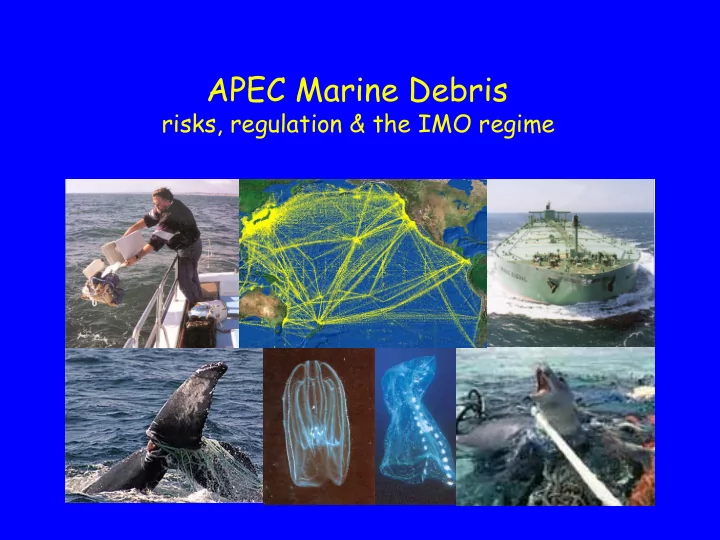
SLIDE 1
APEC Marine Debris
risks, regulation & the IMO regime
SLIDE 2 Shipping in society & the global economy
- Global, multi-national & gargantuan
- Carries >90% world trade
- Underpins global economic
development
- 85,000 ships in world fleet
- 5.4 billion tonnes cargo / year
- Modern society totally shipping
dependant
SLIDE 3
/fishing most intensive human use of the seas
maritime zones
SLIDE 4 Environmental impacts of shipping
- Shipping most energy-efficient, cost-
effective & ecologically sound mode of freight transport
- Net environmental costs/benefits per unit
cargo carried
- However, can still cause major impacts
SLIDE 5
Environmental impacts of shipping
Different ship types = different impacts, e.g.: Tankers – risk of major spills, little sewage & garbage Cruise liners – minor risk of spills, major sewage & garbage
SLIDE 6 Pollution accidents & emergencies
- Global media focus
- However, not a severe as
- ngoing, chronic pollution such
as ‘operational’ discharges, inc. garbage / marine debris
SLIDE 7 Garbage / marine debris
- 6.4 million tonnes / year globally
- 5.6 million tonnes from shipping
- 46,000 pieces of plastic / square mile
- 3 x more garbage into ocean as fish
taken out
- N Pacific – 6 pounds of plastic for
every pound of plankton near surface
- Significant wildlife impacts
- Transfer fouling species
- High seas convergence zones
SLIDE 8 International regulatory regime
UNCLOS:
- 69 of 320 Articles relate directly to
shipping
- Freedom of navigation
- Right of innocent passage
- Flag State control
- Part XII – inc. controls on pollution &
discharges
SLIDE 9
IMO Regime
Specialised agency of the UN
SLIDE 10 IMO Conventions
- MARPOL 73 / 78
- Annex V deals with garbage
- Applies to ALL vessels, as per below:
SLIDE 11 MARPOL 73/78
- Annex V requires waste reception facilities
in ports
- Lack of these is MAJOR problem
SLIDE 12
Technical Guidelines & Manuals
SLIDE 13
Ship-board Management Plans
SLIDE 14 MARPOL Special Areas
The North Sea The Baltic Sea The Black Sea* The Mediterranean Sea* The Gulf Area* The Red Sea* The Antarctic south of 60oS is a Special Area for Annexes I, II and V
Wider Caribbean*
The areas marked (*) have not been enforced as Special Areas in all respects due to lack of adequate reception facilities (the Mediterranean Sea and the Black Sea have
- btained the full Special Area status for Annex I).
SLIDE 15
Additional Annex V Restrictions in Special Areas
SLIDE 16 Malpelo Island Great Barrier Reef Sabana-Camaguey Florida Keys
PSSAs
Wadden Sea
SLIDE 17 PSSAs
- IMO Assembly Resolution A.972(22)
‘The criteria relate to PSSAs within and beyond the limits of the territorial sea. They can be used by IMO to designate PSSAs beyond the territorial sea with a view to the adoption of international protective measures regarding pollution and other damage caused by ships’
SLIDE 18
Last 50 years - performance to date
SLIDE 19 Governance gaps
- IMO regime highly successful in
reducing shipping accidents, oil pollution & sea dumping
- Largely ineffective at addressing
marine debris (distance from land / compliance enforcement / poor waste reception in ports
- Cultural change required – human
element
SLIDE 20 Governance gaps
- MARPOL distances from land criteria
reinforce “out of sight, out of mind” mentality’
SLIDE 21 Governance needs
- Better implementation of existing regime
- Overhaul MARPOL – move away from
distance from land philosophy
- Creative approaches to address marine
debris
- More coastal and port State control with
better flag State implementation (satellite monitoring?)
SLIDE 22
Huge education effort needed
SLIDE 23
Encourage industry initiatives / non- regulatory incentives
SLIDE 24
Ultimate objective
SLIDE 25
Shipping / fishing is global
SLIDE 26
Oceans are inter- connected
SLIDE 27 Garbage / marine debris
- Must be addressed in a, strategic, integrated
manner
- As part of a ‘total oceans management’ regime
SLIDE 28
www.imo.org www.imo.org