Apache Heron executor (e.g. Kafka spout, a bold writing output to a - - PDF document

apache heron
SMART_READER_LITE
LIVE PREVIEW

Apache Heron executor (e.g. Kafka spout, a bold writing output to a - - PDF document

CS535 Big Data 2/17/2020 Week 5-A Sangmi Lee Pallickara CS535 Big Data | Computer Science | Colorado State University CS535 Big Data | Computer Science | Colorado State University CS535 BIG DATA FAQs Quiz 1 Pseudocode should be


slide-1
SLIDE 1

CS535 Big Data 2/17/2020 Week 5-A Sangmi Lee Pallickara http://www.cs.colostate.edu/~cs535 Spring 2020 Colorado State University, page 1

CS535 BIG DATA

PART B. GEAR SESSIONS

SESSION 1: PETA-SCALE STORAGE SYSTEMS

Sangmi Lee Pallickara Computer Science, Colorado State University http://www.cs.colostate.edu/~cs535 Google had 2.5 million servers in 2016

FAQs

  • Quiz 1
  • Pseudocode should be interpretable as a MapReduce
  • Your code should be interpretable as a actual MR code
  • E.g.
  • Step 1. Read lines
  • Step 2. Tokenize it
  • Step 3. group records based on the branch
  • Step 4. Sort all of the record of a branch
  • Step 5. Find the top 10 per branch
  • Can this code an effective mapreduce implementation?
  • <Key, Value> is the core data structure of communication in MR without any exception
  • Next quiz: 2/21 ~ 2/23
  • Spark and Storm

CS535 Big Data | Computer Science | Colorado State University CS535 Big Data | Computer Science | Colorado State University

FAQs

  • How to lead the discussion as a presenter
  • GOAL: You should involve your audience to the discussion
  • Please remember that you have at least 10 other students (3 other teams!) who already read the same paper

and submitted reviews!!

  • Initiate questions
  • “What do you think about this? Do you think that the approach XYZ is suitable for ABC?”
  • Provide discussion topics
  • “OK. We will discuss the performance aspect of this project. This project has proposed approach X, Y, and

Z…”

  • Pose questions
  • “We came up with the following questions…”

CS535 Big Data | Computer Science | Colorado State University CS535 Big Data | Computer Science | Colorado State University

Topics of Todays Class

  • Apache Storm vs. Heron
  • GEAR Session I. Peta Scale Storage Systems

CS535 Big Data | Computer Science | Colorado State University CS535 Big Data | Computer Science | Colorado State University

  • 4. Real-time Streaming Computing Models:

Apache Storm and Twitter Heron Apache Storm

Apache Heron

CS535 Big Data | Computer Science | Colorado State University CS535 Big Data | Computer Science | Colorado State University

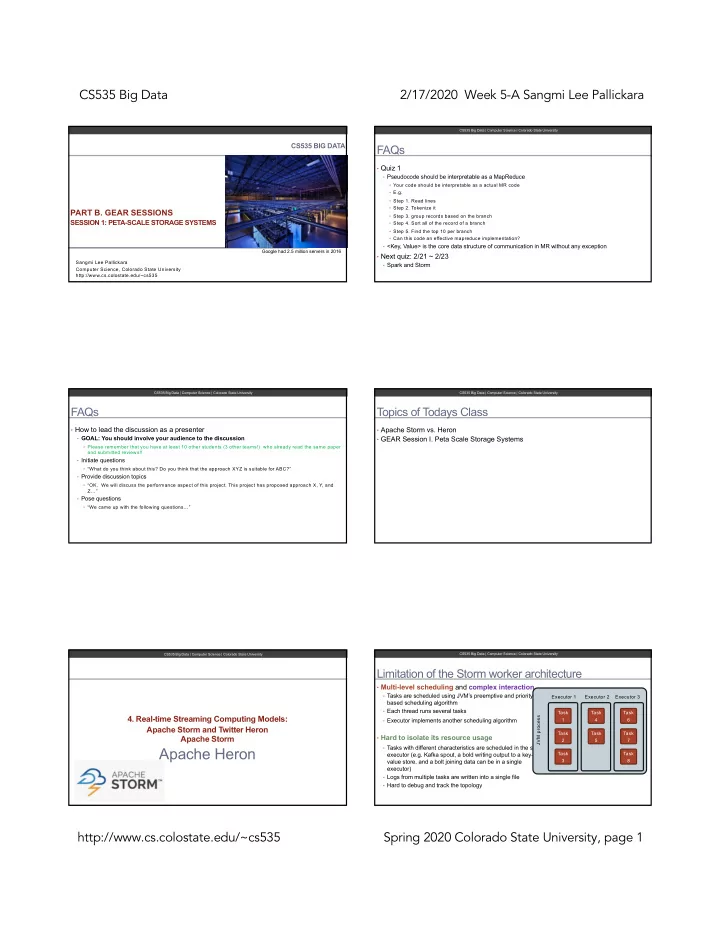
Limitation of the Storm worker architecture

  • Multi-level scheduling and complex interaction
  • Tasks are scheduled using JVM’s preemptive and priority-

based scheduling algorithm

  • Each thread runs several tasks
  • Executor implements another scheduling algorithm
  • Hard to isolate its resource usage
  • Tasks with different characteristics are scheduled in the same

executor (e.g. Kafka spout, a bold writing output to a key- value store, and a bolt joining data can be in a single executor)

  • Logs from multiple tasks are written into a single file
  • Hard to debug and track the topology

Executor 1 Executor 2 Executor 3 Task 1 Task 3 Task 2 Task 4 Task 5 Task 6 Task 8 Task 7 JVM process

CS535 Big Data | Computer Science | Colorado State University CS535 Big Data | Computer Science | Colorado State University

slide-2
SLIDE 2

CS535 Big Data 2/17/2020 Week 5-A Sangmi Lee Pallickara http://www.cs.colostate.edu/~cs535 Spring 2020 Colorado State University, page 2

Limitation of the Storm worker architecture

  • Limitation of the Storm Nimbus
  • Scheduling, monitoring, and distributing JARs
  • Topologies are untraceable
  • Nimbus does not support resource reservation and isolation
  • Storm workers that belong to different topologies running on the same machine
  • Interfere with each other
  • Zookeeper manages heartbeats from workers and the supervisors
  • Becomes a bottleneck
  • The Nimbus component is a single point of failure

CS535 Big Data | Computer Science | Colorado State University CS535 Big Data | Computer Science | Colorado State University

Limitation of the Storm worker architecture

  • If the receiver component is unable to handle incoming data/tuples
  • the sender simply drops tuples
  • In extreme scenarios, this design causes the topology to not make any progress
  • While consuming all its resources

CS535 Big Data | Computer Science | Colorado State University CS535 Big Data | Computer Science | Colorado State University

Apache Heron

  • Maintains compatibility with the Storm API
  • Data processing semantics
  • At most once – No tuple is processed more than once, although some tuples may be dropped,

and thus may miss being analyzed by the topology

  • At least once – Each tuple is guaranteed to be processed at least once, although some tuples

may be processed more than once, and may contribute to the result of the topology multiple times

CS535 Big Data | Computer Science | Colorado State University CS535 Big Data | Computer Science | Colorado State University

Aurora Scheduler

  • Aurora
  • Generic service scheduler runs on Mesos

Aurora Scheduler Topology 1 Topology 2 Topology 3 Topology N

CS535 Big Data | Computer Science | Colorado State University CS535 Big Data | Computer Science | Colorado State University

Aurora Scheduler

  • Each topology runs as an Aurora job
  • Consisting several containers
  • Topology master
  • Stream manager
  • Heron Instances
  • Generic service scheduler runs on Mesos

Zoo Keeper Stream manager Metrics Manager Topology Master(TM)

Topology Master(TM) (standby)

Heron Instance Heron Instance Container Messaging System Stream manager Metrics Manager Heron Instance Heron Instance Container

CS535 Big Data | Computer Science | Colorado State University CS535 Big Data | Computer Science | Colorado State University

Topology Backpressure

  • Dynamically adjust the rate at which data flows through the topology
  • Skewed data flows
  • Strategy 1: TCP Backpressure
  • Using TCP windowing
  • TCP connection between HI and SM
  • E.g. for the slow HI, SM will notice that its send buffer is filling up
  • SM will propagate it to other SMs

CS535 Big Data | Computer Science | Colorado State University CS535 Big Data | Computer Science | Colorado State University

slide-3
SLIDE 3

CS535 Big Data 2/17/2020 Week 5-A Sangmi Lee Pallickara http://www.cs.colostate.edu/~cs535 Spring 2020 Colorado State University, page 3

Topology Backpressure

  • Strategy 2: Spout Backpressure
  • SMs clamp down their local spouts to reduce the new data that is injected into the topology
  • Step 1: Identifies local spouts reading data to the straggler HIs
  • Step 2: Sends special message (start backpressure) to other SMs
  • Step 3: Other SMs clamp down their local spouts
  • Step 4: Once the straggler HI catches upà send a stop backpressure message to other SMs
  • Step 5: Other SMs start consuming data
  • Strategy 3: Stage-by-stage backpressure
  • Gradually propagates the backpressure stage-by-stage until it reaches the spouts
  • which represent the 1st stage in any topology

CS535 Big Data | Computer Science | Colorado State University CS535 Big Data | Computer Science | Colorado State University

GEAR Session 1. Peta-scale Storage Systems

CS535 Big Data | Computer Science | Colorado State University CS535 Big Data | Computer Science | Colorado State University

GEAR Session 1. Peta-scale Storage Systems

  • Objectives
  • Understanding large scale storage systems and their applications
  • Lecture 1. 3/17/2020
  • Distributed File Systems: Google File System I, II and HDFS
  • Lecture 2. 3/19/2020
  • Distributed File Systems: Google File System I, II and Apache HDFS
  • Distributed NoSQL DB: Apache Cassandra DB
  • Lecture 3. 3/24/2020
  • Distributed NoSQL DB: Apache Cassandra DB
  • Workshop 3/26/2020

CS535 Big Data | Computer Science | Colorado State University CS535 Big Data | Computer Science | Colorado State University

GEAR Session 1. Peta-scale Storage Systems

  • Workshop 3/26/2020
  • [GS-1-A]
  • Corbett, J.C., Dean, J., Epstein, M., Fikes, A., Frost, C., Furman, J.J., Ghemawat, S., Gubarev, A., Heiser,

C., Hochschild, P . and Hsieh, W., 2013. Spanner: Google’s globally distributed database. ACM Transactions on Computer Systems (TOCS), 31(3), pp.1-22.

  • Presenters: Team 12 (Miller Ridgeway, William Pickard, and Timothy Garton)
  • [GS-1-B]
  • Xie, D., Li, F., Yao, B., Li, G., Zhou, L. and Guo, M., 2016, June. Simba: Efficient in-memory spatial
  • analytics. In Proceedings of the 2016 International Conference on Management of Data (pp. 1071-1085).
  • Presenters: Team 2 (Approv Pandey, Poornima Gunhalkar, Prinila Irene Ponnayya, and Saptashi Chatterjee

)

  • [GS-1-C]
  • Melnik, S., Gubarev, A., Long, J.J., Romer, G., Shivakumar, S., Tolton, M. and Vassilakis, T., 2010. Dremel:

interactive analysis of web-scale datasets. Proceedings of the VLDB Endowment, 3(1-2), pp.330-339.

  • Presenters: Team 9 (Brandt Reutimann, Anthony Feudale, Austen Weaver, and Saloni Choudhary)

CS535 Big Data | Computer Science | Colorado State University CS535 Big Data | Computer Science | Colorado State University

GEAR Session 1. peta-scale storage systems

Lecture 1. Google File System and Hadoop Distributed File System

CS535 Big Data | Computer Science | Colorado State University CS535 Big Data | Computer Science | Colorado State University

This material is built based on

  • Sanjay Ghemawat, Howard Gobioff, Shun-Tak Leung:

The Google file system. Proceedings of SOSP 2003: 29-43

  • Andrew Fikes, Storage Architecture and Challenges, Faculty Summit, 2010
  • http://static.googleusercontent.com/external_content/untrusted_dlcp/research.google.reverse-

proxy.org/en/us/university/relations/facultysummit2010/storage_architecture_and_challenges.pdf

  • Jeff Dean’s SOCC keynote, Building Large-Scale Internet Services
  • http://static.googleusercontent.com/media/research.google.com/en//people/jeff/SOCC2010-keynote-

slides.pdf

  • http://sysmagazine.com/posts/206986/
  • Erasure Coding: Backblaze Open sources Reed-Solomon
  • https://www.backblaze.com/blog/reed-solomon/
  • An introduction to Reed-Solomon codes
  • http://www.cs.cmu.edu/~guyb/realworld/reedsolomon/reed_solomon_codes.html

CS535 Big Data | Computer Science | Colorado State University CS535 Big Data | Computer Science | Colorado State University

slide-4
SLIDE 4

CS535 Big Data 2/17/2020 Week 5-A Sangmi Lee Pallickara http://www.cs.colostate.edu/~cs535 Spring 2020 Colorado State University, page 4

The Machinery

Servers

  • CPUs
  • DRAMS
  • Disks

Racks

  • 40-80 servers
  • Ethernet switch

Cluster >10,000 nodes

CS535 Big Data | Computer Science | Colorado State University CS535 Big Data | Computer Science | Colorado State University

Google Cluster Software Environment

  • Clusters contain 1000s of machines, typically one or handful of configurations
  • File system (GFS or Colossus) + cluster scheduling system are core services
  • Typically 100s to 1000s of active jobs
  • mix of batch and low-latency, user-facing production jobs

CS535 Big Data | Computer Science | Colorado State University CS535 Big Data | Computer Science | Colorado State University

The Realistic View of a Data Center

  • Typical first year for a new cluster:
  • ~1 network rewiring (rolling downtimes: ~5% of machines over 2-day span)
  • ~20 rack failures (40-80 machines instantly disappear, 1-6 hours to get back)
  • ~5 racks go wonky (40-80 machines see 50% packet loss)
  • ~8 network maintenances (4 might cause ~30-minute random connectivity losses)
  • ~12 router reloads (takes out DNS and external IPs for a couple minutes)
  • ~3 router failures (have to immediately pull traffic for an hour)
  • ~dozens of minor 30-second blips for DNS
  • ~1000 individual machine failures
  • ~thousands of hard drive failures
  • slow disks, bad memory, misconfigured machines, flaky machines, etc.
  • Long distance links
  • Reliability/availability must come from software

CS535 Big Data | Computer Science | Colorado State University CS535 Big Data | Computer Science | Colorado State University

Numbers we should know [1/2]

  • Level 1 cache reference
  • 0.5 ns
  • Branch misprediction
  • 5 ns
  • Level 2 cache reference
  • 7 ns
  • Mutex lock/unlock
  • 25 ns
  • Main memory reference
  • 100 ns
  • Compress 1KB with cheap compression algorithm
  • 3,000 ns

CS535 Big Data | Computer Science | Colorado State University CS535 Big Data | Computer Science | Colorado State University

Numbers we should know [2/2]

  • Read 1 MB sequentially from memory
  • 250,000 ns
  • Round trip within the same datacenter
  • 500,000 ns
  • Disk seek
  • 10,000,000 ns
  • Read 1 MB sequentially from disk
  • 20,000,000 ns
  • Send packet CA->Netherlands->CA
  • 150,000,000 ns

CS535 Big Data | Computer Science | Colorado State University CS535 Big Data | Computer Science | Colorado State University

Back of the Envelope Calculation

  • How long to generate an image results page (30 thumbnails)?
  • Design 1: Read serially, thumbnail images (256KB) on the fly
  • 30 seeks * 10 ms/seek + 30 * 256K / 30 MB/s = 560 ms
  • Design 2: Issue reads in parallel:
  • 10 ms/seek + 256K read / 30 MB/s = 18 ms
  • Lots of variations:
  • caching (single images? whole sets of thumbnails?)
  • pre-computing thumbnails

CS535 Big Data | Computer Science | Colorado State University CS535 Big Data | Computer Science | Colorado State University

slide-5
SLIDE 5

CS535 Big Data 2/17/2020 Week 5-A Sangmi Lee Pallickara http://www.cs.colostate.edu/~cs535 Spring 2020 Colorado State University, page 5

Storage Software: GFS

  • Google’s first cluster-level file system (2003)
  • Designed for batch applications with large files Single master for metadata and chunk management

Chunks are typically replicated 3x for reliability

  • Lessons
  • Scaled to approximately 50M files, and 10PB
  • Large files increased application complexity
  • Not appropriate for latency sensitive applications
  • Scaling limits added management overhead

CS535 Big Data | Computer Science | Colorado State University CS535 Big Data | Computer Science | Colorado State University

Storage Software: Colossus (GFS2)

  • Next-generation cluster-level file system
  • Automatically sharded metadata layer
  • Data typically written using Reed-Solomon (1.5x)
  • Client-driven replication, encoding and replication
  • Metadata space has enabled availability
  • Why Reed-Solomon?
  • Cost. Especially with cross cluster replication
  • More flexible cost vs. availability choice

CS535 Big Data | Computer Science | Colorado State University CS535 Big Data | Computer Science | Colorado State University

Storage Landscape

  • Early Google:
  • US-centric traffic
  • Batch, latency-insensitive indexing processes
  • Document "snippets" serving (single seek)
  • Current day:
  • World-wide traffic
  • Continuous crawl and indexing processes (Caffeine)
  • Seek-heavy, latency-sensitive apps (Gmail)
  • Person-to-person, person-to-group sharing (Docs)

CS535 Big Data | Computer Science | Colorado State University CS535 Big Data | Computer Science | Colorado State University

Storage Landscape: Flash (SSDs)

  • Important future directions:
  • More workloads that are increasingly seek heavy
  • 50-150x less expensive than disk per random read
  • Best usage is still being explored
  • Concerns:
  • Availability of devices
  • 17-32x more expensive per GB than disk
  • Endurance not yet proven in the field

CS535 Big Data | Computer Science | Colorado State University CS535 Big Data | Computer Science | Colorado State University

GEAR Session 1. peta-scale storage systems

Lecture 1. Google File System and Hadoop Distributed File System

  • 1. Google File System

CS535 Big Data | Computer Science | Colorado State University CS535 Big Data | Computer Science | Colorado State University

Demand pulls in GFS (1/2)

  • Files are huge by traditional standards
  • File mutations predominantly through appends
  • Not overwrites
  • Component failures are the norm
  • Applications and File system API designed in lock-step

CS535 Big Data | Computer Science | Colorado State University CS535 Big Data | Computer Science | Colorado State University

slide-6
SLIDE 6

CS535 Big Data 2/17/2020 Week 5-A Sangmi Lee Pallickara http://www.cs.colostate.edu/~cs535 Spring 2020 Colorado State University, page 6

Demand pulls in GFS (2/2)

  • Hundreds of producers will concurrently append to a file
  • Many-way merging
  • High sustained bandwidth is more important
  • than low latency

CS535 Big Data | Computer Science | Colorado State University CS535 Big Data | Computer Science | Colorado State University

The file system interface

  • Does not implement standard APIs such as POSIX
  • Supports create, delete, open, close, read and write
  • snapshot
  • Create a fast copy of file and directory tree
  • record append
  • Multiple files can concurrently append records to the same file
  • Without additional locking

CS535 Big Data | Computer Science | Colorado State University CS535 Big Data | Computer Science | Colorado State University

Architecture of GFS

GFS Master

Client Client

...

Client

GFS Chunk Server Linux File System GFS Chunk Server Linux File System GFS Chunk Server Linux File System

CS535 Big Data | Computer Science | Colorado State University CS535 Big Data | Computer Science | Colorado State University

Chunks

  • Obvious reason
  • The file is too big
  • Set the stage for computations that operate on this data
  • Parallel I/O
  • I/O seek times are 14 x 106 slower than CPU access times

CS535 Big Data | Computer Science | Colorado State University CS535 Big Data | Computer Science | Colorado State University

Chunk size

  • This is fixed at 64 MB (àNow 128MB)
  • Much larger than typical FS block sizes (512 bytes)
  • Lazy space allocation (delayed space allocation)
  • Stored as plain Linux file
  • Physical allocation of disk space is delayed as long as possible
  • Until data at the size of the chunk size
  • Extended only as needed
  • Avoiding internal fragmentation

CS535 Big Data | Computer Science | Colorado State University CS535 Big Data | Computer Science | Colorado State University

Chunk size: But why this big?-Advantage

  • Reduces client interaction with the master
  • Can cache info for a multi-TB working set
  • Reduce network overhead
  • With a large chunk, client performs more operations
  • Persistent connections
  • Reduce size of metadata stored in the master
  • 64 bytes of metadata per 64 MB chunk

CS535 Big Data | Computer Science | Colorado State University CS535 Big Data | Computer Science | Colorado State University

slide-7
SLIDE 7

CS535 Big Data 2/17/2020 Week 5-A Sangmi Lee Pallickara http://www.cs.colostate.edu/~cs535 Spring 2020 Colorado State University, page 7

Large chunk size: Disadvantage

  • Small files (with small number of chunks)
  • May become hot spots
  • e.g. popular executable files
  • Solution
  • Assigning a higher replication factor

CS535 Big Data | Computer Science | Colorado State University CS535 Big Data | Computer Science | Colorado State University

GEAR Session 1. peta-scale storage systems

Lecture 1. Google File System and Hadoop Distributed File System

  • 2. Master Operations

CS535 Big Data | Computer Science | Colorado State University CS535 Big Data | Computer Science | Colorado State University

Architecture of GFS

GFS Master

Client Client

...

Client

GFS Chunk Server Linux File System GFS Chunk Server Linux File System GFS Chunk Server Linux File System

CS535 Big Data | Computer Science | Colorado State University CS535 Big Data | Computer Science | Colorado State University

Master operations

  • Single master
  • Manage system metadata
  • Leasing of chunks
  • Garbage collection of orphaned chunks
  • Chunk migrations

CS535 Big Data | Computer Science | Colorado State University CS535 Big Data | Computer Science | Colorado State University

ALL system metadata is managed by the Master and stored in Main Memory

  • File and chunk namespaces
  • Mapping from files to chunks
  • Location of chunks

Logs mutations into a permanent log

CS535 Big Data | Computer Science | Colorado State University CS535 Big Data | Computer Science | Colorado State University

Size of the file system with 1 TB of RAM: Assume file sizes are exact

multiples of chunk sizes

  • Assume that the chunk size is 64MB ( 26 x 220 )
  • The file namepace data: less than 64 bytes
  • Number of entries = 1TB/(size of namespace data)=240/26
  • MAXIMUM SIZE of the file system

= Number of entries x Chunk size = 240 x (26 x 220) 26 = 260 = 1 EB

CS535 Big Data | Computer Science | Colorado State University CS535 Big Data | Computer Science | Colorado State University

slide-8
SLIDE 8

CS535 Big Data 2/17/2020 Week 5-A Sangmi Lee Pallickara http://www.cs.colostate.edu/~cs535 Spring 2020 Colorado State University, page 8

Tracking the chunk servers

  • Master does not keep a persistent copy of the location of chunk servers
  • List maintained via heart-beats
  • Allows list to be in sync with reality despite failures
  • Chunk server has final word on chunks it holds

CS535 Big Data | Computer Science | Colorado State University CS535 Big Data | Computer Science | Colorado State University

Simple read example

GFS Master

Client

GFS Chunk Server Linux File System GFS Chunk Server Linux File System GFS Chunk Server Linux File System (file name, chunk index within a file) (chunk handle, chunk location) (chunk handle, byte range) Chunk data Control messages Data message

CS535 Big Data | Computer Science | Colorado State University CS535 Big Data | Computer Science | Colorado State University

Questions?

CS535 Big Data | Computer Science | Colorado State University CS535 Big Data | Computer Science | Colorado State University