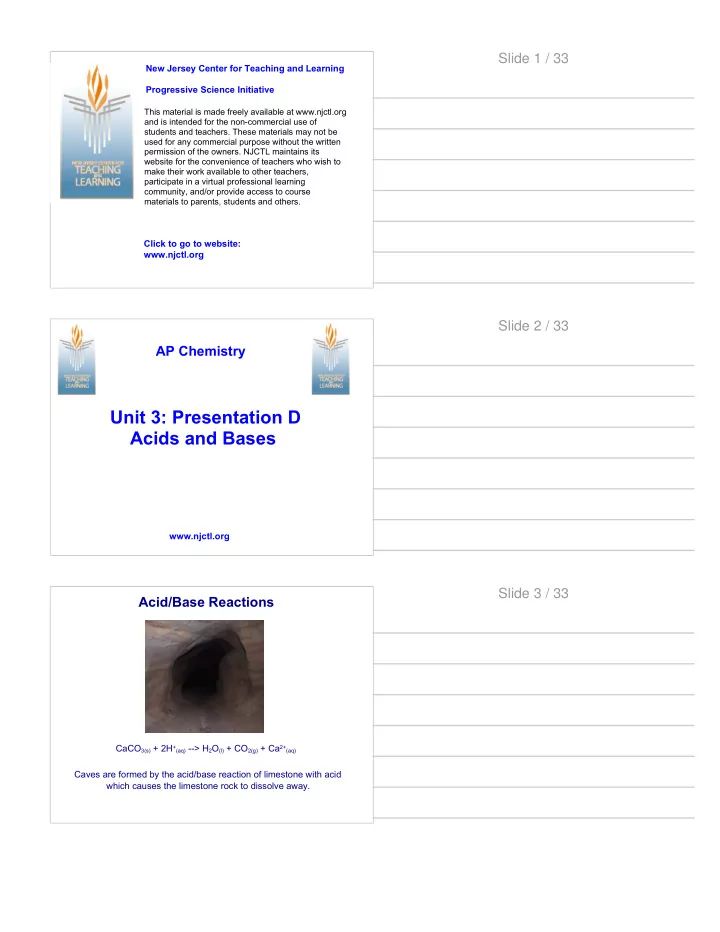
This material is made freely available at www.njctl.org and is intended for the non-commercial use of students and teachers. These materials may not be used for any commercial purpose without the written permission of the owners. NJCTL maintains its website for the convenience of teachers who wish to make their work available to other teachers, participate in a virtual professional learning community, and/or provide access to course materials to parents, students and others.
AP Chemistry Unit 3: Presentation D Acids and Bases www.njctl.org - - PDF document
Slide 1 / 33 New Jersey Center for Teaching and Learning Progressive Science Initiative This material is made freely available at www.njctl.org and is intended for the non-commercial use of students and teachers. These materials may not be
Acid and Base Definitions
The most widely used definition of acids and bases in the Bronsted- Lowry definition. ACID BASE H+ Donor H+ acceptor NH4+(aq) + H2O(l) --> NH3(g) + H3O+(aq) Acid: H+ Donor Base: H+ Acceptor
Slide 4 / 33 Conjugate Acids and Bases
After an acid donates an H+ ion, the resulting species can always behave as a base and grab the H+ back again. NH4+(aq) + H2O <--> NH3(g) + H3O+(aq) Acid: H+ Donor Base: H+ Acceptor Therefore, NH3 acts as the conjugate base of NH4+ and H3O+ acts as the conjugate acid of H2O.
NH4+(aq) + H2O(l) <--> NH3(g) + H3O+(aq)
Slide 5 / 33
Predicting the formula of a conjugate acid or base involves writing the formula
- f the species
produced after the donation or acceptance of an H+ ion.
CN-(aq) --> HCN(aq) HCO3-(aq) --> CO32-(aq) CH3NH2(aq) --> CH3NH3+(aq) CH3COOH(aq) --> CH3COO-(aq)
base base
- Conj. acid
- Conj. acid
acid acid
- Conj. base
- Conj. base
Conjugate Acids and Bases Slide 6 / 33
Amphoteric Molecules
Amphoteric molecules can behave as either acids or bases depending on their environment. Water is a classic example H2O donates H+ accepts H+ OH- H3O+ Whether water acts as an acid or base will depend on the relative "strength" of other acids or bases it is reacted with.
- Conj. acid
- Conj. base
Slide 7 / 33
Common amphoteric molecules are the conjugate bases of diprotic or polyprotic acids
H2C2O4(aq) HC2O4-(aq) C2O42-(aq) Acid Amphoteric Base H3PO4(aq) H2PO4-(aq) HPO42-(aq) PO43-(aq) Acid Amphoteric Amphoteric Base
Amphoteric Molecules Slide 8 / 33
1 Which of the following is NOT an acid/base reaction? A HCN(aq) + H2O(l) --> CN-(aq) + H3O+(aq) B NH3(aq) + HC2H3O2(aq) --> NH4+(aq) + C2H3O2-(aq) C H+(aq) + H2O(l) --> H3O+(aq) D Pb2+(aq) + 2I-(aq) --> PbI2(s) E All are acid/base reactions
Slide 9 / 33
1 Which of the following is NOT an acid/base reaction? A HCN(aq) + H2O(l) --> CN-(aq) + H3O+(aq) B NH3(aq) + HC2H3O2(aq) --> NH4+(aq) + C2H3O2-(aq) C H+(aq) + H2O(l) --> H3O+(aq) D Pb2+(aq) + 2I-(aq) --> PbI2(s) E All are acid/base reactions
[This object is a pull tab]
Answer D
Slide 9 (Answer) / 33
2 In which of the following reactions does the underlined substance behave as an acid? A I only B II only C III only D II and III only E I, II, and III
- I. CH3NH2(g) + H2O(l) --> CH3NH3+(aq) + OH-(aq)
- II. HCOOH(aq)
+ NH2-(aq) --> HCOO-(aq) + NH3(aq)
- III. HClO(aq) + OH-(aq) --> ClO-(aq) + H2O(l)
Slide 10 / 33
2 In which of the following reactions does the underlined substance behave as an acid? A I only B II only C III only D II and III only E I, II, and III
- I. CH3NH2(g) + H2O(l) --> CH3NH3+(aq) + OH-(aq)
- II. HCOOH(aq)
+ NH2-(aq) --> HCOO-(aq) + NH3(aq)
- III. HClO(aq) + OH-(aq) --> ClO-(aq) + H2O(l)
[This object is a pull tab]
Answer D
Slide 10 (Answer) / 33
3 What would be the expected products of the following reaction... A H3PO4(aq) + H2O(l) B H2PO42-(aq) + H2O(l) C HPO4-(aq) + H3O+(aq) D HPO42-(aq) + H2O(l) E None of these
H2PO4-(aq) + OH-(aq) --> ____________
Slide 11 / 33
3 What would be the expected products of the following reaction... A H3PO4(aq) + H2O(l) B H2PO42-(aq) + H2O(l) C HPO4-(aq) + H3O+(aq) D HPO42-(aq) + H2O(l) E None of these
H2PO4-(aq) + OH-(aq) --> ____________
[This object is a pull tab]
Answer D
Slide 11 (Answer) / 33
4 Which of the following is the conjugate acid of the chlorite ion (ClO2-)? A HClO2 B HClO2+ C HClO D HClO3 E HClO2-
Slide 12 / 33
4 Which of the following is the conjugate acid of the chlorite ion (ClO2-)? A HClO2 B HClO2+ C HClO D HClO3 E HClO2-
[This object is a pull tab]
Answer A
Slide 12 (Answer) / 33
5 Which of the following has the acid paired with it's appropriate conjugate base? A I only B II only C III only D I and III only E I and II only
- I. HPO42-(aq)/PO42-(aq)
- II. HBrO2(aq)/BrO-(aq)
- III. H2CrO4(aq)/HCrO4-(aq)
Slide 13 / 33
5 Which of the following has the acid paired with it's appropriate conjugate base? A I only B II only C III only D I and III only E I and II only
- I. HPO42-(aq)/PO42-(aq)
- II. HBrO2(aq)/BrO-(aq)
- III. H2CrO4(aq)/HCrO4-(aq)
[This object is a pull tab]
Answer C
Slide 13 (Answer) / 33
6 Which of the following would be amphoteric? A CO32-(aq) B HC2H3O2(aq) C HC2O4-(aq) D F-(aq) E H3O+(aq)
Slide 14 / 33
6 Which of the following would be amphoteric? A CO32-(aq) B HC2H3O2(aq) C HC2O4-(aq) D F-(aq) E H3O+(aq)
[This object is a pull tab]
Answer C
Slide 14 (Answer) / 33 Strong Acids
Strong acids dissociate 100% in aqueous solutions thereby donating ALL of their H+ ions. Therefore, much like a soluble ionic compound, any strong acid must be written as being broken up into it's ions. Strong Acid Written as... HCl(aq) H+(aq) + Cl-(aq) HNO3(aq) H+(aq) + NO3-(aq) H2SO4(aq) 2H+(aq) + SO42-(aq) HClO4(aq) H+(aq) + ClO4-(aq) HBr(aq) H+(aq) + Br-(aq) HI(aq) H+(aq) + I-(aq)
Slide 15 / 33
Conjugate bases of strong acids are not able to accept H+ ions back and therefore do not participate in acid/base reactions. H+(aq) + NO3-(aq) + NH3(aq) --> NH4+(aq) H+(aq) + NH3(aq) --> NH4+(aq) H+(aq) + Br-(aq) + ClO-(aq) --> HClO(aq) H+(aq) + ClO-(aq) --> HClO(aq)
Strong Acids Slide 16 / 33 Writing Acid/Base Reactions
First write the correct formulas for all species involved, breaking compounds into ions if soluble ionics or strong acids. Example: Aqueous solutions of methlyamine (CH3NH2) and hydroiodic acid are mixed. CH3NH2(aq) + H+(aq) + I-(aq) --> Predict products based on acid/base principles. CH3NH2(aq) + H+(aq) + I-(aq) --> CH3NH3+(aq) CH3NH2(aq) + H+(aq) --> CH3NH3+(aq)
Slide 17 / 33
7 Which of the following species would be an extremely weak base? A Br- B F- C NO2- D ClO3- E NH3
Slide 18 / 33
7 Which of the following species would be an extremely weak base? A Br- B F- C NO2- D ClO3- E NH3
[This object is a pull tab]
Answer A
Slide 18 (Answer) / 33
8 Why are strong acids written as separate ions? A Strong acids are dangerous B Strong acids have strong conjugate bases C Strong acids do not have conjugate bases D Strong acids donate all of their H+ ions E None of these
Slide 19 / 33
8 Why are strong acids written as separate ions? A Strong acids are dangerous B Strong acids have strong conjugate bases C Strong acids do not have conjugate bases D Strong acids donate all of their H+ ions E None of these
[This object is a pull tab]
Answer D
Slide 19 (Answer) / 33
9 Which of the following is NOT a strong acid? A HNO3 B HF C HBr D HClO4 E H2SO4
Slide 20 / 33
9 Which of the following is NOT a strong acid? A HNO3 B HF C HBr D HClO4 E H2SO4
[This object is a pull tab]
Answer B
Slide 20 (Answer) / 33
10 Which of the following best represents the balanced equation for the acid/base reaction of aqueous potassium hydroxide and chromic acid (H2CrO4)? A OH- + H2CrO4 → H2O + CrO42- B 2K+ + H2CrO4 → 2H+ + K2CrO4
C 2OH- + H2CrO4 → 2H2O + CrO42-
D 2K+ + H2CrO4 → 2KH + CrO42- E None of these
Slide 21 / 33
10 Which of the following best represents the balanced equation for the acid/base reaction of aqueous potassium hydroxide and chromic acid (H2CrO4)? A OH- + H2CrO4 → H2O + CrO42- B 2K+ + H2CrO4 → 2H+ + K2CrO4
C 2OH- + H2CrO4 → 2H2O + CrO42-
D 2K+ + H2CrO4 → 2KH + CrO42- E None of these
[This object is a pull tab]
Answer C
Slide 21 (Answer) / 33
11 Which of the following best represents the balanced equation for the acid/base reaction if solid strontium hydroxide is added to a solution of acetic acid (HC2H3O2)? A Sr(OH)2 + 2HC2H3O2 → 2C2H3O2- + Sr2+ + 2H2O B 2OH- + 2HC2H3O2 → 2C2H3O2- + 2H2O
C Sr(OH)2 + 2C2H3O2- → Sr(C2H3O2)2 + 2OH-
D Sr(OH)2 + HC2H3O2 → C2H3O2- + Sr2+ + H2O E None of these
Slide 22 / 33
11 Which of the following best represents the balanced equation for the acid/base reaction if solid strontium hydroxide is added to a solution of acetic acid (HC2H3O2)? A Sr(OH)2 + 2HC2H3O2 → 2C2H3O2- + Sr2+ + 2H2O B 2OH- + 2HC2H3O2 → 2C2H3O2- + 2H2O
C Sr(OH)2 + 2C2H3O2- → Sr(C2H3O2)2 + 2OH-
D Sr(OH)2 + HC2H3O2 → C2H3O2- + Sr2+ + H2O E None of these
[This object is a pull tab]
Answer A
Slide 22 (Answer) / 33
12 Which of the following best represents the balanced equation for the acid/base reaction when solutions of sodium hypobromite (NaBrO) and sulfurous acid (H2SO3) are mixed? A 2Na+ + SO32- → Na2SO3 B 2OBr- + H2SO3 → 2HBr + SO42-
C 2OBr- + H2SO3 → 2OH- + Br2SO3
D 2OBr- + H2SO3 → 2HOBr + SO32- E None of these
Slide 23 / 33
12 Which of the following best represents the balanced equation for the acid/base reaction when solutions of sodium hypobromite (NaBrO) and sulfurous acid (H2SO3) are mixed? A 2Na+ + SO32- → Na2SO3 B 2OBr- + H2SO3 → 2HBr + SO42-
C 2OBr- + H2SO3 → 2OH- + Br2SO3
D 2OBr- + H2SO3 → 2HOBr + SO32- E None of these
[This object is a pull tab]
Answer D
Slide 23 (Answer) / 33 Acid/Base Stoichiometry
Normal stoichiometrical calculations are routinely carried out with acid/ base reactions however there are some specific applications that will be addressed here. Application Purpose Titration Determine (M) of acid or base by reacting it with a known quantity of acid or base Molar Mass Determination Determine molar mass (g/mol) of acid or base by reacting it with a known quantity of acid or base.
Slide 24 / 33
Titrations
In a titration, a known(standardized) solution of acid or base is carefully added to the unknown concentration of acid or base until the reaction is complete. standardized acid or base solution of known M (titrant) unknown concentration of acid or base solution (analyte) By measuring the moles of titrant added, the moles of the analyte can be determined and hence the concentration (M).
Slide 25 / 33
Example: What is the concentration of a 10 mL acetic acid solution if 34.1 mL of 0.2 M KOH was needed to titrate it? Write Reaction OH-(aq) + HC2H3O2(aq) --> C2H3O2-(aq) + H2O(l) Determine moles of titrant reacted and moles of analyte present. 0.0341 L x 0.2 n OH- x 1 mol HC2H3O2 = 0.00682 mol 1 L 1 mol OH- Find Molarity 0.00682 mol/0.010 L = 0.682 M
Titrations Slide 26 / 33 Using Titrations to Find Molar Mass
The identity of an acid can be discerned if the molar mass of the acid is known. The molar mass is determined by titrating a known mass of an acid dissolved in water with a standardized base. Molar Mass = grams/mol
Slide 27 / 33
Using Titrations to Find Molar Mass
Example: If 3.1 grams of an acid are dissolved up with water to make a 25 mL solution it was determined that 45.9 mL of a 2.5 M NaOH standardized solution is needed to titrate the acid. What is the molar mass of the acid? HA(aq) + OH-(aq) --> H2O(aq) + A-(aq)
unknown acid
0.0459 L x 2.5 n OH- x 1 n HA = 0.1148 mol HA 1 L 1 n OH- Molar Mass = g/mol ..... 3.1 g/0.1148 mol = 27 g/mol (HCN)
Slide 28 / 33
13 How many mL of 0.310 M KOH would be needed to completely titrate 100. mL of 0.200 M HCl?
Slide 29 / 33
13 How many mL of 0.310 M KOH would be needed to completely titrate 100. mL of 0.200 M HCl?
[This object is a pull tab]
Answer
64.5 mL
Slide 29 (Answer) / 33
14 How many mL of 0.0340 M Ca(OH)2 would be needed to titrate 120. mL of 0.220 M nitrous acid (HNO2)?
Slide 30 / 33
14 How many mL of 0.0340 M Ca(OH)2 would be needed to titrate 120. mL of 0.220 M nitrous acid (HNO2)?
[This object is a pull tab]
Answer
388 mL
Slide 30 (Answer) / 33
15 What is the molarity of a 50.0 mL solution of acetic acid (CH3COOH) if it took 5.0 mL of 1 M NaOH to fully titrate it?
Slide 31 / 33
15 What is the molarity of a 50.0 mL solution of acetic acid (CH3COOH) if it took 5.0 mL of 1 M NaOH to fully titrate it?
[This object is a pull tab]
Answer
0.10 M
Slide 31 (Answer) / 33
16 What is the molar mass of a monoprotic acid if after 0.430 gram sample of it is dissolved in water, 45.0 mL of 0.300 M KOH is needed to titrate it completely?
Slide 32 / 33
16 What is the molar mass of a monoprotic acid if after 0.430 gram sample of it is dissolved in water, 45.0 mL of 0.300 M KOH is needed to titrate it completely?
[This object is a pull tab]
Answer
31.9 g/mol
Slide 32 (Answer) / 33
17 Which of the following would be the identity of an acid if after 0.398 grams of it are dissolved in water, 6.89 mL of 1.1 M NaOH was needed to titrate it? A HBrO B HCN C HClO D HI E HC3H6O3
Slide 33 / 33
17 Which of the following would be the identity of an acid if after 0.398 grams of it are dissolved in water, 6.89 mL of 1.1 M NaOH was needed to titrate it? A HBrO B HCN C HClO D HI E HC3H6O3
[This object is a pull tab]