AP BIOLOGY This material is made freely available at www.njctl.org - - PDF document

ap biology
SMART_READER_LITE
LIVE PREVIEW

AP BIOLOGY This material is made freely available at www.njctl.org - - PDF document

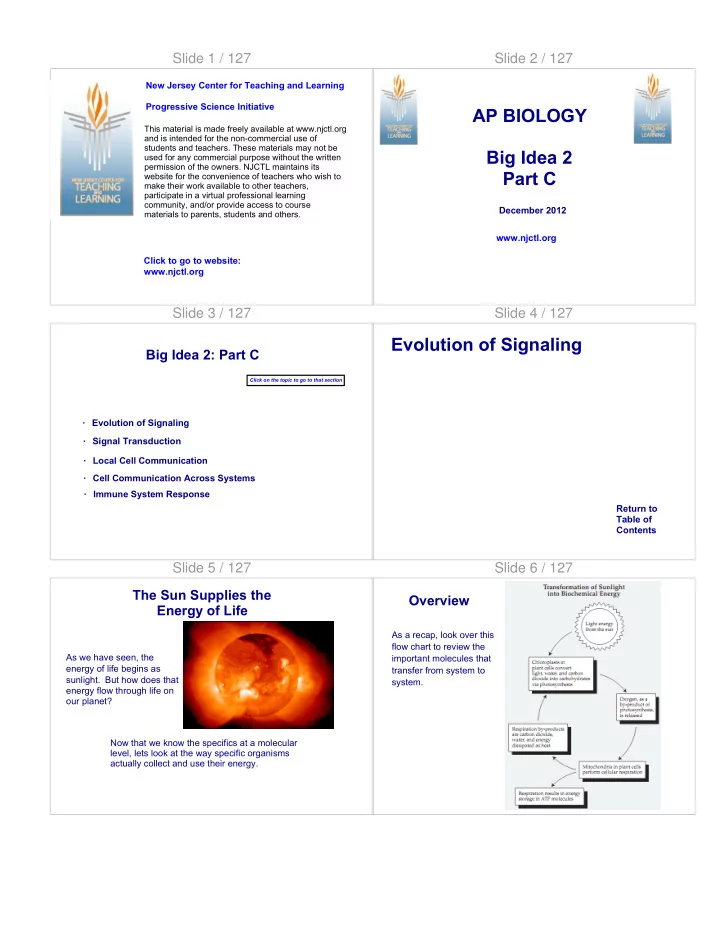
Slide 1 / 127 Slide 2 / 127 New Jersey Center for Teaching and Learning Progressive Science Initiative AP BIOLOGY This material is made freely available at www.njctl.org and is intended for the non-commercial use of students and teachers.


slide-1
SLIDE 1

Slide 1 / 127

This material is made freely available at www.njctl.org and is intended for the non-commercial use of students and teachers. These materials may not be used for any commercial purpose without the written permission of the owners. NJCTL maintains its website for the convenience of teachers who wish to make their work available to other teachers, participate in a virtual professional learning community, and/or provide access to course materials to parents, students and others.

Click to go to website: www.njctl.org New Jersey Center for Teaching and Learning Progressive Science Initiative

Slide 2 / 127

AP BIOLOGY Big Idea 2 Part C

www.njctl.org December 2012

Slide 3 / 127 Big Idea 2: Part C

· Evolution of Signaling · Cell Communication Across Systems · Signal Transduction · Local Cell Communication

Click on the topic to go to that section

· Immune System Response

Slide 4 / 127

Evolution of Signaling

Return to Table of Contents

Slide 5 / 127

As we have seen, the energy of life begins as

  • sunlight. But how does that

energy flow through life on

  • ur planet?

The Sun Supplies the Energy of Life

Now that we know the specifics at a molecular level, lets look at the way specific organisms actually collect and use their energy.

Slide 6 / 127

As a recap, look over this flow chart to review the important molecules that transfer from system to system.

Overview

slide-2
SLIDE 2

Slide 7 / 127

Cellular signaling is a part of a complex system of communication that governs basic cellular activities and coordinates cell actions. The ability of cells to perceive and correctly respond to their microenvironment is the basis

  • f development, tissue repair, and immunity.

Cellular Signaling Slide 8 / 127

Single-celled organisms communicate with one another as well as the cells of multi-celled organisms. Correct and appropriate signaling pathways are generally under strong selective pressure and show shared evolution among

  • rganisms with shared pathways.

Evolution of Signaling Slide 9 / 127

1 Which of the following organisms would likely not show similar communication pathways to the others? A peacock B turtle C butterfly D shark E alligator

answer

Slide 10 / 127 Surface Communication

Cell surfaces protect, support, and join cells. Cells interact with their environments and each other via their

  • surfaces. Cells need to pass water, nutrients, hormones, and

many, many more substances to one another. Signal transduction pathways link signal reception on a cell's surface with an appropriate cellular response.

Slide 11 / 127

In single-celled organisms, signal transduction pathways influence how the cell responds to its environment. Certain bacteria use chemical messengers to communicate to

  • ther nearby cells and regulate specific reproductive pathways

in response to population density. This is known as quorum sensing.

Single-celled Signaling Slide 12 / 127

Quorum sensing is a system of stimulus and response related to the population density of bacteria. Many bacterial species use it to coordinate gene expression regarding specific behaviors which are dependent on the size of a local population. Bacteria will produce and release signaling molecules. The same bacteria also have receptors for that molecule on their surface. When the signal binds to a receptor on another organism, it activates a system which typically causes another specific behavior in the group.

Quorum Sensing

slide-3
SLIDE 3

Slide 13 / 127

Pseudomonas aeruginosa use quorum sensing to coordinate cell aggregation. They grow within a host without harming it until they reach a certain concentration. Once that concentration is reached, they release a signal to aggressively replicate in order to overcome the host's immune

  • system. The bacteria create a biofilm wherein they form a layer

which completely covers the host's tissue and then reproduce at a exponential rate. Research has shown that garlic inhibits the formation of these Pseudomonas biofilms by blocking the quorum sensing

  • pathway. This is called

quorum inhibition.

Example of Quorum Sensing: Pseudomonas aeruginosa Slide 14 / 127 Biofilm development in Pseudomonas aeruginosa Slide 15 / 127 Quorum Sensing

Below is a longer video that ties in quorum sensing and antibiotic

  • resistance. Teacher may want to pause and discuss for student

understanding.

Click here for a TED talk on Quorum Sensing Quorum Sensing Introduction Quorum Sensing Explanation

Slide 16 / 127

2 Quorum sensing would most likely occur when: A an antibiotic attacks a bacterial infection B bacteria reach a certain concentration C bacteria sense the presence of an antibiotic D a biofilm is broken down

answer

Slide 17 / 127 Complexity Continues to Increase

Eukaryotic cells mark a significant increase in the complexity of life... but it does not stop there. With the new found energy efficiency of these cells they soon develop more complex metabolic systems. This leads to new regulation and new ability.

Slide 18 / 127 Surface Area to Volume Ratio

At the time when prokaryotic cells were evolving, there were most likely different sizes of cells. A cell's efficiency and ability to survive depended

  • n its surface area to volume ratio.

The volume of the cell determines the amount of chemical activity it can carry out per unit time. The surface area of the cell determines the amount of substances the cell can take in from the environment and the amount of waste it can release. As a cell grows in size, it's surface area to volume ratio decreases. It performs chemical reactions faster, but it has a harder time getting nutrients in and waste out.

slide-4
SLIDE 4

Slide 19 / 127

We know that cells need to be small enough so that they have an increased surface area to volume ratio, but be large enough to perform the chemical reactions of metabolism.

Most Efficient Least Efficient

The smaller the cell, the larger its surface area and the smaller its volume.

Limits of Cell Size

The bigger the cell, the smaller the surface area is compared to its large volume inside.

Slide 20 / 127

Animal Cell (Eukaryote) Bacterium (Prokaryote)

Eukaryotic cells are, on average, much larger than prokaryotic

  • cells. The average diameter of most prokaryotic cells is between

1 and 10µm. By contrast, most eukaryotic cells are between 5 to 100µm in diameter.

Cell Size Slide 21 / 127 Organelles

To increase efficiency in the larger cell, eukaryotes evolved many bacterium-sized parts known as organelles. Organelles subdivide the cell into specialized compartments. They play many important roles in the cell. Some transport waste to the cell membrane. Others keep the molecules required for specific chemical reactions located within a certain compartment so they do not need to diffuse long distances to be useful. Each organelle has a specific job to do and is essential to the functioning of the cell.

Slide 22 / 127

3 How did eukaryotes solve the problem of diffusion? A By remaining the same size as prokaryotes. B By using a nucleus. C Compartmentalization. D They haven't solved the problem.

answer

Slide 23 / 127

4 Which is NOT an advantage of compartmentalization? A It allows incomaptible chemical reactions to be separated.

B It increases the efficiency of chemical reactions.

C It decreases the speed of reactions since reactants have to travel farther. D Substrates required for particular reactions can be localized and maintained at high concentrations within organelles.

answer

Slide 24 / 127

Signal Transduction

Return to Table of Contents

slide-5
SLIDE 5

Slide 25 / 127 Symbiosis Continues

In the same way that prokaryotes used symbiosis to increase their survivability, the first single celled eukaryotes began to specialize and coordinate into small colonies. These colonies could do more, be more efficient, and out- survive the eukaryotes that were on their own.

Slide 26 / 127 Muticellularity Leads to M acroscopic Life Forms

Early multi-celled eukaryotes were small but they began to lay the foundation for larger and larger

  • rganisms.

These organisms develop different survival mechanisms and metabolic processes based on the ability of the eukaryotic cell.

Slide 27 / 127 Muti-cellularity Leads to M acroscopic Life Forms

Paramecium, single celled eukaryote Fungus, multi- cell euk. that live

  • n decomposing

matter Mammals, animals with highly complex homeostasis Plants, multi- cell

  • euk. that use

photosynthesis to capture sun energy Animals, multi-cell

  • euk. that rely on

plants to produce sugar Algae, simple multi- cell euk. that are similar to the first multi-cell euk.

Slide 28 / 127 Complexity = Survivability?

Macroscopic organisms contain far more complex metabolic

  • systems. These more complex systems require that an
  • rganism take in more energy and nutrients.

If we have established that evolution favors survivability, then why is it that more complex organisms have evolved? What is it about complexity that increases survivability?

Slide 29 / 127 Complexity = Survivability?

Simply stated, the adaptability of an organism or group of

  • rganisms directly relates to their ability to survive.

Higher adaptability requires systems that can adjust to an increasing number of environmental situations. As biological systems "learn" to deal with changes in the environment they naturally become more complex.

Survivability Complexity

  • f

Biological Systems Number of Environmental Situations Number of metabolic Pathways required

Slide 30 / 127

5 Which of the following is a not an example of increased cellular complexity? A Formation of macroscopic organisms B Decreased metabolic activity C Increase of symbiosis D Compartmentalization of cellular proesses

answer

slide-6
SLIDE 6

Slide 31 / 127

Transcription factors are key for regulation of a multi-celled

  • rganism and increased complexity.

Transcription factors are molecules that cause a cell to respond to a signal in the environment in a very specific

  • way. This signal is anything that the cell has the ability to

respond to. It could be light, a chemical, a hormone, heat, etc. A signal transduction pathway is how a cell reads cues in its environment and knows to take the appropriate action.

Transcription Factors Slide 32 / 127 Signal Transduction Pathway

Nucleus Cell The pathway starts when a new signal reaches a cell.

Signal

Reception

Slide 33 / 127

Signal Transduction Pathway

Receptor

Nucleus External signal activates membrane bound protein know as a receptor.

Signal

Cell These receptors are like enzymes in that they will bind with only 1 kind of substrate (signal).

Reception

Slide 34 / 127

Signal Transduction Pathway

Activated Receptor

Nucleus The activated receptor triggers a cascade reaction, a metabolic pathway . Cell

Transduction

Slide 35 / 127

Signal Transduction Pathway

Activated Receptor

The metabolic pathway produces a specific transcription factor in response to signal. The product enters the nucleus. Nucleus

Transcription Factor

Cell

Transduction

Slide 36 / 127

Signal Transduction Pathway

Activated Receptor

Nucleus

Transcription Factor

Cell The nucleus responds by signaling a coordinated response to the signal by all the necessary

  • rganelles.

Response

Signal Transduction Video

slide-7
SLIDE 7

Slide 37 / 127

In multicellular organisms, signal transduction pathways coordinate activities within cells that support the function of the organism as a whole. One interesting example of this is the temperature-dependent sex determination in some vertebrates.

Multicellular Signaling Slide 38 / 127

In some vertebrates, certain hormones are influenced and released when ambient conditions reach a pivotal temperature.

Temperature Dependent Sex Determination

In turtles, typically males are produced when ambient temperatures are lower than a set temperature (species dependent). When temperatures are higher, females are produced.

Slide 39 / 127

6 Which of the following is an example of a signal that can start a signal transduction pathway? A heat B light C hormone D all of the above

answer

Slide 40 / 127

7 The activated metabolic process in a signal transduction pathway produces A A transcription factor B Cell movement C A signal D Receptors on the cell membrane

answer

Slide 41 / 127

Local Cell Communication

Return to Table of Contents

Slide 42 / 127 Multi-cell Organisms Require Cellular Communication

So single cells respond to the environment by adjusting their internal conditions. What about a multicellular

  • rganism? The many cells in the organism must make

adjustments simultaneously. In order for an organism to take advantage of being multicellular it must have the ability to communicate from cell to cell.

slide-8
SLIDE 8

Slide 43 / 127 Multi-cell Organisms Require Cellular Communication

Let us look at a few examples of different types of

  • rganisms adjusting to their surroundings.We will start

with a single celled, photosynthetic, motile (ability to move toward or away from something), eukaryotic

  • rganism.

mitochondria chloroplasts flagella nucleus

Slide 44 / 127 Multi-cell Organisms Require Cellular Communication

This cell has the ability to move toward light by directing its flagellum to oscillate in a particular direction, this is known as phototaxis. Moving closer to the cell allows the cell to produce more sugar by photosynthesis.

Slide 45 / 127

Multi-cell Organisms Require Cellular Communication

Write down a step by step explanation of how this cell will start moving toward the light in terms of a signal transduction pathway.

answer

The light acts a signal that is received by a receptor on the cell membrane. The activated receptor initiates a metabolic process that produces a specific transcription

  • factor. The transcription factor travels to the nucleus

and the nucleus produces proteins that act as a signal to the flagella directing them to move toward the light.

Slide 46 / 127 Multi-cell Organisms Require Cellular Communication

Lets look at a 2 celled organism. Both cells must propel themselves together. If only one does, or one is slower than the other this organism will spin in circles.

Slide 47 / 127 Multi-cell Organisms Require Cellular Communication

Looking more closely, these 2 cells share gap junctions, small channels in their membranes that allow molecules to pass. These ensure that the amount of transcription factor and nuclear signaling is consistent in both cells.

Slide 48 / 127 Multi-cell Organisms Require Cellular Communication

Now lets look at a multi-celled version of the same fictitious organism.

slide-9
SLIDE 9

Slide 49 / 127 Multi-cell Organisms Require Cellular Communication

If we add a light source, what problems does this organism face? How could the organism overcome these problems. Discuss in a small group then suggest problems and solutions to the class.

Slide 50 / 127 Multi-cell Organisms Require Cellular Communication

Problem: Light only signals on the front cells, not the back and they are the ones that need to propel the cell. Solution: Cell-to-cell communication

Slide 51 / 127 Local Cell to Cell Communication

There are several ways a cell can communicate with another cell. In this situation, receptor communication would be best. Lets look closely at 2 of these cells.

Slide 52 / 127 Local Cell to Cell Communication

Unlike the single celled organism, cell 1 does not want to activate its flagella when contacted by light. That would cause it to move away. It would need to signal its partner, cell 2.

2 1

Slide 53 / 127 Local Cell to Cell Communication

2 1

A signal transduction pathway would still occur in cell 1, but the nucleus in 1 would produce proteins that become signals for cell 2.

Slide 54 / 127 Local Cell to Cell Communication

The signal produced by the nucleus of 1 would set off a second transduction pathway that would make cell 2 engage its flagella.

2 1

slide-10
SLIDE 10

Slide 55 / 127 Local Cell to Cell Communication

The organism would move to the light. This system works well for less complex, smaller multi-celled

  • rganisms, and can be used for some systems in larger
  • rganisms.

Slide 56 / 127 Eukaryotic Communication Junctions

Animal and plant cells have different types of cell junctions. This is mainly because plants have cell walls and animal cells do not. The physical pathway that adjacent cells in multicellular

  • rganisms have which aid in communication and transfer of

substances to one another are called cell junctions.

Slide 57 / 127

Plant cells connect using plasmodesmata which are channels that allow them to share water, food, and communicate via chemical messages.

Junctions specific to plant cells Slide 58 / 127

Animal cells have 3 types of junctions: Tight junctions: can bind cells together into leakproof sheets Adhering junctions: fasten cells together into strong sheets. They are somewhat leakproof.

Animal Cell Junctions

Communicating (Gap) junctions: allow substances to flow from cell to cell. They are totally leaky. They are the equivalent of plasmodesmata in plants.

Examples of Animal Cell Junctions

Slide 59 / 127

8 Which type of cell junction is found in plants? A Tight junctions B Gap junctions C Adhering junctions D Plasmodesmata

answer

Slide 60 / 127

9 Which type of junction allows substances to flow between animal cells? A Tight junctions B Adhering junctions C Gap juctions D Plasmodesmata

answer

slide-11
SLIDE 11

Slide 61 / 127

When a receptor receives an external signal from another cell, the response can either be to increase or decrease the concentration of a specific molecule within the cell. Increasing the concentration is called upregulation and decreasing production of that molecule is called downregulation.

Regulation Slide 62 / 127 Upregulation

Specifically during upregulation, the number of receptors on the surface of target cells increase, making the cells more sensitive to a hormone or another agent. For example, there is an increase in uterine

  • xytocin receptors in the third trimester of

pregnancy, promoting the contraction of the smooth muscle of the uterus.

Slide 63 / 127

Alternatively, downregulation is a decrease in the number of receptors

  • n the surface of target cells, making

the cells less sensitive to a hormone

  • r another agent. Some receptors

can be rapidly downregulated. An example of downregulation

  • ccurs in Type II diabetes. This form
  • f the disease is characterized by

Downregulation

elevated levels of insulin in the bloodstream but a loss of insulin

  • receptors. This downregulation can sometimes be reversed

through exercise, and occasionally, a change in diet can also resolve the issue.

Slide 64 / 127

10 An increase of the number of receptors on a targeted cell's surface is known as A upregulation B downregulation

answer

Slide 65 / 127

Eukaryotic cells can communicate over short distances by releasing regulator chemicals. These regulators attach to receptors embedded in the plasma membrane of nearby cells.

Short Distance Cell Communication

Neurotransmitters work this way, being released to travel from a neuron to a target cell across a very small synapse.

Slide 66 / 127

Cells can also communicate over long distances. For example, signaling molecules such as the hormone testosterone, are produced by endocrine cells. These hormones can travel long distances through the blood to reach different target cells in many regions of the body.

Long Distance Cell Communication

slide-12
SLIDE 12

Slide 67 / 127

Cell Communication Across Systems

Return to Table of Contents

Slide 68 / 127 Cell to Cell Communication

What about much larger organisms with lots of specialized cells and complex responses? When many systems have to respond simultaneously? Let us use Darwin as our example of a complex, multi- celled organism.

Slide 69 / 127 Cell to Cell Communication

When Darwin sees a cheeseburger he smiles. Why? What is happening at a cellular level? What is the signal? What cells respond?

Slide 70 / 127 Cell to Cell Communication

Cells To Brain Signal

What is the signal? Neurotransmitters Nerves are specialized cells as well. Neurotransmitters, protein signals, are released by nerve A in a certain pattern, based on the image of the bear. Nerve B receives them as a signal for a specific transduction pathway. Nerve A is the signaling optic nerve, nerve B acts as the receptor for the brain.

Slide 71 / 127 Hormone Response

When Darwin sees an angry bear... Let us take a look at the hormone response that is responsible for most of what Darwin is feeling right now.

Slide 72 / 127

Cells To Brain Signal

Cell to Cell Communication

What is the signal? The image of the bear (pattern of light waves) on the retinal cells in Darwin's eye use synaptic signaling to relay the image to the brain through the optic nerve.

slide-13
SLIDE 13

Slide 73 / 127 Cell to Cell Communication

What is the signal? The brain begins a massive cascade of synaptic signals through millions of nerve cells. It calculates the proper response and releases hormones into the blood stream. In this case, the "fight

  • r flight" molecule will be released: epinephrine (adrenalin)

Slide 74 / 127 Cell to Cell Communication

What is the signal? Epinephrine is released into the blood stream, where it is sent throughout the body. Each cell it contacts will have a different response to the molecule.

Slide 75 / 127 Cell to Cell Communication

Epinephrine

Since epinephrine is only a signal molecule it can have different effects on different cells. It all depends on what a particular cell is programed to do in the presence of epinephrine Hair follicle muscle cell

  • contract, hair stands up

Sweat gland muscle cell - contract, sweat is released Lung cells

  • relax, take in more air

Heart cells

  • speed up, more oxygen to

cells for respiration Liver cells

  • release glucose, to supply

more energy to cells ...among other responses

Slide 76 / 127 Cell to Cell Communication

Click here for an animation of fight or flight signalling

Slide 77 / 127

A feedback loop is the path that leads from the initial generation

  • f a signal to the modification of an event. They are the cause-

and-effect sequence in biology. Feedback loops can either be positive or negative.

Feedback Loops Slide 78 / 127

When the thermostat senses it is too hot, it turns on the air conditioner to cool it off. If the house is too cool, it will send a signal to warm the house up.

Negative Feedback Loops

A negative feedback loop happens when the outcome of an action acts to reverse cause of the original signal. The thermostat in your house acts on a negative feedback circuit.

slide-14
SLIDE 14

Slide 79 / 127 Negative Feedback Examples

Most control systems in the body involve negative feedback

  • systems. Cells send signals to other cells to fix problems they

are sensing. This could involve the release of another signal to counteract a problem or more simply, the shut down of the

  • riginal signal.

Examples include: body temperature control the regulation of pituitary hormones control of blood glucose levels

Slide 80 / 127 Positive Feedback Loops

A positive feedback loop is one which involves cells continually amplifying a signal until an outcome is reached. The key to positive feedback loops is that any small change will be amplified. A snowball rolling down an increasingly steep hill will continue to pick up speed until it gets to the bottom of the hill.

Slide 81 / 127 Positive Feedback Examples

Activities associated with childbirth offer two examples of positive feedback loops. As contractions happen during labor, the hormone oxytocin is released into the bloodstream. As oxytocin levels increase, more contractions occur, until the baby is born which stops the feedback loop. Another example involves lactation. The more a newborn baby suckles, the more milk is produced. This is due to a positive feedback loop involving the hormone prolactin.

Slide 82 / 127 Feedback Loop Explanation

click here for a video explanation of feed back loops

Slide 83 / 127

11 The "fight-or-flight" adrenalin response to an emergency situation would be considered a: A Negative Feedback Loop B Positive Feedback Loop

answer

Slide 84 / 127

12 Calcitonin is a hormone released from cells in the thyroid gland which controls circulating blood levels of calcium in conjunction with the parathyroid hormone. This would be an example of a: A Negative Feedback Loop B Positive Feedback Loop

answer

slide-15
SLIDE 15

Slide 85 / 127

Immune System Response

Return to Table of Contents

Slide 86 / 127 Animal Immunity

The immune system of animals is one of the most complex homeostatic systems found in nature. It has to be complex because it has to be able to adjust to uncountable random events that could undermine the entire metabolic system of a multicellular eukaryote. The 2 major dangers that the immune system protects against: 1. Foreign invading cells 2. Damaged or diseased cells that are part of the animal

Slide 87 / 127 Animal Immunity

Innate immunity refer to the non-specific systems for immediate response to potentially lethal pathogens. Any foreign cell or virus that has the ability to harm the animal is a pathogenic microbe.

Slide 88 / 127 Innate Immunity

First line of defense is skin. There are many varieties but all serve the same functions for immunity.

Komodo Dragon Rhino Puffer Fish

Human

Slide 89 / 127

Thick layer of dead cells in the epidermis creates a physical barrier.

Innate Immunity

Some features that aid skin in its defense of the body.

Slide 90 / 127

Thick layer of dead cells in the epidermis creates a physical barrier. Sweat glands secrete waxy substances that pathogenic microbes have a hard time adhering to. It also has a pH

  • f less than 6 which hurts

pathogenic microbes.

Innate Immunity

Some features that aid skin in its defense of the body.

slide-16
SLIDE 16

Slide 91 / 127

Thick layer of dead cells in the epidermis creates a physical barrier. Sweat glands secrete waxy substances that pathogenic microbes have a hard time adhering to. It also has a pH

  • f less than 6 which hurts

pathogenic microbes. The dermis provides distance and insulation between major vessels of the blood stream and the external environment. Extracellular fluid and fats fill this area.

Some features that aid skin in its defense of the body.

Innate Immunity Slide 92 / 127

Thick layer of dead cells in the epidermis creates a physical barrier. Sweat glands secrete waxy substances that pathogenic microbes have a hard time adhering to. It also has a pH

  • f less than 6 which hurts

pathogenic microbes. The dermis provides distance and insulation between major vessels of the blood stream and the external environment. Extracellular fluid and fats fill this area. Symbiotic bacteria crowds the surface of the skin making it hard for unwelcome bacteria to find room.

Innate Immunity

Some features that aid skin in its defense of the body.

Slide 93 / 127 Innate Immunity

Where contact with the environment is necessary for the animal, skin cannot be used to block foreign contaminants. In these cases, mucus membranes are used to stop pathogenic microbes from entering systems. Mucus cells secrete products that are rich in glycoproteins and

  • water. It is a viscous

fluid containing antiseptic enzymes that will breakdown bacterial and viral components.

Slide 94 / 127 Innate Immunity

In mammals, this mucus serves to protect: respiratory cells, gastrointestinal (digestive) cells, urogenital (vaginal) cells, visual cells, and auditory systems. A major function of this mucus is to protect against infectious agents such as fungi, bacteria, and viruses. The cells in an average human body produces about a quart of mucus per day.

1 quart

Slide 95 / 127

13 Which of the following is not an example of the skin's defense system? A Sweat glands B Symbiotic bacteria C Mucus D Dead skin cells

answer

Slide 96 / 127 Innate Immunity

If a foreign invader makes it past the skin and mucous membrane, the body has specialized cells that can detect and respond.

slide-17
SLIDE 17

Slide 97 / 127 Innate Immunity

Consider a laceration (cut) on a part of your body. Immediately foreign cells are entering the break in your bodies barrier. Take a moment and describe to another person what happens in the few minutes after a cut. Make a list of your bodies responses. Can you relate these symptoms to fighting infection?

Slide 98 / 127 Inflammation

Skin Nearby capilary Mast Cells Extracellular fluid

Inflammation is a response triggered by bacteria that enters the

  • skin. A metabolic pathway is initiated by the presence of

bacteria under the skin.

Slide 99 / 127 Inflammation

A splinter enters the skin

Skin Nearby capilary Mast Cells Extracellular fluid

Slide 100 / 127 Inflammation

Bacterial cells that were on the splinter enter the extra cellular fluid.

Skin Nearby capilary Mast Cells Extracellular fluid

Slide 101 / 127 Inflammation

Mast cells detect foreign proteins produced by the bacteria and a transduction pathway is triggered. The end result is that histamine is released from the mast cell.

Skin Nearby capilary Mast Cells Extracellular fluid

Slide 102 / 127 Inflammation

Histamine acts as another signal molecule that causes the cells of the capillary to separate and blood plasma, red blood cells, and phagocytes spill into the area.

Skin Nearby capilary Extracellular fluid Phagocyte

slide-18
SLIDE 18

Slide 103 / 127 Inflammation

Because of the extra volume of fluid and cells the area becomes hot and

  • swells. This is unfavorable

conditions for the bacteria and they cannot reproduce or spread to new areas.

Skin Nearby capilary Extracellular fluid Phagocyte

Slide 104 / 127 Inflammation

Phagocytes are cells that eat foreign cells. They remove the bacteria, mast cells stop producing histamine and the inflammation is relieved.

Skin Nearby capilary Extracellular fluid Phagocyte

Slide 105 / 127 Inflammation

Skin Nearby capilary Extracellular fluid Phagocyte

Click here for an animation of inflammation

Slide 106 / 127

14 Which of the following best describes the response to bacteria entering under the surface of the skin? A Mast cells produce histamine, swelling occurs, red blood cells and phagocytes enter the area, phagocytes eat the foreign cells B Mast cells produce histamine, red blood cells and phagocytes enter the area, swelling occurs, phagocytes eat the foreign bacteria C Histamine produces mast cells, phagocytes eat the mast cells, swelling occurs, new red blood cells enter the area D Swelling occurs, mast cells produce histamine, red blood cells and phagocytes enter, phagocytes eat the foreign bacteria

answer

Slide 107 / 127 Specific Immunity

Most organisms (simple eukaryotes, plants, fungi, etc) have some amount of innate immunity. But not all have specific immunity. Mammals are examples of organisms that have the ability to defend against specific pathogens.

Slide 108 / 127 Specific Immunity

The specific immunity of mammals includes two types of response Humoral: Attacking pathogens in the extracellular matrix, prior to entering a body cell Cell mediated: Destroying body cells that have been infected by pathogens or have become cancerous. Both responses are derived from white blood cells known as lymphocytes.

slide-19
SLIDE 19

Slide 109 / 127 The Humoral Response

All pathogenic invaders have antigens, proteins that induce the release of antibodies because they are recognized as foreign to the organism being invaded. Antibodies are molecular flags that stick to he antigen and mark them for destruction by the immune system. This bacterial cell has many surface proteins that the mammalian immune system will recognize as non-self proteins. Any of them could act as an antigen.

Slide 110 / 127

15 Antigens are A introduced by pathogens B produced by mammals C serve as flags for the immune system to destroy D another word for antibodies

answer

Slide 111 / 127 The Humoral Response

The humoral refers to the liquid that fills the spaces between the cells in a multicellular eukaryote. This fluid is transported and maintained by the lymph system, a series of vessels that filter and transport humoral through the organism. If an invading microbe makes it past the innate immunity defenses, it will then be in the humoral and enter the lymph system.

Slide 112 / 127 The Humoral Response

Inside the lymph nodes of the lymph system many leukocytes (white blood cells) known as B cells lay dormant until they are activated by a specific antigen.

A cross section of a lymph node magnified 100x. The small dots are millions of B

  • cells. Each is slightly different

than the others and will only be activated in the presence of a specific antigen.

Slide 113 / 127 The Humoral Response

Antibodies, also know as immunoglobulins, bind with the antigen to make the pathogen highly "visible" to phagocytes and restrict the movement of the pathogen.

phagocyte

Slide 114 / 127 The Humoral Response

Clonal selection is the process by which the humoral response to a specific pathogen is activated. Watch the below video and see if you can identify the antigen.

Click here for an animation of clonal selection

slide-20
SLIDE 20

Slide 115 / 127 The Humoral Response

Once a specific B cell is activated is remains active for the life

  • f the organism. If the same invader ever enters the organism

again it will be immediately tagged and destroyed. This is know as immune memory. The second exposure will be quickly handled by the immune system because many B cells and antibodies are already circulating through the body.

Slide 116 / 127 Cell-mediated Response

The last line of defense in the immune system. Once the invading pathogen has infiltrated the cells of the mammal, the only way to get rid of the invader is to destroy the host cell.

Slide 117 / 127 Cell-mediated Response

The pathogen gains access to the cell by penetrating its membrane.

Nucleus Cell

Slide 118 / 127 Cell-mediated Response

Once inside the cell the invader begins to replicate and disrupt the cells normal function.

Nucleus Cell

Slide 119 / 127 Cell-mediated Response

The disruption activates special molecules designed to alert the nucleus to a problem. They start a transcription pathway and a transcription factor is produced.

Nucleus Cell

Transcription Factor

Slide 120 / 127 Cell-mediated Response

The transcription factor activates a gene that produces a membrane protein that will act as a flag to alert immune system cells that it is infected

Nucleus Cell

Transcription Factor

slide-21
SLIDE 21

Slide 121 / 127 Cell-mediated Response

This cell is now a dendritic cell or antigen presenting cell. A special leukocyte known as a helper T cell attaches to the antigens of the damaged cell.

Nucleus Cell

Transcription Factor

Slide 122 / 127 Cell-mediated Response

The helper T cell activates and releases cytokines, free floating proteins that communicate with other cells of the immune system, into the surrounding fluids.

Nucleus Cell

Transcription Factor

Slide 123 / 127 Cell-mediated Response

The cytokines do 2 things: They alert B cells to activate humoral defenses; and they bring cytotoxic T cells that inject hydrolytic enzymes into the diseased cell.

Nucleus Cell

Transcription Factor

Slide 124 / 127 Cell-mediated Response

The diseased cell and its invaders are eliminated.

Slide 125 / 127

16 The end result of the cell mediated response is that the A the T cells are destroyed B the pathogen is destroyed C diseased cell is destroyed D diseased cell and the pathogen is destroyed

Slide 126 / 127

17 An immune memory response is created through A Humoral response B Cell-mediated response

slide-22
SLIDE 22

Slide 127 / 127 Immune System Practice

Imagine you are a virus trying to infect a cell. Put the below words in order of what you would have to overcome to successfully destroy a cell (some may be used more than once)

skin histamine inflammation phagocytes B cells lymph system antibodies phagocytes cell membrane helper T cells cytotoxic T cells mucus

skin histamine inflammation phagocytes B cells lymph system antibodies phagocytes cell membrane helper T cells cytotoxic T cells mucus