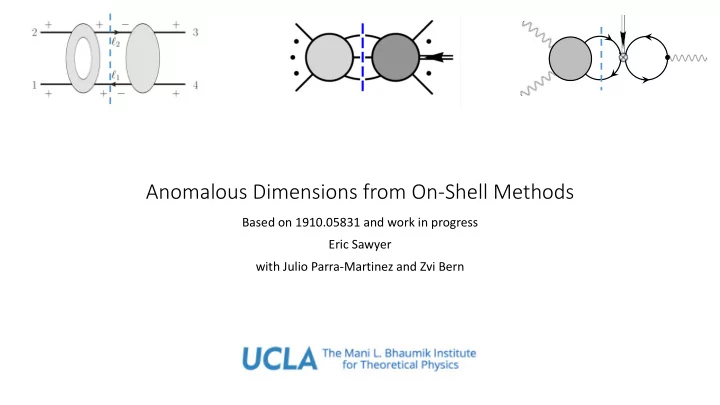
SLIDE 1
Anomalous Dimensions from On-Shell Methods
Based on 1910.05831 and work in progress Eric Sawyer with Julio Parra-Martinez and Zvi Bern
SLIDE 2 Importance of Renormalization
Many major questions involving the UV behavior of field theories
- UV divergence in N=8 SUGRA
(Bern et al. 1201.5366; 1804.09311)
- Renormalization group flow of higher dimension operators
(eg. Alonso, Jenkins, Manohar, Trott 1312.2014)
Traditional ways of calculating:
- Calculate entire amplitude, extract UV dependence
(e.g. Brandhuber, Kostacinska, Penante, Travaglinia 1804.05703)
SLIDE 3
Borrowing Ideas used in Gravity
Two loop UV 1/ε pole is affected by evanescent effects in Einstein gravity Renormalization scale dependence captured by cuts in kinematic variables vs.
Renormalization scale dependence determined through on shell unitarity cuts
(Bern, Cheung, Chi, Davies, Dixon, Nohle 1507.06118; Bern, Chi, Dixon, Edison 1701.02422)
SLIDE 4
Form Factors and Renormalization
From Caron-Huot and Wilhelm (1607.06448)
“the dilatation operator is minus the phase of the S-matrix, divided by π” Unitarity: Analyticity:
SLIDE 5
Form Factors and Renormalization
(Caron-Huot and Wilhelm 1607.06448)
Renormalization scale related to dilatation operator:
Unitarity: Analyticity:
SLIDE 6
(Caron-Huot and Wilhelm 1607.06448)
Form Factors and Renormalization: Perturbative Expansion
One loop anomalous dimensions:
SLIDE 7 (Caron-Huot and Wilhelm 1607.06448)
Form Factors and Renormalization: Perturbative Expansion
Minimal form factors
First chance for
SLIDE 8 Standard Model Effective Field Theory
SM
SM EFT: more systematic way to explore physics beyond the Standard Model than model building
- No need to worry about details of high-energy completion
Operators built out of Standard Model fields Mixing of operators can produce variety of effects at LHC scale from a single operator at scale Λ
Λ
~TeV { }
SLIDE 9
Non-Renormalization
Unexpected zeros in anomalous dimension matrix
(Alonso, Jenkins, Manohar, Trott 1312.2014)
F3 φ2F2 φ2F2 F3
SLIDE 10
Non-Renormalization
Unexpected zeros in anomalous dimension matrix (Alonso, Jenkins, Manohar, Trott 1312.2014) Explained using helicity selection rules (Cheung and Shen 1505.01844)
(from Cheung and Shen 1505.01844 )
SLIDE 11
New Non-Renormalization Theorem
1. : number of field insertions in
SLIDE 12
New Non-Renormalization Theorem
1. 2. : number of field insertions in
SLIDE 13 : total loop number : loops in form factor
Longer operators often cannot renormalize shorter operators, even when diagrams are available
Minimal form factor Required for nonzero result:
- ≥2 external legs on the left
- No scaleless bubbles on the right
q
: number of field insertions in
SLIDE 14
Longer operators often cannot renormalize shorter operators, even when diagrams are available
: total loop number : loops in form factor
q
SLIDE 15
First order of renormalization can often be calculated using only 4-d methods
Requires d-dimensional information
SLIDE 16
Renormalization of φ2F2 by φ6
Two-loop Examples
Renormalization of F3 by ψ4 Scaleless bubble evaluates to zero
q q
SLIDE 17
d=5 d=6
(Bern, Parra-Martinez, ES 1910.05831) Zero by helicity rules of Cheung and Shen Overlap of zeros of Cheung and Shen and our work New anomalous dimension zeros
Results for Dimension 5-7 Operators
SLIDE 18
d=7
(Bern, Parra-Martinez, ES 1910.05831)
Results for Dimension 5-7 Operators
Zero by helicity rules of Cheung and Shen Overlap of zeros of Cheung and Shen and our work New anomalous dimension zeros
SLIDE 19 Non-zero Entries Require 1-loop Amplitudes
- 1. Write down tree amplitudes
- 2. Construct cuts between trees
- 3. Integrate and merge cuts
d-dimensional 1-loop amplitudes
- 4. Construct two-loop cuts
- 5. Extract 2-loop anomalous dimension
(2)
SLIDE 20
The Dimension 6 Operators
SLIDE 21 Results
- All four point SM EFT amplitudes with
dimension 6 operators
- Verifying the anomalous dimension
calculations using on-shell techniques
- Non-zero rational terms everywhere
- 2-loop anomalous dimensions likely
generally non-zero
(Bern, Parra-Martinez, ES 2001.XXXXX)
SLIDE 22 Two-loop Anomalous Dimensions
We can now calculate any 2-loop anomalous dimension of the SM EFT
- Simple cases: calculation of only one type
- f cut required
For a general entry in the matrix, IR dependence must be accounted for
ψ4 D2φ4 φ2F2 ψ4 F3 φ2F2
SLIDE 23 Summary and Outlook
On-shell methods can be used to efficiently calculate anomalous dimensions Unitarity cuts in kinematic variables yield renormalization scale dependence On shell methods can be used in gravity as well, and double copy should help
- Example: F3 double copies to R3
SLIDE 24
Thanks!